Between 1985--2023, MIT's faculty grew 9%. Administrative staff grew 189%. 📈 Why? In new @PNASNews paper, we use dynamical system model to show administrative bloat can emerge without empire-building--just from well-intentioned problem-solving gone awry https://t.co/MZgGkxilZ2
The insane irony of it - Dalit ASHA workers who help delivery babies in Patel (dominant caste) households and provide life-saving healthcare in villages are then told later they can't enter those dominant caste houses. Heartbreaking reportage by @BehanBox
https://t.co/h8fDkhXP9D
We have known for a while that this is coming
And if it isn't a whopper, I'll eat my hat
Hold onto yours - it's going to be a hell of a ride
https://t.co/U5h96cv0DH
We are pleased to invite you to the launch of Standing the Heat: A Union Budget Analysis of Heatwave Financing in India, a report jointly produced by Greenpeace India, CBGA, and BARC Trust.
The report examines how public finance is being directed towards addressing rising heat risks and identifies key gaps and opportunities for strengthening heat resilience in India.
We have limited slots, requesting you to kindly register here: https://t.co/cSgzBO2PIS
Please join us for our upcoming report launch, "Standing the Heat: A Union Budget Analysis of Heatwave Financing in India", on 15 June 2026 at India International Centre, New Delhi.
The report examines Union Budget allocations related to heatwave preparedness, adaptation, labour protection, healthcare systems, and climate resilience.
RSVP here https://t.co/9p25l6N8vR
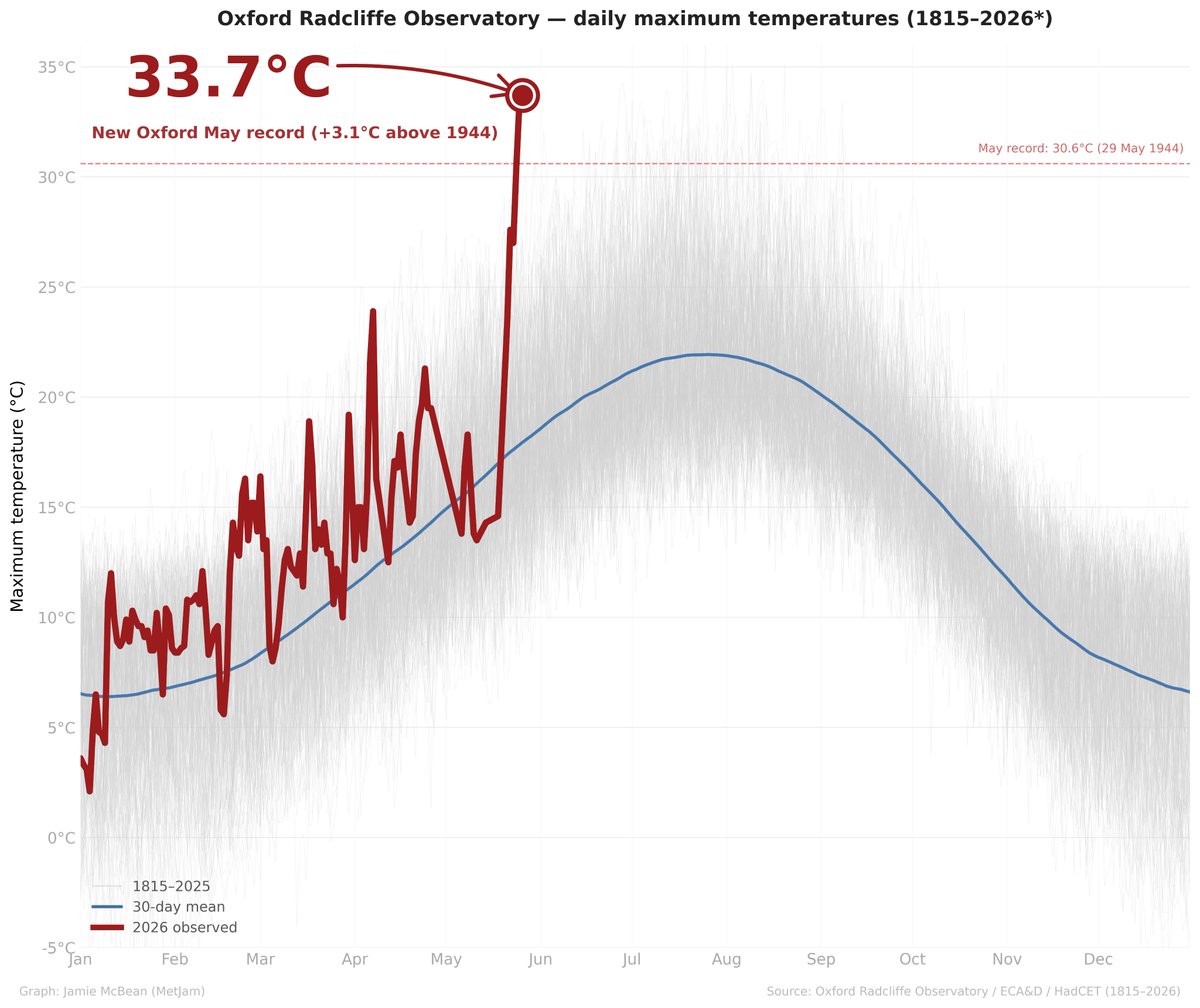
Oxford, the longest running continuous weather station in UK history, with temperature observations stretching back to 1815, has preliminarily broken its maximum temperature record for May yesterday by OVER 3ºC with a temperature of 33.7ºC. Unprecedented in its 211-year history.
A 45°C day in Phoenix, US, — functionally the hottest major city in the developed world — and a 45°C day in Banda, Uttar Pradesh, are arithmetically identical. But they are not the same event.
Heat stress is what happens when the human body, in a specific climate, doing a specific kind of work, in a specific kind of building, can no longer dissipate the heat it produces.
Simply put, the human body cools through four channels: convection (air moving over skin), radiation (giving off heat to cooler surroundings), conduction (touching cooler surfaces), and evaporation (sweat). When ambient air is hotter than core body temperature of around 37°C, the first three reverse and the body starts absorbing heat from its surroundings. Sweat becomes the only channel left. And sweat only works when the air can absorb the moisture.
This is why scientists measure heat stress with three metrics, not raw temperature:
Wet Bulb Globe Temperature (WBGT) – It combines temperature, humidity, wind, and radiant heat. It is the standard for setting safe limits in outdoor labour, sport, and military operations.
Heat Index – It is the “feels-like” temperature, which factors humidity into perceived heat. This is what your weather app shows.
Wet Bulb Temperature (WBT) – It is the most critical. It is the lowest temperature achievable by evaporative cooling. The widely cited 35°C wet bulb threshold is the theoretical survivability limit for a healthy adult in shade with unlimited water. Beyond it, the body cannot cool itself, regardless of acclimatisation.
Two cities can both hit 45°C and have completely different heat stress signatures.
Heat stress is not a temperature. India needs to learn that (as well as most other countries)
https://t.co/UxzRRQfUgd
The pace of climate change has doubled, just as political and business commitment to tackling it has crashed. Our children, grandchildren, and their descendants living in a much more hostile climate - will see this as history’s greatest betrayal.
https://t.co/26AoNlfDI3
Scoop: Suspect Ebola patient who arrived in India from DR Congo, tests negative for the deadly disease, but tests positive for another vector-borne disease.
Govt of India to now decide on timeline for 2nd test at National Institute of Virology (ICMR-NIV) Pune.
@IndianExpress
"We'll have to live like beggars if the land is gone."
Land is being forcibly snatched away from Dalit farmers in Andhra for a giant Google data center. The @ercinvestigates report has been blocked on Insta, thanks to dear Govt of India. Still up on YT:
https://t.co/sVB0DbZ5E0
Gujarat ATS and ICG seize 118.977 kg of Cocaine trafficked from Brazil on a cargo vessel Europe currently moored in the outer anchorage of Mundra Port, Kutch.
Consignment meant for Delhi. Two Tanzanian, one Nigerian and a Ugandan national accused in this case.
@IndianExpress
Gujarat ATS and ICG seize 118.977 kg of Cocaine trafficked from Brazil on a cargo vessel Europe currently moored in the outer anchorage of Mundra Port, Kutch.
Consignment meant for Delhi. Two Tanzanian, one Nigerian and a Ugandan national accused in this case.
@IndianExpress
Imagine stepping outside at 6 PM and the air is still 42.1°C.
Now add enough humidity to push the wet-bulb temperature to 29.1°C. That's what I measured today in Bhalswa, Delhi.
The human body cools itself by evaporating sweat. At wet-bulb temperatures like this, that defense starts failing. A wet-bulb of 29°C is already in the range where prolonged outdoor work becomes dangerous. And this is after sunset is approaching, not at peak afternoon heat.
UP cities are seeing 8-10 hours power cut, often at night. And most working class families cant shell the 15-20k needed for an inverter. If youre a working class kid here, you get poor education, subpar nutrition & bad sleep. No civilized country would have tolerated this in 2026
For many in Delhi whose jobs keep them outdoors or in poorly ventilated workplaces all day, extreme heat means constant exhaustion and illness.
I spoke to workers across the city about what impact the heat has on them, and how they protect themselves - if at all they can.