Research Associate @AEI | Former MA Fellow @Mercatus | Tax, Crime & Health Econ | Economist rooted in the mountains | Tweets are mine, not my employer's
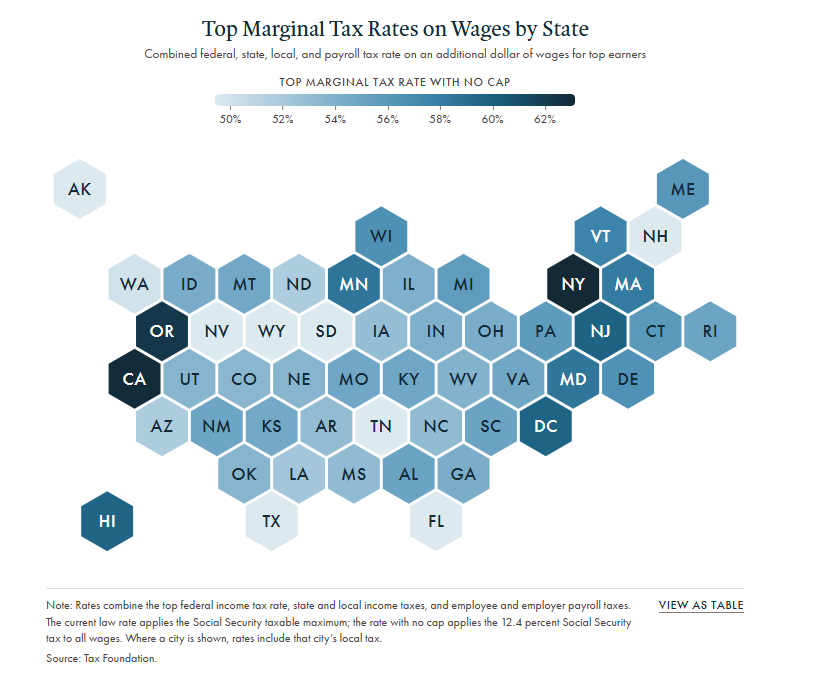
.@Therealalimelad made me an interactive map (link, below).
Uncapping the payroll tax would raise the top marginal tax rate on wages to as high as 63.1% in New York City and just under 50% in states without an income tax.
It often takes nearly a month after a patient visit for healthcare providers to receive an insurer’s initial decision on a claim. In a new report, @ben_ippolito , @Therealalimelad, and @borisvabson find that most of that time passes before providers submit a claim to an insurer.
Read the full report: https://t.co/1dMnv5BIkC
One finding that stands out: Traditional Medicare looks very different from other payers, with extremely low denial rates and payments that come close to what providers expect.
#HealthEconomics#HealthPolicy#Medicaid#Medicare
New paper with @ben_ippolito and @borisvabson
We use data on 118.5 million patient visits across 172 hospitals to document some poorly understood parts of how billing and payment actually work in U.S. healthcare.
1/3
New research from @ben_ippolito, @borisvabson, and Ali Melad: "Using detailed revenue-cycle data, we characterize the timing of billing, claims adjudication, and insurer payments across major insurance types. We decompose payment delays into the portions attributable to provider billing versus insurer adjudication, quantify how much of payments comes via initial payments versus delayed reimbursement, and compare final insurer payments with providers’ expected payments. We find that insurers complete their initial adjudication of claims about one month after a visit, with most of that time attributable to delays in provider billing. Payment completeness and adjudication patterns differ substantially across payers, with traditional Medicare exhibiting unusually permissive payment behavior." https://t.co/2LFpbbFwcN
We look at how long it takes to get paid, how much of that delay comes from providers vs. insurers, how much providers collect from the initial claim vs. later resubmissions and appeals, and how this differs across payers.
2/3
Join me and several other budget and tax experts for a moderated panel discussion on October 1st at noon.
I will be discussing @Therealalimelad and my @JournalTax paper on Tariffs, the Debt, and Deficits.
NEW RESEARCH🚨: The federal government is on an unsustainable fiscal trajectory. Persistent annual deficits are expected to push the national debt from 100 percent of GDP today to 196 percent by 2056. President Trump has long championed import tariffs as a way to shore up new government revenue, even suggesting that a robust tariff policy could eventually replace the federal income tax. @kpomerleau and Ali Melad investigated whether Trump's tariff regime can meaningfully improve the government's fiscal outlook—and whether their revenue benefits outweigh their economic and distributional costs. Read their key points below ⬇️🧵
Long-term care in the U.S. faces growing pressure as the senior population expands.
In our new @CatoInstitute Research Brief in Economic Policy, @MBjoerkheim and I look at what happens when states lift certificate-of-need limits on long-term acute care hospitals.
#LongTermCare
@ssroyyam The price of still asking and them saying no is zero, but the price of not asking is $3000 according to you so the choice is yours. even if you leave by December 7th its cheaper.
Medicare site neutrality is a straightforward concept: The same service should cost the same amount, regardless of where it is delivered. | Ali Melad https://t.co/qXdsgs7b2m
In my latest @NRO op-ed, I discuss why Medicare’s how site neutrality could save up to $146B, reduce patient costs, and improve competition. Read more here: https://t.co/dcRvwPMUDw
#HealthcareReform#Medicare#SiteNeutrality#PolicyChange
Would you be willing to trade your personal health information if it meant potentially saving tens of billions of dollars annually in healthcare costs? Be sure to take the poll to answer that at the end of our article!
https://t.co/uhLu60r6OD
#Healthcare#Privacy#Medicaid
"By using our rapidly growing capabilities in AI and analytics, technology could be used to verify eligibility and service provision, potentially even in real-time, and thus prevent improper payments before they occur.
So, the question becomes, are we willing to trade off some privacy in order to improve eligibility determinations and thus reduce the rate of improper payments?"
Let @Therealalimelad and I know what you think by responding to OpenHealthPolicy's first policy poll in the link below
Balancing Privacy and Efficiency: Should Medicaid Use Sensitive Data to Reduce Improper Payments? https://t.co/anWw0OH3C0