“haha I’m up so much YTD I could just close the book and be done for the year”
you won’t though. we all know you won’t. nobody ever does. stop pretending and get your ass back to the pnl mines.
A nurse quit the ER to run an IV hydration van funded by $40,000 in 0% business credit and she makes more on a Sunday morning than she made in a month at the hospital
She parks outside nightclub districts at 6am. Hungover people crawl out of Ubers looking half-dead. She charges them $175 to sit in her van for 30 minutes and get pumped full of saline, B12, and anti-nausea meds through an IV
She does 15-20 patients every Saturday and Sunday morning. $175 x 18 average = $3,150 per weekend. $12,600/month from weekends alone
Monday through Friday she does corporate wellness events ($2,000 per booking), bachelorette parties ($250/person, groups of 8-12), and house calls for rich people who want "vitamin infusions" ($300 per visit)
Total monthly revenue: $28,000-$35,000
"you need to be a doctor to do this"
No. In most states a registered nurse can administer IVs under a physician's standing order. She pays a doctor $500/month to be her medical director. He signs the standing protocols. She does the work. He plays golf. It's the same structure urgent cares and med spas use
Her startup costs on 0% cards:
Used Mercedes Sprinter van: $22,000
Medical build-out inside the van (IV chairs, mini fridge, sharps containers, medical lighting): $8,000
IV supplies first 3 months (bags, tubing, vitamins, syringes): $3,200
Insurance (malpractice + commercial auto + general liability): $4,800/year
Marketing (Instagram + TikTok + Google ads): $2,000 first month
Total startup: $40,000. All on Chase Ink and Amex Blue Business Plus at 0%
Cost per patient:
IV bag with B-vitamins and saline: $8-$12
Tubing and needle: $3
Medical waste disposal per unit: $1
Total cost per treatment: roughly $14
She charges $175. That's a 92% gross margin. On a medical service. That takes 30 minutes
The cards were paid off by month 3 from weekend revenue alone. She now clears $22,000-$28,000/month after all expenses
Her hospital salary as an ER nurse working 12-hour overnight shifts: $5,800/month after taxes. She was cleaning up vomit for $34/hour
Now she injects vitamins into influencers for $175 and makes $350/hour working 4 days a week
Her busiest day ever: New Year's Day 2026. She set up in a hotel parking garage in downtown Austin. 38 patients between 7am and 2pm. Revenue: $6,650 in 7 hours. She made more before lunch than her old ER paycheck for two weeks
She told me the funniest part is that half her patients are finance bros who spent $800 at the club the night before and then negotiate with her over $175 to feel human again. She doesn't negotiate. There's a line out the van. Next
A registered nurse left a $70K/year hospital job to run a hangover clinic out of a van bought with Chase's money and she'll clear $300K this year sticking needles in people who drank too much lmfaooo
link in my bio and i'll show you how you can qualify for up to 250k in 0% APR funding (if you have a 700+)
Stock "market" correction/hiccup/drawdown playbook:
My order of operations/guidelines for a Long/Short strategy (this can change on the margin due to speed/severity of market drawdown as well easily adaptable based on investment/trading strategy, etc) is the following:
1) cover single name shorts (my approach is to cover reduce across the board in 3-4 phases vs single name security selection)
[Check net and gross exposure (gross more important during market downdraft)]
2) monetize and roll hedges, adjust hedge block trade structures
[Check net and gross exposure and re-run market down 5/10 scenario and change in vol for Port]
3) select single name covers and / or change trade block structure
[Check net and gross exposure]
4) add length the same way you covered shorts (in phases)
[Check net and gross exposure]
5) add length to "top book"
[Check net and gross exposure and re-run down 5/10 scenario and +5 scenario and change in vol for Port and additional knock-on shock scenarios]
6) add additional length to best r/r situations (that have defined duration paths to catalyst/earnings/etc)
[Check net and gross exposure]
7) consider adding some dirty long basket length
[Check net and gross exposure]
8) add additional length to best r/r situations (that have less-defined duration paths)
[Check net and gross exposure, run scenarios, etc]
#Mojo-ism(s) #MojoTweets
Buy the freaking dip on gold miners
Bank of America:
"Free cash flow is 10x higher than it was in 2020, with half the long term debt...gold miners earnings yields are the highest of any sector and the least expensive relative to $spy in the last 20 years"
Continuing with the idea of it’s probably better to try to educate newbies during drawdowns rather than dunk on them, let’s talk about how expectations change as stocks rally significantly.
Basically, in the beginning of a rally you have the highest likelihood of the most positive catalyst being good earnings. People doubt the company or the environment in the present, so the best chance they have to surprise is simply to prove they are doing well right now. (Think memory in 2024, with AI overshadowed by cyclical glut fears)
Now take where we are today, when trailing multiples are twice or three times as high as forward.
Imagine you’re holding a fishing rod. You are grasping it 6 inches from the far end of the pole and sharply raise your hand a foot in the air. The end of the pole will raise pretty much the same as your hand.
Now imagine you’re holding it from the handle and you do the same thing. The tip of the pole will move more than your hand, as there’s more room for the rod to bend and transfer/exaggerate the movement.
That’s what happens in names after everyone has turned positive on them and analyst expectations are universally positive. They aren’t able to rally simply because last quarters expectations were good, because the market is no longer pricing them on an expectation of what’s currently happening but rather on an expectation of what happens 1, 2, 3 years from now.
What that means is higher volatility, earnings take a backseat to narratives. When the narratives are positive, the stock can rally significantly because compounding 50%+ annual growth out 3 or 4 years makes it easy to say the stock is extremely cheap on 2029 numbers.
But it also makes it susceptible to narratives that can’t be falsified today by good earnings or bullish management (just an aside, so everyone knows, semiconductor company management is generally bullish no matter what…with rare exceptions that typically mark the bottom of a cycle).
What that means is news about memory efficiency improvements or anticipated expansion of supply or threats from players like CXMT become really impactful when everyone is already bulled up. This is why it’s extremely difficult to buy or sell semis based on valuation - someone can always come up with a valuation to support a bull or bear case. Especially when the valuation is based on numbers 3 years from now.
These narratives can impact growth estimates by maybe 3-5% a year over the next 4 years, but that can add up to a lot. The market is holding these stocks from the far end of the fishing pole.
This is why stocks get increasingly volatile when they have significant rallies, and also why it always seems like when they put in tops (either near term or long term), they do so over very little real developments in the way of news or fundamentals.
Socially smart people often won’t tell you to your face when they disagree with you because they can sense intuitively that you are too attached to the outcome of the interaction and that you couldn’t handle disagreement. So they will just agree with you… but then you might not hear from them again.
It’s easy to assume this is “fake” when really it’s just what intelligent people do to protect their energy. If you went around saying what you really thought all of the time you’d make way too many enemies, and get in way too many unproductive arguments (cortisol spikes = aging)
Of course the only way to make genuine connections is to say what you really think… but especially if you intend to be deeply involved in society, you must train your intuition to know who can take it.
Since CPI is either going to be a clearing event or a thanos snap event, I figured it might be a decent time to be helpful.
If you’re relatively new to investing, then you’re bound to learn about what happens when your portfolio goes down.
Now, this is coming from someone who’s portfolio is up a paltry 20% YTD and hasn’t been gunning it on risk recently. Although also someone who’s been trading and investing their own money for the better part of a decade and has managed to not go bust (except for one, very painful time early on).
If you’re constructing a portfolio it’s important to realize it is its own position rather than a collection of positions. A stock is not just a company but the sum of its valuation, shareholder base, its sensitivity to liquidity, crowding, financing/rates and its catalyst calendar. High beta stocks are often five different trades in one ticker.
You should always have a working idea of your “tilts”. Does your portfolio go up/down more if tech rallies, if certain countries outperform, if a specific thematic is validated etc etc.
In general, you should not have a portfolio of 20 different stocks that all act the same. You might think you won’t, but getting the value of your book cut in half will make you do stupid things. (As an aside, this is also why even though buying the dip is generally a good strategy, progressively buying the dip early into a drawdown can make you mess up at the exact lows.)
High beta stocks come in all shapes and colors but in general they are selling the distant future. In good markets, the time out to that future is cheap. In bad markets, you start paying rent. That rent tends to appear as a lower multiple even while estimates stay the same.
A lot of times people will tell you the only thing that matters in a drawdown is “is the thesis intact?”. That’s one aspect, the other two are “how have expectations changed?” and “did you size like an idiot?”.
Don’t average down just to improve your cost basis, the market doesn’t care about your cost basis. Only add if you can truly underwrite the expected return improving, and that means taking a view that goes beyond a default return to multiples that may be unsustainable.
Price can become a fundamental and technical sell offs can manufacture fundamental problems - reflexivity cuts both ways.
The best question you can ask yourself in a drawdown is “from here, what is the range of outcomes and what’s the best use of the next dollar?”. If early in a drawdown you note that every time one sector goes up your portfolio goes down, it could be a decent idea to add exposure to that sector.
The ultimate goal is not to avoid every drawdown but to make sure no single drawdown takes away your ability to act on real opportunities when they arise.
No amount of truisms will help make anyone a better investor, but there is something you can do right now. If this is one of your first few drawdowns, you can observe how you react. Take notes on it. Find out what mistakes you make and then optimize your portfolio, sizing, strategy etc to compensate for those shortcomings. It’s a lot easier to do that than try to fight your own psychology - and anyone who pretends there’s a one size fits all answer to that is lying.
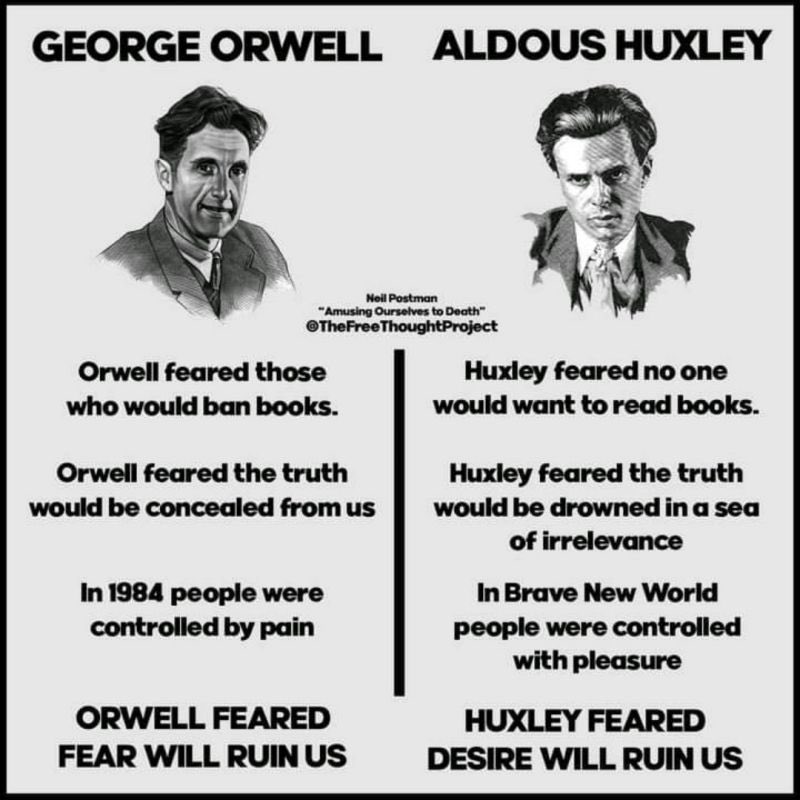
One of my longest-standing arguments is that we are not living in Orwell’s 1984, where truth is centrally suppressed and censored by force (that’s former communist societies, modern-day China, Russia, North Korea).
We are living in something much closer to Huxley’s Brave New World.
The truth is not hidden - it is almost always readily available. But it is buried beneath an industrial quantity of noise: propaganda, outrage, half-truths, conspiracy theories, influencer theatre, algorithmic rage bait and an endless stream of content designed not to inform us, but to keep us emotionally stimulated.
The modern information system does not need to censor the truth when it can simply drown it in noise.
A fact no longer has to be disproven - it only has to be surrounded by a hundred competing claims, stripped of context and nuance, turned into partisan ammunition and pushed into the same feed as celebrity gossip, memes and 15 second videos engineered to deliver the fastest possible dopamine hit. By the time the truth reaches us, it appears as just another piece of content competing for our attention.
That is the more sophisticated form of control: not preventing people from knowing, but exhausting their capacity to care.
Orwell feared a world in which people would be deprived of information. Huxley feared a world in which they would be given so much distraction, stimulation and triviality that they would lose the desire to seek it.
The defining struggle of our age is therefore not simply between truth and censorship, but between truth and indifference.
Something I told 14 yo: People are going to stop reading books. I wish this wasn't so, but I fear it is. The silver lining in this cloud is that if you're one of the few people who still read, you'll have a huge advantage over everyone else.
books are the most underpriced things on earth. for less than $20, you can shift your entire perception of reality, change the trajectory of your life, and become someone completely new. all in just a few hundred pages. insane.
“This is an interesting, data-driven approach to showing something that some passive investing sceptics have long argued. Unterberg’s paper won the Two Sigma Award for “Best Paper in Investment Management” at the Western Finance Association’s 2026 confab last month.
But Alphaville has some niggly issues with the argument, one specific and one more general.”
@RobinWigg with a nice discussion of a paper demonstrating what I’ve been showing for over a decade. Also evidence that you can lead a horse to water, but you can’t make them drink.
https://t.co/n6OYS4tEBh Passive flows -> active woes?
https://t.co/ZiksXOf5w4
Gavin Baker says the best career advice is two words: be kind and be scrappy
"Be kind and be scrappy. A lot of people who are kind are not scrappy, and a lot of people who are scrappy are not kind. Being kind is super powerful. There is karma in the world. I've had hard experiences. If you are kind to people, a lot of people pay it back."
"My rule with someone is I'll bounce the ball once to anyone. If they don't bounce it back, I'll bounce it back one more time, and then never again. And you end up in a group of like-minded people who help each other, who cooperate."
"Investing is a positive sum game, it's not a zero sum game. Even if you're not the best person in your class at Goldman Sachs or Morgan Stanley or JP Morgan, it's going to be okay. People won't remember that you were the best. They'll remember how you treated the other people in your class."
If we are being perfectly frank, it’s a lonely position to take to defend the idea that a long will continue to outperform the market once it has already done so in a significant manner for an extended period of time.
It’s much more sexy and fun to be controversial and contrarian. And I love that stuff in macro & occasionally in individual equities. Shorting MSTR in 2021 produced some great debates and insights and generally was a really exciting play.
But the thing you begin to recognize after long enough in equities is that over the past 2 decades, 40% of shareholder returns have been generated by 1% of companies.
The simple fact is companies that do well often continue to do well. It’s just like a person. We aren’t going to find out tomorrow that Soros, Druck or Buffett suddenly have lost the essence of what makes them good at what they do.
I forget where I first heard it, but someone once said on here “being able to pass on an investment and then get in after it’s gone up 100% is a superpower”.
What do you think the difference is between the guy who bought AAPL at 6 (split adjusted) in 2010 and the one who got in at 12 in 2011? The former is obviously going to have better returns, but the latter is probably going to have better overall performance because they were humble enough to recognize the obvious dominance and genuinely superior aspects of the company despite what I am sure was overwhelming feedback that they were simply being a mindless follower.
We never quite know exactly what the market is thinking in aggregate, so successful contrarianism is often times less about going counter trend to price and more about going counter trend to what the loudest voices tell you is common sense.
That’s all I have to say about it but it’s something that has benefitted the things I’ve done with a long term mindset.
Billion dollar PDFs is underselling it. These are trillion dollar documents. The billion is just what leaks back to whoever wrote them, or read them seriously.
Note that none of them created the opportunity. They revealed one that was already there. And none were secrets: free, public, sometimes leaked.
The authors had already monetized the idea a little; writing it down multiplied their return a thousandfold.
Each one described a regime change that everyone could see and nobody could size correctly. The failure is drastically underestimating fourth-order effects.
The remarkable part: you didn't need to be early. A decade late on any of these still made you a billion dollars. Which means the highest leverage activity available to almost anyone is reading the next one when it appears.
Bitcoin: https://t.co/2P3tjwPLPR
Situational Awareness: https://t.co/VrPfTOlxnO
The Internet Tidal Wave: https://t.co/hLHgydGQkq
The anatomy of a large-scale hypertextual Web search engine: https://t.co/2Uht9mbjBc
Increasing Returns And the New World of Business: https://t.co/MnUUbyZ4oQ
Information Management, A Proposal: https://t.co/HZi7DlnFBB
The Superinvestors of Graham-and-Doddsville: https://t.co/XmqAB6OkIZ
Some others here: https://t.co/F4teKaMT8C
Happiness hack:
Always have something booked.
Whether it's a vacation, concert, golf outing, movie, reunion, marathon, sporting event, etc. – have something you've committed to in the future so you can look forward to it.
The anticipation will make all days leading up to it even better.