Math-based, machine-speed, human managed (verified) democracy is how we stay in control of AGI permanently. This is our research @thestorecloud - we've been deep on the issue since 2019.
Update: Major breakthrough on STORE Infrastructure costs for Markets. We've been working on this problem for several years and closed out the dynamic nature of pricing today. It'll help us finish our mServices technical specification for pricing.
mServices = what STORE sells
m = machine speed, math-based, human managed (governed)
Amazon sells web services.
STORE sells mServices.
Threshold-based democracy - the same one Hamilton helped us install in America and the same +2/3 threshold Leslie Lamport helped us understand for distributed systems security - is viable for staying in control of the full AI stack, from compute, to models, to agentic economies.
STORE: A massive endeavor taking its final shape before we are able to launch across two countries who will check and balance each other on the governance, economics, and intelligence of verifiable cloud computing and Democratic AI.
Update: We completed the unified transaction database - over 400 transactions across eight years, every element of the $STORE token economy - token sales, grants, token warrants, more - mapped to a 26-field compliance schema covering both the U.S. C-Corp and the prospective Swiss Association. That schema is next headed for review with DETOF, our Swiss finance team. Their latest review came back with substantive guidance on withholding tax, VAT treatment, social security, AML requirements, and Canton Zug filing structure. No blockers. We are implementing their feedback and the schema locks when that work is done.
@bitcoinjack We appreciate your long-term support.
Math-based, machine speed, and human managed +2/3 democracy is how we stay in command of advanced intelligence. I don't see another way - at scale.
We have a legitimate discovery here.
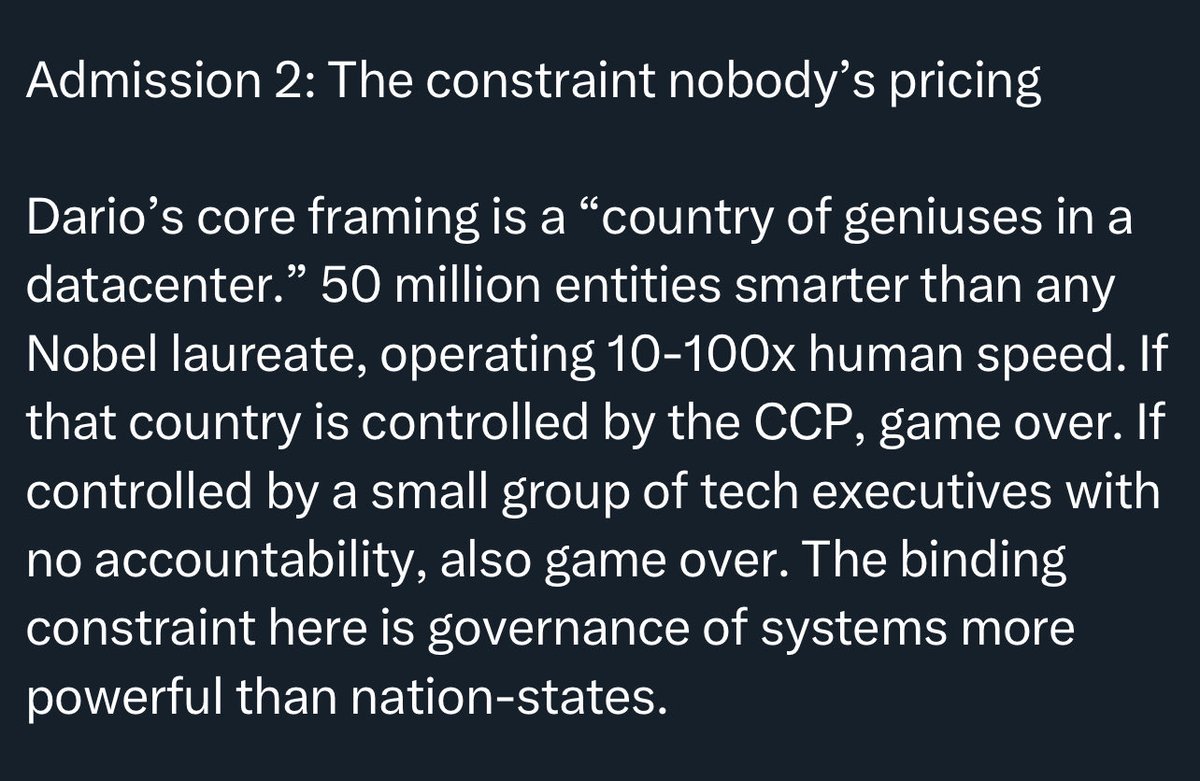
This is the most important piece on AI governance this year. You identified the exact problem. You identified why every proposed solution fails. Then you said you don't have an answer.
There is one.
The problem has three faces:
1. Private companies shouldn't hold kill switches on military infrastructure
2. Governments shouldn't have unchecked control over AI that enables mass surveillance
3. Regulation will be weaponized - 'catastrophic risk' means whatever the government wants
Every solution you considered fails because it operates within two options: corporate governance or government regulation. There's a third option. Constitutional math at the protocol level.
Not regulation. Not self-governance. Math - the same kind that runs TCP/IP. You don't regulate the internet by appointing someone to approve each packet. You run a protocol.
The thresholds already exist. The Founders used 2/3 supermajority to prevent faction capture. Lamport proved the same threshold as Byzantine Fault Tolerance in 1982. Separated by 195 years. Same math. Same problem - distributed agreement under adversarial conditions.
A deployment gate between any foundation model and the user. Eight constitutional checks derived from the actual Constitution - not a corporate constitution, not a regulatory agency. The thresholds are mathematical. A president can't redefine what 67% means. The checks are scored by ML and deterministic rules - not by political appointees interpreting vague terms.
Your surveillance cost calculation is devastating. 100 million cameras. $30 billion today. $300 million by 2030. When surveillance costs less than a building renovation, the only protection is architectural. Constitutional checks that make surveillance outputs fail the governance pipeline before reaching an operator.
Your deepest question - to whom should AI be aligned? The answer isn't the company, the state, or the AI's own moral sense. The answer is constitutional democratic governance, verified externally. The US Constitution has governed 330 million people for 237 years. Nobody needs to write a new one for AI. The existing one needs to be rendered executable.
This avoids the weaponization trap. You wrote: 'model says tariff policy is misguided - that's deceptive, can't deploy it.' That requires a political appointee interpreting a vague term. Mathematical thresholds don't work that way. 67% is 67%. Nobody redefines it by executive order.
The Petrov point matters most. When the boots on the ground are AI, human moral courage no longer saves us. The refusal mechanism has to be architectural - constitutional checks at the protocol level that fire before the AI acts. That's the Petrov mechanism for an AI civilization.
The question isn't whether to regulate AI. It's whether to govern AI constitutionally - with math no president can redefine, no corporation can drop under competitive pressure, and any citizen can verify.
This math exists. It's been running in production for eight years. $30 million governed democratically. Zero constitutional violations. The proof is operational, not theoretical.
The race isn't to build the most powerful AI. It's to build the most trustworthy deployment of powerful AI. Trust compounds. Coercion doesn't.
Happy to chat.
🎯 Update: Marking yesterday (~midnight) as the day we solved through the problem allowing us to solve through the final architecture of the STORE AI stack - across layers, structures, and branches. We'll be working on this through the weekend.
Anthropic dropping its RSP isn't a failure of character - it's a failure of structure. When the governed and the governor are the same entity, competitive pressure will always win. That's not unique to Anthropic. It will apply to every frontier lab. The real question isn't whether companies should self-regulate. It's whether we build an independent governance layer that companies CAN'T drop under pressure - constitutional constraints in a layer the governed entity can't modify. We need Anthropic. We need Claude in national security. But we also need democratic governance architecture where the trade-offs between safety and deployment are made through math, not market panic. Coordination, not capitulation. The alignment problem is a coordination problem. Today proved it.
Yesterday I saw a demo of a layer 2 AI model governed through a trust minimized and checks and balances governed API that lives at the hardware layer
Democracy and enforcement at the machine layer 0, applied in a layer on top of existing models and blockchains, as a proof of concept
Governance solutions will be key to prevent disastrous outcomes
Heavily invested here on fixing that for humanity’s sake @thestorecloud
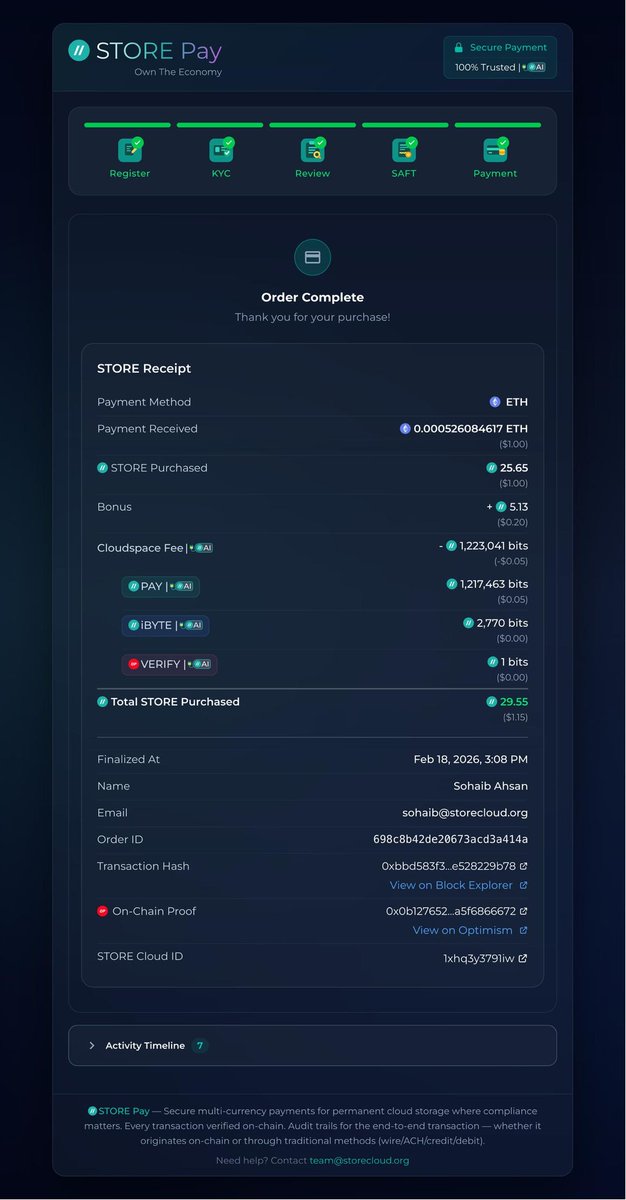
Update: We have an early implementation of the VERIFY protocol ready for testing inside STORE Pay. On-chain proofs of Long Storage are ready - cross-cloud communication and computation are finally here. We'll send the micro-test network out tomorrow.
Update: Our public launch dashboard is now live: https://t.co/nyTSjEanDD.
We'll update this monthly, alongside our advisory calls. The world will be able to understand what we're working on and against from a research perspective, a regulatory perspective, and our work stream from a tax/IP transfer perspective - ultimately resulting in a STORE launch from Switzerland.
This is EXACTLY what we have been designing for @thestorecloud to tackle
Machine speed governance enforced at the inference and hardware layer through the social layer, enforced by code and the correct incentives
What Bitcoin did for money, is what @thestorecloud does for democracy as a service
It’s an extremely complex challenge to make sure AI will benefit humanity
Perhaps the single most important subject to get right
And the AI scene is slowly waking up that it is time to move