Tech Wrap-Up is an open podcast and interactive session summarizing Africa’s major tech trends for the year, with segments on gaming, networking @kwekutech
We said pull up and
You said, “it’s not a biggggg problem for me.”
And just like that, the room was full of ideas, opinions, laughs, and real conversations.
Thank you for showing up, sharing boldly, and wrapping the year with us.
This one was for the ecosystem. 🤍
2 free student tickets to pycon ghana up for grabs
to enter: follow all of kweku tech's socials, follow pycon ghana's socials, and subscribe to our youtube. then reply with why you want to attend and tag a friend who should be there with you.
we'll be announcing the winners on August 15.
national ict week 2026 is happening from 17th to 20th august at the cedi conference centre, university of ghana, legon.
@NITAGhana is bringing the country's digital ecosystem together under one theme: innovation at scale, creating opportunities across ghana's digital ecosystem.
sessions run from 9am to 3:30pm daily. we're the official media partner and we'll be there for all four days.
see you there [link to register in below👇]
most events end when the closing ceremony does. the @everything_OSS sprint at google accra ai lab ended 5 june 2026 and we're still talking about it.
code, docs, research, design, storytelling, all counted as building. we filmed the whole thing.
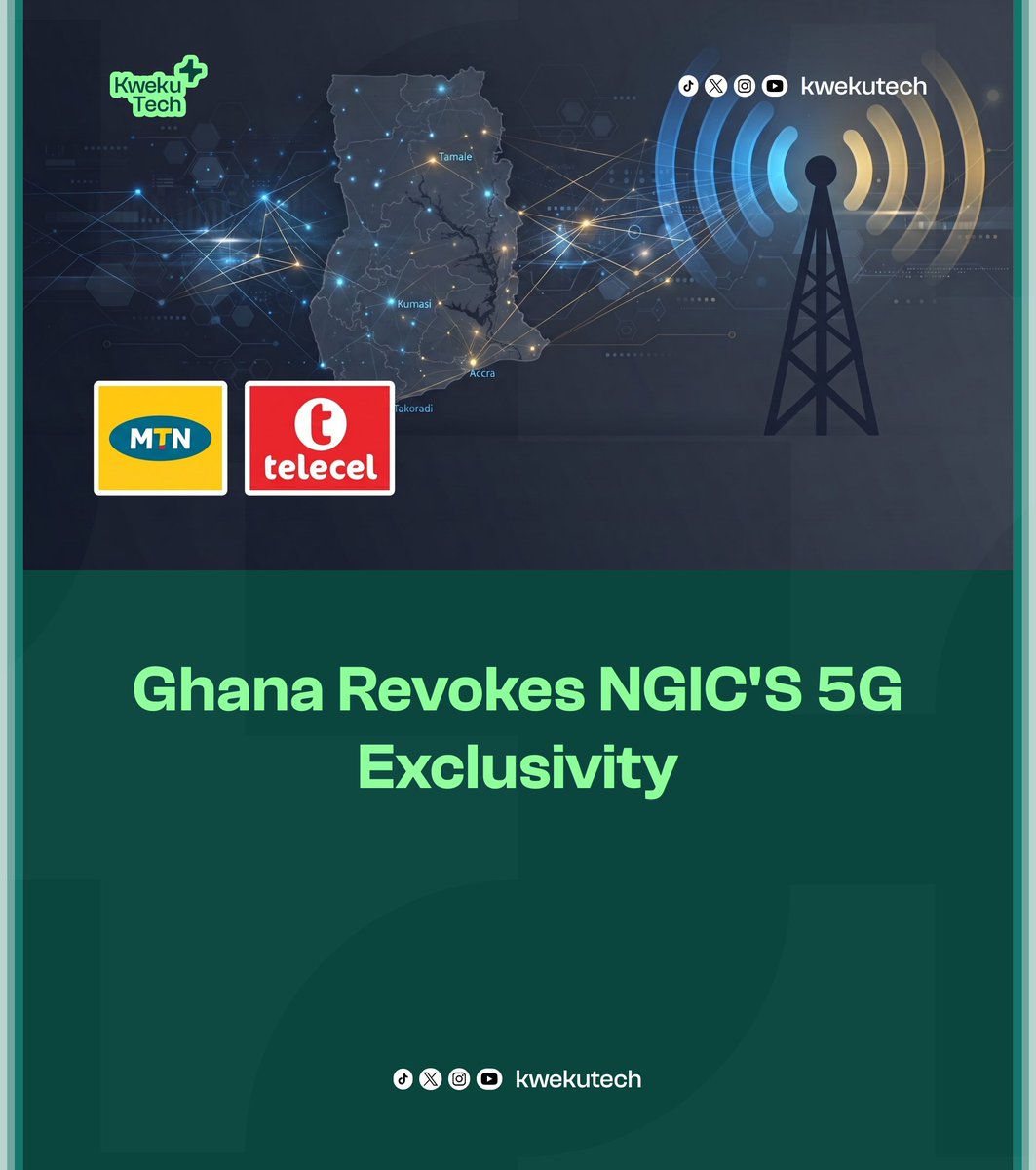
Ghana just ended a two year old bet on shared infrastructure, and the process took months, not a headline.
In 2024, the previous government awarded Next Gen Infraco exclusive rights to build Ghana's 5G backbone, a wholesale model built with Reliance Industries' Radisys, designed so mobile operators would share one national network instead of each building their own. The concession was set to run until 2034.
By March 2026, NGIC had built 49 sites nationwide, most concentrated in Greater Accra, against a target of 1,200 sites by 2027. The National Communications Authority also disclosed that NGIC was behind on its licence fee instalments, part of a $125 million obligation.
On March 4, the NCA issued a formal Notice of Proposed Licence Amendment under Section 14 of the Electronic Communications Act, 2008, to remove NGIC's exclusivity. NGIC filed an objection. The NCA board reviewed it before proceeding. This was not a snap decision, it was a regulatory process that ran its full course.
MTN Ghana and Telecel have now confirmed to Bloomberg that both companies plan to bid once an open spectrum auction opens, expected to launch within weeks. Telecel Group CEO Moh Damush has flagged a concern worth watching, that the auction should not simply favour whichever bidder pays the most, an outcome he warned could deepen the advantage of Ghana's already dominant operators.
The idea behind NGIC was sound. Shared national infrastructure can be cheaper and faster to deploy than parallel buildouts. The execution did not hold up, and government is now trusting two operators with existing networks and capital to do what a single wholesale provider could not, with a stated goal of 70% 5G coverage by Ghana's 70th independence anniversary.
Has 5G actually reached where you live, or is this still mostly a headline? Tell us in the comments.
Most people assume an AI chat only costs you for what you type. That is not the full picture.
Tools like Claude and ChatGPT cache your recent conversation so they do not have to reprocess everything every time you send a message.
That cache is not permanent though. It expires after a short window of inactivity, often around five minutes.
Step away for a coffee break mid task, come back, and your next message gets reprocessed from scratch instead of pulling from the cheaper cached version. Same words, higher cost to process.
For anyone building with AI tools daily, this is worth knowing.
Staying active in a session, or picking back up quickly after a pause, keeps you on the cheaper side of that mechanic.
Wait too long and you pay the reprocessing tax without realizing why your usage feels heavier than it should.
Small detail, real impact if you work with these tools often.
Have you noticed your AI usage limits hitting faster than expected?
we showed up to ho.
cameras, team, and everything.
wherever there's an african tech story to be told, there's kweku tech.
#gdss2026 coverage, straight from the oxygen city.
Most conversations about AI in Africa start with opportunity. The market size. The leapfrogging potential. The billions of users waiting to be served. Kojo Apeagyei(@Apeagyei_) starts somewhere else entirely. He starts with who controls the tools. Who set the rules. Who gets to decide what counts as progress.
And he has been asking those questions long before AI became the world's favourite talking point.
Kojo's path did not start in a computer science department. It started in housing policy and advocacy campaigns at Shelter UK, where he learned how small policy decisions ripple outward in ways their architects never anticipate. That lesson, that technical decisions are always political decisions in disguise, became the intellectual engine behind everything that followed.
When he arrived at LSE to study Data and Society, he already understood consequences. The MSc distinction he earned there confirmed the framework. His dissertation went straight to the uncomfortable heart of the matter: examining the development of AI in Africa through the lens of power dynamics, agency, and trust. Not what AI can do for Africa. What AI is doing to Africa's ability to shape its own future.
Today, Kojo holds two roles that most people would treat as separate careers.
At Energy Systems Catapult in Birmingham, he advises startups, utilities, and policymakers on responsible AI adoption in the clean energy sector, helping build the infrastructure for a net-zero future. He built a Retrieval-Augmented Generation platform that puts technical, policy, and market knowledge directly in users' hands.
Simultaneously, through his policy work at Qhala, he helped shape the Africa AI Council, a body convening the continent's ICT ministers and industry leaders to build Africa's own governance frameworks from the inside out. He developed AI governance toolkits for policymakers working in data-constrained environments, the kind of environments that Silicon Valley frameworks were never designed for.
And in June 2025, he founded COUSINS, a platform built to solve the discovery problem in African tech: connecting people, ideas, and information across the continent. Over 250 members. Growing.
When the Black Tech Achievement Awards gave out its inaugural AI Tech Champion of the Year in 2025, they gave it to him.
He will tell you, politely, that he is not a technologist. He is someone who learned, through housing campaigns and LSE research and years of ecosystem building, that AI is not a solution handed down from above. It is contested terrain. And the work is to make sure Africa is not just a recipient of the outcome, but an architect of it.
That distinction, between receiving and architecting, is the work of his career.
Who in the African tech ecosystem is quietly building AI governance infrastructure that the continent will need for the next 20 years? Drop their name below.
"until your startup starts building you, you're not building your startup."
we sat down with @b3npayd, the founder of @paydhq, went deep on his journey as a builder, what building fintech in africa actually costs, and what he'd tell his younger self.
and then he said that line and the whole conversation shifted.
full convo is live on youtube. link in the comments.
now here is where you can be in the same room as Dr. Moore(@moorekwesi).
he is a confirmed speaker at the one vecta ai summit 2026. september 8 and 9, the palms by eagles, accra.
secure your spot: https://t.co/W2k8skkgYd
Most mathematicians choose one problem and spend a career solving it. Stephen Moore(@moorekwesi) looked at Africa's most urgent problems and decided all of them were math problems.
He was not wrong.
Born in Saltpond, Ghana. BSc Mathematics with distinction from KNUST. Then two master's degrees in Europe, one from Kaiserslautern, one from Johannes Kepler University Linz, where he stayed to complete his PhD in Computational Mathematics. He was being shaped by the finest applied mathematics institutions on the continent, and then choosing to come back.
That choice is the whole story.
Because Stephen did not return to teach and wait. He returned to build infrastructure that Ghana did not yet know it needed.
He joined @GhanaNLP and became Director of Programs. What started as a quiet research initiative became the engine behind @KhayaAI, Africa's first AI translation tool for Ghanaian languages. His team published what is now the largest Ghana language dataset ever released online: 41,513 parallel sentence pairs across Twi, Fante, Ewe, Ga, and Kusaal. Not proprietary. Public. So every researcher, every developer, every language technology builder in the world could access it freely.
He was not building a product. He was building a floor for everyone else to build on.
Then came the grants. Google Research, twice. Over USD 95,000 to advance multilingual and multimodal work for global health. The Bill and Melinda Gates Foundation, for AfriMed-QA, a pan-African medical question-answering benchmark. USD 100,000. The British Council. A collaboration with University College London worth GBP 150,000 for AI solutions to humanitarian challenges.
The world kept arriving at his door. He kept answering and routing everything back to Cape Coast.
His research now spans computational mathematics, mathematical epidemiology, machine learning, and African language AI. Forty-plus published papers. Collaborations with INRIA in France, University of L'Aquila in Italy, where he is a Visiting Professor.
The National University of Singapore invited him to a joint ASEAN-Africa workshop on computational mathematics. He was one of ten Africans in the room.
He is also the person who set up a formal exchange program so that mathematics graduate students from the University of Cape Coast can spend a semester in L'Aquila studying at the highest level. Six students have gone so far. More are going.
He teaches, supervises, publishes, builds, and then builds the pathway so others can follow.
At the 2025 Global AI Summit on Africa in Kigali, Stephen stood at Booth 18 and demonstrated Khaya AI to the world. The tool that started in a research group at a Ghanaian university was now being shown on a continental stage.
@moorekwesi is proof that the most powerful thing a mathematician can do is refuse to separate the theoretical from the practical, and refuse to separate their success from their community.
`
The equations were never just on paper. They were always about the people.
3,936 youtube subscribers.
we need 64 more before midnight.
if you have ever watched one of our videos and smiled, nodded, or sent it to someone, today is a good day to hit subscribe.
🔗: https://t.co/aCFPCarFxR
prompt: "create a photorealistic image of a complete player combining the abilities of 08 ronaldo, 2011/12 messi, and the flair of talk-and-do lamine yamal"
result👇:
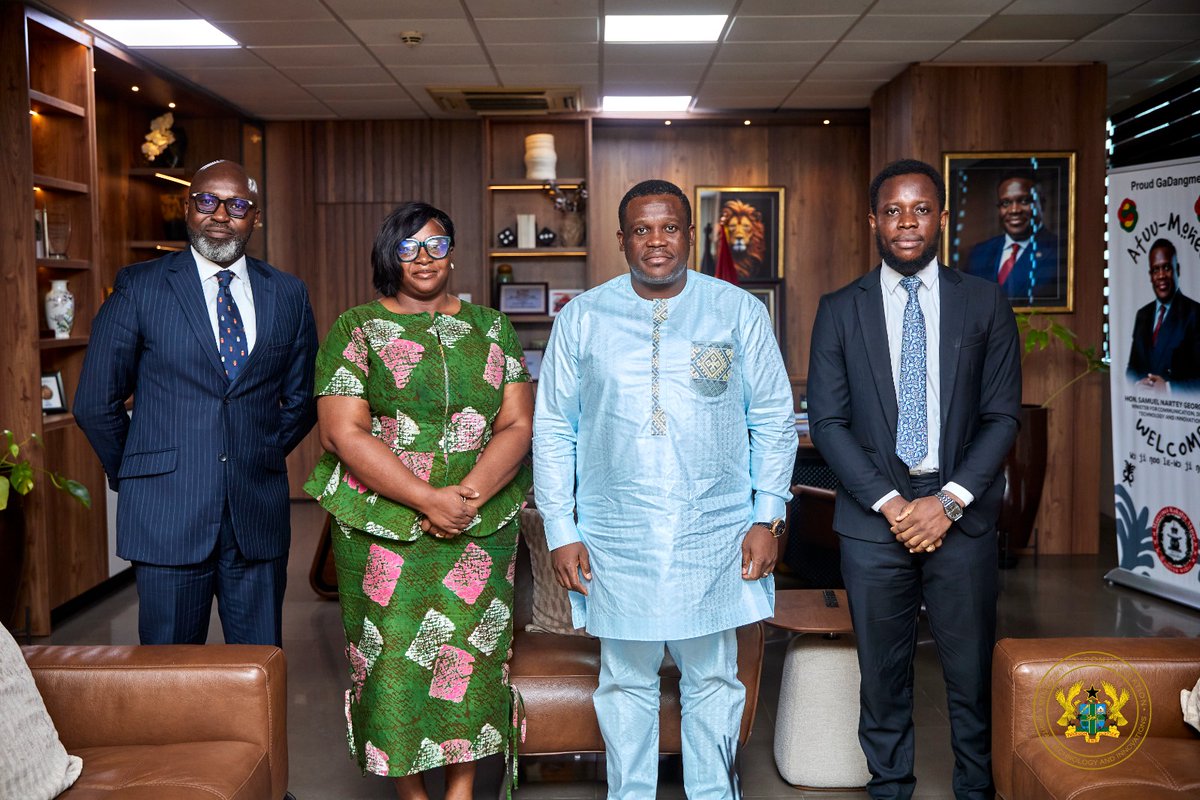
Minister Hon. Samuel Nartey George(@samgeorgegh), sat down with Carlos A., CEO of AlphaVecta Technologies, to talk about one thing: what it looks like for Ghana to anchor Africa's AI agenda.
@onevectasummit 2026 is coming to Accra on September 8 and 9. And the ask on the table for Hon. Sam George was direct: serve as Chair and Continental Patron of a summit designed to bring ministers, regulators, industry leaders, and innovators from across the continent into one room.
He did not turn it down.
Here is what makes this conversation more than a courtesy meeting.
Ghana is not showing up empty-handed. The Minister pointed to a $250 million AI compute infrastructure currently being built to serve the sub-region. He mentioned ongoing tech diplomacy with Zambia and Malawi, where Ghana is already exporting digital identity systems. This is a country that has made a decision about where it wants to stand in Africa's digital future, and is funding that decision.
The line from Carlos Amoako that deserves to be heard by every founder, policymaker, and investor following this space: "The need to move beyond dialogue to execution."
Africa has hosted AI conversations before. The summits, the panels, the communiques. What One Vecta is promising is different in scope: policy frameworks, implementation roadmaps, and investment pathways that do not stay on paper.
The Ministry has directed its technical teams to advance discussions in areas aligned with government priorities including health, education, financial inclusion, e-governance, and digital architecture. The engagement is not over. It is deepening.
Accra is being positioned as a continental convening capital for emerging technologies. That is an ambition Ghana is now actively building infrastructure to back.
One Vecta AI Summit 2026. Accra, Ghana. September 8 to 9, 2026.
Tickets are live. Link in the first comment.
While everyone else was at the @3iafricasummit taking selfies with regulators, chris, the ceo of @_moondoog was the only one honest enough to say we are losing the race against fraud.








![kwekutech's tweet photo. national ict week 2026 is happening from 17th to 20th august at the cedi conference centre, university of ghana, legon.
@NITAGhana is bringing the country's digital ecosystem together under one theme: innovation at scale, creating opportunities across ghana's digital ecosystem.
sessions run from 9am to 3:30pm daily. we're the official media partner and we'll be there for all four days.
see you there [link to register in below👇]](https://pbs.twimg.com/media/HPTbKwCWgAAno7a.jpg)