This is extraordinarily rare.
In fact, according to a key figure in the German business community (who is a dear friend of mine), it's unprecedented.
An op-ed, two pages, centerpiece, in Germany’s most important economic newspaper (the Handelsblatt) that begs the German establishment to stop looking at China via the prism of propaganda. And it's by their Shanghai bureau chief - not some outside contributor.
The title is "The China debate cannot continue like this!" and the article makes the case that it's suicidal, from a German and European standpoint, to keep reducing China to false caricatures rather than facts.
In effect it's rubbish in, rubbish out: if you tell people lies about China - whichever direction they go (anti or pro) - then obviously the policies that come out will be rubbish, designed for a mirage of a country that exists only in people's imagination.
Needless to say, this is absolutely music to my ears because it's literally the main point I've been making in my advocacy around China for now almost 10 years. Some are finally seeing the light...
I also believe, as I argued in my article "Are Western media turning China-friendly?" last year (https://t.co/Xg1hoSRtNy) that this type of coverage was bound to happen, and there will be more and more of it.
Why? For a very simple structural reason: China is now too powerful to coerce. The West, and Europe in particular, just don't have the leverage anymore. Which means that if you tell China to do something and they don't want to, they just won't do it. Period.
In this situation, incapable of coercing, your only remaining choice is... convincing. And what do you need if you want to convince someone? Well, you need to understand them: understand how they think, how they behave, what drives them, what they actually want.
In other words: the moment coercion stops being an option, not only does propaganda stop being useful, it begins to be actively harmful as genuine understand becomes a strategic necessity. Reality is finally becoming profitable again.
Which means, if you're a journalist reading this and you're peddling some of your usual lies, describing China as some sort of cartoonish dictatorial dystopia that's simultaneously on the verge of collapse yet a "threat" to the whole world (in short, if you write on China for The Economist or the FT), be on notice: the real threat to your country isn't China. It's you.
🇯🇵 Sanae Takaichi, Japan’s anti-China PM, Exposed by Her Family: Her Grandson Started Full-Time at a Top Chinese University. She Was the Last to Know 🇨🇳
Japan’s most outspoken anti-China politician just faced a family situation that politics can’t sweep under the rug. Her only grandson has started full-time study at a top Chinese university this year. She found out after it was already decided.
Sanae Takaichi built a career on hardline confrontation with China. Yasukuni visits, constant red-line pushing, the usual right-wing performance that keeps her base energised. Yet the boy she expected to carry on the family name politically, her son’s only child, is now pursuing a full multi-year degree in China.
Not a short exchange. It’s a real undergraduate commitment at one of China’s premier universities, not a holiday program. The student bypassed the usual prestigious US and UK universities for a Chinese path.
The timing intensifies the pain. Only when the bags were packed and flights were booked did Takaichi learn the news. Her son, who is expected to take over her political endeavours, made the decision after personally examining Chinese higher education, specifically engineering and technology. He evaluated daily safety conditions, finding both options to be superior to the others.
Japanese media and online reaction has been merciless. “Anti-China is the job, running to China is real life” captures the mood in six words. Old clips of Takaichi attacking other politicians for being too soft on China are circulating with new captions asking how red her face is right now.
This isn’t an isolated case. Global political families are quietly making the same calculation. Trump’s granddaughter, Putin’s granddaughter, Vucic’s son and Biden’s niece have all spent time learning Chinese or studying in China. Once you look beyond the rhetoric, the pattern becomes clear.
The numbers back it up too. Japanese students heading to the US have fallen for five straight years while the flow toward China keeps growing. When families evaluating education quality, cost, safety and long-term opportunity look at the data, the results keep pointing in one direction.
Takaichi’s brand was built on painting China as a permanent adversary. Her own household just reached a different conclusion. That gap between public performance and private choice is the part that travels.
When the grandkids of the harshest critics are opting for Chinese universities, it makes you wonder where the real long-term investments are going.
A breathtaking sight in Zhaosu county, Ili Kazak Autonomous Prefecture, northwest #China's #Xinjiang Uygur Autonomous Region! 🐎✨
A herd of #horses charges across the grasslands and splashes through a river, creating a scene that looks straight out of a painting. In Chinese culture, horses symbolize strength, success and determination—may this spectacular view bring you good fortune and success.
Fanjing Mountain is located in Tongren City, Guizhou Province of China. It is China's latest addition to the UNESCO World Natural Heritage List, is a breathtaking beauty in all its primitive glory. It is a holy Buddhist mountain with the highest peak 2,500 meters above sea level.
Seven years later, Chinese President Xi Jinping and his wife made their second visit to North Korea.
Most Westerners have never been to North Korea.
They know almost nothing about its people, its education system, its daily life, its history, or how a country survives decades of sanctions, isolation, military pressure, and ideological demonization.
But in their imagination, North Korea already exists as a completed villain template.
Dark.
Backward.
Brainwashed.
Poor.
Disposable.
A cartoon state built for Western moral theater.
China has been placed into the same narrative machine, only on a larger scale.
Not a civilization.
Not a country.
Not 1.4 billion human beings with history, memory, labor, grief, ambition, and survival.
Just “the authoritarian threat.”
A giant villain with ports, factories, missiles, AI models, high-speed rail, engineers, and 5,000 years of civilizational continuity.
That is how Western ideology works.
First, it removes human complexity.
Then it replaces reality with a label.
Then it treats the label as evidence.
“Dictatorship.”
“Regime.”
“Threat.”
“Axis.”
“Rogue state.”
“Authoritarian bloc.”
Once the label is installed, no fact is allowed to disturb it.
If a sanctioned country survives, it is propaganda.
If its people are educated, it is indoctrination.
If life expectancy rises, it is ignored.
If it builds industry, it is militarization.
If it resists Western pressure, it is aggression.
This is why the West misunderstands both China and North Korea.
It does not study them as societies.
It consumes them as villains.
For years we’ve been told that China’s economy is on the brink, that manufacturing is leaving, that sanctions, tariffs and geopolitical pressure would finally bring the country’s export machine to a halt.
Yet here we are again.
Reuters is reporting that China’s exports are expected to rise by around 15% in May, driven by strong global demand for semiconductors, AI-related products and advanced manufacturing. China’s trade surplus is also forecast to increase significantly.
What many commentators still fail to understand is that China is no longer competing primarily on cheap labour. It is increasingly competing on technology, supply chains, manufacturing scale and speed. While some countries debate industrial policy, China is building the factories, producing the chips, manufacturing the components and shipping the finished products.
Much of this growth is being driven by the very sectors that critics claimed China would struggle to dominate: semiconductors, AI hardware and high-tech manufacturing.
I’ve said it before and I’ll say it again. Every round of pressure seems to accelerate China’s determination to innovate, localise and move further up the value chain.
The narrative may not change overnight, but the numbers don’t lie.
Do not underestimate China.
This is genuinely incredible and says SO SO MUCH about the perception of China in the West.
This is the #1 news show in France, and the host - David Pujadas - asks the pundits around the table (a sample of the top media figures in France) if they can name 3 living Chinese people.
That's it: they just need to say the names of 3 living Chinese people, anyone. This should be extremely easy.
Yet not of a single one of them can name a single Chinese beyond Xi Jinping. They do not know a single living Chinese person beyond the president.
That's the level of ignorance of China we're dealing with in the West today, in 2026.
This is the source for the video: https://t.co/9UnWyu63g8 Aired live yesterday 28th of May 2026.
Russian presidential spokesperson Dmitri Peskov revealed that his own daughter was speaking Chinese before her native Russian.
"Our nanny is Chinese, from a village about 200 kilometres from Beijing. She lived with us for four years and spoke Chinese during that time," he said.
“My daughter loves the Chinese language and China very much”, Peskov added.
#china #russia #language #culture #chinese #russian #putin
Yet another striking illustration of just how ideologically rigid the West has become compared to what we used to be.
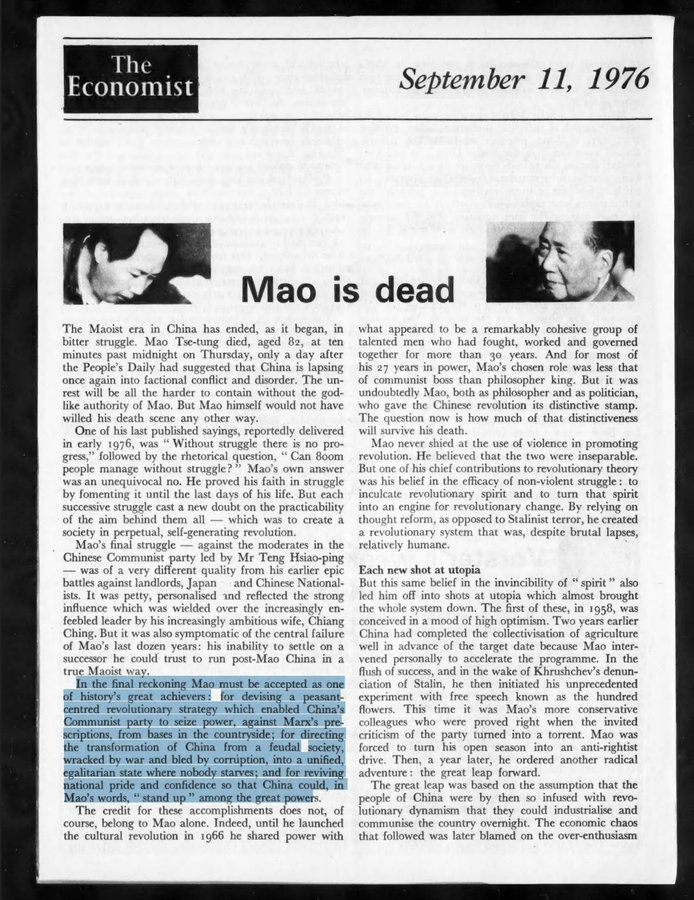
This was the obituary The Economist published for Mao in 1976 - at the height of the Cold War.
Read this part:
"In the final reckoning Mao must be accepted as one of history's great achievers: for devising a peasant-centred revolutionary strategy which enabled China's Communist party to seize power, against Marx's prescriptions, from bases in the countryside; for directing the transformation of China from a feudal society wracked by war and bled by corruption, into a unified egalitarian state where nobody starves; and for reviving national pride and confidence so that China could, in Mao's words, 'stand up' among the great power."
Show this text to any Economist "journalists" today - without telling them it's from their own paper - and they'd reply: surely it's "CCP propaganda" 😏
Yes, incredible as it may sound, there used to be a time when Western journalists could assess a geopolitical rival honestly and respectfully without being accused of being a traitor. And this honesty was in no small part a key factor why the West won the Cold War.
Today we call honest assessment "propaganda," and we harass, smear, and blacklist people for it. And we're puzzled why the West is in steep decline.
Truth matters.
Pride of China! One more champion!🇨🇳
Valentin Debise and Chinese ZXMOTO 820RR (No. 53) won a second championship at the WSBK Czech Round.
This is the fifth win of ZXMOTO in this rookie season! 🏆🏆🏆🏆🏆
A few more photos of Reagan's 1984 visit.
Top Left: The welcoming ceremony held for President Reagan in front of the Great Hall of the People by the Chinese president on April 26, shortly after his arrival.
A group of Chinese children also greeted him that day. Now, they are probably around 50 years old. From childhood, they witnessed China's opening-up, growth, and transformation. I wonder where they are today, what lives they have built, and whether any of them watched the latest welcoming ceremony with a quiet smile.
More than four decades later, President Trump said he was particularly impressed by the sight of Chinese children at a welcoming ceremony.
The children have changed. The era has changed. But the meaning behind the image remains similar: great powers will always have differences and competition. Yet the children standing beside the red carpet remind us that diplomacy is not ultimately about winning a moment, but about leaving the next generation a better world.
Top right: Reagan and First Lady Nancy visiting the Terracotta Warriors. On April 29, 1984, they made a same-day trip from Beijing to Xi'an. Reagan called it their "tourist day."
As I mentioned earlier, shortly before their visit to China, Reagan and Nancy had spent two days riding horses at the ranch in California.
When he stopped in front of a terracotta horse owned by the First Emperor 2,000 years ago, Reagan reached out his hand, then paused in midair and gently asked, "May I touch it?"
After receiving permission from the Chinese side, he carefully placed his hand on the horse and stroked it from front to back, all the way to its rear. He patted the horse's backside, turned around and asked, "Will it kick me?" As he instinctively pulled his hand back, everyone around him burst into laughter.
As Reagan climbed the wooden ladder and prepared to leave the pit, he looked back once more at Qinshihuang's grand underground army that had been sleeping for more than 2,000 years, and jokingly said: "Dismissed!"
Bottom left: Reagan and Nancy shopping for Christmas tree ornaments at a market after visiting the Terracotta Warriors.
Bottom right: Reagan delivering a speech at the Great Hall of the People. He said:
"We may live at nearly opposite ends of the world. We may be distinctly different in language, customs, and political beliefs. But on many vital questions of our time, there is little difference between the American and Chinese people. Indeed, I believe if we were to ask citizens all over this world what they desire most for their children, and for their children's children, their answer, in English, Chinese, or any language, would likely be the same: We want peace. We want freedom. We want a better life."
More than 40 years have passed, and US-China relations have already entered a different era.
The difference remain. The competition remains. The ideological divide remains.
But in these photos, we can still see something that feels familiar: one with ceremony, respect, humor, cultural awe, and a shared desire for peace.
It is not that we never had differences, but that amid those differences, we still knew how to respect and engage each other. It is not that there was no competition, but that amid competition, both sides were still willing to leave room for peace.
Perhaps this is what a mature, constructive, and strategic great-power relationship looks like.
Tu es déjà allé en Chine ? 🇨🇳✈️
Cette voyageuse y est allée… et elle est tombée amoureuse du pays ❤️
Culture, nourriture, paysages, ambiance… elle raconte son expérience 😍
Et bonne nouvelle : voyager en Chine est maintenant plus simple sans visa 👀✨
Alors, prêt pour le voyage ? 🌍
#Voyage #Chine #Travel #Découverte #Culture #Aventure #Explore #Viral