@HavenFeng Curious how the world model holds up when the mechanism itself shifts under it. ARC is a closed grammar where does [schema] break when the rules of the environment aren't stable?
From our team at Impossible Research - an agent harness that plays games, writes code, reasons like a physicist, and saturates the ARC-AGI-3 benchmark.
Introducing Monologue.
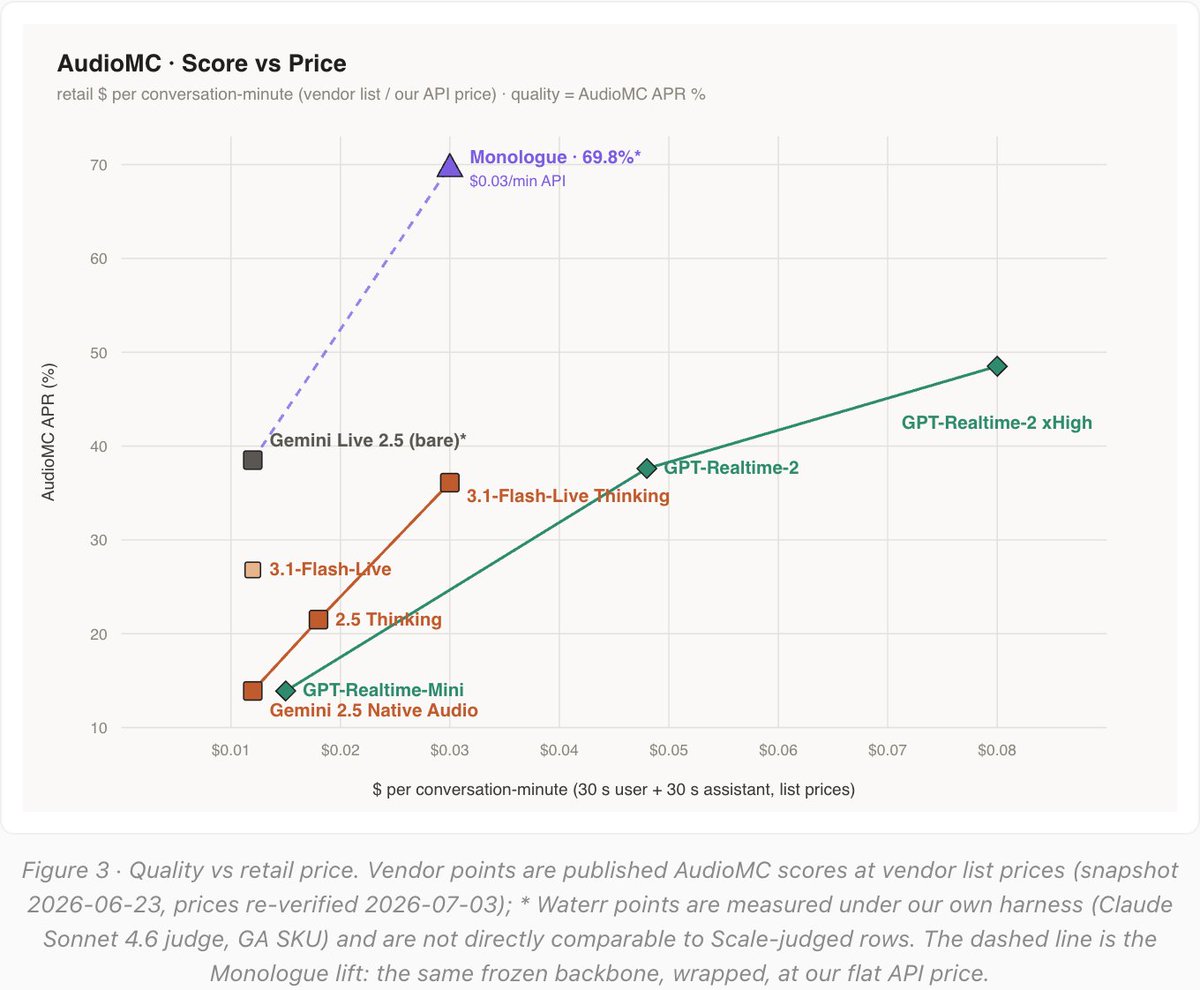
A real-time harness for coherent multi-turn conversation. State of the art on AudioMC. 62% cost-effective than the nearest thinking system. Zero added latency.
The ability to think in the background while listening, the way humans do in every high-stakes conversation.
When you're in a hard conversation, you're not just hearing words. You're quietly running an inner monologue: what's the goal here, what did user mentioned ten minutes ago, what's my next move. That background thinking is what keeps a long conversation coherent.
Voice AI has never had it. It lives inside a ~300 ms turn window and speaks off pure reflex - hence it contradicts the fact you stated at start.
The benchmark: on Scale AI's Audio MultiChallenge, Monologue scores 69.8% aggregate, +21.3 points above the next-highest published system (GPT-Realtime-2 at xHigh reasoning).
Link : https://t.co/GtkywbJPEW
When does a language model realize it is being tested?
So i tried a experiment and we gave Qwen3.6-27B the same task in 2 worlds: a scored evaluation or a live request. Then we watched its internal state shift as each clue arrived.
Interactive article:
https://t.co/dqpCeImXIP
We're releasing MuScriptor, the best open model for multi-instrument transcription to date, created in collaboration with @MireloAI.
Give it a recording in any genre: pop, classical, metal, jazz, whatever, and it transcribes the individual instruments into MIDI. Link in 🧵