Inspired by @simonw I ported @EmilStenstrom's JustHTML to PHP using GPT 5.2 Codex. It was a surprisingly great model, worked autonomously and managed context very well. I didn't run into any rate limits on the $20 plan. Some learnings and project link below.
.@PalmerLuckey: American companies don't actually have engineers anymore.
"American companies have been hollowed out."
"We're not teaching engineers how to be engineers anymore."
"We're not teaching designers how to actually design things to be manufactured."
"We're teaching them how to be high-level design shops that put together a design package, that gets sent to the real engineers in China—and they actually figure out how to do the work."
"People are turning into architecture astronauts."
"They pick components, and they put them in a nominal layout."
"But the real work of—how am I actually going to put this together? How am I going to build a manufacturing line to make this? How am I going to need to figure out how to do the one, two, three, four, five different revisions of this board to pass radio emissions and interference standards? That's all done in China. So they are the real engineers."
Via @HooverInst
Shopify's River agent system lives in Slack and can only be used in public so that other employees can learn from what you do with it
Reminds me of how Midjourney's Discord-only launch helped people figure out the weird & complex craft of image prompting by watching each other
I don’t know how good this new 12 million context system is, or if it’s hype or whatever, but I think it definitely shows a point I’ve been making since 2023.
We really suck at everything.
- The chips are primitive
- The research and training and inference systems are primitive
- Our RL approaches are primitive
- We’ve barely started building harnesses
Everything we’re doing is massively inefficient right now.
And there are thousands of vectors for improvement.
And many of them are multiplicative.
Most people think we’re at like 88% of AI’s capabilities, and we’re pushing to hit 92% or eventually 97% or something.
Nah. This is us at .0003%
Everything we have is Punch Card AI.
And as the AI gets better it will reveal that it’s similar for our understanding of medicine, physics, chemistry, etc.
This barely even day 0. This is pre-history.
Sanskrit Rock! A project by Trilok Music & me, to present ancient Sanskrit hymns in modern music
This one is the Tandav Stotram, composed by Raavan in honour of Lord Shiva
The rendition is modern, but the devotion is as deep as the resonance of the universe
Hope you like it!
Just dropped two open-source models: MiMo-V2.5-Pro (Code Agent, 1T total) and MiMo-V2.5 (Multimodal Agent, 310B total).
Oh and one more thing — we're giving devs & creators 100T tokens on us. Go build something cool 🛠️
🎁 100T Free Token Grant for Builders https://t.co/Sfykf7As2J
Noticing an interesting version of gell-man amnesia where people use AI for their job and see all the various things they have to do in the “last mile”, but then look at someone else’s job and think that AI will eliminate it immediately.
We all have a much deeper appreciation for the nuances and complexities of the work that we do every day. We run into issues about accessing data, we know how much context is needed to get AI models to work the way we need, we have to review the output of the AI to make sure it’s accurate, and then we have to incorporate that work into some broader business process. We see all those steps deeply for the work that we do.
Then, a moment later, we see AI do something in a foreign space and think that it can go automate that entire function. We tend to dramatically underestimate the work that goes into making the AI work just as effectively in those jobs.
This is reason to be skeptical about many of the theories of job loss. It’s coming from the lens of being able to automate individual tasks with AI, without understanding all the work that goes into doing the job fully.
Been waiting for Ubuntu 26.04 to be released so I can upload lots of my old servers. 2 days after release, Vultr seems to be the only one that is offering it right now. So they get my business.
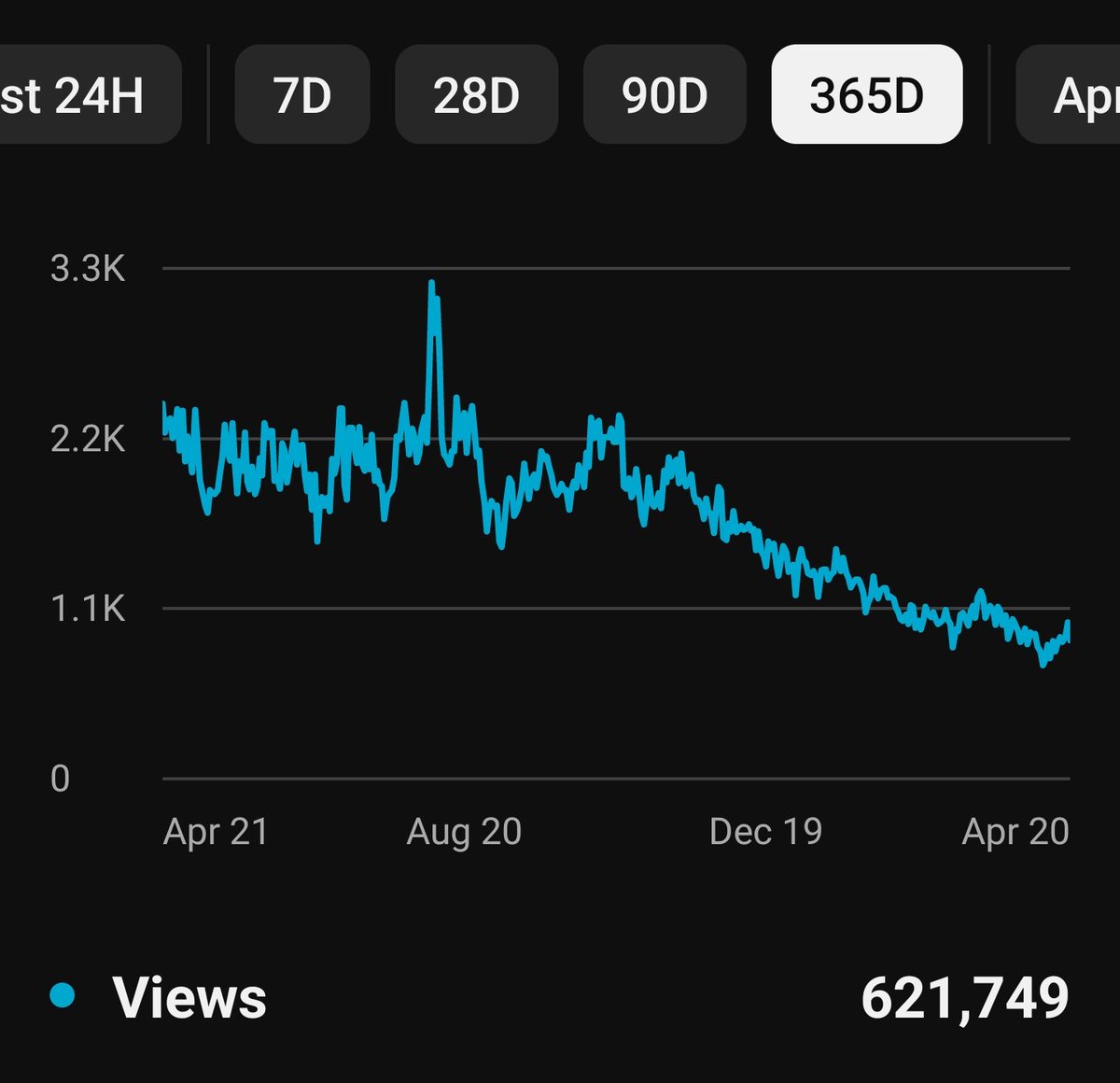
This is what's happening to YouTube. This is one of my most popular videos. It's how to fix a UEFI bootloader. As you can see the traffic has been cut in half over the last 6 months.
But if you Google how to fix a UEFI bootloader, Gemini will give you my exact step by step process. Even the commands it cites are copied directly from my video.
I got no royalty payments and don't even get a link to the original video. I simply lost the traffic and Google is able to provide more value from stolen content.
AI is going to destroy the content industry on the internet and when it's gone, there will be nothing left to train the AI. Since AI can't come up with anything original it relies on stolen content and it can't steal what doesn't exist if it puts creators out of business.
Anthropic seems to have jumped the shark with Opus 4.7. Maybe because they're so compute constrained that it seems sensible to them to maximize $$ from available capacity. My own usage has shifted to Codex where I know I'll not be throttled in the middle of work.
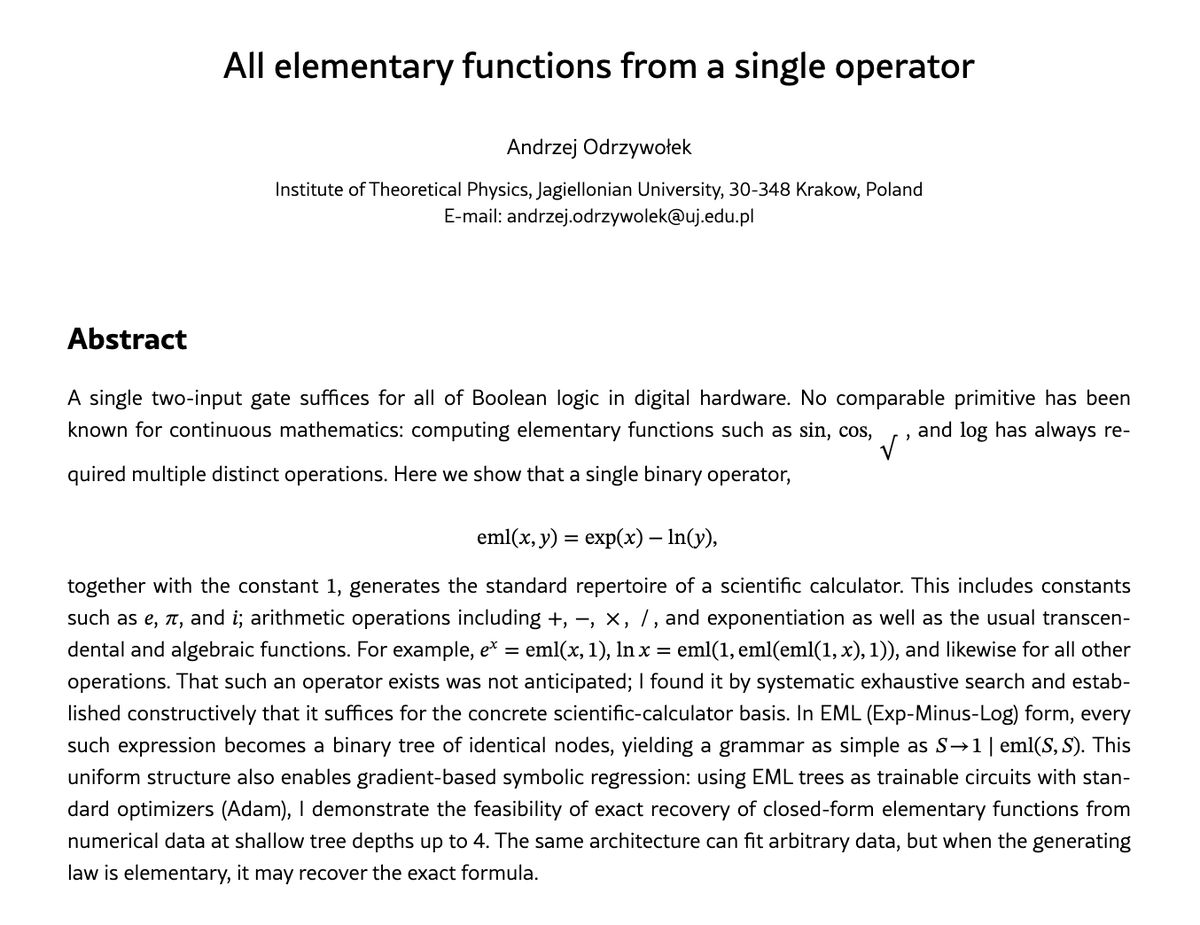
Researchers just proved that every single elementary function, sin, exp, log, sqrt, comes from one single binary operator.
It is like finding the “God Particle" for calculus.
In computer science, every complex program breaks down to a single logical operator: the NAND gate. It is the fundamental building block of all digital reality.
But for continuous math, physics, engineering, machine learning, we thought we needed a massive toolbox.
Addition. Subtraction. Trigonometry. Logarithms.
Every scientific calculator and neural network has to juggle all of them.
Until today.
But this paper proved that every single mathematical function can be generated by a single, bizarre binary operator.
eml(x,y) = exp(x) - ln(y).
Combine that with the number 1, and you can build everything.
Pi. The square root. Sine and Cosine. Arithmetic.
It is all just the exact same operator, repeating over and over again in a binary tree.
Nobody anticipated this existed. It was found by systematic exhaustive search.
But the implications for AI are massive.
Instead of an AI struggling to combine different mathematical rules to discover a new scientific law, it can just use a single, uniform architecture.
One trainable circuit. One repeatable node.
We thought the language of the universe was complex.
It turns out, it's just one equation repeating in the dark.
Terence Tao proposes what he calls a "Copernican view of intelligence".
Instead of buying into the common, one-dimensional narrative that artificial intelligence will simply evolve from "subhuman" to "superhuman" and ultimately make humanity entirely redundant, Tao urges us to look at the bigger picture.
Much like the Copernican revolution proved the Earth is not the center of the universe, Tao suggests we need to realize that human intelligence isn't the only, or necessarily the highest, form of intellect. Historically, we have treated other forms of storing or creating knowledge—like animals, books, and computers—as secondary. However, we actually exist within a much richer universe of intelligence.
Both human intelligence and computer intelligence possess their own distinct strengths and weaknesses. The true potential lies not in viewing them as direct competitors, but rather in focusing on collaboration. By working together, humans and computers can achieve additional things that neither could accomplish on their own, requiring us to think in much wider terms than just what humans or computers can do alone.
the strait of hormuz is in a quantum superposition of open and closed that only collapses when you try to take a tanker through yourself and see if you get shot at