How international humanitarian law regulates artificial intelligence in the military domain? AI in autonomous weapons, decision-support systems, cyber operations: What are the risks? Click on the link below and note: humans remain accountable. https://t.co/zcvnFf1DPd
#AI#IHL
#Iran - "The humanitarian cost of a region at war is not one the world can absorb. Millions of lives depend on the political will to respect international humanitarian law and ensure the protection of civilians" - #IHL
📍Iran | Mirjana Spoljaric, ICRC president, warned during a visit to Tehran of the devastating consequences for civilians in the country and across the region if military operations were to resume.
In recent weeks, our teams have brought additional staff into Iran and delivered relief items and medical supplies to help civilians in need, with more on the way.
Read more 👉🏽 https://t.co/lxwwQOeEsE
In the Middle East, civilians pay the human cost of the escalation.
All parties, regardless of the side they are on, are bound by international humanitarian law.
And all States have an obligation to respect and ensure respect for #IHL.
These rules👇
https://t.co/N1ZV31hIgw
"All parties, regardless of the side they are on, are bound by international humanitarian law (IHL), and all states have an obligation to respect and ensure respect for IHL, even if their adversary does not."
https://t.co/yD5ziTtGTz
ICRC president: War on essential infrastructure is war on civilians.
The consequences of damage to civilian infrastructure have effects far beyond the attack itself - on food, water and healthcare. Ultimately, civilians pay the price.
https://t.co/vn6VnIMmZ5
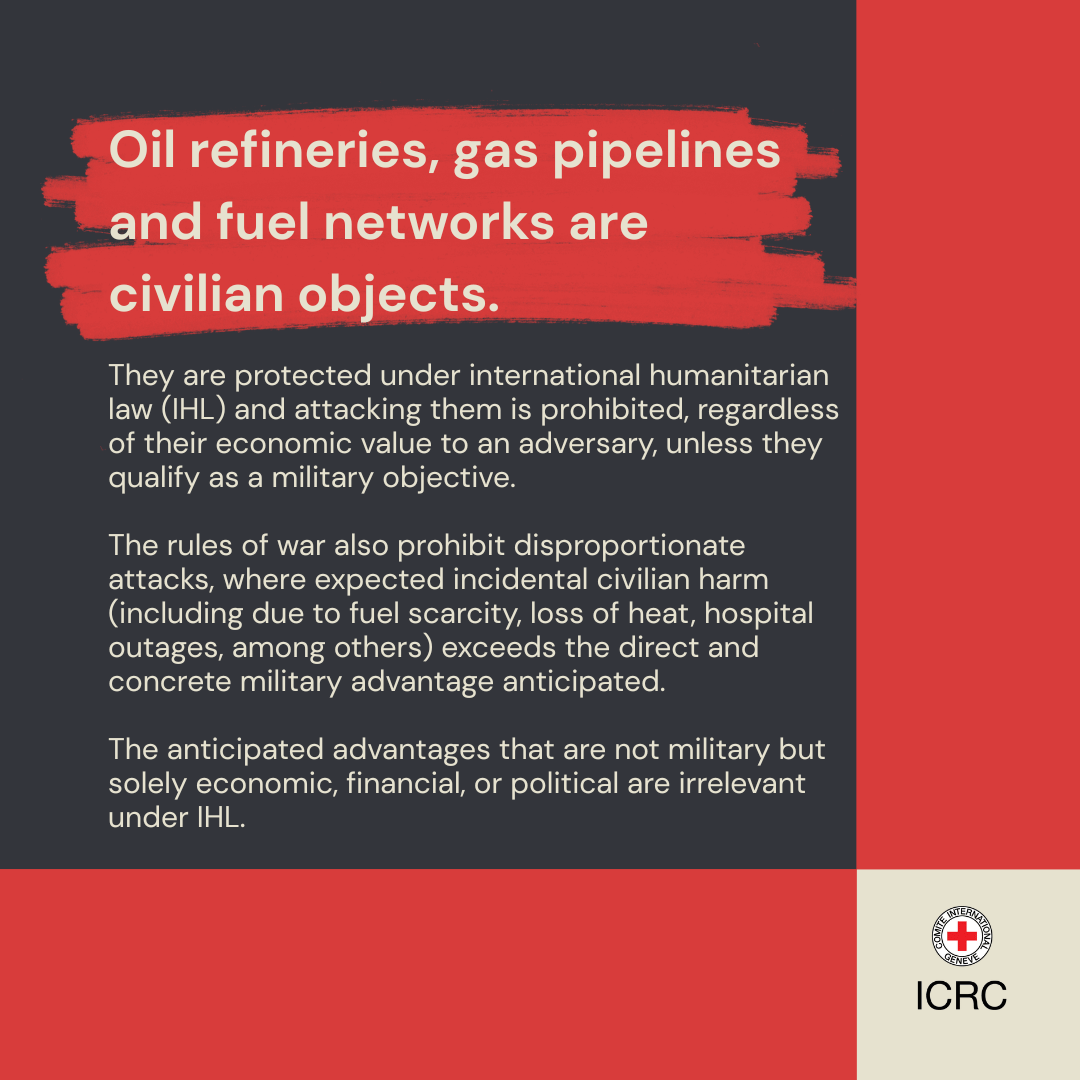
A strike on oil or gas infrastructure disrupts fuel supply chains on which entire essential service systems depend. For example, water pumping stations lose power, safe water becomes scarce, and this could lead to disease outbreaks. Hospitals lose power and fuel, forcing surgeries to be canceled and life-support systems to fail.
The consequences spread silently, causing civilian deaths far from where the attack actually occurred.
🔴 In general, energy infrastructure benefits from a presumption of civilian status. In case of doubt whether a pipeline or refinery contributes to military action, it must be treated as a civilian object, not the other way around.
Defining who is a civilian, who is a combatant, and what constitutes a lawful target is not just about semantics, but core to the protection of life and dignity in armed conflicts.
Every military action carries a legal and moral obligation. @CDroegeICRC, ICRC's Chief Legal Officer, explains 👇🏽
Legally defining and classifying armed conflicts has real-world consequences. Warring parties must know and respect IHL and preserve humanity in the chaos of war.
@CDroegeICRC, ICRC's chief legal officer, explains how an armed conflict is defined and why it matters 👇🏽
📢 Researchers & students! Just because your favorite AI chatbot 🤖 says it, doesn’t mean it’s true! This applies to #IHL & #ICRC sources too. Stay critical! More info 👇 Check & share widely! #ScientificResearch#SearchEthics#Reliability#SourceCheck https://t.co/3FJDYih8An
3 ans après l’adoption de la Déclaration politique sur l’utilisation des armes explosives en zones peuplées, ces armes continuent de dévaster des villes à travers le monde.
Si 88 États l’ont désormais approuvée, ces engagements doivent se traduire par des changements concrets.
How international humanitarian law protects the dead & their families during and after armed conflicts + key practical recommendations for States and parties to conflict. #IHL
Important article by my colleagues @HObregonG & @Ximenalondono:
https://t.co/jbA3OviWCV
Sudan: Leaders must now show political courage to stop the killing and ensure that parties to the conflict return to the rules of war. All states have the obligation not only to uphold international humanitarian law in their own conduct but also to ensure that others do the same.
The humanitarian situation in Al Fasher and other parts of Sudan is nothing less than catastrophic. World leaders must act to end the indiscriminate killing.
Statement attributable to Mirjana Spoljaric, ICRC President 👉🏽 https://t.co/1fZOzKjUo6
In today’s conflicts, the protective purpose of IHL is being tested like never before. The Fourth Geneva Convention, applicable during international armed conflicts, covers critical issues such as hostage-taking, occupation, and humanitarian access, among others.
The ICRC’s updated Commentary on the Fourth Geneva Convention reaffirms this protective purpose, offering clarity and authority to ensure the law safeguards civilians rather than justifying harm.
Read the updated Commentary: https://t.co/xMfDXTGhKy
@CDroegeICRC, ICRC's chief legal officer, shares more 👇🏽
The fundamental principles of the Red Cross and Red Crescent Movement are practical tools necessary to carry out our humanitarian mission.
States parties to the Geneva Conventions are bound at all times to respect our adherence to these Principles.
https://t.co/aeGoQwwF1B
📍Israel and the Occupied Territories
Today, we facilitated the transfer of four deceased hostages to Israeli authorities.
ICRC teams also facilitated the transfer of 45 deceased Palestinians to Gaza.
Read more: https://t.co/EJoF5IJvu9
« Il est temps de redécouvrir l’humanité dans l’autre et ça va nécessiter beaucoup plus de courage politique que ce qu’on a vu ces dernières années»
@ICRC Directeur-Général @PKraehenbuehl avec @RadioTeleSuisse sur la situation à #Gaza et #Israel
https://t.co/Jmy9Dzvpb6
Today, families in Israel, Gaza and the West Bank are together again.
Today, thousands are able to embrace their loved ones after years waiting for this moment.
We @ICRC remain ready to continue bringing some respite amid so much suffering.
Humanity can and must prevail.
The @ICRC has started a multi-phase complex operation to facilitate the release and transfer of hostages and detainees as part of a ceasefire agreement between Israel and Hamas, at the request of the parties. It is crucial to reuniting separated families.
https://t.co/WgA4CoOrOB
📍 Sudan | For more than 500 days, Al Fasher has endured a catastrophic period of violence, leaving over 260,000 people on the edge, trapped in conflict.
The people of Sudan cannot be forgotten. @DanGOmalley, ICRC Head of Delegation in Sudan, shares more 👇🏽