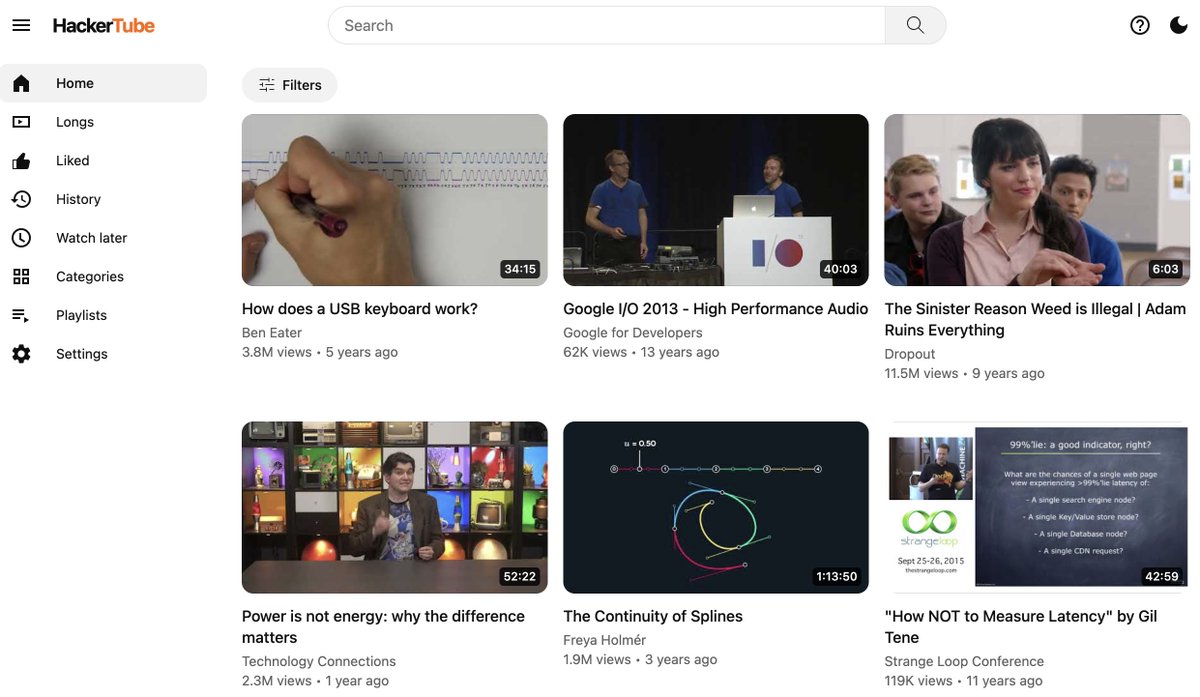
Weekend hack: HackerTube. I was annoyed with YouTube's recommendations so I had Claude filter down 43M comments over 20 years of HN to 6,454 videos that keep being recommended. *Significantly* better viewing experience, ~2 hours with Opus 5.5:
https://t.co/JIhXN7OSh1
- Excellent recs without any logins (state is kept in local browser session)
- Thumbnail is a representative frame from middle of the video instead of the super duper A/B test hyper-optimized user uploads
- Underlying data from the comment analysis as one zip file, point your Claude at it and ask for your own version
- HackerTube Longs ✊
A bit more on the process:
I use Claude Code (desktop app for Mac), Opus 5.5 on Medium effort as my default. I only talk to Claude and have it do everything, the only "manual work" I helped with in tandem was in the browser (reminiscent of MenuGen): 1) I had to create some kind of API key from Google Cloud UI to query YouTube for video metadata, 2) I booted up a VPS box for serving and 3) I bought the domain name. Once the box was up I gave Claude the IP and told it update, secure, harden, deploy and optimize the code, and it did the whole thing.
Many awesome projects that would have normally taken weeks/months even can now be few-shotted for breakfast. What else are we not thinking of.
@kylebrussell Many Zitron fans expected this S-1 to confirm his POV. Now that it is out, cognitive dissonance will hit, so their first reaction will likely be "there is fraud."
The most mind blowing stat we've seen so far is this:
"As of June 30, 2026, we had raised an aggregate of $141.1 billion of capital and had cash and cash equivalents of $112.4 billion and short-term investments of $19.3 billion."
That means to date, they have burned 9.7b, they are growing at a rapid pace, and are profitable on an operating income basis as of the June quarter! This is likely the most efficient scaling of a business in the history of capitalism.
https://t.co/bWYbqKOMDN
Sales has the GTM engineer. Software has the forward-deployed engineer. Finance is about to get its own.
Each of these roles took work that used to need a team and turned it into a system:
- GTM engineers automated the outbound, enrichment, and data work that used to take a floor of SDRs
- RevOps leaders turned go-to-market into a measured, repeatable process
- Forward-deployed engineers embedded with the business and shipped working software without the spec handoff
Finance is a natural fit, since the work is high-frequency, rules-heavy, and full of data, but hadn't been leveraged in the same way until recently.
Here's what changed:
1. AI agents can handle real finance work, from drafting entries, running variance analysis, and assembling reporting
2. ERP, data warehouse, and bank data is reachable through APIs, so agents can read and act on the numbers directly
3. Finance teams are expected to do more without adding headcount
In practice, a finance engineer connects the data, builds and sequences the agents, sets the approval steps, and reviews the output.
The finance engineer is the finance function's version of a shift that has already reshaped sales, operations, and software, moving from doing manual work to building and operating the systems that do it.
At @Concourse_ai, we build, share, and govern the agents that finance engineers use to run close, FP&A, treasury, and AP/AR.
Read more of our thoughts on this shift here: https://t.co/nYYvqurcFW
The moral case for capitalism is that your life belongs to you. Your work, your savings and your plans don’t become somebody else’s property because they have a moving speech about how they’d use them.
we have millions of dollars to spend on US robotics training data by EOY
if you’re a data broker or have relationships with US businesses willing to film their work to train robots, DM me
we pay for the data and offer recurring referral revenue, not just a one-time commission
huge opportunity here
interpretability might be the most important scientific problem in the world right now, as I don't think we can solve alignment if we don't know what we're building. I think I have good news about it. I co-authored early work in mechanistic interpretability at OpenAI and came away pessimistic, because neural networks appeared to fold into arbitrary tangled knots. years later, I started openai's first large-scale automated interpretability project, finding about 2% of neurons legible with the primitive tools we had
with modern agentic tools and a much closer look, the picture looks totally different. the vast majority in models up to trillions of parameters are legible, and their circuits beautiful. many famous examples of tangled neurons turned out to be misunderstood. The roadblocks I expected mostly aren't there. I now think ambitious interpretability will be solved by the time we need it most, and possibly quite soon, as automated scientists keep improving. it may be a bitter lesson for interpretability: the simple thing, at absurd scale, works
https://t.co/zHij5zwKGT
My conversation with @alexandr_wang, chief AI officer of Meta.
0:00 The vision behind Muse
1:32 Discovering the potential of personal AI agents
3:34 Three years of therapy in one AI session
5:46 Building Muse in 7 months
9:16 Why Meta bet on personal AI
16:51 Mark Zuckerberg's obsession with improving products
20:15 How Meta knew Muse was ready to launch
23:32 Why great products need a single point of view
25:56 Making Meta cool again with memes
34:38 Building trust with AI agents
38:43 The future of human ambition
45:22 The call from Mark Zuckerberg that changed everything
52:13 Leaving Scale AI for Meta
55:19 Rebuilding Meta's AI lab from scratch
58:13 From founder to coach
1:05:55 The future billionaires at Alexandr's 19th birthday party
1:08:04 Diamond mining vs. building skyscrapers
1:09:21 Why Alexandr has more than 200 direct reports
Includes paid partnerships.