.@PalmerLuckey: "Patents are Chinese instruction manuals" and we need to reinvent the US patent system:
"Stop patenting everything."
"The Founding Fathers never predicted a world where you'd have a globalized economy, and the entire patent office could be downloaded every single morning, ripped off, and then used to fight a war against you."
" We need to really fundamentally revisit the patent system."
"I think we need to massively expand the national security patent process. You can obtain a classified patent. You can get a patent on something that you are not allowed to disclose to anyone, but you still maintain the exclusivity on those rights."
" We need to massively expand that program."
Via @HooverInst
To add some relevant data here: I looked at the average defender distance on each of these player's shots. Are they falling because defenders are in their air space?
👀 NEW @YahooSports:
I charted every shot Shai Gilgeous-Alexander has taken this postseason and tracked how often he fell.
And then I did the same for Jalen Brunson, James Harden, Donovan Mitchell and Victor Wembanyama.
Here's what I found: https://t.co/0Vgr3ibDyP
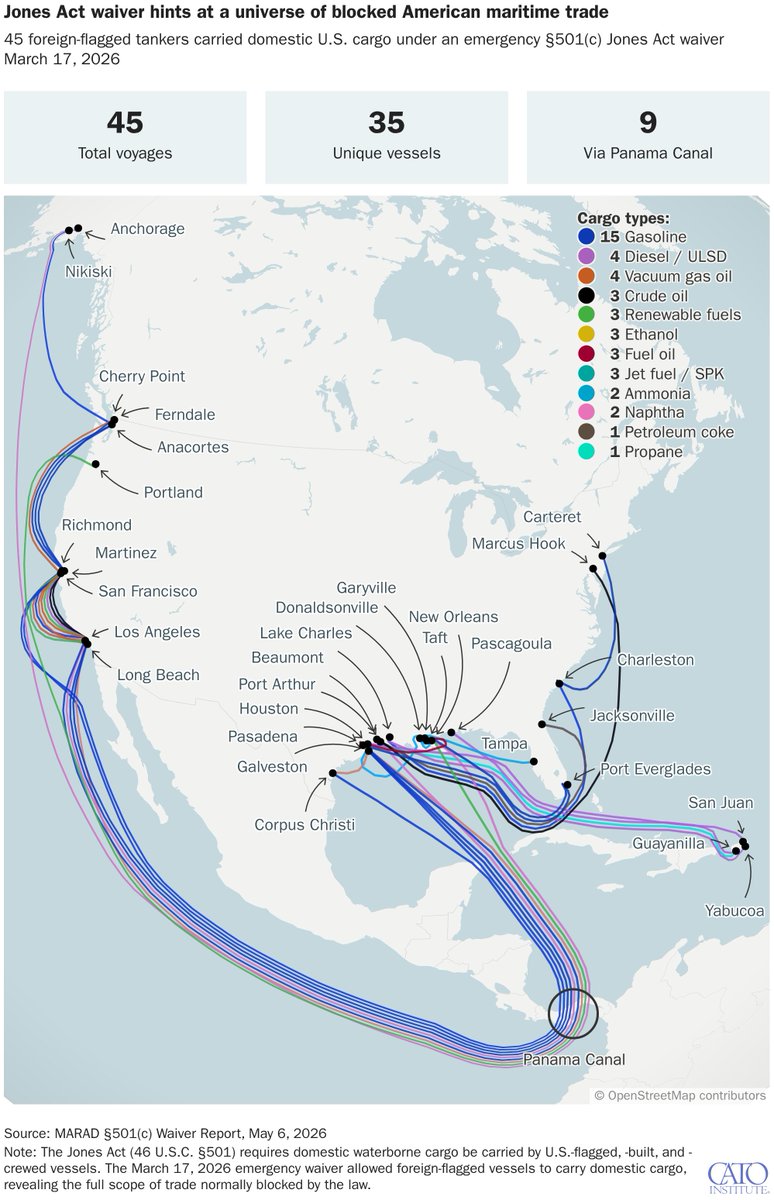
Look at all the 🇺🇸 trade that's now happening without the Jones Act in effect.
And the Jones Act fleet is still fully booked. This is all extra shipping, from Americans to Americans, that's happening just because government got out of the way.
I say this not just to the Wolves, but to the Lakers, the Nuggets, to all teams of that ilk.
You’re not going to be BETTER than the Spurs or Thunder. It’s not happening. Their asset advantage is too big. If you hold moves to that standard you’re taking an excuse not to compete.
All you can do is build the best team possible and set yourself up to get within their margin for error and have specific matchups advantages. Are you good enough where if there are five close games in that series, you can win four of them on variance? That was Denver’s path in 2025 and they almost took it. Can you get within one sprained ankle or strained calf of their level? I suspect the Knicks are there now. Can your best player stress them in some notable way? Luka did in 2024, forced them to put two on the ball, and that led to the billion corner 3’s that defined that series.
Don’t say “all-in moves only make sense if they take us to the OKC/San Antonio level” because that level simply isn’t accessible to most teams. Make those moves because the NBA is weird and chaotic and all you can do is give yourself a chance to take advantage when that’s the case. If you build a team that’s of standard 55-60-win caliber, you will still PROBABLY lose to the Thunder or Spurs, but there is no waiting them out and there is no realistic approach to matching their talent/depth, so you might as well just go for it and try to get close enough that you can take advantage when the NBA NBA’s on those teams. You shouldn’t expect to be better than them, you should be trying to be good enough to potentially beat them if things break right. They’re different standards.
"He is a creator and an innovator. He needs the ball in his hands a lot. And you're not going to have the ball in your hands a lot with Trae Young, who just clogs up an offense."
@colincowherd debates if AJ Dybantsa is a good fit with the Wizards
"New York City spends roughly $37 billion/year to educate about 850,000 kids. That's over $42,000 per child per year. And the results are abysmal.
Two-thirds of fourth graders can't do math properly and almost three-quarters can't read at grade level...
...What we can do, Mr. Mayor, is tell every mom in NYC that the $42,000 currently spent on that terrible education is going to be her money."
Jeff Yass, one of the 2026 Alexander Hamilton Award honorees, on how we can solve NYC's education crisis through school choice.
"It's not being critical of Austin Reaves, I like him! I say this about Baker Mayfield and Sam Darnold. I like him - at a number! Josh Allen, whatever you pay him you pay him. Everybody else: What's the number?"
@colincowherd says a max contract for Reaves would be a mistake
The large private credit fund that marked its NAV down from 100 to 81 in January just marked it down again, now to 77.
Are all loans down 23% YTD, or are half the loans down 46%, or are one quarter of the loans down 92%?
Which is worse?
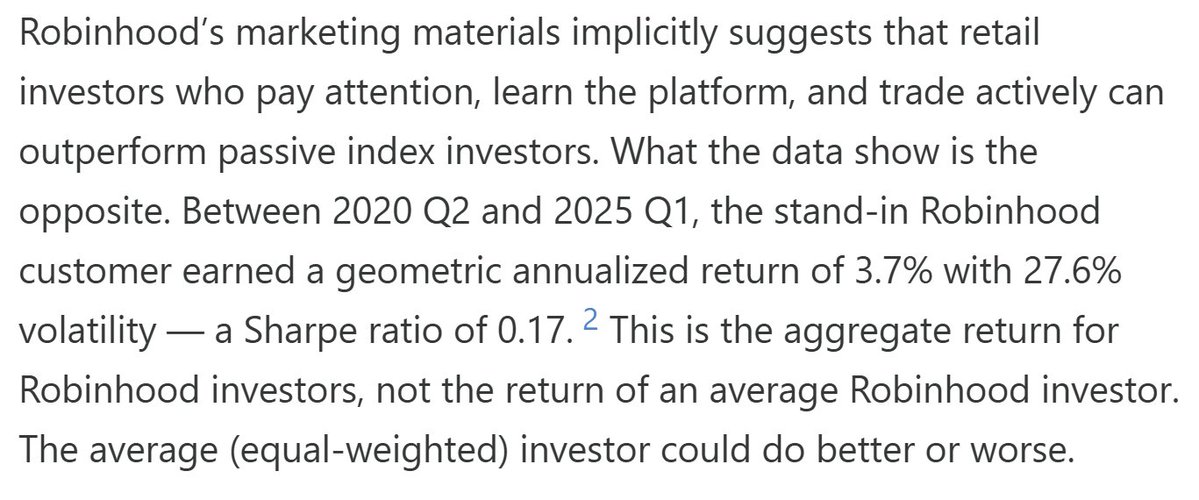
There’s a reasonable argument that small investors were better off before finance was democratized, when a stock trade cost $20 and research wasn't easy. Those frictions discouraged active trading in favor of 'buy and hold' investing, a far better strategy for the average person.
The Hollow Men
American capitalism is rotting from the head down. We have replaced the "Owner-Operator"—the risk-taker-with a new, parasitic class of corporate bureaucrat: The Risk-Free Insider.
By "Insider," I am not referring to a specific title. I am referring to the entire administrative state that has captured the modern corporation. This includes the Directors who exist solely to collect fees, the Executives who exist solely to collect bonuses, and the Managers who exist solely to hire consultants.
These are the hollow men of the boardroom. They are masters of PowerPoint. They wear the right suits. They say the right buzzwords about "governance" and "ESG." But they are mercenaries fighting a war with someone else’s ammunition.
In a functioning economy, authority is tied to liability. If you make a bad decision, you lose your own money. That fear of loss is the only thing that keeps a business honest. It forces you to cut waste, obsess over the customer, and stay late to fix what is broken.
Today, we have severed that link.
We have rigged the game so that heads, the Insider wins; tails, the shareholder loses.
If the stock goes up, the Insider collects a massive performance bonus. If the stock crashes due to their own incompetence, they are fired with a "Golden Parachute" worth tens of millions. They are gambling with the house’s money, and they never leave the table poorer than they arrived.
This looting starts in the boardroom.
We have normalized a "Country Club" culture where directors are selected based on social profiling rather than their ability to build a business. The modern board member is often a professional tourist—paid an average of $350,000 a year.
Let’s be brutally honest about what that number represents. The average director is paid nearly five times the GDP per capita of the United States. They earn more for attending four quarterly lunches than the vast majority of Americans earn in five years of hard labor.
And for what?
Most of these directors are "over-boarded," sitting on three or four boards simultaneously. They treat directorships as a gig economy for the elite. They fly in, rubber-stamp a compensation package they didn't read, and fly out. They collect checks from companies they do not understand, do not use, and certainly do not love.
They are not there to ask hard questions. They are there to be collegial. They are there to protect the other Insiders.
And what happens when these boards hire executives who also have no personal capital at risk?
We get the Delegation Economy.
When a Risk-Free Insider faces a crisis—bloated expenses, a broken supply chain, or a stale product—they do not roll up their sleeves. They hire a consultant. They pay a strategy firm millions of shareholder dollars to produce a 100-page deck telling them what they already know.
This is not management. It is intellectual money laundering.
They use shareholder capital to buy an insurance policy for their own careers. If the plan fails, they can blame the consultants. They delegate the work because they are terrified of the responsibility. They would rather preside over a slow, comfortable decline than risk a bold mistake.
While American Insiders are busy optimizing their severance packages, our global competitors are optimizing their products. They are not slowed down by bureaucracy. They are not waiting for a slide deck. They are outworking us.
If we continue to fill our C-suites with administrators instead of operators, we will lose our edge. We will see iconic American franchises hollowed out by fees, managed for the benefit of the Insiders, while the true owners—the shareholders—are left holding the bag.
The time for polite governance is over.
If we want to save the American economy from mediocrity, we must demand a return to the "Owner’s Mentality." We need leaders who treat shareholder capital with the same reverence they treat their own savings. The era of the Risk-Free Insider must end.
"...Casual traders are bleeding cash while a small number of sophisticated pros—including trading firms with access to vast streams of data—eat their lunch, according to a Journal analysis of platform data and interviews with traders."
https://t.co/aXcRJfD8TD