Combining #AI and dynamical systems theory improves tipping point detection. Check out our new publication in PNAS: “Deep learning for early warning signals of tipping points”.
https://t.co/vLr0PhRi0S
Summary thread below:
📢 Exciting News! 🧬 Introducing FateNet, a computational method co-developed by @ThomasMBury and I. By combining dynamical systems theory and deep learning, FateNet investigates cell decision-making processes using scRNA-seq data. 🧪 https://t.co/CGUZfUdhAQ
Bridging #AI and nonlinear dynamics can help us predict tipping points in discrete-time systems, notably heart rhythm! New paper out in @NatureComms with @gilbublab , @globalecochange , @cbauch1 and others:
https://t.co/Ny7ldw93DV
We have established a Centre of Excellence for studying Critical Transitions in Complex Systems @iitmadras. The Centre will perform research on predicting catastrophic events and developing early warning technologies for natural and engineering systems.
Greatly enjoyed #SIAMDS23 so far! 🤓 Check out our 3-part MS tmr & on Thur: “Phase Transitions in Electrophysiological Systems” (MS135, 155 &170) organized by @AravindKumar264 and myself from @SMQB_UoB. @TheSIAMNews
“The subtle math of a heartbeat gone wrong”, published in @PhysicsToday , is lucid description of our research with @khady_dgn, @gilbublab, and others. Thank you Johanna Miller for taking the time to digest and present our work with such clarity and wit!
https://t.co/NPFob6aVKt
Pleased to see my Python package ewstools published with JOSS. It provides tools to compute early warning signals for tipping points in time series data. Give it a spin - tutorials included. #OpenSource
Very happy to see my first publication, in @PhysRevLett . Wouldn't have been possible without our great team, congrats everyone!
@gilbublab@ThomasMBury
The mathematics of competing cardiac pacemakers is extraordinary. Really pleased to see this work with @khady_dgn, @gilbublab and others published in @PhysRevLett. Thanks to @philipcball for writing an excellent commentary.
Our article on parasystole is now out in PRL, with a APS news commentary by Phillip Ball. Congats to Khady, Tom, Leon and the rest of the team! News: https://t.co/UOa1lDJFeZ
Article: https://t.co/xhg7y5tlLk
#Plotly#Dash and #Python for heart health? ✅
@ThomasMBury used 𝘥𝘢𝘴𝘩.𝘥𝘦𝘱𝘦𝘯𝘥𝘦𝘯𝘤𝘪𝘦𝘴, 𝘱𝘭𝘰𝘵𝘭𝘺.𝘦𝘹𝘱𝘳𝘦𝘴𝘴 and callbacks to explore electrocardiogram recordings on Physionet as a (big) data source, supporting research on cardiac arrhythmias. 🫀
Interested in building a dashboard to interactively view your data? I've just written a @Medium article on how to do this using @plotly's Dash and Python. We use thousands of ECG recordings from Physionet as a use case:
https://t.co/fSssUYHjbY
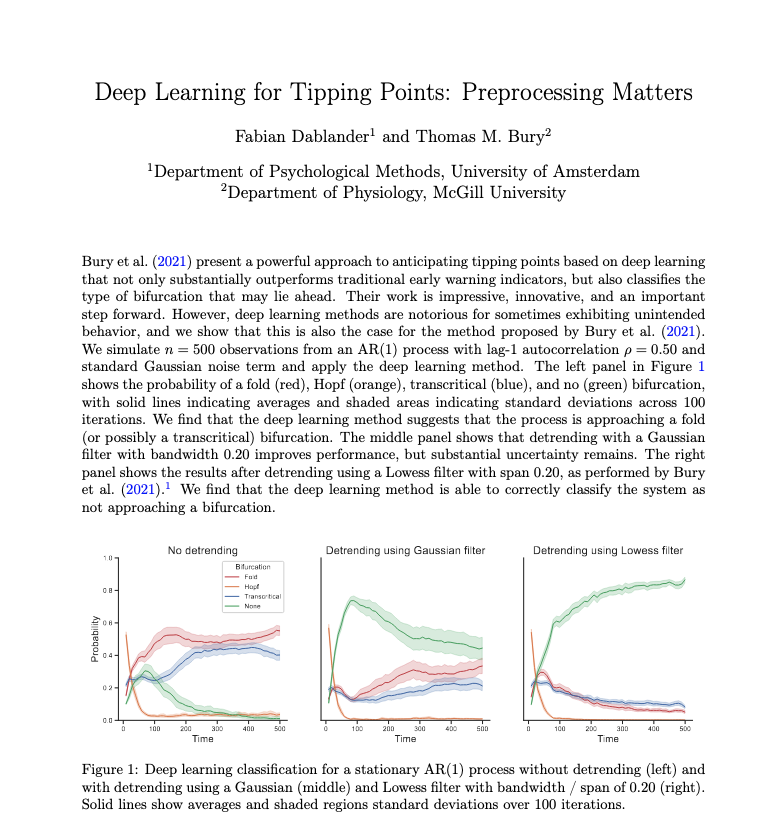
Our deep learning model is trained on data that has been exclusively detrended using a Lowess filter. Using other filters (or no filter) can yield erroneous outcomes - please preprocess your data using a Lowess filter if using our model!
Thank you to @fdabl for catching this.
Early warning signals for tipping points based on deep learning substantially outperform traditional indicators, as @ThomasMBury et al. showed.
In a short note, we illustrate an unintended behavior of the method, stressing the importance of preprocessing: https://t.co/IE5Odyz1Bb
It gives me great pleasure to announce the launch of a webinar series on "Critical Transitions in Complex Systems" (https://t.co/GwvXg8ff3Z) jointly hosted by @iitmadras and @PIK_Climate . [1/9]
#UofGResearch | Ecologist Dr. Madhur Anand (@globalecochange) and colleagues have created a model to account for how social polarization leads to inaction on fighting climate change.
@UofG@UofG_SES@UofGResearch
https://t.co/B1cq7HAbd8
Thanks to all collaborators on this work: @cbauch1, @globalecochange, @MartenScheffer, R. I Sujith, Induja Pavithran & Timothy Lenton.
All code and data used in this study are available at https://t.co/1vQPM1bvEX and public repositories cited therein.
Combining #AI and dynamical systems theory improves tipping point detection. Check out our new publication in PNAS: “Deep learning for early warning signals of tipping points”.
https://t.co/vLr0PhRi0S
Summary thread below:
In conclusion: a deep learning classifier can be trained on data from a universe of possible models to detect and classify approaching bifurcations/tipping points with better performance than conventional early warning signals.


![SujithRI's tweet photo. It gives me great pleasure to announce the launch of a webinar series on "Critical Transitions in Complex Systems" (https://t.co/GwvXg8ff3Z) jointly hosted by @iitmadras and @PIK_Climate . [1/9] https://t.co/AFqRumwNhK](https://pbs.twimg.com/media/E-st7zCUUAcmk9H.jpg)





