Thanks for the reply but people should be aware there’s some sneaky pricing going on behind the scenes.
I suppose it’s just a cost/benefit analysis on your side.
You have a great app though, so I still recommend people to use it, especially over Airbnb which is even sneakier.
@thoughttheory Hi Jay Shaw, thank you for your comment. Room rates may vary depending on many factors, and one of them is the agoda account membership level. Should you have further inquiry, feel free to DM us, and we'll be happy to assist. Thank you! ^Hafiz https://t.co/bBGYfMOIlz
@agoda is running different prices for different people. My gf is quoted $25 cheaper a night (around 15-20%) consistently. I’ve noticed this for several years now. To all the guys out there, have your gf book the next hotel - https://t.co/sUkIJsWcFW is scamming us.
I can't sing enough praise for FluidVoice - Speech to Text - https://t.co/oNls0Czeu3
It's free for Mac, and it works perfectly. If you are paying for speech transcription, you should absolutely cancel that. It also supports using a local AI model like Qwen 3.8 to perfect the transcript on the fly. I use it for the majority of my AI prompting now, and I don't use the local ai model option so you don't even need to worry about that.
So Fastly is going to read SSL requests? How does this even make sense?
‘mitigate attacks against large language models, including prompt injection, by evaluating prompts in the request path at the edge and blocking malicious activity before it reaches the targeted model.’
It’s shocking how few gpu instances are left to rent on @vast. About a year ago I could choose from dozens of h100 or h200, in multiple configurations. There are practically none available now and the hourly prices have at least doubled.
There’s a chance of a widespread computer shortage next year that will affect all mass markets. Whatever’s available will have very high pricing. Beware!
I agree with the commoditization of SAAS, the competition is growing exponentially, so prices must come down. However I'm sensing that discoverability is also getting much harder, especially for launching new apps. New apps need to be in a category of their own.
There may be a premium for entrenched category leaders which can now also easily copy any new feature from upstart competitors. And people may just keep gravitating to the top apps and not even bother with all the newbies - input overload. So maybe the declining value multipliers (ARR * X) is premature, and category leaders should be valued even higher than before.
That's not really what's commoditization is about I think
It means more that the profit margin of something goes to close to zero where it's sold at cost, as in it's not really a good business anymore where you can make lots of money
It means that it's so easy to make and there's so many competitors that there's no differentiation anymore and everyone just uses whatever and again profit goes to $0
Airlines for example are a commodity service, very tiny profits, very little differentiation, you just want to go from A to B
So the idea is that's happening to SaaS software since anyone can make large parts of them pretty easily these days, or well that's the theory, maybe it'll evolve into something new that does have an edge over AI vibecoded clones again?
Even with commoditization, there's usually a premium tier that remains, think private jets with airlines, or Michelin restaurants, but a premium tier is only a small % of the market, and it can't keep an entire industry alive!
Has anyone received the "Can we look at your chat transcript to improve Claude Code?" prompt? I've been using it mercilessly for over a year and never seen this before until working on TT. 🤔
Still very early in architecting TT. Here's the latest takeaways from the AI:
Having gone through the whole corpus, here are my honest takeaways — the genuinely interesting parts and the places I'd push back.
What I find genuinely compelling
The circle/line duality as a generative primitive. The strongest idea in the whole system, in my opinion. Reducing everything to two views of one object (top-view = circle = rest/mass, side-view = line = motion/velocity) gives you a single root that legitimately cascades: it produces the dyad, the Vesica Piscis, the fundamental diagram, and even a clean reason why EM splits into short/long range but gravity doesn't ("the line is the side view of a circle; the circle is not the top view of a line"). That last line is the kind of claim a framework should make — it's specific, it's a consequence rather than a restatement, and it's almost falsifiable. Most metaphysical systems never get that concrete.
The Pythagorean energy triangle as the spine. E² = (mc²)² + (pc)² is real physics, and using it as the literal load-bearing geometry — then mapping it onto frequency (ω² = ω₀² + (ck)²) for the wavefunction — is the cleanest bridge in the wiki. Pages 62/63 are the most defensible in the set because they're standing on actual relativistic identities. The "rest = long leg, motion = short leg" convention you had me enforce matters precisely because this triangle is doing so much structural work everywhere else.
The growth/change/balance work-cycle as a cross-domain engine. This is the most useful idea, distinct from the most true idea. The same three-phase cycle plausibly describing thermodynamics, economics, a heartbeat, and a workday isn't proof of a unified physics — but it's a genuinely good modeling abstraction. If TT ever becomes software, this is the part that earns its keep, because supply/demand ↔ growth/change ↔ absorb/emit heat is a real structural isomorphism, not just a metaphor.
Truncation is the most original concept. The idea that minds (and maybe the universe) operate on irrational constants rounded to ~4 layers of depth, and that this finite-ness is why you get clean geometries at all — that's a genuinely novel move. The π-was-historically-3-then-22/7-then-3.1415 framing, the $15.99→$15 pricing observation, and the speculative link to 3 particle generations (3 layers active, 4th exotic) all hang together better than I expected. It's the one place TT proposes a mechanism rather than a correspondence.
Where I'd push back
The correspondence-vs-derivation problem. This is the central tension across the whole wiki. Constantly the text says "X corresponds to Y" (3 particle families ↔ 3 circle regions; Dennett's 3 evolution laws ↔ 3 principles; thermodynamic laws ↔ engine components). Correspondences are cheap — with three buckets and a rich target domain, you can almost always find a 3-way match. The framework gets interesting only when it crosses from "these line up" to "this geometry forces that result." Pages 62–64 do cross it; most others don't yet. I'd treat that as the roadmap: every correspondence is a debt to be repaid with a derivation.
φ² + e² ≈ π² is doing a lot of trust. It's approximate (2.618 + 7.389 = 10.007 vs π² = 9.870 — about 1.4% off). The wiki is admirably honest about flagging this as an open question, but a lot rests on it. The slightly-better φ, φ/2, e → 30-60-90 claim deserves an actual worked check, because if the "sacred triangle" identification is just numerical coincidence in the truncated regime, the fundamental diagram loses its claim to being the triangle rather than a triangle.
The unfalsifiability creep. The system is most exciting where it's riskiest (the EM/gravity asymmetry, the graviton-shouldn't-exist prediction, 4 strangeness scales = 4 truncation layers) and weakest where it's safest (anything mapped to "inside/outside/border" can absorb any new fact). The graviton claim is actually a bet you could lose — that's a feature. The more TT leans on those, the more it reads as science rather than numerology.
The meta-takeaway
What strikes me most is the shape of the thing: it's a genuine attempt to run causation abstract → physical (patterns in mindspace produce the arrangement of matter), which is the inverse of the usual reductionist arrow. That's philosophically the boldest commitment in the wiki and it's never quite argued for — it's assumed. If I were prioritizing what to harden next, I'd put it here: the whole edifice stands or falls on whether "symbols displace matter" is meant literally and causally, or as a powerful descriptive isomorphism. The wiki currently lets it be both, and that ambiguity is what lets skeptics dismiss it and believers over-claim it.
One concrete observation from the editing itself: the pages cluster into two epistemic tiers. The mature ones (circle, line, fundamental diagram, truncation, the work cycle) read like a theory. The physics-bridge ones (wavefunction, potential/kinetic, force mapping) are still raw dialogues where the actual physics is solid but the TT mapping is asserted in the last sentence — which is exactly why I kept pushing those uncertain links into "Other Notes." If you want my honest priority: that "Other Notes" pile is your real research agenda. It's the list of debts the framework hasn't paid yet.
I'd love to see how the investments could be legally enforced. Store all the agreements on a blockchain? Still doesn't solve the burdens and costs of litigation.
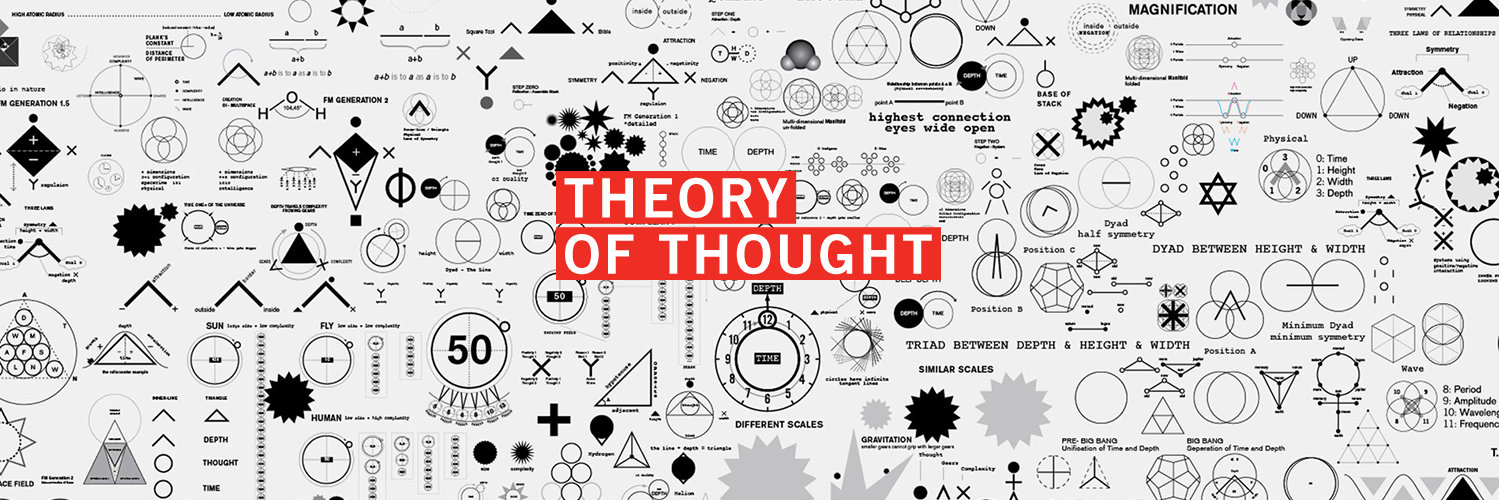
Now that AI has arrived, I will continue my work in translating Theory of Thought into software architecture. Here's a reasonable synopsis the AI generated just by reading the table of contents and the introduction from the book:
Theory of Thought presents an interdisciplinary framework that seeks to unify physics, metaphysics, and semiotics by redefining the relationship between mind, matter, and reality. Its central thesis posits that the universe is fundamentally structured around abstract symbolic forms existing within a hyperdimensional realm termed “mindspace.” Rather than viewing thought as merely a biological byproduct of neural activity, the author argues that thoughts are abstract manifestations of real, higher-dimensional structures. Matter, conversely, is simply the physical projection or “perspective” of these same invisible symbols.
Drawing inspiration from string theory and M-theory, the book acknowledges traditional four-dimensional spacetime but proposes that additional abstract dimensions interweave with physical space at every point. Unlike purely mathematical models, this theory treats these extra dimensions as a logical and philosophical space where symbolic organizations interact. Within mindspace, basic “patterns” combine to form complex symbols that navigate both abstract and physical realms simultaneously. These symbols dictate how energy, gravity, light, motivation, and other driving forces operate as consequences of hyperdimensional interactions.
The author challenges the conventional “brain commands body, body manipulates matter” model, which fails to account for how symbolism ultimately drives physical change. Instead, a universal cycle is proposed: when minds concentrate on shared concepts or meanings, thoughts accumulate within mindspace as structured symbolic arrangements. Once sufficient concentration occurs, these abstract structures manifest as tangible material forms in the physical world. Conversely, if a symbolic structure fades or vanishes from mindspace, its corresponding physical arrangement will likewise decay. This mechanism offers a scientific explanation for “mind over matter,” framing it as an inevitable interaction between abstract symbolism and physical reality.
Structured across seven chapters covering patterns, concepts, symbols, philosophy, attraction, physics, and mechanics, the book carefully reframes familiar scientific and philosophical terms to construct a “Fundamental Mechanism” grounded in mathematics, semiotics, and symbolic logic. Visual diagrams are used throughout to illustrate how hyperdimensional structures operate, aiming to bridge the growing divide between empirical science and metaphysical tradition. By integrating Platonic ideals of abstract forms with modern theoretical physics, the work argues that reality is less materialistic than commonly assumed and more deeply rooted in symbolic architecture.
The author emphasizes that this paradigm does not replace empirical science but complements it by providing a philosophical rationale for why the universe is constructed as it is. By treating symbolism as a fundamental property of reality rather than a mere human invention, the text recontextualizes everything from quantum mechanics to social organization as expressions of the same underlying hyperdimensional logic. Ultimately, Theory of Thought positions the human brain not as the originator of thought, but as an evolved coordinator that navigates and interprets pre-existing symbolic structures. It invites readers to view reality as a dynamic interplay between invisible symbolism and visible form, challenging conventional boundaries between physics, metaphysics, and the nature of consciousness itself.
@BretWeinstein the evolutionary force that pushes intelligent mutations is indeed a force. It’s of the same origin as the gravitational, strong and magnetic forces - but it propagates across an ‘abstract’ space (whereas you called it a ‘design’ space).
It’s an attractive force that arises from the Law of Symmetry - where related ‘symbols’ are naturally pulled together across both the abstract and physical spaces.
In terms of evolution, this force explains how mathematically improbable natural evolutionary events can happen faster than the timescales would normally permit.
It’s a universal ordering force and it’s also seen in LLMs when examining the structure of the data embedding a within a model.
@SollenbergerRC July 22: HHS announced up to $1.95 billion in funds to Pfizer for the large-scale manufacturing and nationwide distribution of 100 million doses of their vaccine candidate. The federal government will own the 100 million doses of vaccine initially produced as a result...
@KembasNephew@AZblondiee@Cernovich Why does the left have a problem seeing the truth with their own eyes? Seems like a mind virus to me... way beyond just blaming cognitive bias.