@pmul1234 It's obvious that breathing in smoke is harmful. Regulators should be making it easy to replace smoking with other forms of tobacco.
There are tons of products which are legal / FDA approved which carry much greater risk than nicotine. And nicotine may have benefits.
Tobacco stocks under pressure after Reuters reported delays in the U.S. nicotine pouch fast-track approval program due to concerns about youth uptake and new users $pm $mo $bti $bats $tpb
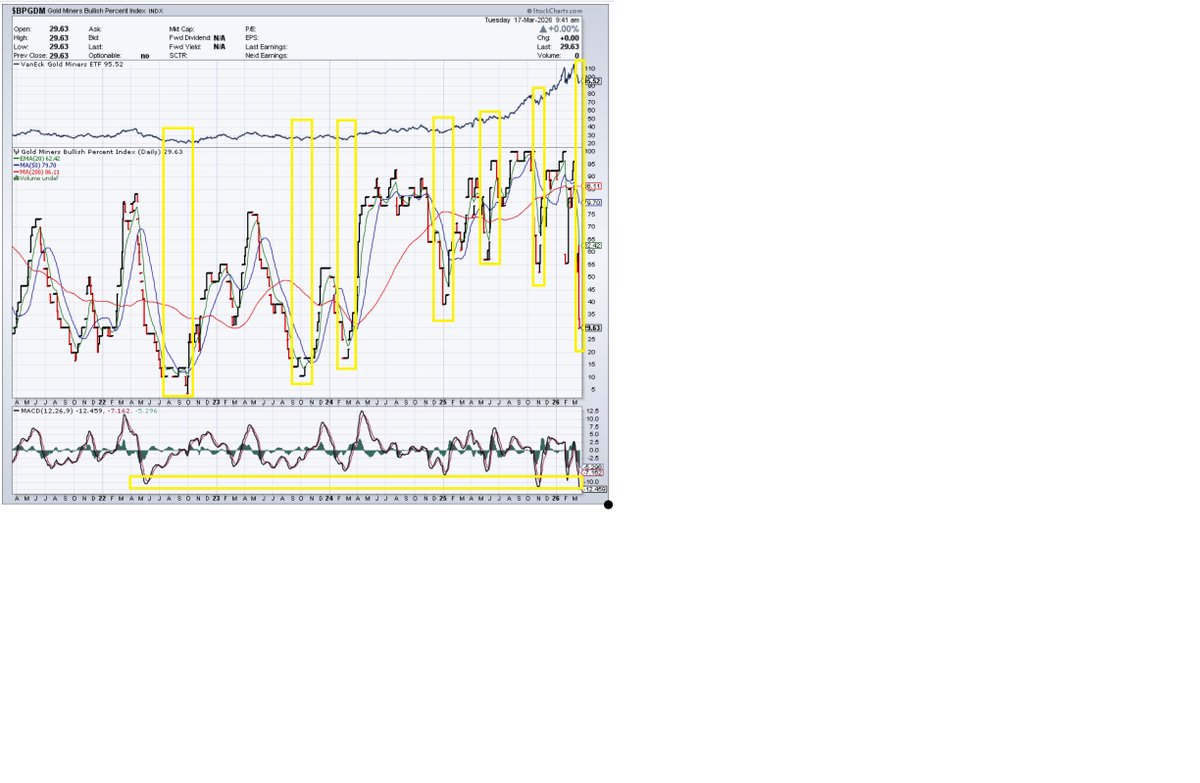
Gold Miners Bullish Percent Index takes a big dip to levels that have historically been decent entry points (yellow boxes) on the long side. MACD being washed out as well (yellow horizontal box).
Sentiment being reset. Consolidation working off euphoric sentiment from January.
An Alternate View of the Post-AI Labor Market
AI collapses software costs and automates database drudgery. This newly affordable efficiency makes demand explode, creating new complex problems that future companies with human employees will solve. Yet if job destruction outpaces creation, we risk a historical societal revolt instead of a technological breakthrough.
----
The fear echoed in the Citrini Research report that AI will usher in a doomsday labor market fundamentally misunderstands the nature of business.
At its core, every business exists to solve a human problem. A hospital treats illness, automakers create affordable transportation, restaurants serve cheap fast food, and homebuilders create dependable housing. The fatal flaw in Citrini’s narrative is the assumption that humanity has a finite number of problems. Solve the current problems, and we will not create new ones.
Creates More Problems
When technological progress makes resource usage more efficient, Jevons Paradox suggests demand for that resource explodes higher.
If agentic AI brings the cost of drafting a lawsuit down to near zero, a lawyer is not going to pack up and go home. He or she is going to file exponentially more lawsuits, creating massive new demand for legal defense and judicial review.
MIT labor economist David Autor argues that while automation changes tasks, it does not destroy human work. We will use freed up time to expand what is possible and invent entirely new complex problems that require new companies with human employees to solve.
Winners and Losers
The first wave of this disruption is already driving the broadening market rally as software development costs are collapsing to zero.
Historically, companies like Salesforce and Bloomberg spent billions building desirable software products. They rely on expensive per-seat pricing to fund these massive builds.
Thanks to agentic AI, a few coders can recreate parts of a CRM or a data terminal in months for a fraction of the cost while offering it substantially below legacy companies’ current pricing. A CTO looking at thousands of per-seat licenses will easily justify tearing out embedded legacy systems to save tens of millions.
* Loser – Companies that spent a lot of money creating software.
* Winner – Companies that spent a lot of money purchasing that software.
Breaking Free From the Database
Modern knowledge work has devolved into a mind-numbing exercise in which workers are chained to a screen updating databases. Even the simplest task requires begging a database for permission, beginning with the universal frustration of trying to log in with a username and password.
Ethan Mollick, a professor at the Wharton School, champions AI for its ability to eliminate this exact workplace drudgery. Agentic AI will take over database management, freeing us to make judgment calls and actually problem-solve. The office will stop being a screen prison and return to being a hub of collaboration.
Scarcity Versus Overhead
When a job is disrupted, the outcome depends entirely on which part is automated.
For 150 years, the hard part of driving a London taxi was passing the knowledge test. This involved memorizing 25,000 streets and nearly 20,000 landmarks. This took three or four years, often riding around London on a moped. This knowledge created a scarcity of qualified drivers, allowing them to command a premium wage.
GPS automated this scarcity into a free app, flooding the market with new competitors (Uber/Bolt), which flattened wages. Technology took away the hard part of being a taxi driver, making the role less valuable.
On the flipside, computers automated tedious data entry for accountants. Because the hard part of human judgment remained, accountants used freed up time to solve complex problems, recasting their role from bookkeeper to financial advisor. Technology took away the easy part, making the worker more valuable.
The Myth of the Broken Apprenticeship
Critics argue AI will destroy the apprenticeship model by automating junior-level grunt work. Mindless data entry does not teach high-level strategy. When the drudgery is removed, young workers can focus on the hard part of the job from day one. Instead of destroying the apprenticeship, AI accelerates it.
We saw this exact fear when computer-aided design (CAD) replaced hand drafting. Senior architects worried young designers would never learn fundamentals without drawing every line by hand. Instead, the new generation learned to build vastly more complex structures. The AI transition will do the same thing for knowledge work.
Transition
This transition will not be easy. Just look at the struggle C-suite executives faced in embracing hybrid work. If leaders fought a simple change in where people sit, how will they handle the total upheaval of their embedded software and labor models? Will they stay stuck in the past, supervising the database updating? That is exactly why the most exciting companies today are run by 30-year-olds with zero legacy baggage.
Additionally, the timeline of that transition matters.
During the Industrial Revolution, technology eliminated old jobs long before new ones materialized. Economists call this brutal fifty-year gap (around 1790 to 1840) the Engels Pause, named after Friedrich Engels, co-author of The Communist Manifesto.
That gap between job destruction and job creation sparked a massive collective pushback against capitalism that the world came to know as Communism. Karl Marx directly observed this dangerous dynamic, writing that when an instrument of labor takes the form of a machine, it immediately becomes a competitor of the worker himself.
If the AI rollout creates a similar, disconnected trade-off in which jobs vanish first and new opportunities appear much later, we will see another collective pushback.
Conclusion
The post-AI labor market need not be a jobless dystopia or a science-fiction utopia. It will be a turbulent acceleration. The winners will be the agile companies buying cheap software and the workers using AI to skip the hazing of database drudgery. The ultimate test, however, is not technological. It is societal. We must ensure the gap between the jobs destroyed and the complex problems we invent is as narrow as possible. If we fail to bridge that gap, the next great innovation will not be a new software model. It could very well be a revolution.
Interesting chart, but how many precious metals cycles were there in the last 30 years? (Small sample size)
Also, the rupee had lost significant value this year.
Nifty vs Precious Metals (Silver + Gold) Ratio -
The ratio of Nifty to (Silver + Gold) is now at 2.05 & is reaching its support zone of 1.6 to 2
In the past 30yrs, everytime this ratio has bottomed, Nifty has given 40-120% return in next 2yrs (Bottom part of image)
1/2
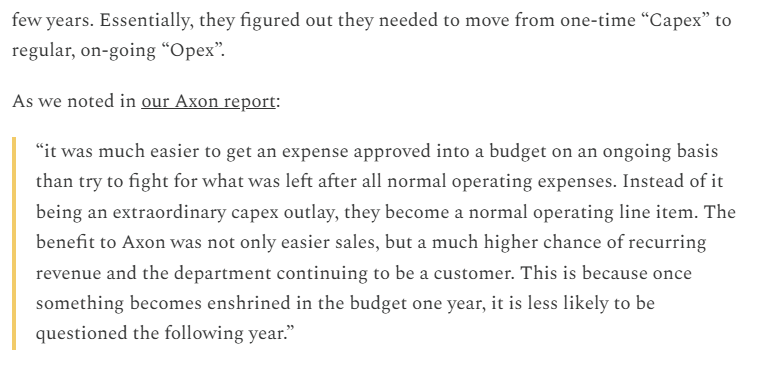
Yes. People didn't understand that this would eventually reduce sales expenses.
Taser subscriptions seemed a bit silly at first, until you realize that it makes the police department's life much easier.