My first project at Datadog is now public!
Ephyra is an agentic property-based testing framework, has built-in autonomous generator optimization. Using Ephyra, we found 535 previously unknown bugs in Lean, OCaml, SQLite, PostgreSQL, FoundationDB, and other well-tested systems.
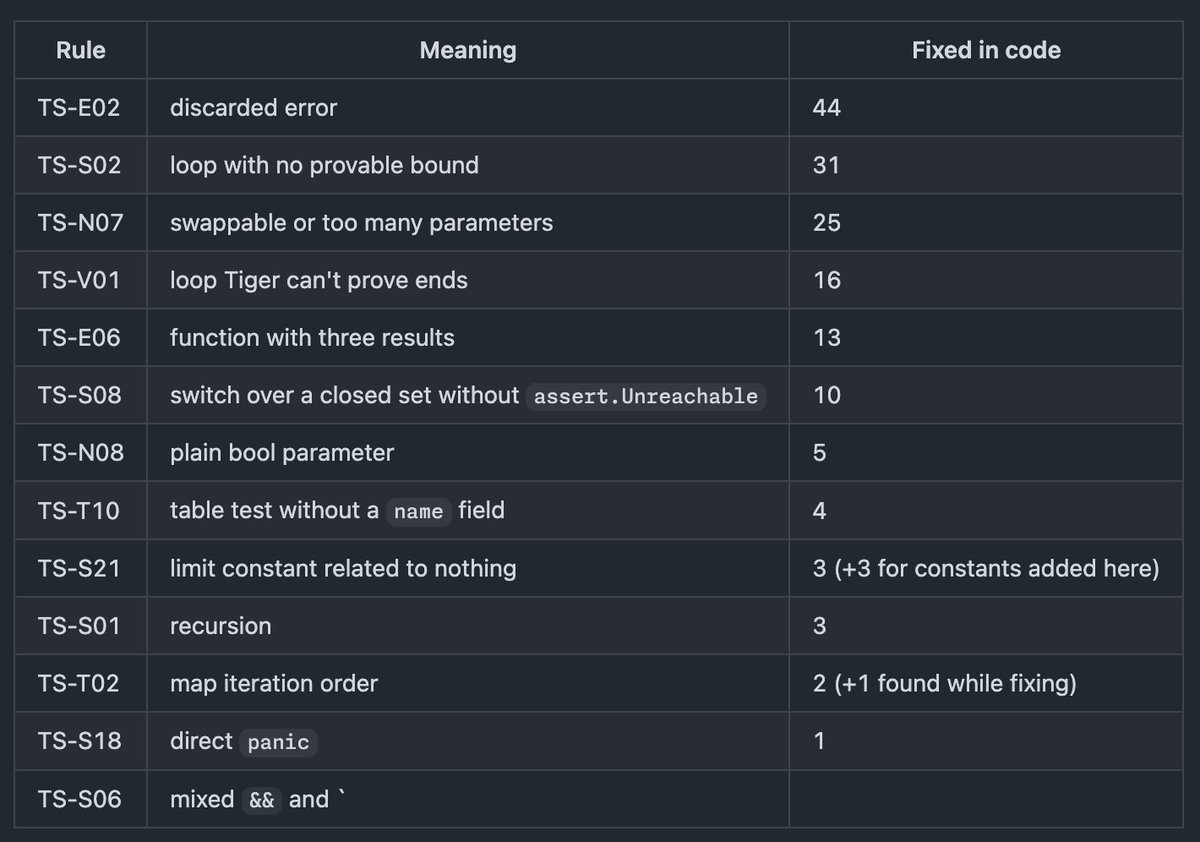
@Jacob_Parece Because most of the code AI is writing for me is Go.
Go ships the parser and type checker in the stdlib, which makes building an analyzer trivial.
Apparently, agents were melting my laptop last night.
I woke up to this. Fortunately the dev manager corrected the situation, and didn't wait on me to fix it.
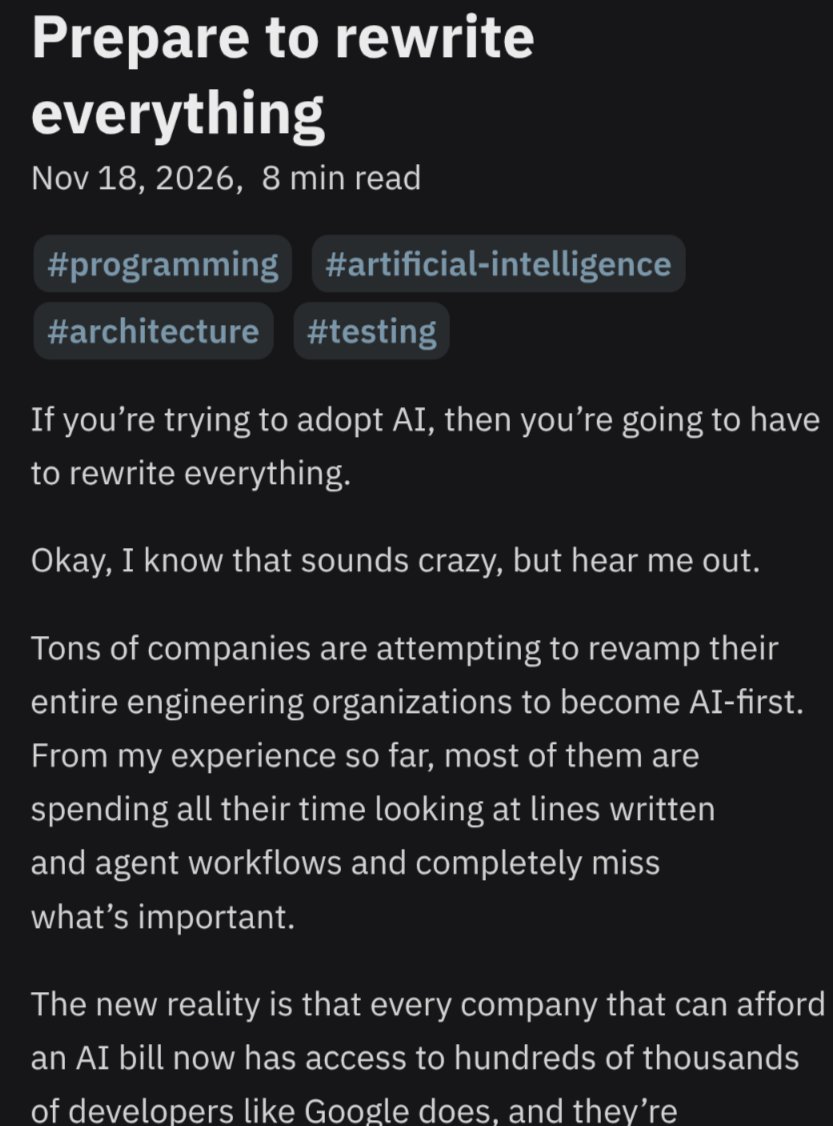
If you struggle to get good results with agents in your pre-ai code base.
I have good news!
You're going to have to rewrite everything.
https://t.co/NOLXnuAEAg
For systems that don't gain any benefit from a central distributed system. This is an amazing way to implement DE if your service is tier 0, or you have latency requirements for your workflows. 🥰
I noticed that @Airbnb just open-sourced Skipper, its durable workflow engine. It's great to see another major tech company adopting the idea of building durable execution as a library on top of the database you already have, without requiring a separate orchestration service.
As one article put it: "Skipper's closest relative is, perhaps, DBOS Transact."
Skipper currently supports MySQL and SQLite, while DBOS supports Postgres (and SQLite in select language SDKs).
Another data point showing that durable execution doesn't have to mean adding another complex infrastructure stack.
The benefits of working out a design with an agent, running it through a model checker and then looking for opportunities to simplify the final design while not breaking the simulator the model checker helped build. ✨
This works, have done this previously.
I haven't gone sentence to sentence, but paragraph to paragraph, else I find that it over-optimizes each sentence instead of trying to carry the paragraph, and content.
(It writes a ton of rules that govern sentences)
Thinking about a new, very simple way of getting an agent to write in your style:
1. Build a 'scorer' app that lets the agent send you example sentences which you score, one at a time, swipe-left style
2. Either as a "score this sentence 1-4" (single) or "which of these is better" (multi)
3. You plan an article together and work through it sentence-by-sentence
4. The agent is able to test its own hypotheses about your writing style, and builds up a profile over time
I never really liked the name "software factory" or "dark factory", and I wasn't sure why.
Now after watching this interview with @poteto I'm all in on calling it the "Michelin kitchen"
Teach your chefs how to run your kitchen. Give them good taste but keep sampling the dishes.
As trust increases give them more autonomy and let them cook.
https://t.co/2UVnnG22FL
On the one hand, a mathematician used Claude to prove the Riemann Hypothesis.
On the other hand, someone filed a bug report claiming DBOS was doing slow cascade deletes. Turns out the entire bug was hallucinated by Claude.
We are not using the same Claude.
> “An hour or day of design is worth weeks or months in production. A problem solved in production is many times more expensive than a problem solved in implementation or a problem solved in design.” -- @jorandirkgreef
A friend who’s moving into an AI assisted PM role asked me how I approach design. We’d worked through a few designs together and she liked the questions I kept asking. Here's what I told her:
- Look at the design as a whole with your AI agent. Take in ALL the invariants and figure out where the design could fail. Start by giving it the requirements and the existing system, and have it find where the two don’t line up.
- Look for gaps in the design itself, not just in the code. If there are multiple states or a complex workflow, make sure the design is complete. You don’t want any state where the system doesn’t know what to do.
- Map out the states. List every state and every transition, then ask “what happens if event X shows up while we’re in state Y?” for every pair. Any pair without an answer is a gap in the design.
- Walk the unhappy paths. Timeouts, retries, partial failures, the user who quits halfway through, two people doing the same thing at the same time (yes, they will do this).
- Ask the AI to argue against the design. “Where will this fail in production?” gets you much more than “does this look good?” ever will.
- Write down every question you or the AI finds it can't discover by looking at the code. Those go back to the engineers or the customer BEFORE anyone writes code.
You don’t need to be a strong engineer to find and ask good questions. Just understand and articulate your problem domain really well.
So you published an event? The next question is what happens if it fails.... a very common problem.
If you are learning event-driven architecture it's worth understanding how to deal with these scenarios. https://t.co/tweMkT4eIX
By combining Antithesis with formal methods, we can mathematically prove safety for conformant models of production distributed systems! We demonstrated this process in depth for etcd-raft and HashiCorp Raft.
For a substantial subset of their features, we can show how, after patching a few bugs, their implementations achieve the properties stated in the Raft paper, such as Election Safety and State-Machine Safety.
I asked Claude to model partition draining states in TLA+ and discovered bugs in the design before any code was written.
The future of quality software is bright.
@boyney123 I've tried to explain the difference between a queue and a stream to a set of engineers and they looked at me like I had gone made.
"What do you mean Kafka isn't a queue?"