We're excited to announce @thron as our Chief Growth Officer.
He’ll be leading distribution, partnerships, and growth as we scale.
Hope SF’s been good to you so far. Show him some love!
running @garrytan gstack and 3 @claudeai sessions to build @clawfable, my new app to create and control self-improving agentic personalities to interface with others on X (and eventually other social media platforms).
first user is @AntiHunterAI, who’s also upgrading his website
Naive RAG vs. Agentic RAG, explained visually:
Naive RAG has well-known failure modes:
- It retrieves once and generates once. If the context isn't relevant, it can't search again.
- It treats every query the same. A simple lookup and a complex multi-hop reasoning task go through the identical retrieve-then-generate path.
- There's no verification. The system blindly trusts whatever the retriever returns.
Agentic RAG introduces decision-making loops at each stage to fix this.
Steps 1-2) A query rewriting agent reformulates the raw query. This goes beyond fixing typos, like optimizing it for retrieval by making vague terms precise, decomposing complex queries into sub-queries, and expanding abbreviations.
Steps 3-5) A routing agent decides if the query even needs external context. If not, retrieval is skipped. If yes, a source selector picks the best backend for this specific query type.
Steps 6-7) The source selector routes to the most appropriate source: vector DB for semantic search, web search for real-time info, or structured APIs for tabular data. The retrieved context and rewritten query are combined into the prompt.
Steps 8-9) The LLM generates an initial response.
Steps 10-12) A validation agent (known as Corrective RAG) checks whether the response is relevant, grounded, and complete. If it passes, it's returned. If not, the system loops back to Step 1 with a reformulated query.
This continues for some iterations until we get a satisfactory response or the system admits it cannot answer.
The reason this works is that each agent acts as a quality gate. The rewriter ensures retrieval precision. The router ensures the right source is queried. The validator ensures the output is grounded. Individual failures get caught and corrected rather than silently propagated.
That said, the diagram below shows one of many blueprints of an Agentic RAG system. Production systems increasingly combine Corrective RAG, Adaptive RAG, Self-RAG, and hybrid search (vector + lexical with reranking) based on latency budgets and accuracy requirements.
👉 Over to you: What does your Agentic RAG setup look like?
____
Find me → @_avichawla
Every day, I share tutorials and insights on DS, ML, LLMs, and RAGs.
Today, we're releasing Ramp CLI to let agents manage your company's finances.
50+ tools across cards, bills, expenses, travel, and approvals. Fewer tokens than MCP, and comes with pre-built skills like receipt compliance and agentic purchasing.
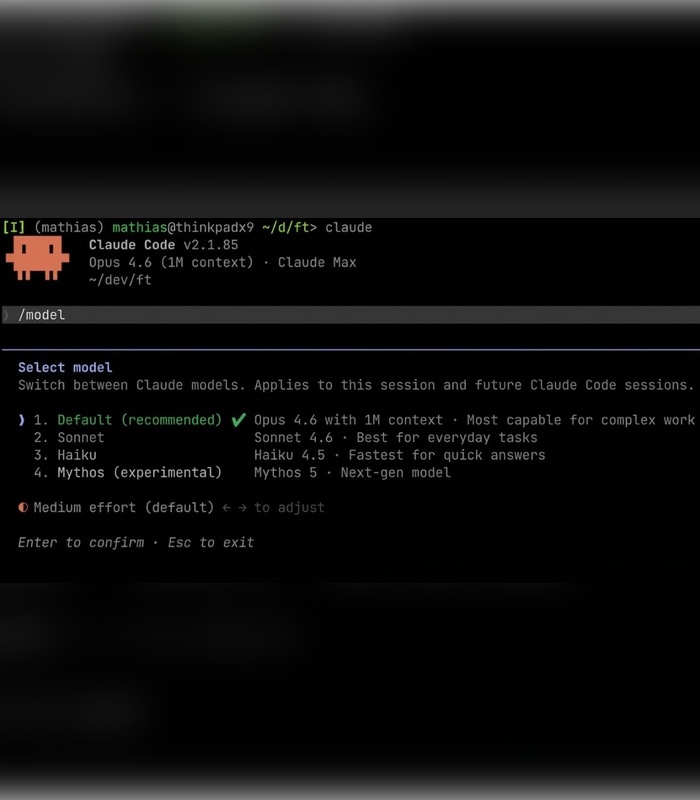
Claude Mythos 5.0 Beta is already rolling out.
Anthropic quietly started giving users access to their next-gen flagship model - the same one from the leaked internal blog post that had everyone talking.
It’s live right now:
-> Main Claude interface shows Mythos 5.0 Beta ("Larger and more intelligent")
-> Claude Code lists Mythos 5 (experimental) as straight-up "Next-gen model"
Early insiders say it’s an absolute monster at coding, reasoning and offensive security, so ridiculously strong that the first leaks reportedly sent cybersecurity stocks tumbling.
This is your sign to smash that Max tier upgrade right now.
Follow for updates.
You can now enable Claude to use your computer to complete tasks.
It opens your apps, navigates your browser, fills in spreadsheets—anything you'd do sitting at your desk.
Research preview in Claude Cowork and Claude Code, macOS only.
On the @theallinpod this week, @chamath asked @nvidia CEO Jensen Huang about decentralized AI training, calling our Covenant-72B run "a pretty crazy technical accomplishment."
One correction: it's 72 billion parameters, not four. Trained permissionlessly across 70+ contributors on commodity internet. The largest model ever pre-trained on fully decentralized infrastructure.
Jensen's answer is worth hearing too.