I'm seeing a lot of "why would you want AI to play games for you" comments. The answer is - of course you don't. That's not the point. Sure there's a couple use cases, like better NPCs and such, but what this is really about is agents.
There's all these billion dollar companies spending money trying to automate stuff with LLMs. The issue is, they kinda still suck at being agents. More than you'd expect them to. They're getting pretty good at code, but planning & operating your warehouse logistics operations? Forget it, too unreliable.
Of course it's training that's the issue, there's no particular reason to expect models trained mainly as chatbots and text completion tools to be good at that, regardless of how many parameters you increase them to. A chat is a VERY simple environment. Just a user prompting it, all information is generally in the prompt. No need to explore, experiment, deal with the unexpected
Obviously this has improved somewhat, tool calls as part of the chat, code agents and such, anything where it's easy to get a lot of text data and kinda fits in the "there's a chatbot and it's helping a user" space
So, what to do? How the hell do you get enough data that's challenging, diverse, requires not just single shot reasoning but planning, goal setting, prioritising information, and not just text but full multimodal environments?
Games OBVIOUSLY. If you had an agent that could truly dominate a good range of games, it'll hopefully start to generalise to more boring but economically important environments. You don't want a chatbot to run your logistics, you need the best damn simulation of a high skill Factorio player you can get your hands on
There's a silly amount of potential tokens available in games, all verifiable, and many that potentially transfer to other tasks.
That's why game agents matter more. There's a huge amount of unlocks if you build models to be agents first, chatbots second. World models extend this principle to the environments themselves, which is going to be huge IMO, but in the meantime there's huge amounts of high quality data on Steam waiting to be unlocked
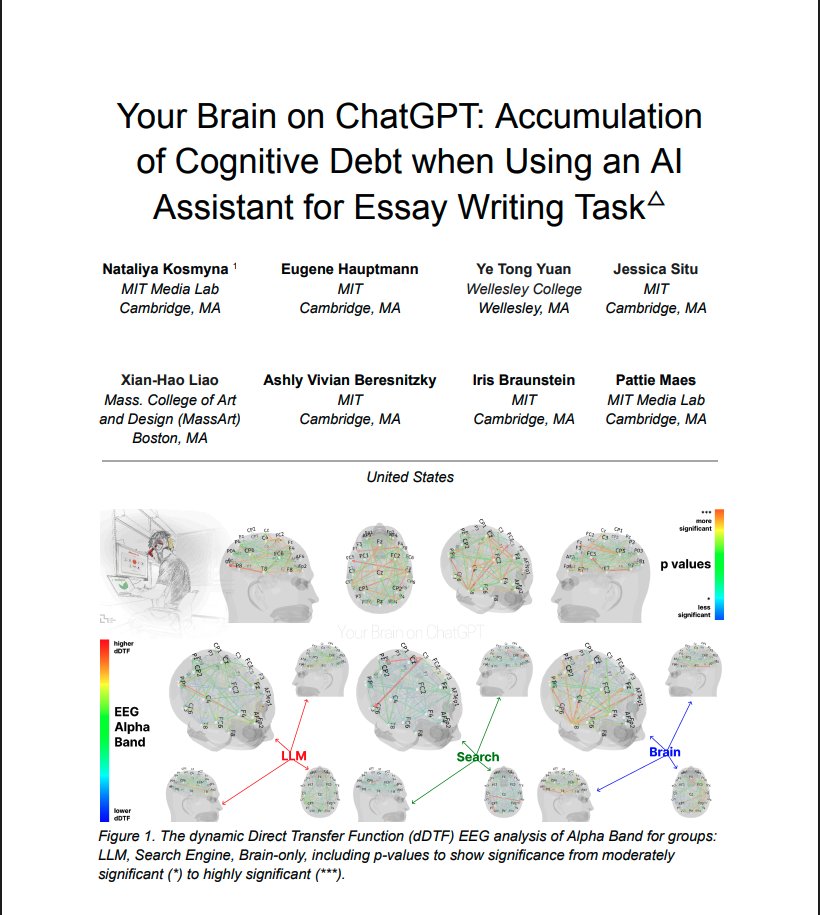
BREAKING: MIT just completed the first brain scan study of ChatGPT users & the results are terrifying.
Turns out, AI isn't making us more productive. It's making us cognitively bankrupt.
Here's what 4 months of data revealed:
(hint: we've been measuring productivity all wrong)
If you're building AI agents, read this twice:
There’s a new invisible OS being written for the autonomous future. It’s built on two emerging protocols:
• Model Context Protocol (MCP)
• Agent-to-Agent Protocol (A2A)
Here’s why they’re a big deal—and why you need to care:
Using AI-assisted coding to build software prototypes is an important way to quickly explore many ideas and invent new things. In this and future posts, I’d like to share with you some best practices for prototyping simple web apps. This post will focus on one idea: being opinionated about the software stack.
The software stack I personally use changes every few weeks. There are many good alternatives to these choices, and if you pick a preferred software stack and become familiar with its components, you’ll be able to develop more quickly. But as an illustration, here’s my current default:
- Python with FastAPI for building web-hosted APIs: I develop primarily in Python, so that’s a natural choice for me. If you’re a JavaScript/TypeScript developer, you’ll likely make a different choice. I’ve found FastAPI really easy to use and scalable for deploying web services (APIs) hosted in Python.
- Uvicorn to run the backend application server (to execute code and serve web pages) for local testing on my laptop.
- If deploying on the cloud, then either Heroku for small apps or AWS Elastic Beanstalk for larger ones (disclosure: I serve on Amazon’s board of directors): There are many services for deploying jobs, including HuggingFace Spaces, Railway, Google’s Firebase, Vercel, and others. Many of these work fine, and becoming familiar with just 1 or 2 will simplify your development process.
- MongoDB for NoSQL database: While traditional SQL databases are amazing feats of engineering that result in highly efficient and reliable data storage, the need to define the database structure (or schema) slows down prototyping. If you really need speed and ease of implementation, then dumping most of your data into a NoSQL (unstructured or semi-structured) database such as MongoDB lets you write code quickly and sort out later exactly what you want to do with the data. This is sometimes called schema-on-write, as opposed to schema-on-read. Mind you, if an application goes to scaled production, there are many use cases where a more structured SQL database is significantly more reliable and scalable.
- OpenAI’s o1 and Anthropic’s Claude 3.5 Sonnet for coding assistance, often by prompting directly (when operating at the conceptual/design level). Also occasionally Cursor (when operating at the code level). I hope never to have to code again without AI assistance! Claude 3.5 Sonnet is widely regarded as one of the best coding models. And o1 is incredible at planning and building more complex software modules, but you do have to learn to prompt it differently.
On top of all this, of course, I use many AI tools to manage agentic workflows, data ingestion, retrieval augmented generation, and so on. https://t.co/zpIxRSuky4 and our wonderful partners offer courses on many of these tools.
My personal software stack continues to evolve regularly. Components enter or fall out of my default stack every few weeks as I learn new ways to do things. So please don’t feel obliged to use the components I do, but perhaps some of them can be a helpful starting point if you are still deciding what to use. Interestingly, I have found most LLMs not very good at recommending a software stack. I suspect their training sets include too much “hype” on specific choices, so I don’t fully trust them to tell me what to use. And if you can be opinionated and give your LLM directions on the software stack you want it to build on, I think you’ll get better results.
A lot of the software stack is still maturing, and I think many of these components will continue to improve. With my stack, I regularly build prototypes in hours that, without AI assistance, would have taken me days or longer. I hope you, too, will have fun building many prototypes!
[Original text: https://t.co/cfQkXolEJk ]
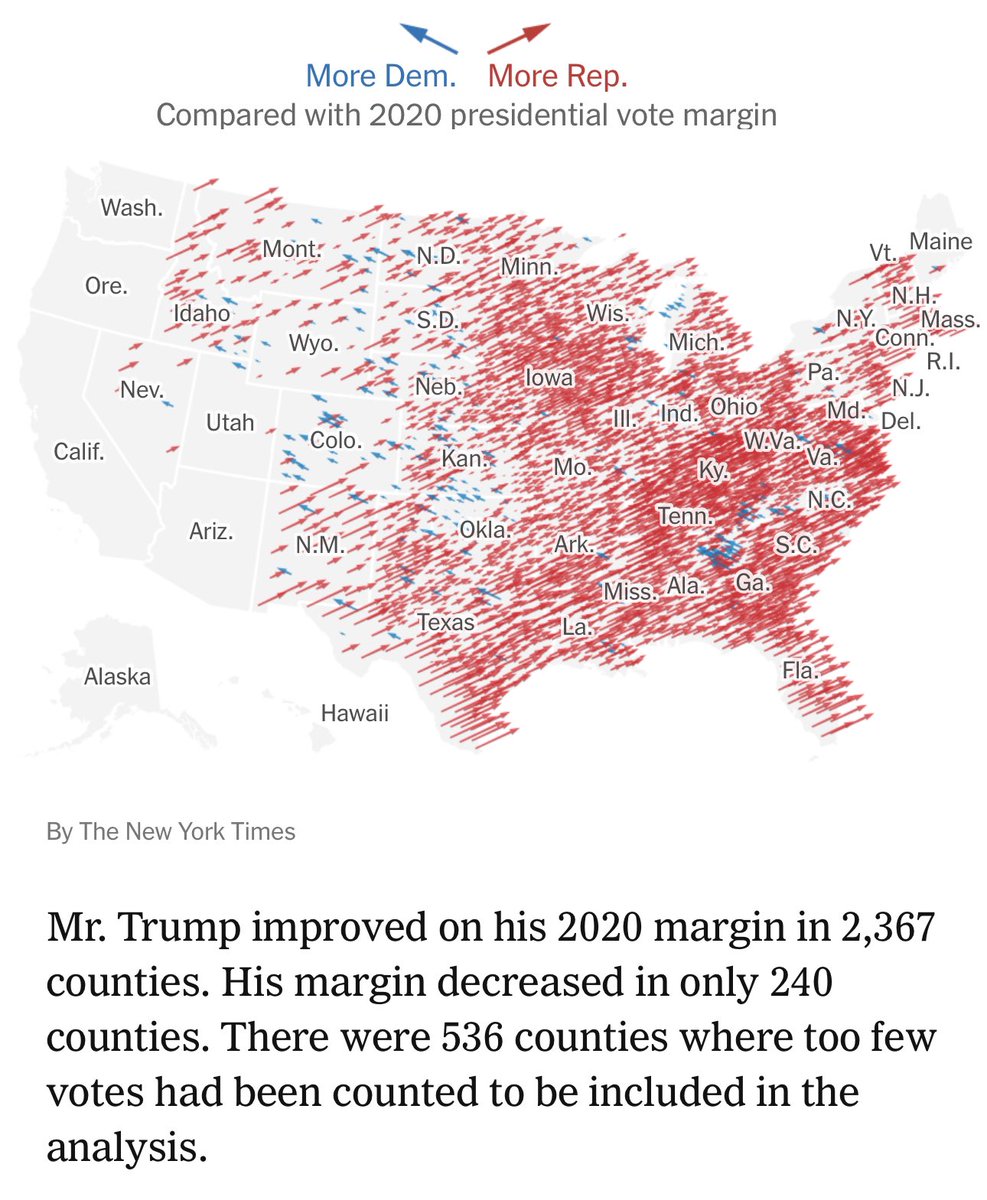
Looking at the county shift from 2020, it seems pretty clear that this election was more broadly a referendum on the current administration/Biden/perceived direction of the country and economy and less about [insert specific demographic group/campaign strategy/candidate quality]
If you are an absentee ballot voter here in Georgia, and you still physically have your ballot, DO NOT mail it. You need to take it to your county elections office before they close on Tuesday. That means you have all day tomorrow and Tuesday, Election Day, to get it in.
Update: More than 300,000 people cast their votes today during the first day of early voting in Georgia, per Gabriel Sterling. The number is 123% higher than the previous record for the first day of voting.
If you own an LLC or Corporation, you must register it with FinCEN as part of the Corporate Transparency Act by the end of 2024.
Penalty for not filing is $500 PER DAY.
Here's everything you need to know: