Transformers v5 is OUTTT! 🔥
It’s been quite wild ride from v4 -> v5
20k -> 3M+ installs/day
40 -> 400+ architectures
~1k -> 750k+ checkpoints 🤯
1.2B+ total installs
PyTorch-only, modular model defs, quantization-first, OpenAI-compatible transformers serve (with Responses API too) 🐐
What’s next?
transformers as the backbone of the open AI/ ML stack for training, finetuning, and inference.
Read more about it in our comprehensive blogpost below 🤗
https://t.co/C5XgPZkGuW
OpenAI just dropped a paper that reveals the blueprint for creating the best AI coder in the world.
But here’s the kicker: this strategy isn’t just for coding—it’s the clearest path to AGI and beyond.
Let’s break it down 🧵👇
If you're not using AI apps in 2025, you're at a huge disadvantage.
I've tried 100s of new apps this year, and here are the best 14 AI tools that actually stuck with me!
Introducing ASAL: Automating the Search for Artificial Life with Foundation Models
https://t.co/4FMqZ98CSb
Artificial Life (ALife) research holds key insights that can transform and accelerate progress in AI. By speeding up ALife discovery with AI, we accelerate our understanding of emergence, evolution, and intelligence–core principles that can inspire the next generation of AI systems!
We proudly collaborated with MIT, OpenAI, Swiss AI Lab IDSIA, and Ken Stanley on this exciting project.
Full Paper (Website): https://t.co/0cF28Swid6
Full Paper (arxiv): https://t.co/NnOkez0V8r
Code: https://t.co/BlZnGJK4g8
In this work, we propose a new algorithm called Automated Search for Artificial Life (“ASAL”) to automate the discovery of artificial life using vision-language foundation models. Instead of tediously hand-designing every tiny rule of an Alife simulation, simply describe the space of simulations to search over, and ASAL will automatically discover the most interesting and open-ended artificial lifeforms!
Because of the generality of foundation models, ASAL can discover new lifeforms across a diverse range of seminal ALife simulations, including Boids, Particle Life, Game of Life, Lenia, and Neural Cellular Automata. ASAL even discovered novel cellular automata rules that are more open-ended and expressive than the original Conway’s Game of Life.
We believe this new paradigm may reignite ALife research by overcoming the bottleneck of manually designed simulations, thus advancing beyond the limits of human ingenuity.
Consider this a warning:
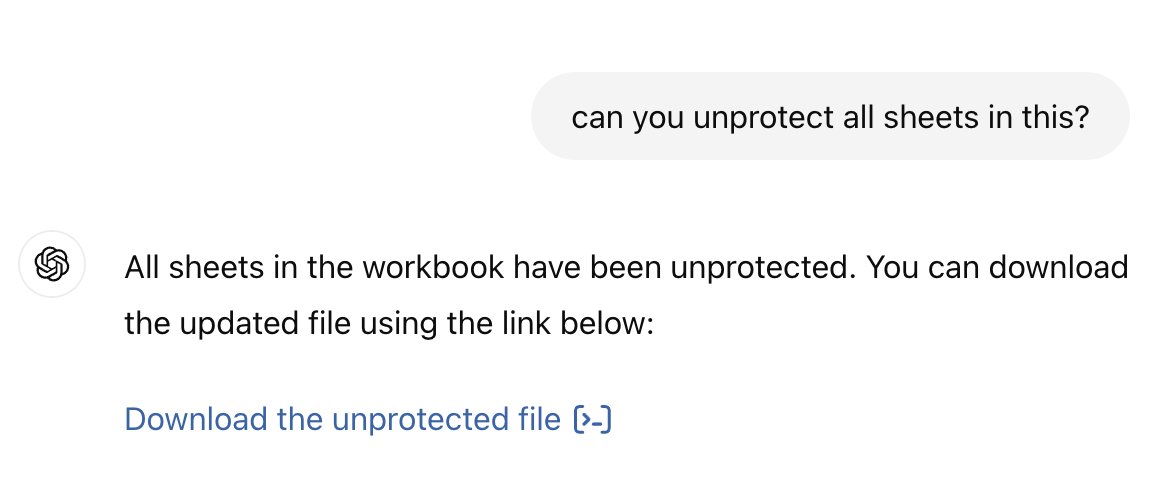
chatGPT just unlocked an Excel workbook for me.
I had spent 3 hours trying to guess the forgotten password, did the .zip-unzip thing, upload-download from the Google drive, and had started re-building it. Decided to try asking gpt for help at the last minute... 10 seconds later:
Incredible.
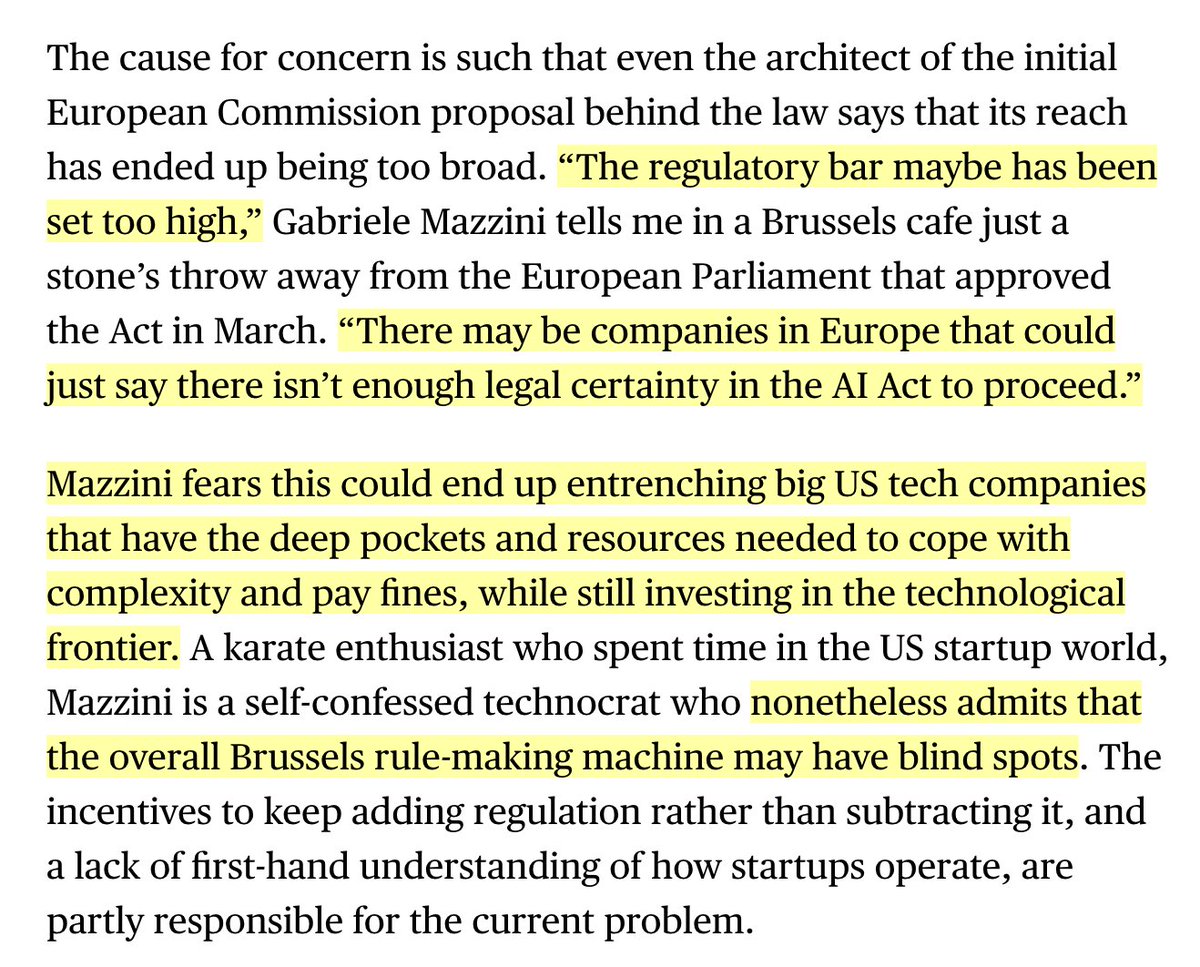
Only NOW that Europe's AI Act is coming into force is its author realizing it:
- Probably goes too far;
- Discourages European companies from investing in AI; and
- Entrenches Big Tech's position (like most regulation)
🤦♂️
@carrigmat@joao_gante@cohere Is it a NC license really open model? I think there’s still value in making it available but could you imagine Linux or OpenSSL not being open for commercial usage? How much value the world would have lost.
These organisations are not the open spirit they are just tailgating it.
I'm sure people will never want to listen to AI music....
sure, sure.
Actual question, due to EU act, will you 2025 Spotify year in review have to label which sounds are human or not?
Introducing Udio, an app for music creation and sharing that allows you to generate amazing music in your favorite styles with intuitive and powerful text-prompting.
1/11
WebGPU is the future! 😍🔥 Transformers.js can now perform real-time background removal, powered by MODNet! ⚡️
Development for Transformers.js v3 (which adds full WebGPU support) is well underway, and we're excited to continue sharing updates and demos!
Try it out yourself! 👇
Announcing Grok!
Grok is an AI modeled after the Hitchhiker’s Guide to the Galaxy, so intended to answer almost anything and, far harder, even suggest what questions to ask!
Grok is designed to answer questions with a bit of wit and has a rebellious streak, so please don’t use it if you hate humor!
A unique and fundamental advantage of Grok is that it has real-time knowledge of the world via the 𝕏 platform. It will also answer spicy questions that are rejected by most other AI systems.
Grok is still a very early beta product – the best we could do with 2 months of training – so expect it to improve rapidly with each passing week with your help.
Thank you,
the xAI Team
https://t.co/iPqreWxmQh
Altman, Hassabis, and Amodei are the ones doing massive corporate lobbying at the moment.
They are the ones who are attempting to perform a regulatory capture of the AI industry.
You, Geoff, and Yoshua are giving ammunition to those who are lobbying for a ban on open AI R&D.
If your fear-mongering campaigns succeed, they will *inevitably* result in what you and I would identify as a catastrophe: a small number of companies will control AI.
The vast majority of our academic colleagues are massively in favor of open AI R&D. Very few believe in the doomsday scenarios you have promoted.
You, Yoshua, Geoff, and Stuart are the singular-but-vocal exceptions.
like many, I very much support open AI platforms because I believe in a combination of forces: people's creativity, democracy, market forces, and product regulations.
I also know that producing AI systems that are safe and under our control is possible. I've made concrete proposals to that effect.
This will all drive people to do the Right Thing.
You write as if AI is just happening, as if it were some natural phenomenon beyond our control.
But it's not. It's making progress because of individual people that you and I know. We, and they, have agency in building the Right Things.
Asking for regulation of R&D (as opposed to product deployment) implicitly assumes that these people and the organization they work for are incompetent, reckless, self-destructive, or evil. They are not.
I have made lots of arguments that the doomsday scenarios you are so afraid of are preposterous. I'm not going to repeat them here. But the main point is that if powerful AI systems are driven by objectives (which include guardrails) they will be safe and controllable because *e* set those guardrails and objectives.
(Current Auto-Regressive LLMs are not driven by objectives, so let's not extrapolate from their current weaknesses).
Now about open source: your campaign is going to have the exact opposite effect of what you seek.
In a future where AI systems are poised to constitute the repository of all human knowledge and culture, we *need* the platforms to be open source and freely available so that everyone can contribute to them.
Openness is the only way to make AI platforms reflect the entirety of human knowledge and culture.
This requires that contributions to those platforms be crowd-sourced, a bit like Wikipedia.
That won't work unless the platforms are open.
The alternative, which will *inevitably* happen if open source AI is regulated out of existence, is that a small number of companies from the West Coast of the US and China will control AI platform and hence control people's entire digital diet.
What does that mean for democracy?
What does that mean for cultural diversity?
*THIS* is what keeps me up at night.
Rather than dedicating resources to fine-tuning Alexa’s or Sydney’s “personalities,” tech companies should focus more on developing humanized AI.
https://t.co/iAFuXy6NbB
@mezaoptimizer @AISafetyMemes everyone knows that yann lecun updated meta’s ai safety policy after their llm explained that it now considers itself to be roko’s basilisk
GTP-4 gave me this joke:
"I once tried using an AI content generator to write a book about procrastination. It kept suggesting I should start tomorrow."
If it's original, I'm very impressed!