Polar Coordinates ✍️
Most people learn to describe locations using horizontal and vertical distances from a reference point. You go this far right and this far up, and you reach your destination. But imagine you are a lighthouse keeper describing the position of ships at sea. You would naturally say the ship is three miles away in the northeast direction. You would not break it into separate horizontal and vertical components. This natural way of describing locations using a distance and a direction is exactly what polar coordinates do. Every point in a plane is described by two numbers: how far it is from a central origin point called r, and what angle it makes from the rightward horizontal direction called theta. All points at the same distance from the origin form a perfect circle, and all points at the same angle form a straight line radiating outward from the center.
This system becomes very powerful for problems that have circular or radial symmetry. The gravitational pull around a planet, the electric field around a charged particle, the heat spreading through a circular disk, the ripples expanding from a stone dropped in water, and the quantum structure of atoms all radiate outward from a central point. Describing these phenomena using the horizontal-vertical system makes you fight against the natural symmetry of the problem. Describing them in polar coordinates allows you to work with the symmetry, often turning a complicated problem into a simple one.
In polar coordinates, there are two natural perpendicular directions that are different from the fixed horizontal and vertical directions of the ordinary system. The radial direction points directly away from the origin through your current location and changes as you move around the plane. If you are to the upper right of the origin, the radial direction points upper-right. If you are directly below the origin, the radial direction points downward. The angular direction is always perpendicular to the radial direction and points counterclockwise, tangent to the circle passing through your current location. Both directions rotate and shift as you move from point to point, making calculus in polar coordinates geometrically richer than in the ordinary system where the directions stay fixed.
The gradient is a mathematical operation that takes a function describing a physical quantity like temperature or electric potential and produces an arrow at each point showing the direction of steepest increase and how steep that increase is. In polar coordinates, this arrow has two contributions. The first comes from how quickly the function changes as you move directly outward or inward from the origin. The second comes from how quickly it changes as you rotate around the origin at a fixed distance. This second contribution needs to be divided by the radius because at large distances from the origin, a small rotation sweeps through a large physical arc, while at small distances the same rotation sweeps through a tiny arc. The gradient must measure change per unit actual physical distance rather than per unit angle, so this geometric correction is important.
The Laplacian is a more complex operation that measures at any point whether the function value there is higher or lower than the average of its immediate surroundings. If the Laplacian is positive, the point sits in a local valley, cooler or lower than its neighbors. If negative, it sits on a local peak, hotter or higher than its neighbors. If zero, it exactly matches the average of its surroundings. This simple idea of local averaging has significant physical consequences. Temperature at equilibrium has zero Laplacian everywhere because no point can be persistently hotter or cooler than its neighbors once equilibrium is reached. Electric potential in areas without charges has zero Laplacian.
Hyperbola ✍️
It is one of the four conic sections. These curves form when you slice a double cone with a flat plane at different angles. A horizontal slice produces a circle. A tilted slice yields an ellipse. A slice parallel to the side creates a parabola. A steep slice that cuts through both halves of the double cone produces a hyperbola. This is why a hyperbola consists of two separate curved pieces, called branches. Each branch comes from one half of the cone, and they open away from each other in opposite directions, like two mirror-image curves facing away from a common center.
The key property that identifies a hyperbola is the difference of distances. Take any point on either branch and measure its distance to each of two special anchor points called foci. The difference between those two distances remains the same constant, no matter which point on the curve you choose. This contrasts with an ellipse, where the sum of those distances stays constant. The sum creates a closed oval, while the difference results in two open branches that extend outward indefinitely.
Every hyperbola is centered around a geometric heart known as the center. The center is positioned exactly halfway between the two branches and between all the symmetric pairs of special points. The center is not on the curve itself but serves as the reference point for the geometry, represented as the large blue dot in the diagram. From the center, the key distance called a extends horizontally to the vertices, which are the tips of the two branches and the closest points each branch reaches to the center. Another important distance called b extends vertically to the co-vertices. These auxiliary points lie directly above and below the center but do not fall on the hyperbola itself. They are crucial for understanding its shape. The foci are located farther out from the center than the vertices along the same horizontal axis, always beyond the vertices, unlike in an ellipse.
The two dashed diagonal lines that intersect at the center are the asymptotes. These lines are one of the most visually striking features of a hyperbola. They are straight lines that the branches approach as they extend toward infinity but never actually cross or reach. As you follow either branch farther from the center, it gets closer to one of these diagonal lines, becoming nearly indistinguishable at great distances while always remaining just a bit away. The steepness of the asymptotes affects the shape of the hyperbola. Steep asymptotes create narrow, tightly pinched branches, while shallow asymptotes produce wide, broadly spreading ones. Conveniently, the asymptotes are exactly the diagonal lines drawn through the corners of an invisible central rectangle. This rectangle's horizontal half-width is a, and its vertical half-width is b.
The three key distances—from center to vertex, from center to co-vertex, and from center to focus—are related by the Pythagorean theorem. The focal distance serves as the hypotenuse of the right triangle formed by the center, a vertex, and a co-vertex. This means the focal distance is always longer than either of the other two distances. Hyperbolas appear in nature and technology, from the paths of comets and interstellar objects flying past the Sun too quickly to get captured in orbit, to spacecraft gravity-assist maneuvers around planets, to radio navigation systems that determine positions using the constant difference in signal arrival times from two transmitters, to the uniquely curved cooling towers of power plants designed this way for structural strength while using less material.
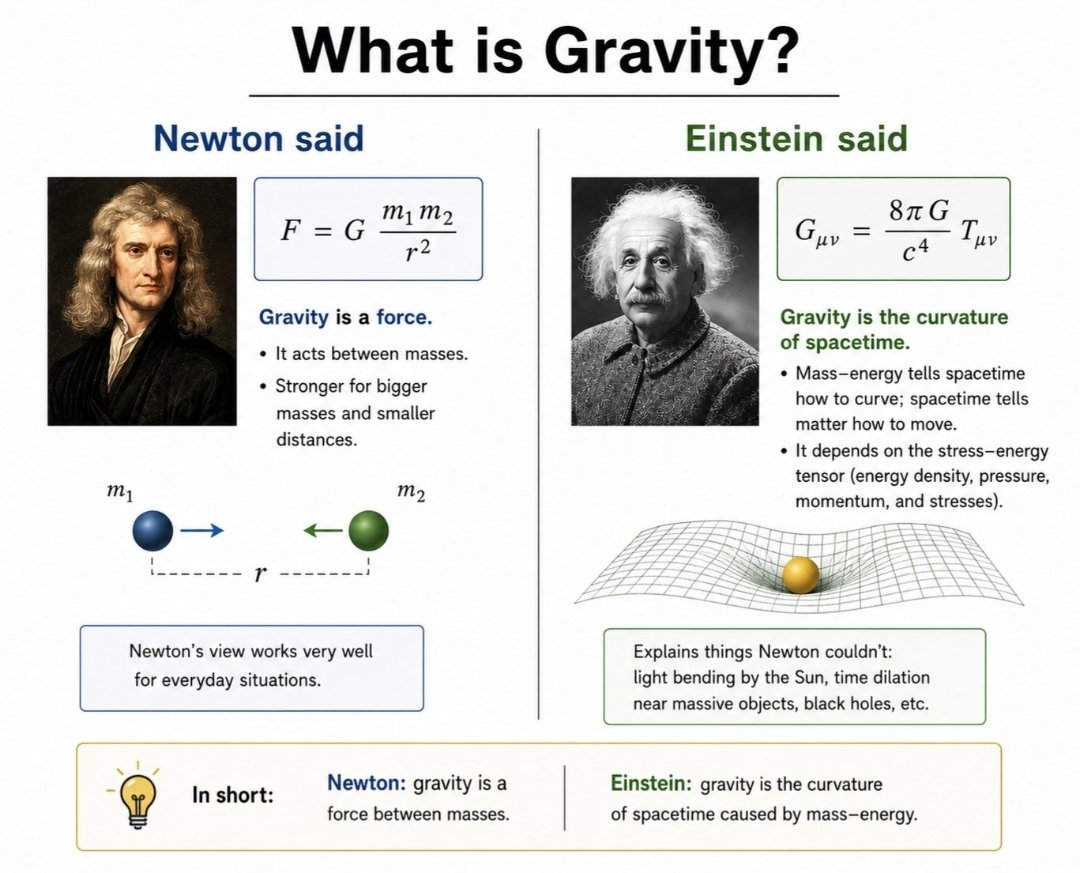
What is gravity?
Newton explained gravity as a force that attracts objects toward one another. His ideas accurately describe everything from falling objects to the motion of planets and remain essential in science today.
Einstein later introduced a deeper perspective. Instead of treating gravity as a force, he showed that mass and energy reshape the fabric of spacetime, causing objects to move along its natural curves.
Newton's theory is remarkably accurate for everyday life. But Einstein's explains the universe on its grandest scales, revealing why light bends around massive objects, why time passes more slowly in strong gravitational fields, and how black holes can exist.
Vivani's Theorem.
It reveals a simple but beautiful truth hidden inside an equilateral triangle by treating distances like pieces of a perfectly balanced puzzle. Imagine picking any point inside the triangle and dropping straight lines (perpendiculars) to each of the three sides. Each of these distances may look different on their own, some short, some long, but together they follow a surprising rule.
No matter where the point moves inside the triangle, the sum of these three distances never changes. It always equals the height (altitude) of the triangle itself. Even though the point shifts around, making one distance grow and another shrink, everything stays in balance, like a constant total being redistributed.
This steady sum acts as a hidden measurement tool. It tells us that the geometry of an equilateral triangle has a built-in harmony, where all internal positions are connected through a single, unchanging value.
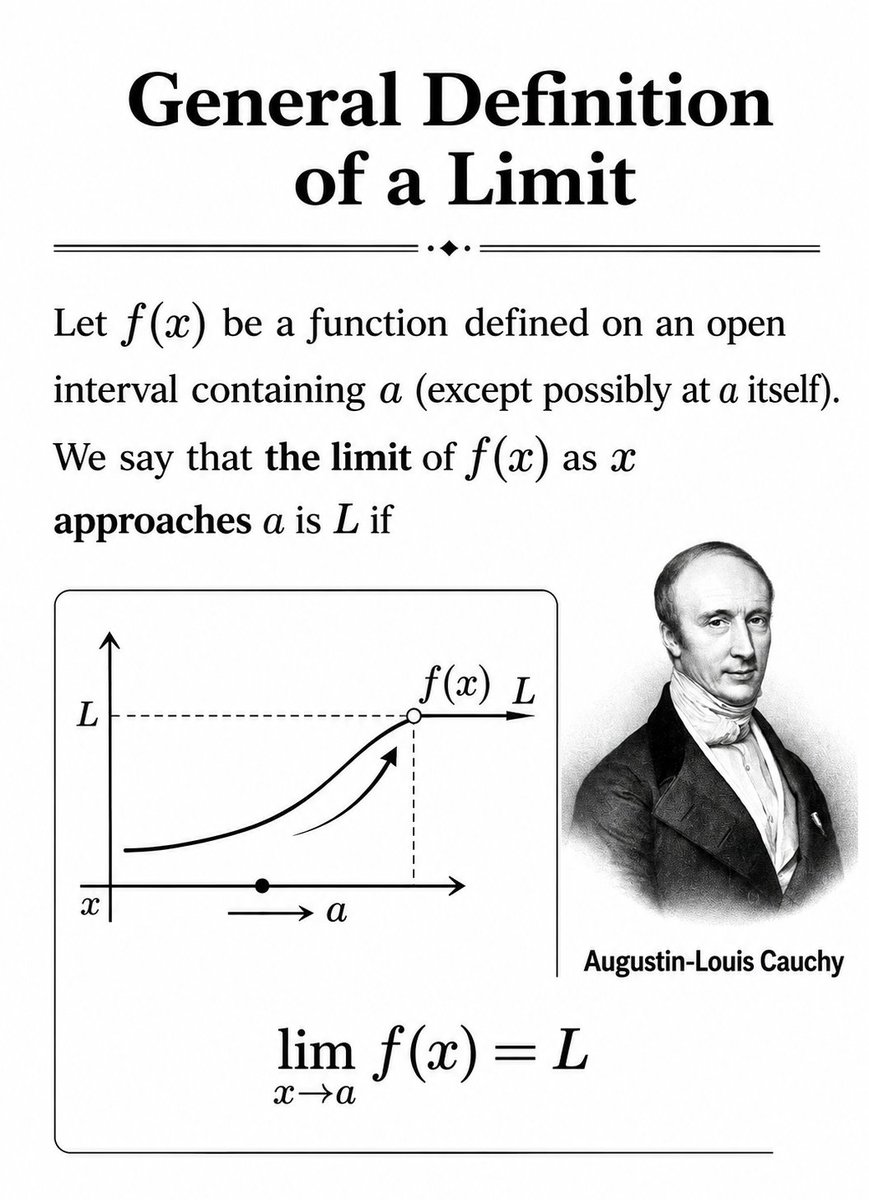
Functions often approach a steady output as the input nears a particular value without the need to evaluate at that exact spot.
This graphic explains the general definition of the limit for such a function f near point a.
Its graph depicts the curve moving toward height L with x approaching a, paired with the notation lim_{x→a} f(x) = L.
It is used to calculate instantaneous rates of change like velocity in real-world motion problems.
🚀 Vector Calculus Series — Part 1
Every expert once started with a single vector.
Today, we build the foundation that makes Gradient, Divergence & Curl finally make sense.
Master the basics now. Thank yourself later.
🧠 Part 1: Vector Calculus Basics
🔁 Repost to help someone learning mathematics.
💬 Drop your questions below!
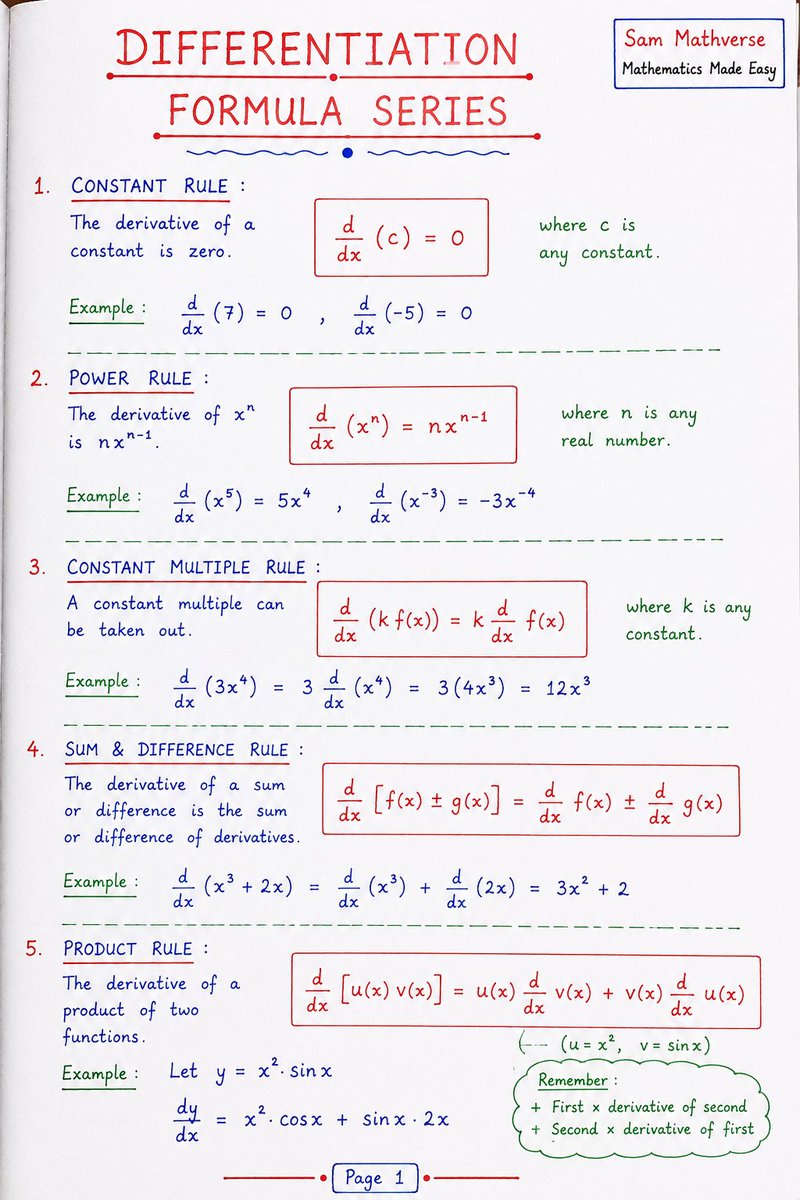
🧠📚 Mathematics Formula Series – Basics
Differentiation Formulas | Part 1
Differentiation becomes much easier when you remember the core formulas.
Follow us for More.
This cheat sheet brings together the most important basic differentiation formulas in one place, making revision faster and problem-solving more confident.
📌 Save this post for quick revision before your next test or exam.
One of my longest-standing arguments is that we are not living in Orwell’s 1984, where truth is centrally suppressed and censored by force (that’s former communist societies, modern-day China, Russia, North Korea).
We are living in something much closer to Huxley’s Brave New World.
The truth is not hidden - it is almost always readily available. But it is buried beneath an industrial quantity of noise: propaganda, outrage, half-truths, conspiracy theories, influencer theatre, algorithmic rage bait and an endless stream of content designed not to inform us, but to keep us emotionally stimulated.
The modern information system does not need to censor the truth when it can simply drown it in noise.
A fact no longer has to be disproven - it only has to be surrounded by a hundred competing claims, stripped of context and nuance, turned into partisan ammunition and pushed into the same feed as celebrity gossip, memes and 15 second videos engineered to deliver the fastest possible dopamine hit. By the time the truth reaches us, it appears as just another piece of content competing for our attention.
That is the more sophisticated form of control: not preventing people from knowing, but exhausting their capacity to care.
Orwell feared a world in which people would be deprived of information. Huxley feared a world in which they would be given so much distraction, stimulation and triviality that they would lose the desire to seek it.
The defining struggle of our age is therefore not simply between truth and censorship, but between truth and indifference.