🚨US MARGIN DEBT HAS ALMOST NEVER BEEN RISING FASTER:
Since Q4 2023, US margin debt has skyrocketed +136%, the largest expansion on record, excluding February and March 2000, just before the Dot-Com Bubble burst.
This surge began after Powell's dovish pivot fueled expectations of Fed rate cuts and unleashed a powerful wave of risk-taking.
In effect, margin debt as a % of US nominal GDP has surged to an all-time high, surpassing even the 2000 and 2021 frenzy peaks.
In June alone, US margin debt spiked +$86.5 billion, to a record $1.5 trillion, up +49% YoY and more than doubling since the start of 2024.
Historically, this kind of borrowing surge, where leverage grows far faster than the market itself, has preceded major market tops rather than followed them.
What happens when this massive leverage begins to unwind?
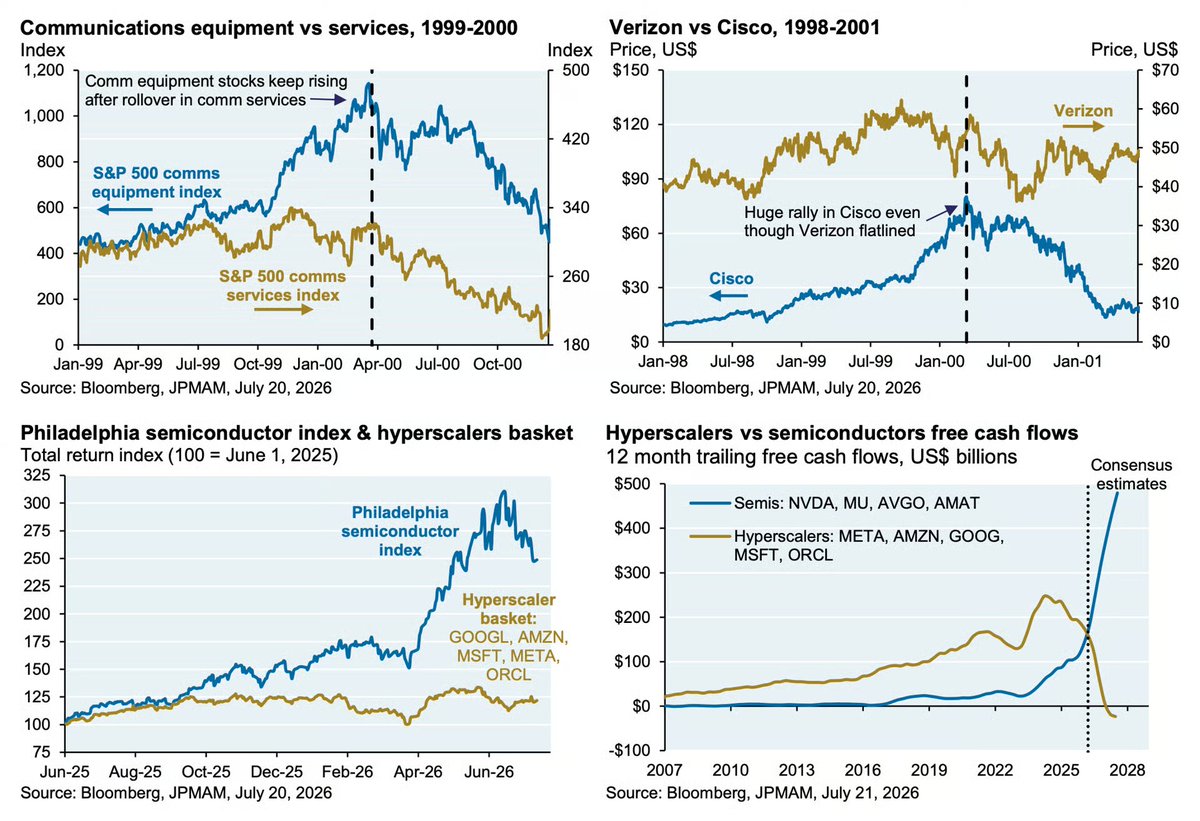
"The worrisome part of a boom cycle is when companies closest to final demand roll over, even as capital spending beneficiaries of the cycle keep on thriving"
-JPM Cembalest
Diamond Top (Bearish Reversal) in the Nasdaq 100 $QQQ will CONFIRM tomorrow with a close below 693 and higher than normal volume 🚨🚨 After confirmation, Diamond Tops have an 80% success rate ✅ Stay safe friends 🫂
$SPX weekly MACD is about to cross bearish.
These don't always matter, but when they have, they've really mattered. Two bear markets and two corrections started with this signal.
Worth being aware of.
⚠️ Hedge funds are RUSHING OUT OF US TECH AT A FURIOUS PACE:
Hedge fund net exposure to the US information technology sector has dropped nearly -10 percentage points as a % of total US exposure, to ~15.5%, the lowest since the start of the year.
It has given back nearly all of this year's gains and is now near the lowest level in 3.5 years.
This is an even larger decline than during the 2022 bear market.
In other words, hedge funds are cutting directional technology stock bets at the largest pace on record.
Will hedge funds dumping tech stocks lead to a bear market in the US?
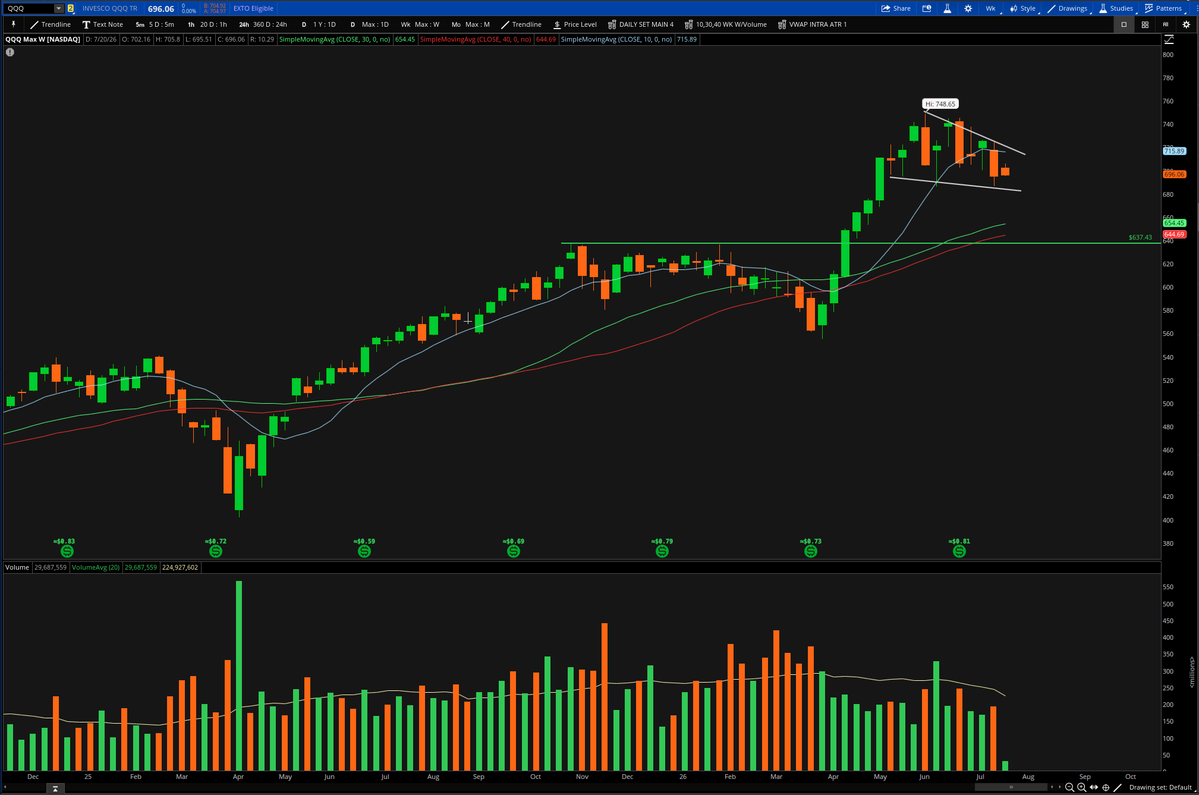
$QQQ Daily/Weekly
A lot of doom and gloom out there, but the reality is Tech is doing nothing wrong.
Choppy price action always makes market participants extremely emotional. The pendulum swings from extremely bearish to bullish constantly when the market is just trading in a range.
Off the bottom in March, QQQ made a 34% move. It's normal and healthy to spend a few weeks basing out and building a new range.
⚠️Hidden debt at US Big Tech is EXPLODING:
Off-balance-sheet obligations across Microsoft, Alphabet, Amazon, Meta, and Oracle have surged +700% in just 4 years, to a record ~$1.65 trillion.
These commitments represent future spending obligations, including AI infrastructure, data center capacity, equipment, and long-term leases, disclosed in company filings rather than reflected as traditional debt on the balance sheet.
This already exceeds the ~$1.35 trillion these same 5 companies carry in actual on-balance-sheet debt, making their true financial commitments are FAR larger than what standard debt metrics show.
Meta's hidden debt alone stands at ~$420 billion, nearly 3 times its recorded debt, while Oracle's has surged more than +2,900% in 4 years to ~$273.3 billion, largely tied to its Stargate data center project with OpenAI.
Tech giants are also pushing higher on traditional corporate bond and equity issuance, as AI-related capital spending begins to outpace earnings growth, adding visible leverage on top of these future commitments.
This practice, sometimes called "shadow borrowing," carries a warning that it raises the risk of AI anxiety spreading through markets if data center demand fails to materialize.
Much of this hidden debt will eventually become real spending, and the question is whether AI revenues grow fast enough to justify the trillions being committed today.
The massive AI debt bomb is ticking under the surface.
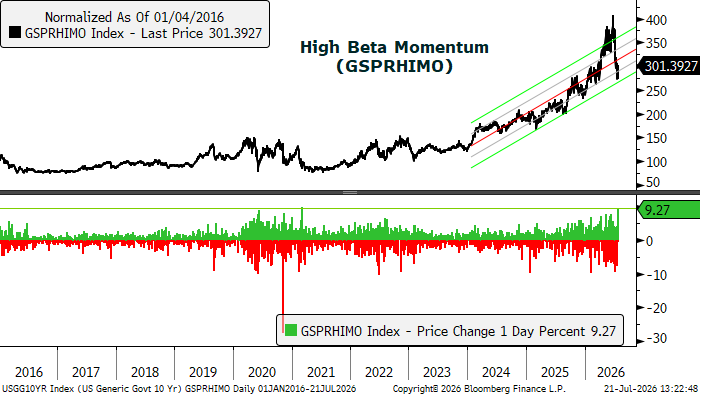
Momentum coming back to life:
"The GS High Beta Momentum Pair (GSPRHIMO) is up 9.3%, marking its strongest one day rally in the last five years following a 33% drawdown in the factor. Our sector specific TMT Unconstrained Momentum Pair (GSTMTMOM) is also posting its best day on record (+11.5%) and the GS Broad AI Pair (GSPUARTI) is up 7.3%, its best day since the launch of ChatGPT." - GS
🚨US tech stocks are EXTREMELY VOLATILE:
The spread of the Nasdaq 100 volatility index, $VXN, over the S&P 500 volatility index, $VIX, is up to 13 points, the highest since the Dot-Com Bubble burst.
This metric has more than TRIPLED since February.
In other words, tech stocks are carrying way more risk than the rest of the market, even more than during the 2020 crash.
The only period with a wider premium was the aftermath of the 2000 Dot-Com Bubble, when this spread briefly spiked above 30 following the bust.
Tech stocks have rarely been this volatile.
This is an extremely risky market and many simply are ignoring this.
⚠️Oracle's credit risk has never been higher:
Oracle's 5-year credit default swaps rose ~10bps to 198.23bps on Friday, the highest closing level on record, surpassing the previous peak of ~197.8bps reached during the 2008 FINANCIAL CRISIS:
This also exceeded the prior 2026 high of 198.18bps set on March 27th.
The move comes after S&P Global downgraded Oracle to BBB-, just one notch above junk status, citing repeated underestimates of the amount of cash needed to fund its AI investments.
Oracle's free cash flow has turned negative as the company ramps up its massive data center buildout.
$ORCL also has ~$117 billion of bonds included in Bloomberg's US high-grade corporate bond index, making it the largest non-bank issuer in the benchmark.
This comes as tech stocks broadly sold off on Friday after a new Chinese AI model reignited concerns that US AI leaders could lose their edge.
Oracle's AI gamble is becoming one of the biggest tests of the AI boom.
Buy the dip...on steroids.
Investors increased margin debt borrowing last month despite a drop in stocks.
This is historically unusual and shows very high confidence, which has typically not worked out all that well.
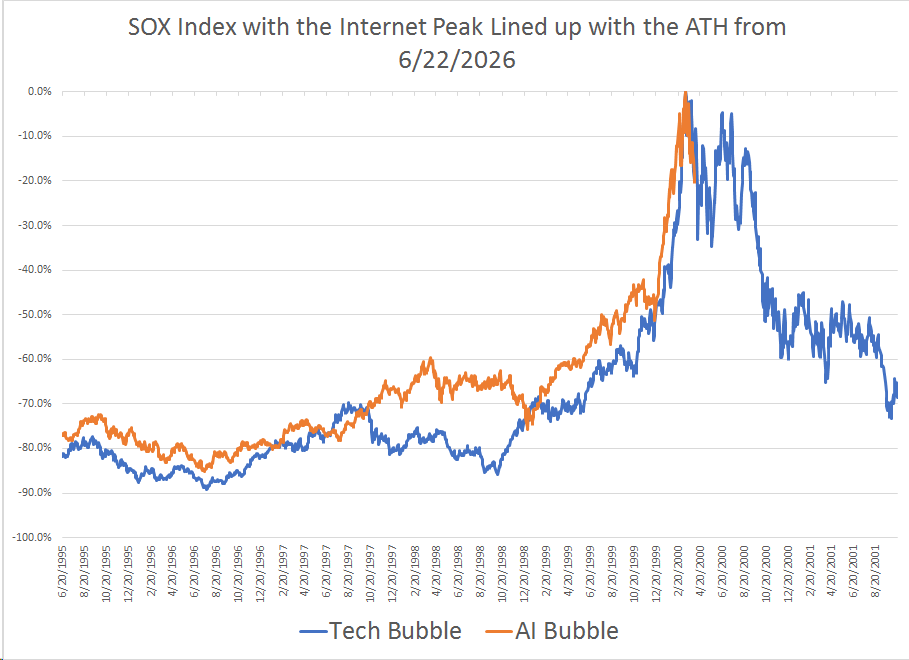
As mentioned 6 weeks ago we are in a bubble. If it popped. Don't know and probably not. But if it popped heres how the Internet bubble played out. Choppy for a few months. Don't hate. No chart crime just lining up the top and the potential top on a single y axis. This is a bubble whether the top or not. https://t.co/0ZfbHMkuRo
⚠️HYPERSCALER CASH FLOW IS COLLAPSING:
Combined free cash flow for Nvidia, Micron, Broadcom, and Applied Materials is projected to hit a record ~$430 billion over the next 12 months, more than TRIPLE what they generated just 2 years ago.
At the same time, combined free cash flow for the hyperscalers is projected to turn negative for the first time on record, a stunning reversal from the +$260 billion peak these companies posted in 2024.
This comes as these same companies are projected to spend ~$725 billion on AI capex this year alone, with Wall Street expecting that figure to climb toward ~$900 billion in 2027.
However, the market is NOT rewarding the cash-rich side of the trade either.
Chip stocks have been hit hard, with the semiconductor index $SOX down -20% and back in bear market territory, while SanDisk and Micron have fallen even more than several hyperscalers.
Even strong earnings beats from TSMC and ASML failed to stop the selloff in chip stocks last week.
Tellingly, Apple, the only Magnificent Seven stock that has avoided massive AI capex spending, is up +23% this year, by far the group's strongest performer.
With Alphabet and Tesla reporting Big Tech earnings this week, followed by Microsoft, Meta, Apple, and Amazon next week, investors are no longer willing to take AI spending on faith. They want to see real revenue growth.
If the numbers fail to deliver, the biggest AI spenders could become the biggest drivers of the next selloff.
Bearish bets on US stocks are surging:
Short interest in the S&P 500 is up to ~3.7% of its free float, near the highest in data going back to 2010.
Short interest in the Russell 3000 is up to ~6.1%, also near an all-time high.
Both metrics have steadily increased since the start of 2025.
Furthermore, short interest across all NYSE-listed stocks rose to a record 9.0% of shares outstanding in late June.
By comparison, this metric peaked at ~5.0% during the 2008 Financial Crisis and ~6.0% during the 2020 pandemic.
Conditions for a short-squeeze are rising.
🔴MOMENTUM STOCKS ARE UNRAVELING AT THEIR FASTEST PACE SINCE THE GREAT FINANCIAL CRISIS:
Goldman's US High Beta Momentum basket is on track to fall -23% this month, its worst monthly decline in 17 years, when it fell as much as -34% in its steepest month.
This basket tracks volatile, high-beta momentum names, with stocks like Nvidia, $NVDA, Super Micro Computer, $SMCI, Palantir, $PLTR, D-Wave Quantum, $QBTS, and Navitas Semiconductor, $NVTS, among the names contributing most to its moves.
These stocks are also among the most favorite of retail investors.
This comes as investors increasingly question whether AI hyperscalers are overbuilding their capacity.
The most speculative corner of the AI trade is unwinding at a furious pace.