Interested in water quality? Here is our open-access review of waterborne contaminants in high intensity agriculture and plant production, which highlights the importance of catchment position and connectivity.
https://t.co/z9EifBjZqU
@NaturePortfolio The findings, reported in a paper in @CommsEarth, could explain why these pyramids are concentrated in what is now a narrow, inhospitable desert strip.
Read the open access article here: https://t.co/UuwXKfXRg2
@UNCWilmington@NRIAG @UNCW_EOS @timjralph
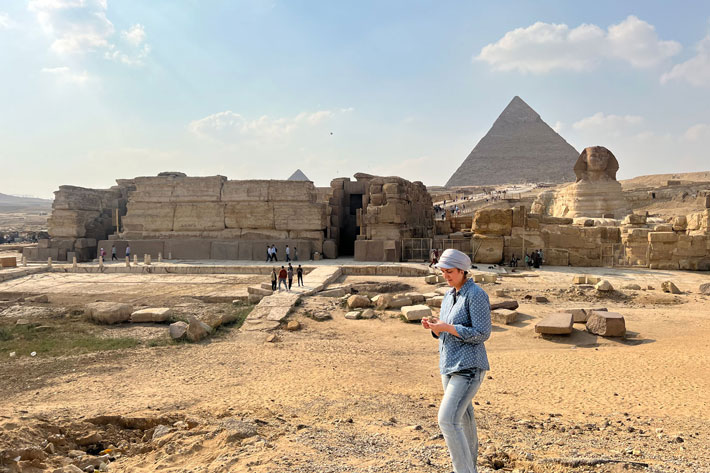
31 pyramids in Egypt, including the Giza pyramid complex, may originally have been built along a 64-km-long branch of the river Nile which has long since been buried beneath farmland and desert.
@NaturePortfolio
Geological surveys have revealed a long-lost branch of the river Nile that ran close to many Egyptian pyramids. The ancient waterway was probably used to transport building materials before it dried up thousands of years ago. https://t.co/zcug1UASlH
Did the Nile transport pyramid builders? 🏺🌊 New research uncovers a buried tributary that once flowed past 31 pyramids, including Giza! Learn how this ancient "superhighway" shaped Egypt's history. #AncientEgypt#Archaeology#Pyramids https://t.co/vjNMem05Qp
Researchers have discovered evidence of an ancient "mega waterway" linking over 30 Egyptian pyramids to the river Nile, which may have been used to transport the enormous slabs of stone that fed the construction of the ancient tombs. https://t.co/8K2mgbtPzT
Many of Egypt's pyramids are built on inhospitable, arid land, far from the Nile River. So how did ancient Egyptians get heavy stone there?
Chen Ly says geoscientists may have uncovered an ancient, dried up branch of the Nile nearby.
🎧 https://t.co/BpwUttS6BI
🏜️The pyramids of the Western desert in #Egypt were built alongside a now extinct branch of the Nile River named as the Ahramat Branch and identified using a combination of radar satellite imagery, geophysical data and deep soil coring.
🔗https://t.co/sL3uRtYn0q
Researchers have found evidence of a 40-mile-long branch of the Nile River, known tje Ahramat Branch, that flowed some 4,700 years ago along the western banks of the modern Nile by the pyramids at Abusir, Saqqara, Dahshur, Lisht, and Giza.
https://t.co/SCof6TJ0vB
Terrific research by Tim Ralph @timjralph, Suzanne Onstine (U Memphis) & Eman Gohneim (U NCW) + team, mapping a 64km lost branch of the Nile that supported the #pyramid fields of the #Egyptian state
#egypt#archaeology
https://t.co/ydPCvRQZQN via @ConversationEDU