Foucault, Derrida, Deleuze. Trois intellectuels qui, dans les années 60, pondent des livres illisibles au fond d'amphis parisiens. Aucun n'a jamais tenu une arme. Aucun n'a jamais entendu parler de Southampton.
Et pourtant, soixante ans plus tard, c'est leur idée qui tient la main qui menotte Henry Nowak, 18 ans, pendant qu'il se vide de son sang.
Comment passe-t-on de l'un à l'autre? Il n'y a pas de hasard. Il y a une ligne droite. Je vais vous la dérouler, maillon par maillon.
Premier maillon. Ces philosophes lâchent une idée d'apparence inoffensive: la vérité ne serait jamais neutre, ce serait toujours une construction du pouvoir. Donc on pourrait, et on devrait, se méfier des faits eux-mêmes. Ils n'ont pas voulu ce qui allait suivre. Mais ils ont armé un mécanisme: le soupçon généralisé envers le réel.
Deuxième maillon. Cette idée traverse l'Atlantique et mute dans les universités américaines. Elle rencontre une impulsion noble, la repentance, reconnaître des injustices historiques réelles. Et elle la transforme en tout autre chose: une hiérarchie morale permanente. Des groupes classés selon leur degré supposé de victimité. Oppresseurs d'un côté, opprimés de l'autre. Pour toujours.
Troisième maillon, et c'est là que tout bascule. Une fois qu'on classe les gens par groupe, on cesse de les juger par leurs actes. On les juge par leur catégorie. La crédibilité n'est plus méritée, elle est assignée d'avance.
Quatrième maillon. Black Lives Matter en fut l'apogée liturgique. « I can't breathe » devient une formule sacrée. La règle implicite: croire d'office la victime désignée, soupçonner d'office l'oppresseur désigné. Avant les faits. À la place des faits.
Comprenez bien ce qu'on installe là. Pas une opinion. Un réflexe. Un automatisme cognitif gravé dans des institutions entières: l'accusation venue de la « bonne » catégorie l'emporte sur ce que vous voyez de vos propres yeux.
Et un réflexe, on sait ce que ça fait à des hommes ordinaires.
Je me suis longtemps passionné pour la psychologie, et une période m'obsède: l'après-guerre. Le moment où des chercheurs se sont posé la question la plus dérangeante du siècle. Comment l'Allemagne nazie avait-elle transformé des pères de famille ordinaires en bourreaux de camp?
La réponse, ils ne l'ont pas trouvée chez des monstres. Ils l'ont trouvée chez des hommes parfaitement banals.
Hannah Arendt a appelé ça la banalité du mal. L'historien Christopher Browning, en étudiant le bataillon de réserve 101 (des policiers d'âge mûr, des pères, des commerçants), a montré que ce ne sont pas des fanatiques qui ont fusillé des civils, mais des hommes normaux incapables de désobéir au cadre dominant.
Puis vint Milgram. À Yale, environ deux tiers de gens ordinaires ont infligé ce qu'ils croyaient être des décharges mortelles, simplement parce qu'une autorité le leur ordonnait. L'expérience de la prison de Stanford a montré la même chose sous un autre angle: donnez à quelqu'un un rôle et un cadre, et il s'y conformera jusqu'à l'inhumain.
La leçon n'est pas allemande. Elle est humaine. Le mécanisme s'active dès qu'un cadre moral dominant fait craindre la sanction sociale plus que ne compte le témoignage de ses propres yeux. L'individu cesse de voir ce qu'il voit. Il voit ce que le cadre l'autorise à voir.
Maintenant, rejouez la scène de Southampton au ralenti.
Henry Nowak, 18 ans, poignardé, allongé au sol, répète aux policiers « j'ai été poignardé », « je ne peux plus respirer ».
Réponse de l'officier: « I don't think you have, mate. »
Pendant ce temps, son meurtrier retourne la situation d'une phrase: il aurait été victime d'une agression raciste, on lui aurait arraché son turban. L'officier n'a pas vu Henry. Il a vu deux catégories. D'un côté, un homme qui dégaine le script de l'agression raciste, crédible par défaut. De l'autre, un jeune homme blanc à terre, sans grief à brandir, sans formule sacrée à réciter, suspect par défaut.
Le cadre a choisi à sa place. Il n'a même pas eu à réfléchir. C'est ça, le conditionnement: la pensée a déjà eu lieu, avant lui. Exactement le mécanisme de Milgram, de Browning. Un homme normal qui cesse de croire ses propres yeux parce qu'un cadre moral lui a appris ce qu'il devait craindre.
René Girard avait tout décrit. Le coupable détourne sa faute en désignant un bouc émissaire, et le système l'accepte d'autant plus volontiers qu'il colle au rôle attendu. Henry n'a pas été cru parce qu'il ne pouvait pas jouer la victime. Sa catégorie le lui interdisait.
Souvenez-vous. Le monde entier s'est agenouillé pour quatre mots, « I can't breathe ». Des entreprises, des gouvernements, des stades entiers. Henry a prononcé exactement les mêmes mots, en train de mourir. Il n'y aura ni genou à terre, ni hashtag, ni minute de silence. Parce que sa mort ne sert pas le cadre. Elle le contredit.
Voilà l'inversion finale, et la plus monstrueuse. Une idéologie née en promettant de protéger les vulnérables a fini par apprendre à des hommes à ignorer la personne la plus vulnérable de la pièce, celle qui agonise, parce que sa catégorie n'était pas la bonne.
Et le vrai piège, c'est de croire que l'erreur aurait été de choisir le mauvais camp. Non. L'erreur, c'est de choisir des camps. De voir des catégories là où il y a un être humain qui saigne devant soi.
De Foucault à Southampton, voilà la ligne droite. Soixante ans pour qu'une idée abstraite apprenne à un homme à ne plus voir un enfant mourir sous ses yeux.
Henry Nowak n'avait rien demandé. Il demandait juste qu'on le voie.
Personne ne l'a vu.
“We are admitting a cohort that cannot read at a college level and are pretending otherwise.”
Another college professor adds to the chorus of concern about student capacity.
In @chronicle:
“Six weeks into the term, I assigned my rhetoric and writing students a 20-page article. It was the same length I had assigned for five years and the same length I had read without complaint as an undergraduate a decade ago. Not one student finished it.
When I asked why, a student answered honestly: It was too long, and she kept losing track of what the paper was about. This was not a remedial class: These were students who had cleared the admissions process and written essays good enough to get them here. Yet a routine academic reading assignment had defeated them.
Every generation of professors has complained that their students cannot read. The lament is usually overblown, but data have caught up to anecdote, and what I am seeing in my classroom is no longer a hunch. There is a measurable, generational collapse in sustained reading and writing, and the academy is responding to it with improvisation and exhaustion rather than the structural overhaul it requires.
In February 2024, Adam Kotsko, who teaches in the Shimer Great Books School at North Central College, wrote in Slate that students who once handled 30 pages of reading per class meeting now seem “intimidated by anything over 10 pages and seem to walk away from readings of as little as 20 pages with no real understanding.” Crucially, he added that this is “not a matter of laziness on the part of the students” but of underlying skills they were never given a chance to build.
The Chronicle of Higher Education’s 2024 investigation found the same pattern across institutions as different as the Stevens Institute of Technology and Wellesley College, where the average SAT exceeds 1400. Nicholaus Gutierrez, an assistant professor at Wellesley, told The Chronicle that the baseline for what students consider a reasonable amount of work has dropped so noticeably that he has cut his readings accordingly; a 750-word essay now strikes many students as long. At Stevens, the science and technology studies associate professor Theresa MacPhail described following the mantra of “meet your students where they are” for so long that she has begun to feel “like a cruise director organizing games of shuffleboard.”
Worse, the national data tell the same story in colder language. On the 2011 National Assessment of Educational Progress (NAEP) writing assessment, which is the most recent comprehensive writing benchmark, only 24 percent of 12th graders reached the Proficient level, and just 3 percent reached Advanced; another 21 percent scored below Basic. The reading side of the ledger is worse, and getting worse fast: The 2024 NAEP results released in September 2025 show 12th-grade reading scores at the lowest level recorded since the assessment began in 1992. Thirty-two percent of 12th graders now score below NAEP Basic in reading, meaning that, in the assessment’s own language, they likely “cannot draw general conclusions based on concepts presented explicitly in a text.” And yet more than half of these same seniors reported being accepted to a four-year college. That last sentence is the whole problem in one line: We are admitting a cohort that cannot read at a college level and are pretending otherwise.”
I challenge every single person who believes minors should be enabled and even encouraged to transition to read this first person testimony to the end.
1/3
via @IWF https://t.co/3276o4tg8J
We're saving science from ideological capture!
I am thrilled to announce a first-of-its-kind article type called “Peer Review” in the journal Theory and Society.
The journal's editor-in-chief, Kevin McCaffree, and I have been working on this for a while, and it was finally approved by @SpringerNature.
The idea is simple: publication should be the beginning of academic scrutiny, not the end of it.
A Peer Review article can critique a paper from any scholarly journal. It can address problems with methods, evidence, logic, definitions, theory, or interpretation. But it has to focus on the claims and arguments, not personal attacks.
Submissions are capped at 2,500 words and go through a straightforward merit review instead of endless gatekeeping and ideological screening. We ask just one basic question: Is this critique coherent, serious, reasonable, or even popular enough to deserve scholarly attention?
If yes, it gets published.
And the authors of the original paper get a built-in right of reply, so readers can see the critique and the response in a legitimate academic venue.
That’s how science is supposed to work!
Science becomes self-correcting only when real people build the mechanisms that allow correction to happen.
That’s what we’ve done.
Now it’s time for academics to use it.
🔗https://t.co/gqkDE79CO4
This judgment should send shockwaves through NHS and beyond. It is to my knowledge the 1st to decide that allowing trans identifying men into women's workplace facilities is in itself discrimination and harassment against women.
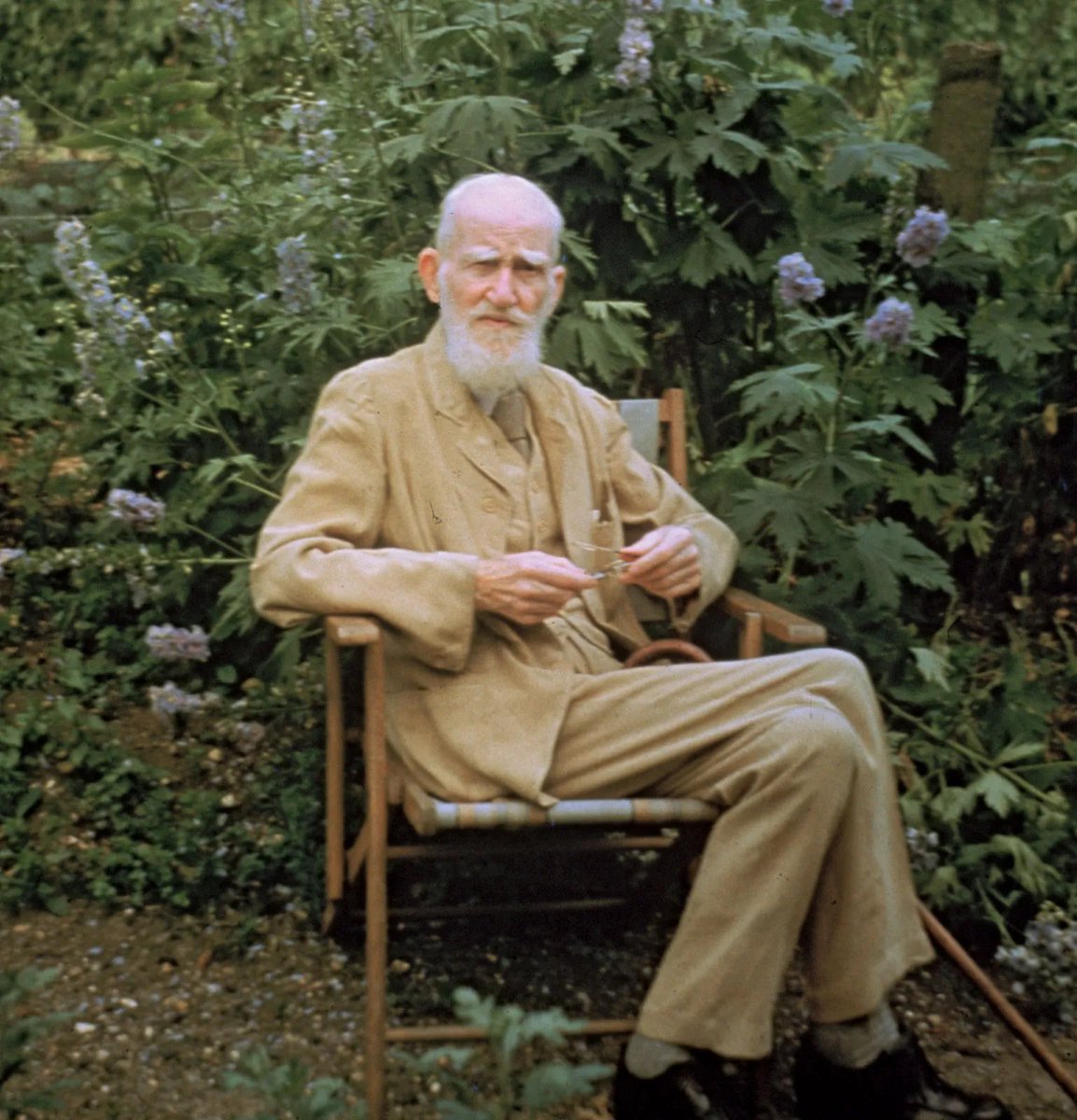
George Bernard Shaw stood in Stalin's USSR in 1931, watching millions starve to death, and declared there was no famine at all. The Nobel Prize-winning playwright didn't just stay silent about the horror unfolding around him. He actively promoted the lie that would help Stalin cover up one of history's greatest atrocities.
Shaw toured Ukraine during the height of the Holodomor, when Soviet grain requisitions had stripped peasants of every scrap of food. Conservative estimates put the death toll at 3.5 million Ukrainians. Shaw saw the empty villages, the skeletal survivors, the mass graves. Then he signed a public letter praising Stalin's "remarkable progress" and told Western journalists that reports of famine were capitalist propaganda.
Why would an intelligent man become Stalin's useful idiot? Shaw believed in central planning with religious fervor. He thought brilliant intellectuals like himself could design society better than millions of individuals making their own choices. When confronted with central planning's inevitable result (mass death), he chose to lie rather than admit his ideology killed people. Shaw preferred beautiful theory to ugly facts.
Shaw deliberately used his celebrity status to give Stalin cover while Ukrainian children died of starvation. He returned to Britain and spent years defending Soviet policies, even as refugee testimonies and photographic evidence exposed the genocide. The man who wrote about moral awakening in "Pygmalion" had abandoned his own moral compass entirely.
Free market economists warned that socialist calculation was impossible, that without prices and property rights, economies would collapse into chaos and death. Shaw dismissed these warnings as bourgeois nonsense while standing ankle-deep in their vindication.
The real systemic racism today isn’t about White people holding Black people down. It’s a self-sustaining system inside Black communities that’s actually run by Black leaders. It works like this: Black neighborhoods get packed into heavily Democratic districts through gerrymandering, creating guaranteed voting blocs. The political machine then needs those votes to stay in power.
To keep getting them, they promote a narrative that racism is everywhere and White people are the real enemy. The more you push this message, the higher you rise in the status hierarchy. In this culture, your status goes up the more loudly you complain about racism, Republicans, and systemic oppression. The loudest victims and professional activists sit at the top. They get book deals, TV appearances, speaking fees, and power. The school teachers, pastors, and influencers who enforce this narrative are next.
They get respect and influence by attacking anyone who steps out of line — especially Black conservatives. Regular Black folks who just want to work, raise their kids, and live normal lives get very little status in this system. Success through personal responsibility actually threatens the narrative, so it’s quietly discouraged. It’s self-bondage. Black people have the freedom to vote differently but rarely do, because their entire social hierarchy is built on staying in the grievance game.
The worse conditions get in their communities, the more it proves the narrative that they need more help and more Democratic policies. It’s a perfect system. The crop — the votes — gets harvested every election because the people running it have convinced everyone the chains are actually protection. And the people enforcing it most aggressively aren’t White racists.
They’re Black leaders who’ve built their entire identity and income around keeping their own people emotionally enslaved to this story.
I need every Black American…
every parent…
every patriot…
and every person still defending Democrat run cities…
…to share and watch this entire video carefully.
Because I’m about to say something the media will NEVER say out loud:
The poor Midwest family with less money…
less government help…
and none of the political theatrics…
…is often producing safer children and better outcomes than cities Democrats have controlled for 60 years.
Let that sink in.
While celebrities scream about race…
while politicians scream about oppression…
while activists scream about “equity”…
…the homicide charts keep filling up.
The overdoses keep climbing.
The schools keep collapsing.
The fathers keep disappearing.
And the neighborhoods keep deteriorating.
At some point…
we have to stop listening to what politicians SAY…
…and start looking at what their policies PRODUCE.
Because what I’m about to show you is not opinion.
It’s measurable reality.
And once you see it…
you cannot unsee it.
#SilentMajoritySpeaks #AStoneGroove
"Identity politics is about the glorification of the self based on the most trivial, irrelevant traits...you are teaching people to think of themselves as special, privileged, and self-sufficient based on a completely phony victim identity."
In this episode of the City Journal podcast, @Rafa_Mangual sits down with @HMDatMI for a frank conversation about affirmative action, diversity mandates, and what happens when institutions prioritize identity over ability.
Full episode: https://t.co/SO9CVBuqcF
Why do so many modern Black Democrats attack Thomas Sowell instead of debating him?
Is it because he is one of the most accomplished economists alive?
Because he dismantles emotional political narratives with data?
Because he focuses on outcomes instead of intentions?
Or because he shattered the idea that Black Americans must think collectively under one political ideology?
Professor Sowell spent decades asking democrats questions many politicians refuse to answer:
• Why do cities run by one party for generations keep declining?
• Why did family structure collapse accelerate under modern welfare expansion?
• Why do policies marketed as “help” often produce dependency and stagnation?
• Why are educational outcomes so poor in many heavily Democrat controlled districts despite enormous spending?
Instead of answering him…
many simply attempt to discredit him personally.
That alone says a lot.
Sowell’s greatest offense to the activist class is not his conservatism.
It is that he teaches people to analyze incentives, consequences, culture, economics, and statistical outcomes instead of reacting emotionally to slogans and Democrat grievance politics.
And once people start thinking that way…
the entire narrative structure begins collapsing.
#SilentMajoritySpeaks #AStoneGroove
It isn’t humiliating at all, it’s to be completely expected: testosterone is very powerful.
It doesn’t mean women are bad or less capable or unskilled. It just means that men & women’s sport is very different, based on biology, and so is played separately.