@OnchainLens Inventory, not a directional bet.
Retail is long → they sell into the flow, collect funding as carry, and lay the residual delta off-venue (spot, other perps, options).
$3.66M UPnL is mark-to-market.
$203M lifetime is the edge.
That’s how a real MM book looks.
Smart Money takes time, and that's how we roll…⏳
@macroinsight has a combination of:
Algorithmic Trading and Technical Analysis
That's why we can have outstanding results like this.
Join for free for 7 days and watch yourself…⏳
+325% SPOT on $MRNA 🎯
It was already a strong year. This week's rumor-driven high multiplied the profits members were already carrying, and gave us the handoff.
That's the exit. Trading with the crowd is always too late.
Don't miss another opportunity, follow @MacroInsight.
@elonmusk won already
This is insane
I used ML stuff and GPTs before it happened to the world but that written below is THE homerun for @grok and @SpaceXAI
Grok 5 is still deep in training on the massive Colossus II cluster.
Roughly 220k high-end NVIDIA GPUs are already online, with more being added.
Power draw is sitting around 1 GW and climbing.
The model is targeting the 6 to 10 trillion parameter range, which puts it in a completely different league from anything currently public.
Training has been running since at least January.
Elon recently confirmed it should arrive before the end of 2026 and will be trained on the full 25-year SpaceX engineering data set.
That combination of extreme scale plus proprietary real-world engineering data is the real story here.
This is not another incremental Grok 4.x update.
It is the much larger architectural and compute jump happening in the background while the smaller releases keep rolling out.
When it lands it should give SpaceX a serious internal edge on engineering, simulation and design problems that current models still struggle with.
Cursor is already running on the same cluster, so the jump in capability should show up there too.
No firm date yet, but the ambition on both compute and data is very real.
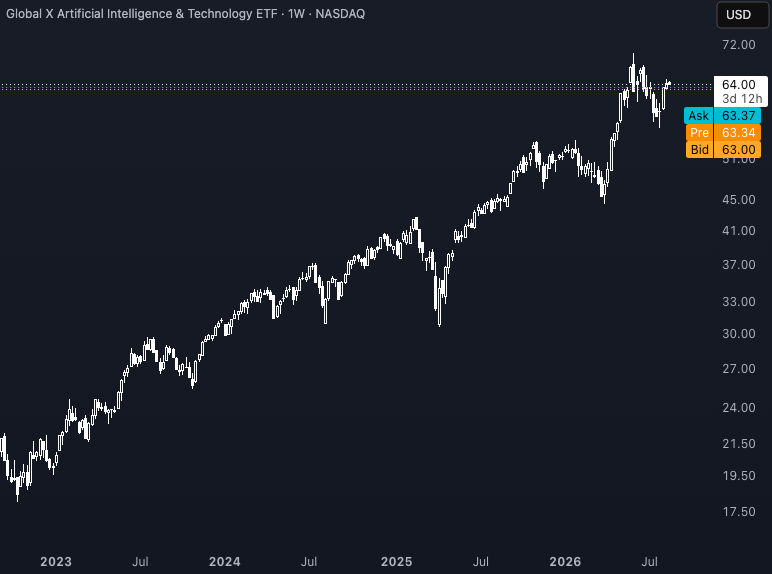
The stock market looks calm, but there’s a real risk building underneath, and almost no one is protecting against it.
Investors have stopped buying “insurance” against a drop, right when they should be buying more of it.
Everyone assumes the good times keep going.
To be clear: the danger isn’t company earnings.
It’s that too many investors have borrowed heavily to bet on the same AI stocks.
If they’re forced to sell at once, prices could fall fast.
And the recent dip?
People didn’t panic-sell, they bought more.
So all that borrowed-money risk is still sitting there.
The bottom line: the bets are still on, but the safety nets are not.
Two economists mathematically proved that AI will destroy the economy.
Researchers from Wharton and Boston University published a terryfiying paper called "The AI Layoff Trap."
They mapped out the economic end-game of the AI transition, and it exposes a fatal flaw in competitive capitalism.
When a company replaces a worker with AI, it captures 100% of the wage savings.
But that displaced worker is also a consumer. When they lose their job, they stop buying things.
The company gets all the savings, but the loss of consumer demand is spread across the entire economy.
If there are 20 competitors in a market, a CEO only absorbs 1/20th of the economic damage their layoffs just created.
So every single rational CEO has a mathematical incentive to automate as fast as possible.
They can literally see the cliff approaching, and they still step on the gas.
It triggers an unavoidable Prisoner’s Dilemma. If you don't automate, your competitors will, and they will crush you on price.
It doesn't just hurt workers. It destroys the businesses, too.
The economy gets trapped in an automation arms race. Companies fire their workforce to stay competitive, until the entire consumer base is completely hollowed out.
At the limit, the paper concludes: “Firms automate their way to boundless productivity and zero demand.”
And the scariest part?
The researchers mathematically tested every popular fix.
Universal Basic Income? Fails. It raises the living standard but doesn't change the corporate incentive to cut jobs. Retraining? Fails. Worker equity? Fails.
The paper proves that more competition actually makes the collapse happen faster. And "better" AI makes the damage worse.
The only thing that mathematically stops the collapse is a targeted automation tax, forcing companies to pay for the purchasing power they destroy before they automate the job.
bitcoin:native 's patient money is signaling a floor, prepare for what might come next.
Adjusted Long Term Holder MVRV asks whether veteran holders are in profit or in pain.
It measures spot price against the cost basis of coins aged six months to ten years, filtering out fresh speculators and lost Satoshi-era supply.
Here's the read.
Above 10 is Extreme Profit and heavy distribution.
At 1 the cohort breaks even, and below it the blue Extreme Underwater bars fire.
To put this into perspective: the peak keeps decaying each cycle, from 48 in 2013 down to 3.5 last cycle, but the blue prints keep firing at EXACTLY 1.
In 2012, 2015, 2018, 2022-2023, and now in 2026.
The read: each window lasts months, marking accumulation zones rather than timing signals.
With price sitting on the cohort's cost basis near 65K, staggered buys beat one bet on the exact low.
Trading doesn’t always mean buying or selling assets.
Sometimes it means getting early on the right side and collecting crazy high APYs while the market pays you to hold.
That's how we do it with Coffee⬇️
…☕️…📈
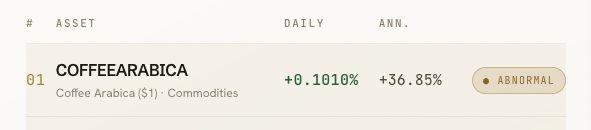
Coffee has been constructively compressing even while being heavily shorted.
Due to this, funding is extremely positive, paying participants who are long 36% APY, which members are collecting daily.
Only at MacroInsight will you find unique, asymmetric bets across all markets.
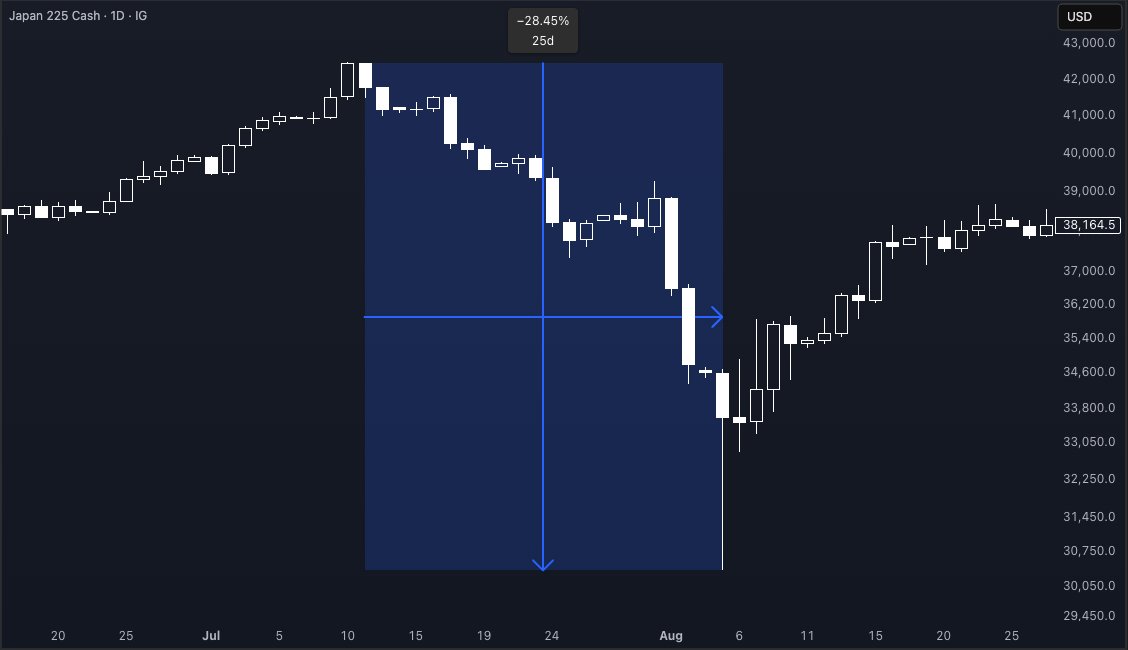
A push into the final target completes the Nikkei trade, MacroInsight members bank another win.
For insights into where we are looking join our newsletter at: https://t.co/4UZXYK1ePv
Free setups, macro outlooks, and commentary on the fast changing landscape.
The hidden risk under the S&P 500 rally is coming into view, prepare for what might come next.
Record-high valuations have left US stocks hypersensitive to liquidity.
A small contraction could now swing the market by roughly 10%.
To put this into perspective: the real risk isn't earnings.
It's the yen carry trade sitting beneath the whole rally.
If that trade unwinds, a modest rise in the yen could drive a sharp drawdown, even with strong tech and NVDA numbers.
This is key: this exact setup played out in 2024, when the unwind took the Nikkei down 28%.