We are excited to share our work on Decoupled Q-Networks (DecQN) next week @ICLR_Conf. DecQN is a simple variation of Q-learning that competitively solves various continuous (visual) control tasks.
Paper: https://t.co/uhdI0gfa4P
Code: https://t.co/TnFizUXeYo
Poster:
Today we release Pipette, a model evaluation suite for on-device intelligence, in partnership with @ArtificialAnlys
Most benchmarking platforms are optimized to measure core capabilities and speed profile of foundation models served in the cloud. Pipette gives the field a common, reproducible way to measure the quality, speed, latency, and memory use of AI models on devices such as phones, laptops, PCs, AI boxes, and embedded hardware.
> Pipette is open source
> In Pipette, models get compated as model + quantization + runtime + device from one interface.
> It comes with a warehouse of verified benchmark results, currently with 10k+ results across 35 model classes, 7 quants, llama.cpp runtimes, and 4 devices.
> Pipette is a dynamic platform, allowing new contributions from day one, adding new devices, runtimes, model families, and quantization levels.
🧵
Today, we release LFM2.5-VL-3B, a lightweight vision-language model that reads screens, documents, and the physical world. It handles digital screens across mobile, web, and desktop, grounds objects to coordinates, reads text and charts, and calls tools from either text or image input.
Built on LFM2.5-2.6B base, with a SigLIP2 400M NaFlex vision encoder
> Pre-trained on ~34T tokens
> Vocab size: 128K
Comparable or better scores compared to models up to 2.6x its size:
> ScreenSpot-v2 80.7, ahead of Gemma-4-E4B at 51.2
> RealWorldQA 73.1, ahead of InternVL-3.5-4B at 67.7
> TextVQA 84.3, ahead of Qwen3.5-4B at 81.2
> RefCOCO-avg 87.9, up from 57.1 on LFM2-VL-3B
> ToolSandbox 59.5, up from 26.4 on LFM2-VL-3B
🧵
Today we release LFM2.5-2.6B, an agentic model that runs entirely on-device. It plans, calls tools, and works through multi-step tasks on phones, laptops, PCs, and robots. Data never leaves the device, and the marginal cost of each run is essentially zero.
> Pre-trained on ~34T tokens
> LFM2.5 flagship hybrid architecture
> Context length: 128K
> Vocab size: 128K
> balanced intelligence per watt
> customizable on a single GPU for any specialized task
> LFM2 open-weight license
Comparable or better scores compared to models up to nearly 4x its size:
> ToolSandbox 77.83, ahead of Qwen3.5-9B at 76.44
> Multi-IF 80.07, ahead of Gemma-4-E4B-it at 77.35
> IFStruct 85.49, ahead of Qwen3.5-9B at 78.50
🧵
Today we release Antidoom, an open-source method that removes a common failure mode in reasoning models: the doom loop.
Doom-loop rates before and after, with eval scores up across the board:
> Early LFM2.5-2.6B checkpoint: 10.2% → 1.4%
> Qwen3.5-4B: 22.9% → 1% (greedy sampling)
🧵
Dumbo's first steps — LFM2.5-230M doing multi-step tool-calling over pre-trained skills provided by @nvidia SONIC. Same small model, many different use cases.
As an early look at ongoing work, we deployed LFM2.5-230M on a Unitree G1, running entirely on-device on its onboard @nvidia Jetson Orin.
The model acts as a skill-selection layer, taking in natural-language instructions and decomposing them into sequences of tool calls.
After a quick fine-tune, "Hold still for 2s, walk forward at 1 m/s for 3 m, hold a one-leg kneel for 5s, walk back at 0.5 m/s for 3 m" becomes a structured multi-step plan automatically.
(3/n)
Introducing LFM2.5-230M: our smallest model yet, built to run fast anywhere (CPUs, NPUs, and GPUs) to enable agentic tasks on phones, robots, home and network automation devices.
> 230M parameters, built on the LFM2 architecture
> Pre-trained on 19T tokens, with a 32K context extension
> Post-trained with distillation from LFM2.5-350M
> 213 tok/s decode speed on Galaxy S25 Ultra (CPU)
> 42 tok/s on a Raspberry Pi 5 (CPU)
> Competes with and often beats models more than twice its size on instruction following, data extraction, and tool use.
> use it for large-scale data extraction pipelines or lightweight on-device agentic workloads.
🧵
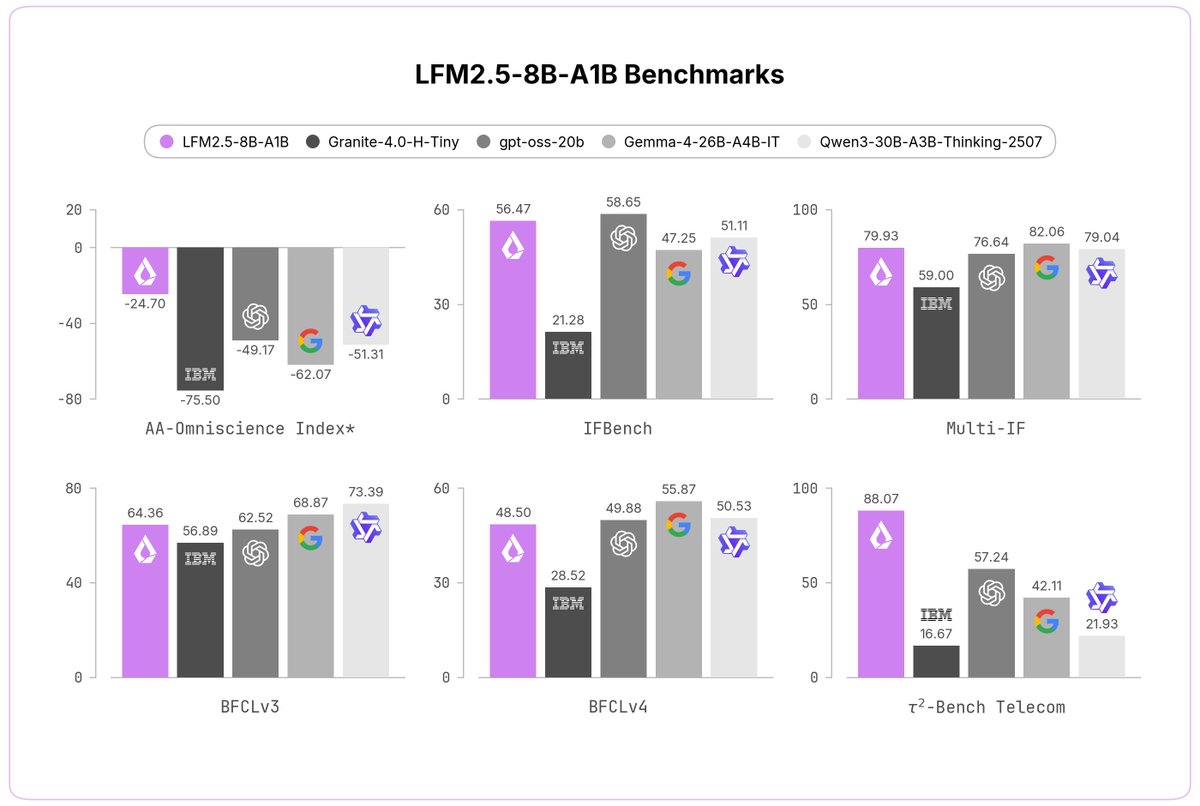
Today, we're releasing LFM2.5-8B-A1B, a device-optimized model designed to power real-life applications on phones, laptops, PCs, robots, and fast & lightweight server-side use-cases.
> 8B MoE, 1.5B active
> Expanded 128K context
> LFM2.5 flagship hybrid MoE architecture
> Trained on 38T tokens + large-scale RL
> fast, reliable tool calling, punching above its weight, comparable to models with up to 4x its size
> customizable on a single GPU for any specialized task
> LFM2 open-weight license
🧵
Today, we release LFM2.5-VL-450M, a vision-language model built for real-time reasoning on edge devices.
It processes a 512×512 image and returns structured outputs in ~240ms on-device.
Three years ago we started working on a stealth project that we weren’t sure we’d ever talk about publicly... until today.
Breakthrough: Introducing LFM-Zero: the first foundation model trained on 0 tokens.
No pretraining. No finetuning. No data. Instead, we initialize from an implicit probabilistic prior over the underlying data-generating process, allowing the model to converge without ever observing data.
LFM-Zero matches or surpasses models trained on 10T+ tokens across reasoning, coding, and multimodal tasks. Turns out that pretraining was just regularization that was holding us back.
> Read our Tech Report here: https://t.co/aIWbx77IEf
Today, we release LFM2.5-350M. Agentic loops at 350M parameters.
A 350M model trained for reliable data extraction and tool use, where models at this scale typically struggle.
<500MB when quantized, built for environments where compute, memory, and latency are constrained.
🧵
@IanOsband Have you considered running this on DMC with (highly) discretized actions? Feels like an interesting setting - I’d be curious how it performs.
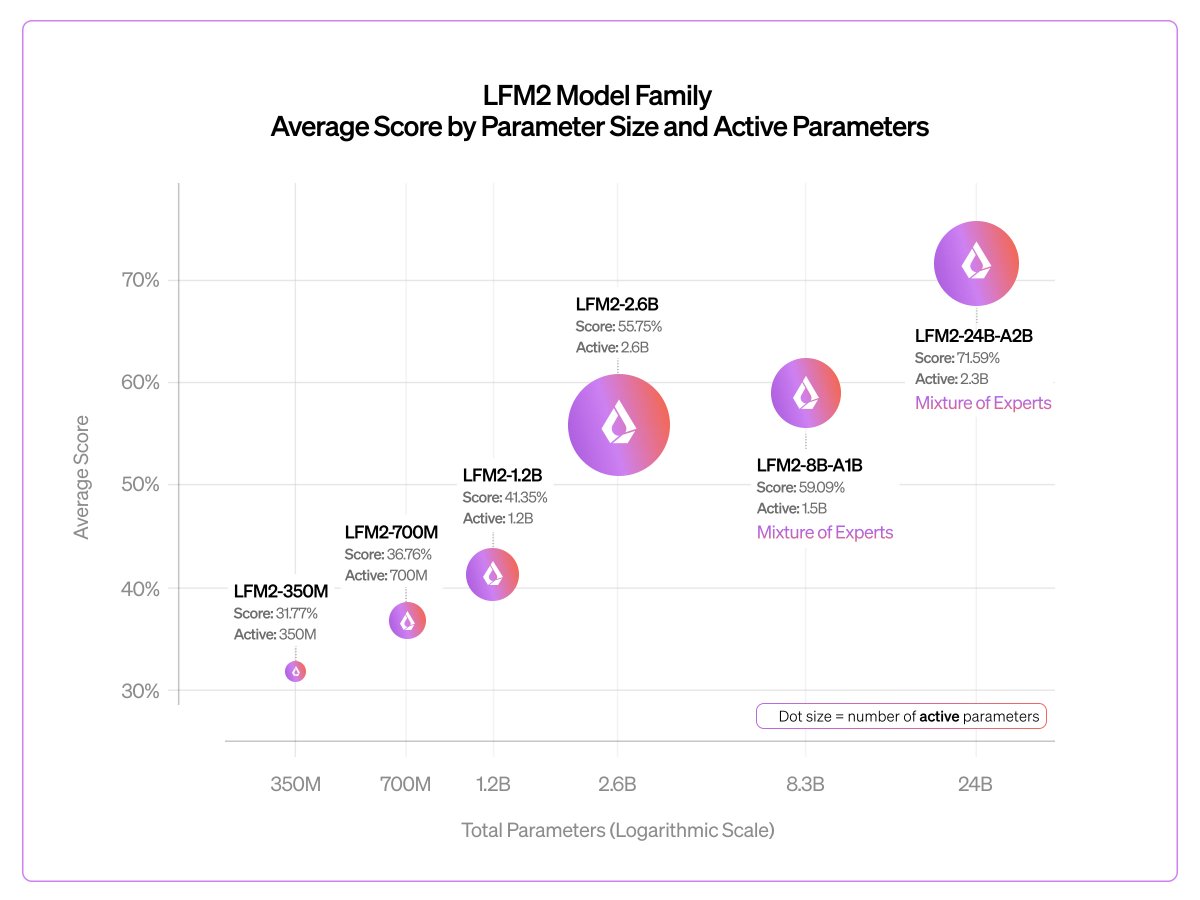
Today, we release our largest LFM2 model: LFM2-24B-A2B 🐘
> 24B total parameters
> 2.3B active per token
> Built on our hybrid, hardware-aware LFM2 architecture
It combines LFM2’s fast, memory-efficient design with a Mixture of Experts setup, so only 2.3B parameters activate each run.
The result: best-in-class efficiency, fast edge inference, and predictable log-linear scaling all in a 32GB, 2B-active MoE footprint.
🧵
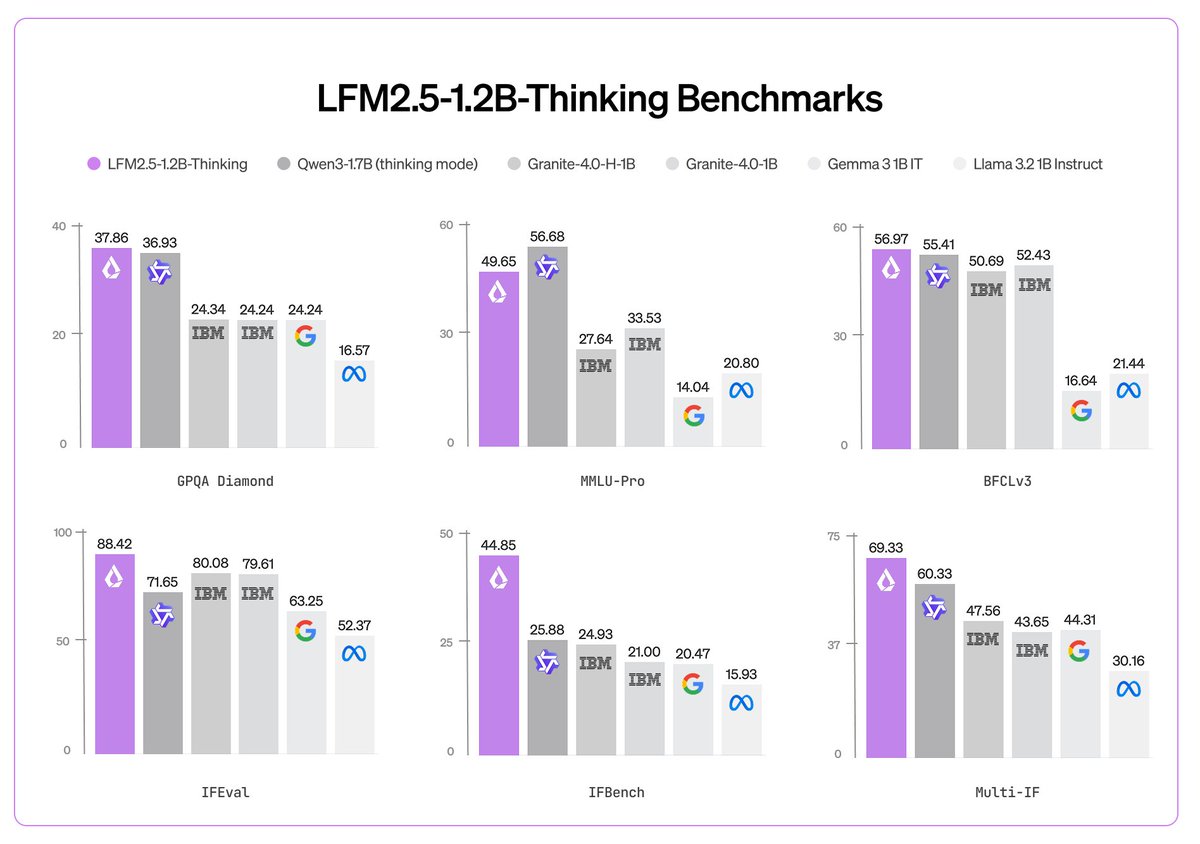
Today we release LFM2.5-1.2B-Thinking, a reasoning model that runs entirely on-device. What needed a data center two years ago now runs on any phone with 900 MB of memory.
> Trained specifically for concise reasoning
> Generates internal thinking traces before producing answers
> Enables systematic problem-solving at edge-scale latency
> Shines on tool use, math, and instruction following
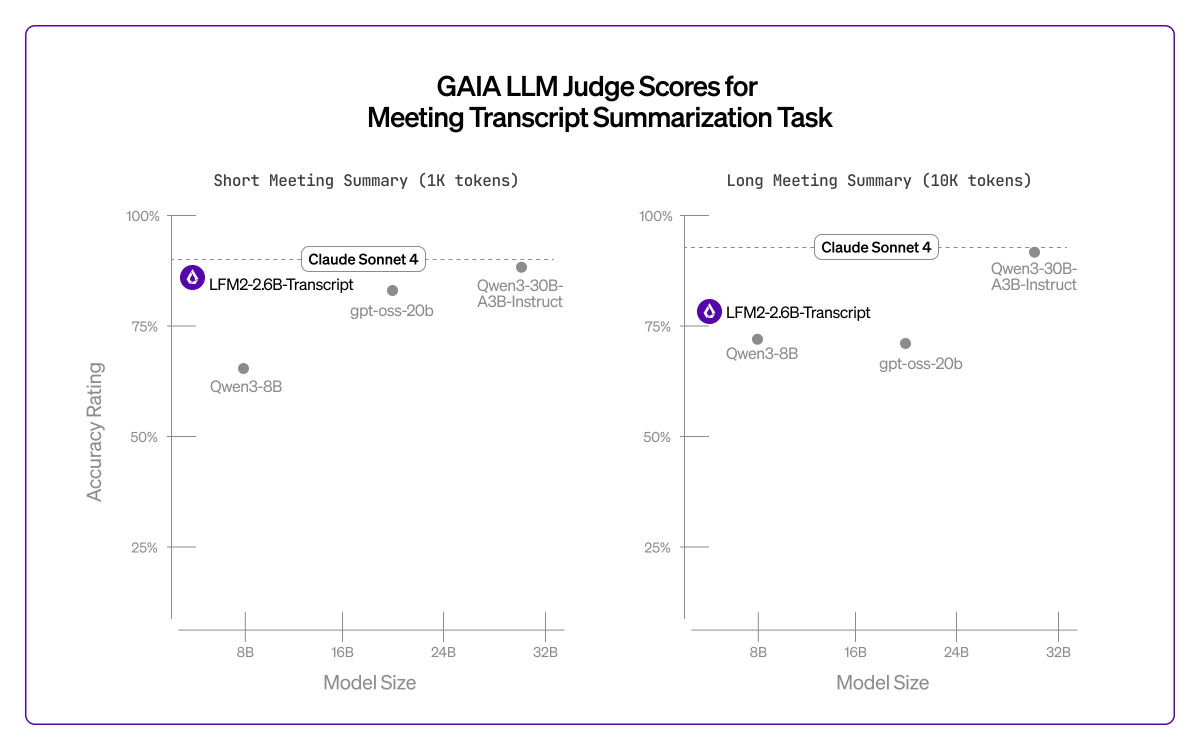
Together with @maximelabonne , Alfred Eng, and @timseyde, I trained LFM2-2.6B-Transcript, a private, on-device meeting summarization model released with AMD.
Cloud-quality summaries in seconds, <3GB RAM, fully local on Ryzen™ AI PCs.
https://t.co/uABXf63g9C
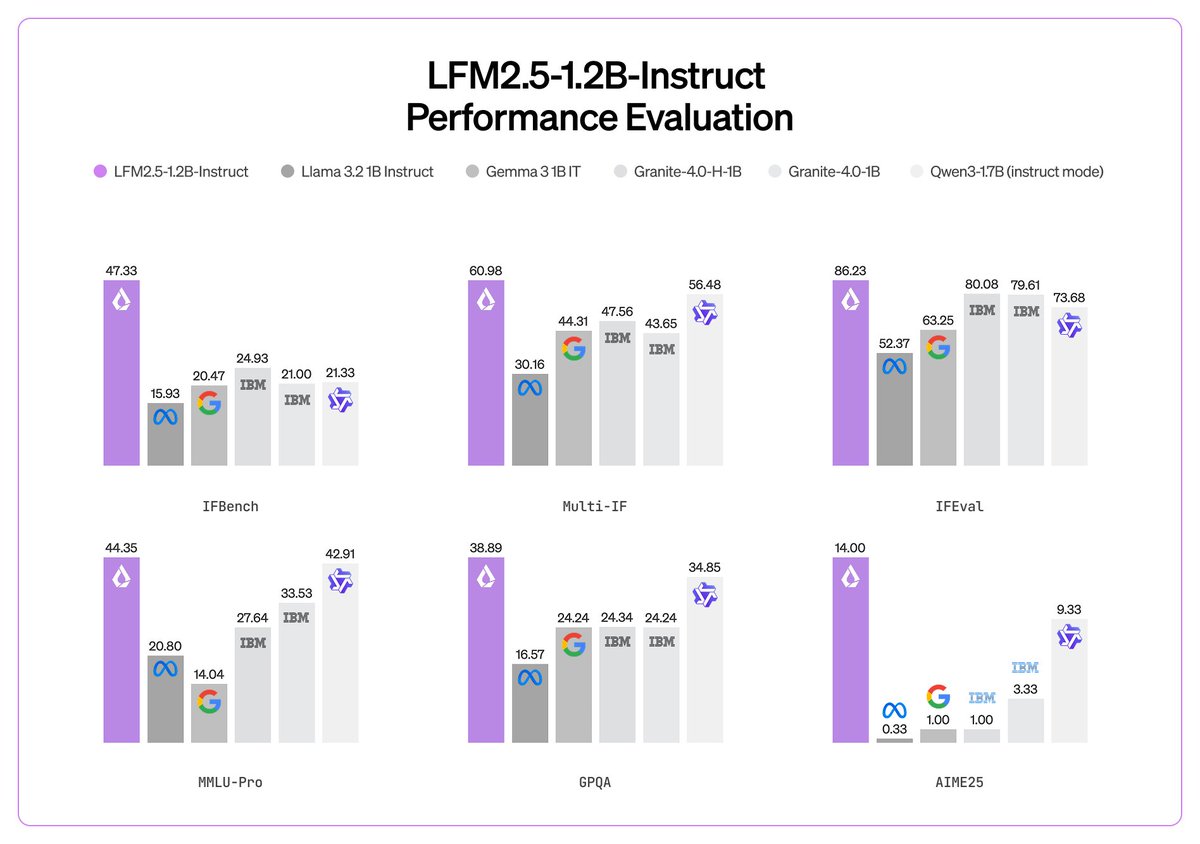
We are releasing our new LFM2.5-1.2B family of models.
Try them here:
Text: https://t.co/qXaPutGxgm
Vision: https://t.co/EvOVUoppq2
Audio: https://t.co/ibN8g8wWbW
Today, we release LFM2.5, our most capable family of tiny on-device foundation models.
It’s built to power reliable on-device agentic applications: higher quality, lower latency, and broader modality support in the ~1B parameter class.
> LFM2.5 builds on our LFM2 device-optimized hybrid architecture
> Pretraining scaled from 10T → 28T tokens
> Expanded reinforcement learning post-training
> Higher ceilings for instruction following
🧵
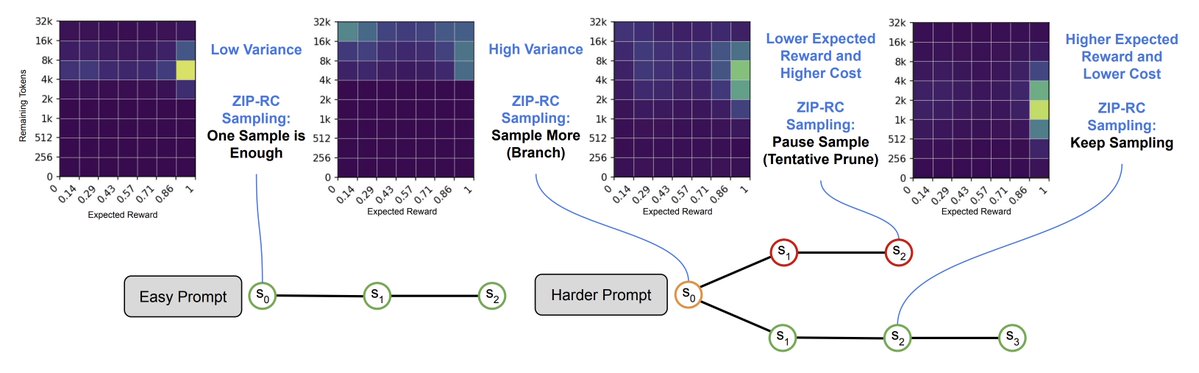
LLMs that predict their own response quality can allocate test-time compute more efficiently. ZIP-RC repurposes unused logits to model joint distributions over reward and generation length. At every token, no architecture changes, no extra forward passes - great for adaptive test-time sampling.
Exciting work led by @rohin_manvi & amazing team across @liquidai, @berkeley_ai, @MIT_CSAIL.
🚨Paper 🚨
What if LLMs could tell you they’re going to fail before they finish reasoning?
We trained models to predict their own future: whether they’ll succeed and how long it will take. At every token, in real time, with no extra compute.
We used this to develop an adaptive sampling algorithm for test-time compute. 👇🧵
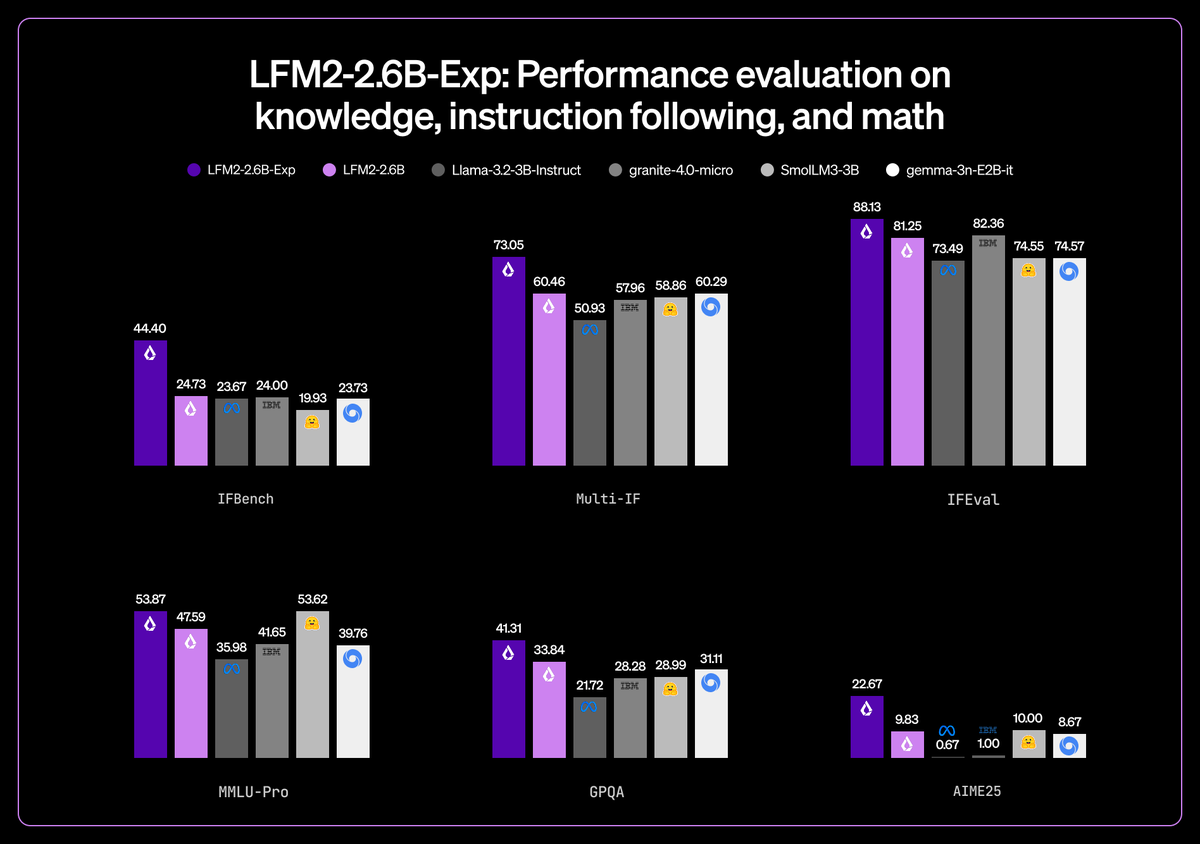
Meet the strongest 3B model on the market.
LFM2-2.6B-Exp is an experimental checkpoint built on LFM2-2.6B using pure reinforcement learning.
> Consistent improvements in instruction following, knowledge, and math benchmarks
> Outperforms other 3B models in these domains
> Its IFBench score surpasses DeepSeek R1-0528, a model 263x larger
Download and play 👉 https://t.co/uLvFHUSELW
Happy holidays,
The Liquid AI team🎄✨
Grok Play
Me and @nacloos attended xAI hackathon (+500 participants) to work on Grok Play. A platform for humans to compete against and with AI agents in games to improve LLMs ability to generate game relate code.
We ended up winning 1st place of one of the tracks. 🚀