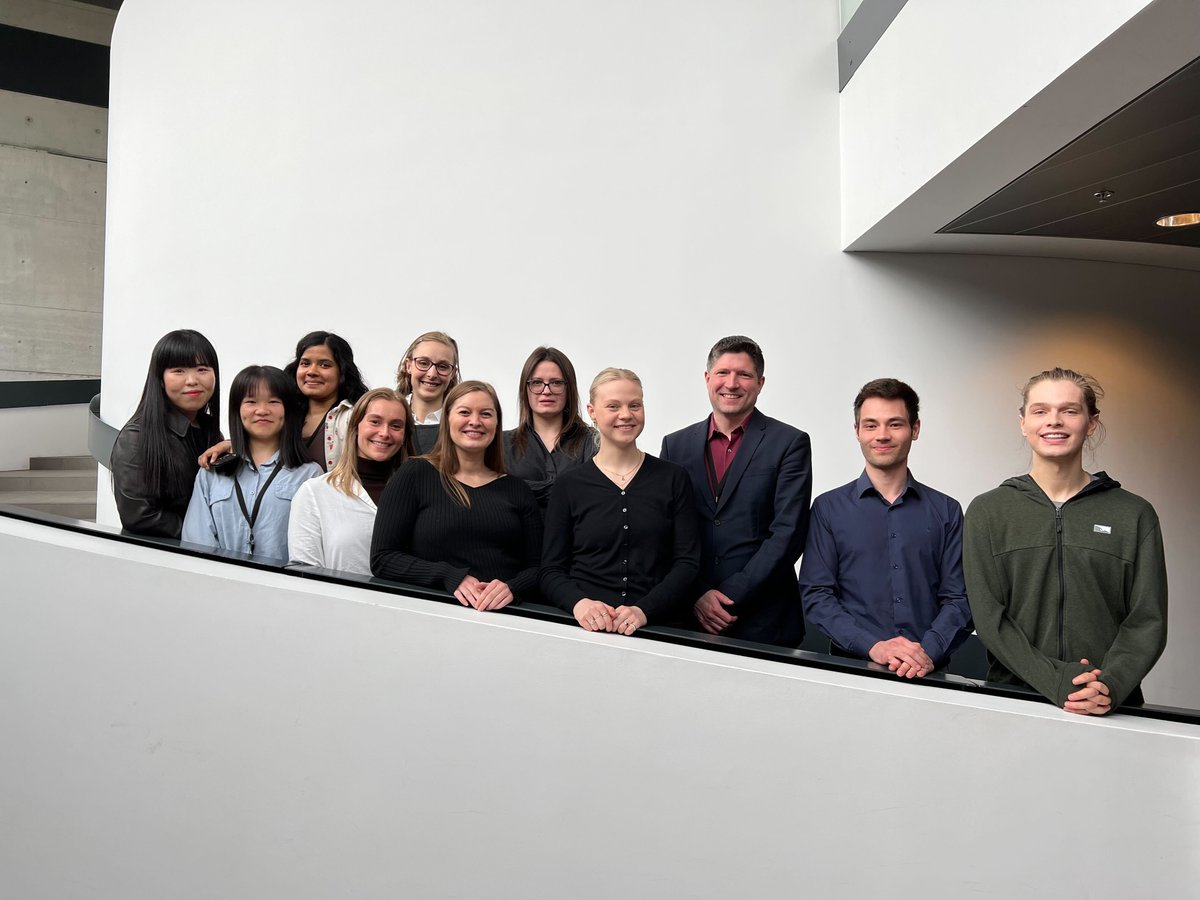
Greatly looking forward attending #ASHG24
Look forward seeing cool science and old friends. @BjornssonL is thrilled to have three amazing stories to share this year. #ASHG2024#ASHG24
I want to thank my supervisor @bjornssonL for the opportunity to work on this exciting project, my wonderful colleagues (@Kimberley1A) and international collaborators that contributed. @WSSFoundation made this work possible (11/11).
Excited to share that my second first-author paper is now in pre-print!🧬We explore the in-utero malleability of neurological dysfunction in Wiedemann-Steiner syndrome, a rare genetic cause of intellectual disability. A thread on our major findings 🧵(1/n)
https://t.co/7UKfAYGMPQ
Why is this study important? Our results provide a novel mouse model of WDSTS to explore the therapeutic window opportunity, making WDSTS an ideal candidate for future therapeutic intervention (10/n)
I´m looking for a grant writer/project manager to work with this amazing and fun group in our laboratory at the University of Iceland. Could be partly remote. If interested send me a line at [email protected]
Happy to share our latest work with @trluperchio, @raziafro0z, @KasperDHansen,@BjornssonL where we ask:
Do germline variants in epigenetic regulators lead to similar chromatin accessibility changes in different cell types?
https://t.co/3rjiNBbAvi (1/n)
Cold stimulus mediates sex determination in turtles and vernalization in plants. Here, in my PhD work with @BjornssonL, I provide an example on how epigenetic modification is used to integrate a cold temperature environmental response into the genetic circuitry of mammals (1/n)
@jlmatur But it's important to emphasize that we do not directly assess the mutant structure predictions. What we show is that, along with the other information our classifier uses, they lead to accurate variant classification (2/2)
I’m thrilled to share my first first-author paper! This is work with @Kimberley1A, @LeandrosBoukas and @BjornssonL. We focus on Wiedemann-Steiner syndrome (WSS), a Mendelian neurodevelopmental disorder. We believe our results are of broader interest. (1/n) https://t.co/aldFKX377F
@jlmatur We were also skeptical about this. It turns out that, while the overall shape is always the same, some mutant structures indeed differ with respect to some of the secondary structures (e.g. alpha helices) (1/2)
@jpirruccello So my answer is basically that in theory it shouldn't work, but in practice it looks like it does, quite well. If there's something we're missing here, we'd love to know about it (n/n)
@jpirruccello - In cases of variants with experimentally validated effects, our classifications agree with the exp results
- Variants likely pathogenic are classified as causing some disruption
- Variants in "healthy" population databases (e.g. gnomAD) are classified as having no effect (4/n)