@jakphd Great trio of papers. Amazing what happens when data on whole genome sequence are analyzed instead of exome. Whereas non-coding genes where known, role of variants in such genes have been surprising us all. Agnostic approach is fueling scientific breakthrough. @NatureGenet
@ShihchengGuo@NatureComms Nice paper- diversity is key . Very consistent with what we observed among Europeans that were assessed by the 2 platforms ,wrt to modest correlation -Eldjarn 2023
@SFatumo In Eldjarn et al Nature 2023 we reached similar observation by analysing UKB participants with African ancestry. Gaining both poulation specific/ enriched variant pqtl and ancestry refinement of ld class for pqtl
In population studies, there is now multiple studies of individiuals with African ancetsry including replication / meta-analysis
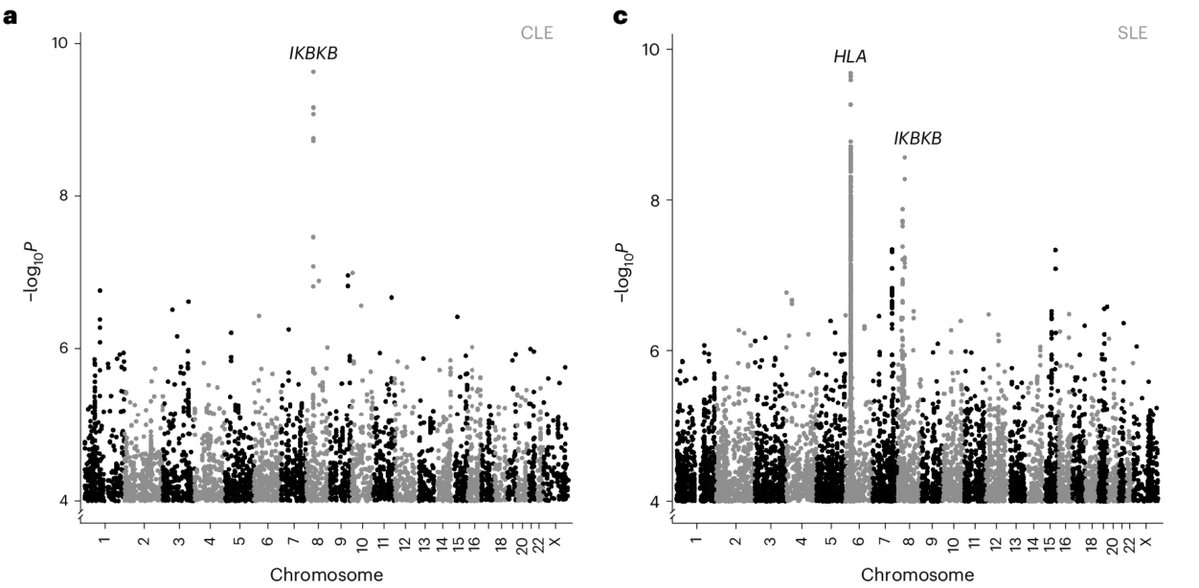
Many years after starting a series of findings in Europeans, novel findings in GWAS of non-Europeans are now reported: IBKB and Lupus @NatureGenet
Another incredible GWAS finding this year: an African ancestry–specific missense variant confers the largest common-variant risk effect reported to date for SLE.
Just weeks ago, there was a GWAS paper reporting the discovery of a major genetic risk factor for dilated cardiomyopathy--an African ancestry-specific loss of function variant in CD36--explaining up to 8% of the cases in African populations. (https://t.co/jk7F05bAlM).
Now, deCODE Genetics has uncovered a major genetic risk factor for lupus, a missense variant p.Glu502Lys in IKBKB, explaining 10.4% of cutaneous lupus (CLE) and 6.4% of cases of systemic lupus (SLE) in African populations.
The variant increases CLE risk by 5.4 fold, uncovered by comparing just 211 cases to 25,360 controls of African ancestry from the Alliance for Genomic Discovery (AGD). It highlights how deeply African ancestries have been underrepresented in lupus GWAS efforts.
Lupus is more common (2-3x) and more severe in individuals of African ancestry compared with those of European ancestry. Certain forms, like discoid lupus, are 10 times more common in African populations. Despite that, only one of the past 33 SLE GWASs involved African-ancestry population!!
Interestingly, that one study (Langefeld et al. Nat Comm 2017) that involved African ancestry individuals actually captured this IKBKB locus (connecting the signal to a different nearby gene, PLAT), but they seemed to have never identified the right gene and overlooked the importance of the finding.
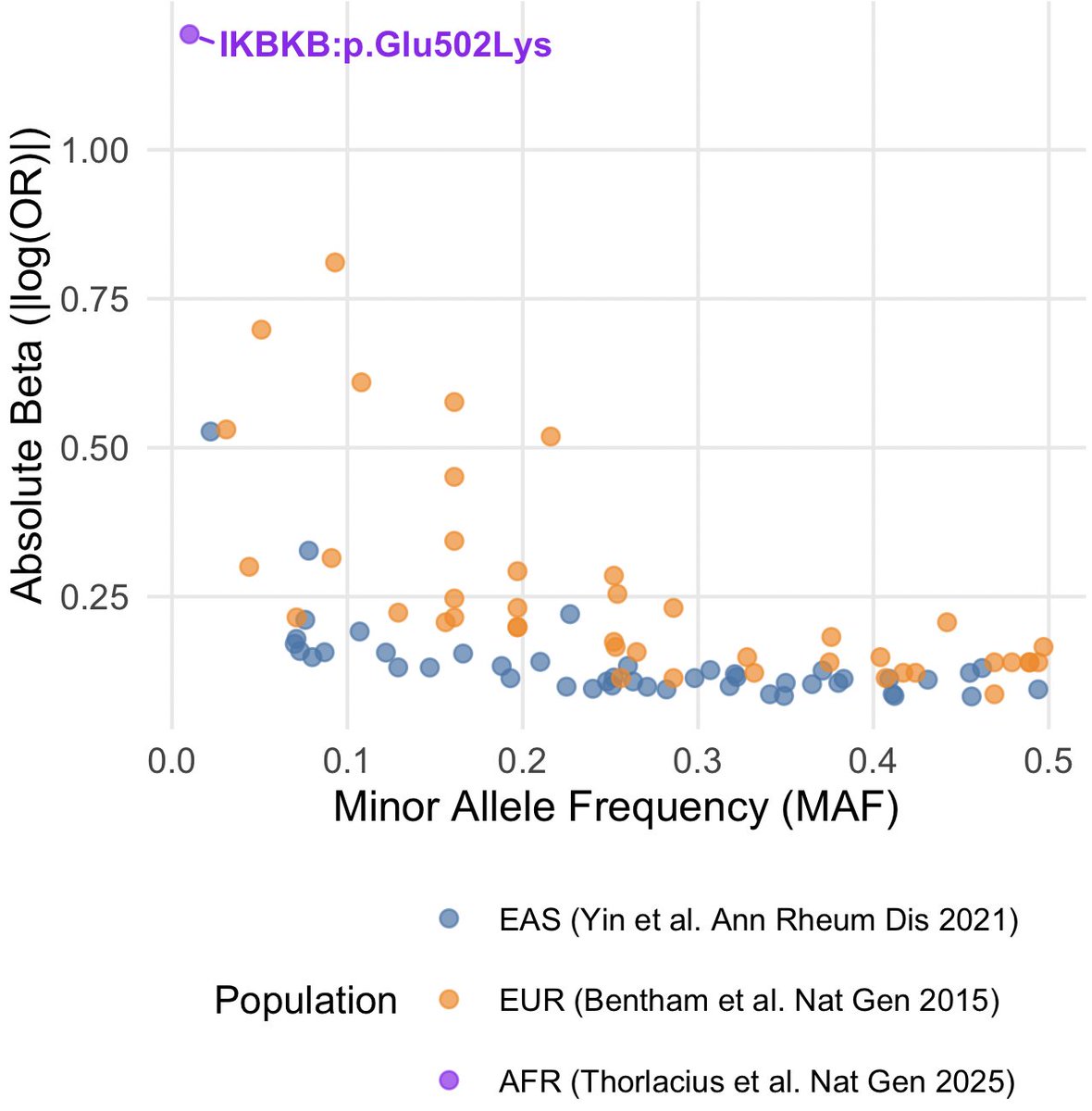
Here is a plot I roughly made to highlight the effect size of this variant. The plot compares the effect sizes vs minor allele frequency of GWAS loci reported the past large SLE studies in European (Bentham et al. Nat Gen 2015) and East Asian ancestries (Yin et al. Ann Rheum Dis 2021). I overlayed the IKBKB missense variant to show the it's effect size for SLE dwarfing even the largest effect sizes reported for HLA variants.
The allele frequency of this missense variant in African ancestries is ~1%. Around 2% of the African ancestry individuals are carriers, and among the SLE/CLE cases, more than 10% carry this variant. Amazing!
Analyzing related clinical phenotypes, the authors found that the carriers tend to have a more severe phenotype (more CLE, more glomerular involvement, proteinuria and lower blood counts).
The gene IKBKB encodes an immune protein that activates the NF-κB signaling, a key immune response pathway. Partial or complete loss of IKBKB cause Mendelian forms of immunodeficiency conditions. The missense variant likely confers a gain of function effect leading to autoimmunity.
This discovery highlights the importance of NF-κB signaling in lupus pathogenesis, particularly in individuals of African ancestries. The finding has many translational implications, for example, it suggests a large target population (~10% of African cases) for any NF-κB targeted SLE treatment.
Another great work by deCODE scientists!
Thorlacius et al. Nat Gen 2025
@manuelrivascruz@doctorveera Entering into the study of individuals with Non European ancestry is somewhat reminding me of the start of gwas some years back. A word at the time was low hanging fruit… it is seasonal again. My colleagues have made a rare type of finding . Large risk, low freq @erna_valdis
THis is great to have the cardiomyopathy CD36 story in the same journal as our new publication. African specific genetic asociations are empowered by more diverse populations @NatureGenet
Congratulations to my colleagues Gudny Ella and Erna.
Studying diverse ancestries as part of a large collaboration enables the discovery of association, with lupus, of an IKBKB missense quite specific to individuals with African ancestry. @NatureGenet
https://t.co/T8duxeLYFe
@doctorveera Augmenting population diversity brings extra variants pointing to new associations, and the sample size reached are still modest, so more will likely come.
@drughunter_com This post sent me back in time 13 years ago when TREM2 missense were shown by my colleagues to confer Alzheimer’s predisposition #microglia
New in Nature Metabolism: CNS GIPR and GLP-1R are both essential for weight loss response to a GIPR-Ab/GLP-1 peptide–antibody conjugate in mice—and this signaling happens through brain regions that reach outside the blood–brain barrier. This provides a new perspective on central metabolic control.
Kudos to Murielle Véniant-Ellison, @ClarissaMLiu & partners @UofT. #MyCompany
Delighted to see LLF580 (efimosfermin alfa) acquired by @GSK, an FGF21 biologic for MASH. Thanks to @BostonPharm for believing in this idea. Third NIBR-born spin-out to be acquired for approx $1 bn or more. https://t.co/0I030HWpg9
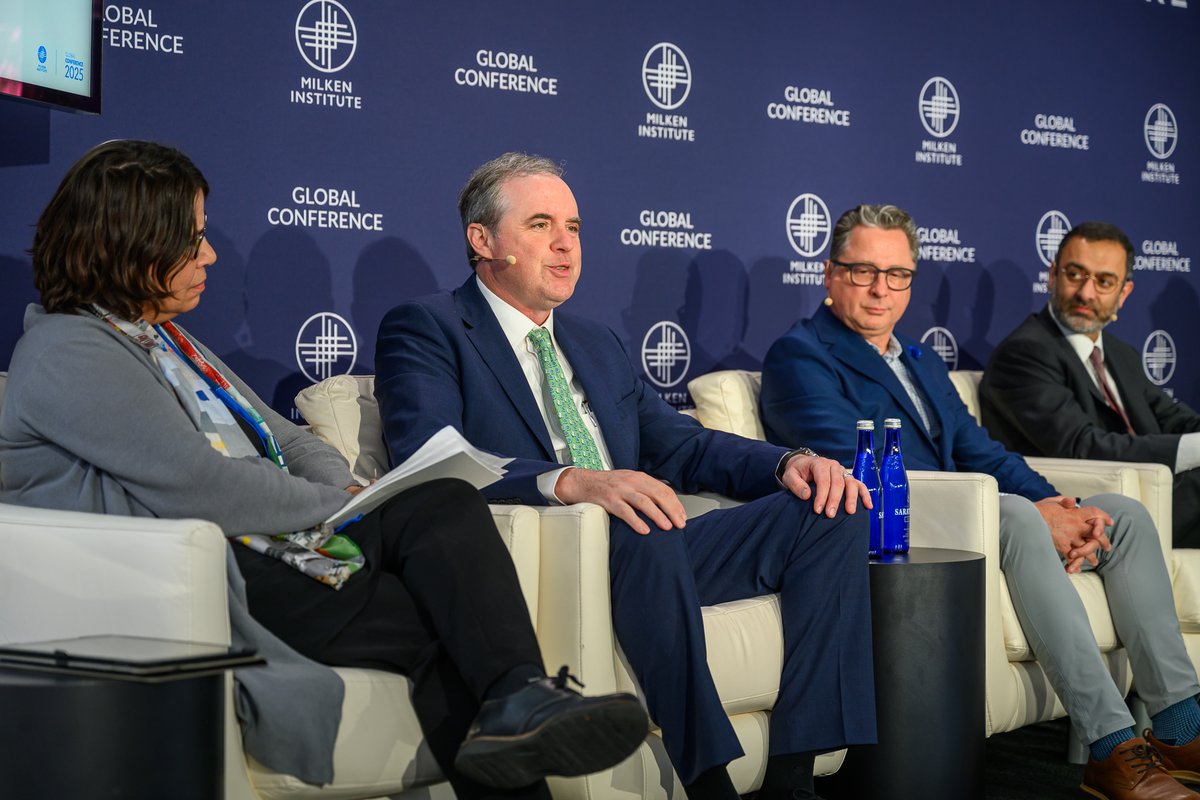
At the @MilkenInstitute Global Conference panel, we discussed how AI, genetics & protein engineering are transforming drug discovery.
From our research targeting Lp(a) to uncovering potentially protective mutations in obesity, we’re entering a new era of precision and prevention.
The future of medicine is happening now. #MyCompany
@MariosGeorgakis Rarer variants or smaller effect sizes drive most of the discoveries. The latter is sometimes tough to detect due to need of sequencing data, but they have the potential to have large effect size.