RubyScore × Inferum AI
We’re excited to introduce RubyScore, our largest inference partner.
@rubyscore_io is building on-chain analytics and reputation infrastructure, spanning over 70 blockchain networks and more than 1 million users.
The team has a strong track record of collaborations and integrations across leading Web3 ecosystems:
• Linea (Consensys): Integrated Proof of Humanity solutions, helping identify over 243,000 bots.
• Circle: Listed in the official partner directory of the company behind USDC.
• Ecosystem integrations: Scroll, Celo, Boba, Somnia, Soneium, Katana, and other blockchain networks.
Today, RubyScore leverages AI agents powered by Inferum AI to analyze wallets across multiple blockchains, investigate transaction patterns, identify suspicious activity, and assess on-chain reputation.
For us, this is a real-world example of how AI inference powers Web3 applications, enabling agentic systems to process and analyze massive amounts of on-chain data at scale.
More inference, less cost.
🚨 BREAKING: OPENAI IS REPORTEDLY IN TALKS TO ACQUIRE ONE OF CRYPTO'S MOST RESPECTED SECURITY FIRMS
According to The Information, OpenAI is in early discussions to acquire Trail of Bits.
But this story is much bigger than crypto.
We're talking about a company that has spent more than a decade finding vulnerabilities in critical software, building security tools and researching ways to discover and fix bugs automatically.
And now one of the biggest names in artificial
Trail of Bits was founded in 2012. It's is a cybersecurity research and engineering company.
Unlike a typical crypto auditing firm, its expertise extends far beyond smart contracts.
Its work covers:
• Blockchain and smart contract security
• Cryptography and zero-knowledge systems
• Software vulnerability research
• Reverse engineering
• Fuzzing and symbolic execution
• AI and machine learning security
• Security engineering and automated vulnerability detection
Three important examples:
Slither: open-source static analysis framework for Solidity and Vyper.
It helps developers identify potentially dangerous patterns in smart contracts without executing them.
Echidna: smart contract fuzzer that tests whether contracts behave correctly under large numbers of generated inputs.
Instead of checking only a few manually written scenarios, developers can use it to search for unexpected behavior.
Manticore: symbolic execution framework used to explore different execution paths and identify potentially vulnerable conditions in software.
These aren't speculative products.
They're real tools that have been used by security researchers for years.
And they help explain why Trail of Bits has a reputation that extends well beyond the crypto industry.
Trail of Bits has already been working on automated cybersecurity research.
In 2025, the company placed second in DARPA's AI Cyber Challenge, earning a $3 million prize.
Buttercup, was designed to autonomously discover and patch software vulnerabilities.
Traditional security research depends heavily on human experts examining code, identifying weaknesses, reproducing bugs and developing fixes.
But increasingly capable AI systems could help automate parts of that process.
It's directly relevant to OpenAI.
OpenAI isn't necessarily buying a crypto company to enter crypto.
Trail of Bits is well known in blockchain security, but its capabilities are much broader.
According to The Information, OpenAI is trying to build a substantial cybersecurity business.
Acquiring a company with years of experience in vulnerability research, security tooling and automated bug discovery could accelerate those ambitions.
Instead of building every capability internally, OpenAI could gain an established team with deep technical expertise.
The opportunity isn't limited to protecting OpenAI's own systems.
It could also involve developing security products for other organizations.
The same technology that can help defenders discover vulnerabilities can also make attackers more capable.
AI can help analyze code, investigate attack surfaces, and automate repetitive security work.
But those capabilities can potentially be misused.
As AI models become more capable, security becomes increasingly important.
Companies need systems that can identify vulnerabilities before attackers exploit them.
They also need ways to evaluate whether AI-generated code is secure.
And as AI agents gain access to tools, files, APIs, and sensitive systems, the consequences of security failures become much more serious.
An AI assistant giving a wrong answer is one problem.
An autonomous agent making a dangerous change to a production system.
It's clear that OpenAI aims to integrate its products into crypto, which will bring a whole new set of challenges the industry has never faced before.
Imagine an AI agent that can:
• Interact with smart contracts
• Manage on-chain assets
• Execute transactions
• Interact with DeFi protocols
• Pay for services
• Operate through connected applications
Every additional capability introduces potential security risks.
A compromised tool, malicious instruction, vulnerable contract, or poorly configured permission could have financial consequences.
Unlike a traditional chatbot mistake, a blockchain transaction may be irreversible.
That makes security especially important for financial AI agents.
OpenAI and Trail of Bits already have a connection
Trail of Bits public website lists security work involving OpenAI, including an OpenClaw assessment.
The company also references an open-source security initiative in collaboration with OpenAI. So this isn't necessarily a situation where two completely unfamiliar companies are suddenly considering a deal.
There's already a documented professional relationship. That doesn't prove an acquisition will happen.
But it makes the reported discussions particularly interesting.
What could an acquisition actually change?
There are several possibilities.
First, OpenAI could strengthen its internal security capabilities.
Second, it could accelerate the development of AI-powered cybersecurity products.
Third, it could combine advanced AI models with established vulnerability research methodologies and security tools.
Fourth, it could expand its expertise in securing autonomous agents and complex software systems.
And fifth, Trail of Bits blockchain experience could become valuable if OpenAI develops products involving financial infrastructure.
That last point is a possibility, not a confirmed strategy.
There's currently no evidence that this acquisition is specifically intended to launch a crypto product.
According to The Information, discussions are still at an early stage.
The potential purchase price hasn't been disclosed.
There's no announced agreement, closing date, or confirmed acquisition structure.
And the negotiations could still fall apart.
It's also worth noting that OpenAI's interest in Trail of Bits doesn't automatically imply a new token, blockchain launch or crypto partnership.
Those would be separate developments requiring their own evidence.
The most interesting part of this story isn't that OpenAI might acquire a company known for auditing smart contracts.
It raises the biggest question:
As AI gets better at writing code, finding vulnerabilities, and operating software autonomously, who will build the security infrastructure that keeps those systems safe?
Maybe the next major AI business opportunity isn't another chatbot.
Maybe it's securing everything those chatbots and agents are about to control.
We have been absent from the media space for a while - now it’s time to explain the situation and share our future plans.
For many of you, this will be sad news. Due to reasons beyond our control, we can no longer work with Gensyn as a Hub or represent their views.
We still have good personal relationships with the team, but we are no longer associated with the project.
We don’t want to abandon this account, as we have invested a lot of time and effort into it.
Our metrics for 7 months of active work:
— 548,000 impressions
— 1,300 real followers
— 7,700 profile visits
— 16,500 likes
We are planning to change the Hub’s name and shift our focus to AI, AI x Crypto, AI automation and everything related to it.
If you have any ideas or suggestions, feel free to send them to us in DMs or comments.
Thank you very much for supporting us throughout our journey. It truly means a lot to us.
It’s interesting that 15 hours after this update, the total amount staked reached 176M, while the APR is 3.93%, which is very close to the target.
ZKsync.
Many people probably missed the audit done by @taran_space at the beginning of 2026, because some were still on holidays at that time. Others do not take audits seriously at all, which is completely wrong.
Audits are direct proof that a protocol is secure and that you can safely interact with it.
We reviewed all 51 pages of the document and summarized everything for you in one short image.
As you can see, there are currently no serious technical issues. The ones that existed were already fixed (see the first audit). Other minor issues were pointed out and will be fixed by the developers in the near future.
This once again shows that zkSync is a mature technology, and that privacy is not just a dream of geeks, but a full solution for institutional clients.
2025 sailed through without major financial shocks. History shows these calm years often shape long-term trends.
In the last 12 months, quiet shifts emerged:
- Large funds ramped up short-term bond exposure faster than in over 5 years
- Central banks dialed back explicit policy guidance
- Companies hoarded excess cash outside public markets
Such periods frequently set the stage for the next economic cycle.
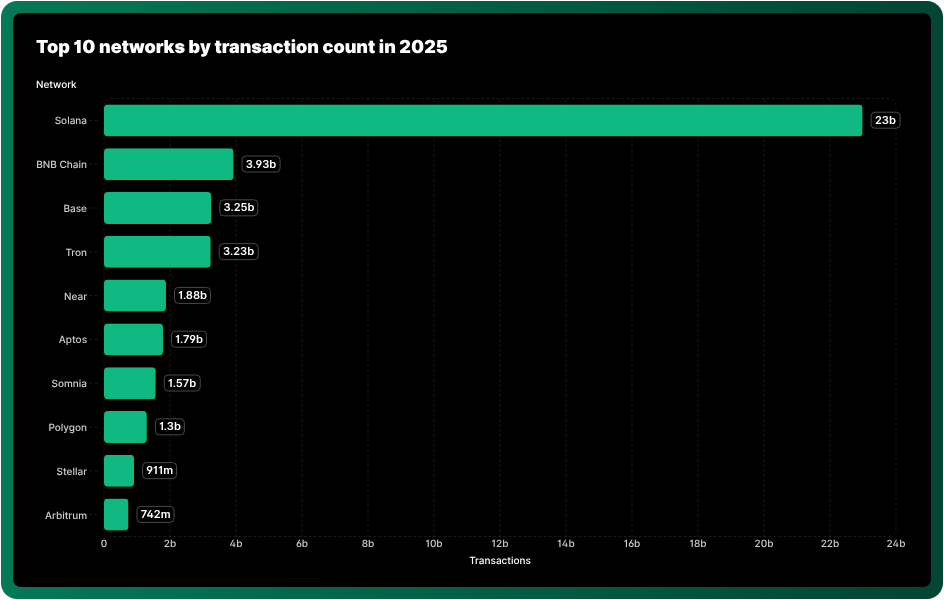
Top 10 networks that processed the most transactions on their chains:
Combined, they've handled a massive 34.59B transactions in total.
The absolute standout this year is @Somnia_Network it processed 1.5B transactions in under half a year since launch. Insane growth! 🚀
Active users (last 30 days) crypto projects 📊
1. BNB Chain — 57.0M
2. NEAR Protocol — 38.4M
3. Solana — 37.7M
4. Tron — 16.4M
5. Polygon — 16.3M
6. opBNB — 15.9M
7. Aptos — 14.3M
8. Jito — 12.1M
9. Ethereum — 10.5M
10. Sei Network — 10.2M
BNB leads by a wide margin, while NEAR and Solana are nearly tied.
Which one surprised you the most?
Crypto Fundraising Rounds History (2010-2026) 💰
2010 — $26.40 M
2011 — $69.37 M
2012 — $16.85 M
2013 — $190.71 M
2014 — $477.39 M
2015 — $663.44 M
2016 — $1.10 B
2017 — $3.36 B
2018 — $7.07 B
2019 — $5.55 B
2020 — $7.58 B
2021 — $42.68 B
2022 — $40.18 B
2023 — $10.59 B
2024 — $17.50 B
2025 — $34.94 B
2026 — ? 🤔
2025 was a major comeback. What’s your 2026 prediction? Drop your guess below 👇
@Polymarket is valued at ~$9B after the ICE investment in 2025🧐
But key metrics in early January 2026:
Open Interest (OI): ~$274M
2025 trading volume: over $21B (with some adjustments for double-counting).
Liquidity is highly concentrated: roughly 50% of OI is in just the top ~50 markets. The remaining 6000+ markets average $20–30K each low liquidity and higher volatility.
For a $9B valuation, the metrics could be even stronger, particularly after the post-election slowdown and increased competition in regulated segments like sports and economy