How are #Chainlink services monetized and how will this accrue value to $LINK?
Let’s dive in👇
Chainlink services including CCIP, Data Streams, Functions, and more have been monetized since day one, key for achieving economic sustainability
That means, as a user, you are required to pay fees in order use such services
These fees cover the operating costs (e.g. gas and infra costs) of the service providers that operate/secure that service, as well as provide a margin of profit to incentivize proper operation
Service providers today include the node operators who fetch requests, perform computations, generate consensus, and return aggregated responses
Over time, this will increasingly expand to include $LINK stakers who will be paid a portion of user fees for providing additional cryptoeconomic security for CL services
Stakers include node operators staking $LINK, which can be slashed for not fulfilling predefined performance requirements and will increasingly play a key role in node reputation / job selection
Stakers also includes community stakers who raise alerts and will eventually support a loss protection solution to help cover user losses related to a CL service
Service providers also encapsulates network coordinators who help coordinate research, development, launch, maintenance, and support around oracle services, such as Chainlink Labs today
The Chainlink Network has various payment models that support monetization and economic sustainability
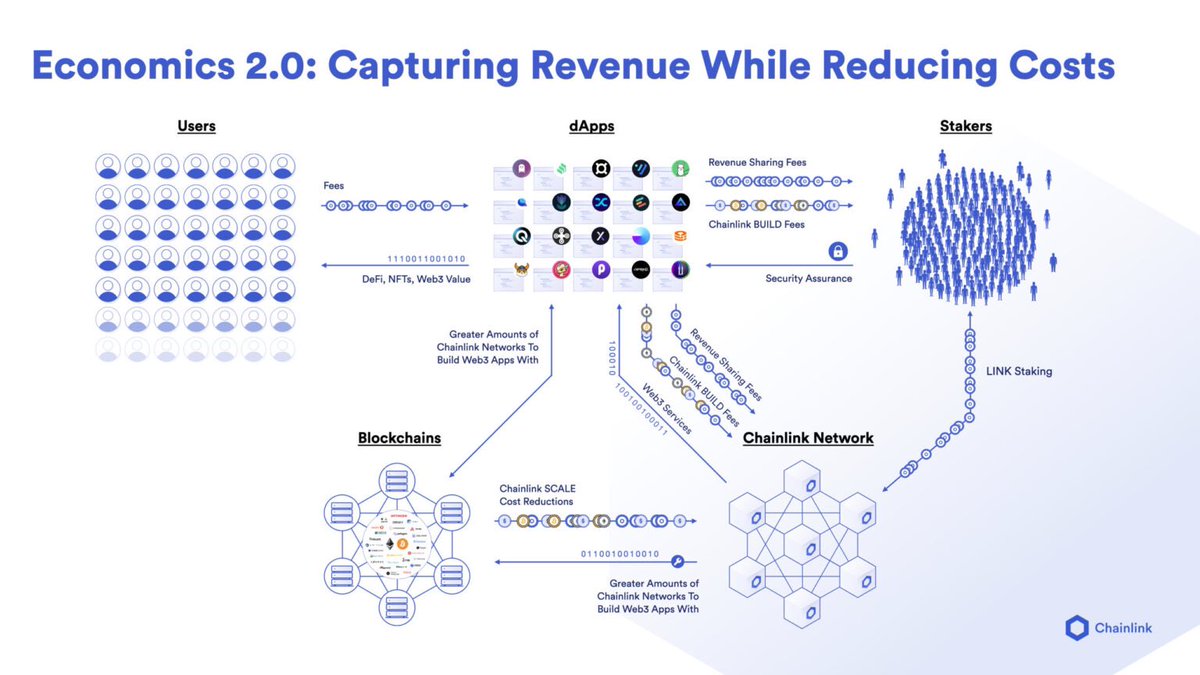
- Usage-Based Payments: The standard model where users pay for CL services based on their usage. This includes funding a subscription contract that is drawn upon as services are rendered (Functions, Automation, VRF), as well as a pay-per-request model where the end-users pay a fee as they use a Chainlinked application (CCIP, Data Streams)
- User-Fee Sharing: Chainlinked users share a portion of the fees they generate with the CL Network. This model accounts for established protocols with custom needs and where usage based fees are not preferred. The first fee-sharing deal with @GMX_IO passed recently, where 1.2% of the total fees generated by GMX V2 are paid in exchange for using Data Streams and technical support by CLL (now on mainnet)
BUILD Program: Early-stage, pre-revenue projects, allocate a percentage of their native token supply (3-7%) to the CL Network in exchange for using CL services and enhanced support (akin to an accelerator). A portion of the tokens will be made available to stakers helping sercure CL services used by BUILD projects. There’s now 50+ BUILD projects
SCALE Program: Blockchain ecosystems cover the operating costs of various CL services on their chain for a period of time. Blockchains need CL services for growth, so this cost sharing is mutually beneficial. SCALE participation is also a determining factor in chain integration prioritization. 8+ blockchains are now in the SCALE program, which seen by the @CeloOrg deal is in the millions of $$
There hasn’t been a dashboard built yet that tracks all of this, particularly given some forms of payments today are 1-1 deals, but Chainlink is working on standardizing onchain payment flows, which will be easier to track
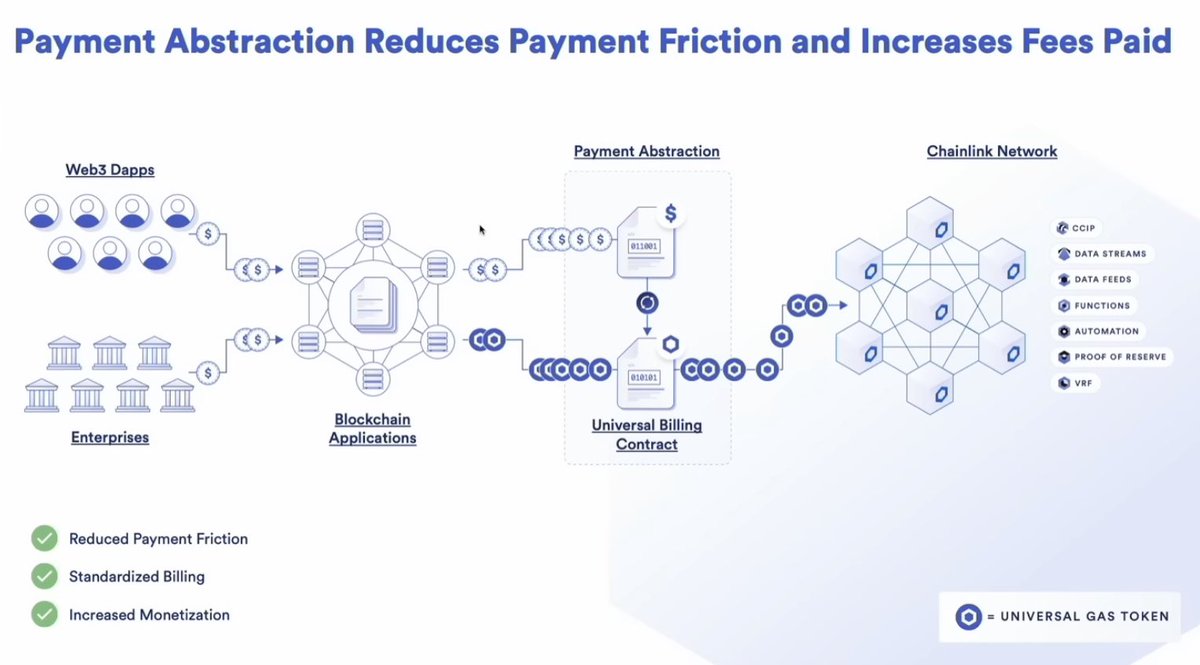
In addition to the various payment models, Chainlink is actively working on reducing payment friction by devoloping a Payment Abstraction solution where users can pay in any asset they want (at a premium), which is then converted to LINK and paid to service providers
This means users paying fees using their credit card, bank account, tokenized cash deposits, etc
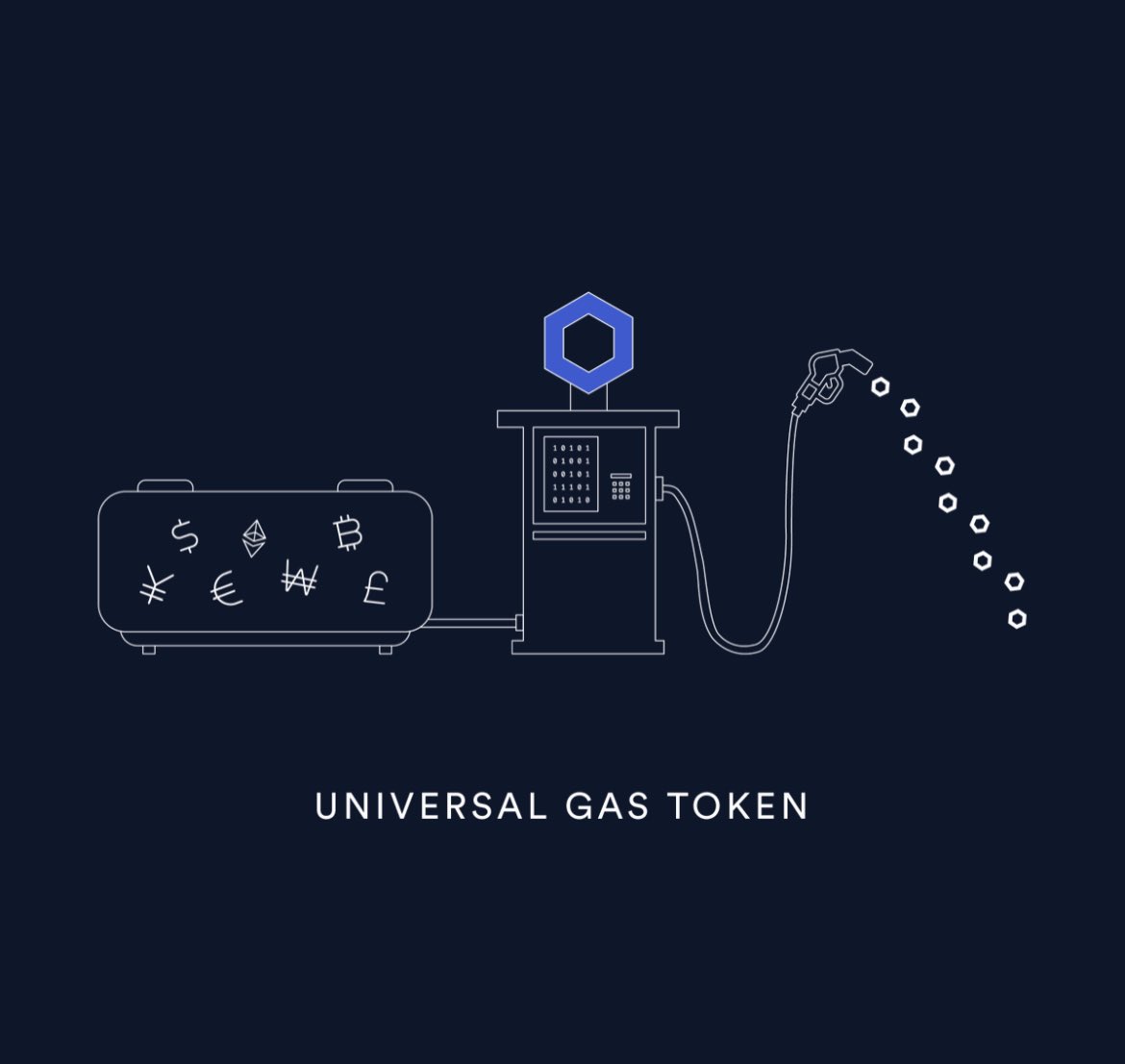
The result is that $LINK is a universal gas token, the standard form of payment for Chainlink services, either directly or abstracted into the background via conversion
Chainlink’s economics will continue to evolve over time as Web3 itself evolves, but the goal of building useful secure services that become the industry standard remains the same
When you achieve network effects, the monetization naturally follows
Welcome to @CoinStats, your one-stop shop for market updates and insights!
With us, you can track all of your crypto assets - CeFi, DeFi and NFTs. And in addition to that take advantage of our DeFi Wallet, Swap & Earn.
Let us walk you through everything CoinStats 👇
The Internet of Contracts will eventually encompass both the public chain landscape and the bank chain ecosystem.
With the world’s largest financial institutions and DeFi protocols being able to easily transact with each other, CCIP is now starting the process of enabling this Internet of Contracts.
I’m sick of hearing crypto confused with a heavily-marketed centralised, mismanaged exchange. FTX’s failure is far from a harbinger of crypto. Quite the opposite: it’s a concrete demonstration of the need for more, better decentralised, trust-free technology.
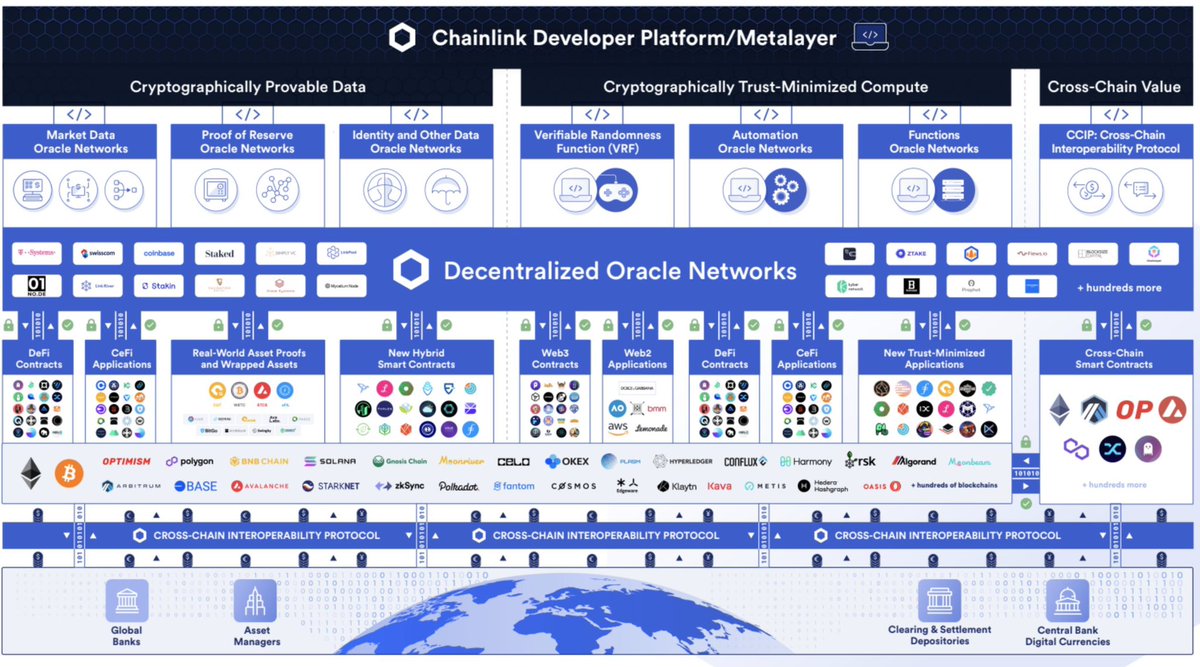
#Chainlink is the most widely adopted decentralized oracle network across the blockchain ecosystem
Below I have compiled a list of some of the best written/recorded resources across the Internet that dive deep into @Chainlink
Learn more today 👇
https://t.co/88BKODV2ud