I've been researching $CPSH more and the story is genuinely one of the most underappreciated names in the entire space supply chain.
I'm seeing it as a space bottleneck, with the potential to become an AI bottleneck.
They make AlSiC hermetic packaging... the metal matrix composite housings that protect sensitive electronics from the brutal conditions of space.
The material is aluminum silicon carbide, a composite that delivers roughly 50% weight savings compared to traditional aerospace alloys while surviving heat cycles, radiation exposure, vibration, and thermal shock that would destroy normal aluminum or copper packaging.
The lightness matters because every gram launched into orbit costs real money.
The durability matters because once a satellite is in space, you cannot service it.
The packaging MUST work for 10 to 25 years without failure.
They solved a materials science problem that legacy packaging suppliers couldn't solve as cleanly.
And I believe they represent approx a quarter of the market, with a US domicile and fortress balance sheet IMO.
NASA Mars Perseverance Rover...
$CPSH produced the AlSiC hermetic housing for the turret power supply on the SHERLOC scientific instrument that is currently operating on the surface of Mars.
SHERLOC is the instrument that detects organic compounds and minerals, which is the core scientific mission of finding evidence of past life.
Perseverance has been operating since Feb 2021.
Everyday that instrument continues to function is a real-world endurance test of $CPSH technology in conditions worse than anything you can simulate on Earth.
International Space Station...
$CPSH AlSiC components are installed in multiple electronic systems aboard the ISS.
The station has been continuously occupied since Nov 2000.
Components inside have been subjected to 25 years of micro-meteorite impacts, thermal cycling between 250 and minus 250 degrees Fahrenheit, and continuous radiation exposure.
$CPSH technology has been tested in that environment longer than most aerospace suppliers have existed.
US Space Force GPS III satellites...
$CPSH hermetic packages are inside the most recent generation of military GPS satellites.
The GPS III SV10 satellite launched in April 2026 carries this hardware.
Every GPS signal that reaches your phone routes through hardware that includes $CPSH.
Authorities don't certify suppliers for GPS satellites lightly.
The qualification process takes years and costs millions.
Once a supplier is in, the relationship is sticky for the entire program life cycle.
These three missions represent the most stringent qualification environments in the entire aerospace industry.
Earth orbit is hard.
Lunar trajectory is harder.
Mars surface operation is the hardest.
$CPSH has flight heritage across all three.
That kind of cross-domain validation is genuinely rare and it is what separates real space suppliers from companies with a pitch deck and a domain name.
Every satellite launched into low Earth orbit needs hermetic packaging that survives launch and orbital conditions.
Every payload, every power supply, every communications module, every sensor array uses some form of hermetic housing to protect the electronics inside.
The volume requirement is multiplying.
SpaceX Starlink has roughly 7,000 active satellites in orbit and plans to scale to 12,000 in the first generation buildout, with a long term target of 42,000 satellites.
Amazon Project Kuiper is targeting 3,200 satellites for its initial constellation.
The European Union IRIS satellite constellation is targeting 290 satellites.
China is building constellation programs with thousands of satellites planned.
Defense programs are adding hundreds more.
The total LEO satellite market is on a trajectory to grow from roughly 12,000 active satellites today to potentially 60,000 to 100,000 satellites by 2035.
Every single one of those satellites contains multiple electronic systems that need hermetic packaging.
We're not talking about one package per satellite.
We are talking about dozens of packages per satellite across power, communications, propulsion, and sensor systems.
The supply side has not scaled to match this demand.
Hermetic packaging is a materials science discipline that requires specialized facilities, decades of process refinement, and qualification approvals from aerospace and defense customers that take years to obtain.
New entrants cannot just decide to compete in this market and start shipping product next quarter.
The barriers to entry are real and they protect incumbents like $CPSH.
There are very few public companies with the materials science track record and the active flight heritage to supply that volume of satellite packaging.
$CPSH is one of them.
While the launch companies build the rockets and the satellite operators run the constellations, $CPSH makes the packaging that lets the electronics inside actually work.
They don't have to win the satellite race or the launch race.
They just have to sell the AlSiC hermetic packages to whoever does.
Picks and shovels at the materials science layer.
Our game plan is clear... long the space theme until the $SPCX SpaceX IPO (at which point we seek to lock in gains), with the possibility of quick rotations between different space tickers.
NFA of course.
Currently my biggest space position.
Wild to think my post and thesis on $RKLB was posted only two years ago. The idea of the SpaceX IPO creating a huge surge in bullish momentum for all space names. $LUNR and $RDW as my side bets.
I now plan to roll everything into Robotics, as the hype reaches maximum extremity’s in the Space sector.
Once again I’ll be slightly early, yet with a larger TAM (likely the largest ever), it’s just a matter of time before the robotic theme fully kicks off.
My bets are $ARBE $MBLY and $XPEV
Most themes take approximately 18 months to play out, let the games begin.
$RKLB thesis:
https://t.co/fg6lQeZKVc
$RDW thesis:
https://t.co/aAnWY1Nzbg
And now we move into $MBLY
https://t.co/Tjp1yVuNVB
$OUST and $ARBE are both must haves for Robotics.
Seeing a lot of chatter about Ouster here but very little on ARBE robotics.
They’ve already been chosen by Chinese state automakers for LVL4 autonomy.
Already received orders from US defence, still trades at 100m market cap. Wild.
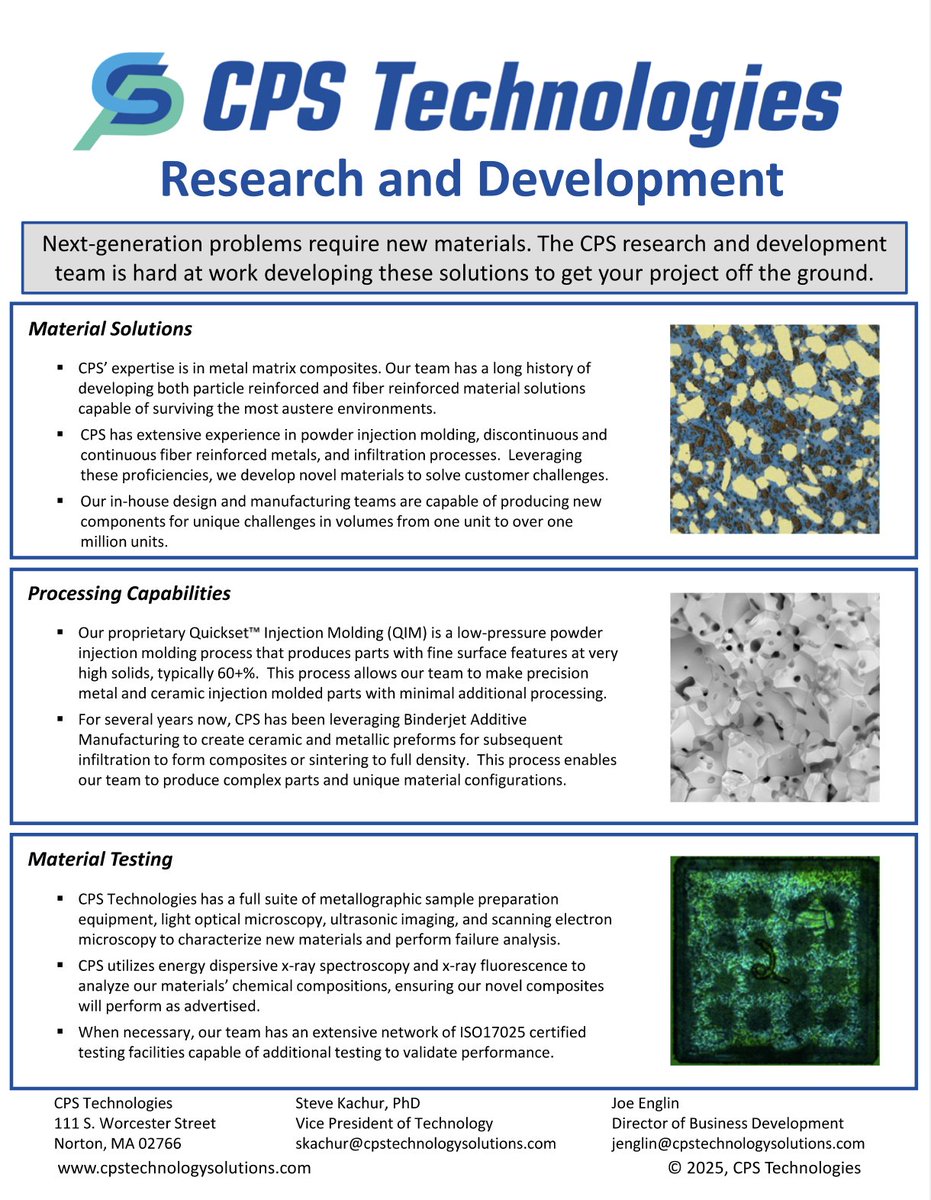
$CPSH this is a 3 post segment of all the composite and metal matrix materials...including ALMAX. Read all the info..they are the leader in producing these materials and the US Dept of Defense and Nuclear Energy has 6 working contracts along with big tech companies and more. The reason sales are under $100M is they had a small facility and could never meet the demand and take on a lot of custom projects at once...Well thats all changing in the turn around year in 2025 with record sales and the decision to scale into much larger facility this quarter. PART 1 See 4 Pics:
I've initiated positions in $CPSH as a US AlSiC pure play chokepoint.
They represent ~25% of the near-term semi-grade AlSiC market.
Their customers:
- U.S. Navy (War)
- U.S. Army (War)
- U.S. Dept. of Energy (Energy / Nuclear)
- U.S. Space Force / NASA (Space)
- Lockheed Martin ( $LMT )
- Raytheon ( $RTX )
- Northrop Grumman
- General Dynamics
- The U.S. Navy uses $CPSH for ballistic protection systems of the newest carriers (like the USS Gerald R. Ford and USS Abraham Lincoln). As well as other fleets like the Danish Navy through Lockheed.
- US Army uses $CPSH for 40mm Tungsten Warheads and UH-60 Black Hawk Helicopters.
- The US Dpt of Energy uses $CPSH for impact limiters when transferring nuclear fuel (SNF) and high-level radioactive waste via rail.
- U.S. Space Force / NASA uses $CPSH for GPS satellites and it sits in many electronic systems in the International Space Station. (Also not including Mars Rover missions)
- Lockheed, Raytheon, Northrop, and General Dynamics uses $CPSH for missile heat-shielding components. AlSiC housings for radar systems, and thermal management materials.
AlSiC or (aluminum silicon carbide) is a well known material composite that handles extreme thermal conditions for many applications above from space to defense.
But as architectures from $NVDA Rubin to scale up to 2300-2500W in 2027-2028, that same material may be used AI due to heat warpage.
My thoughts were that the tiny TAM material used to handle extreme changes in heat from hypersonic missiles to rocket nose cones may likely be used for AI deployments.
This is similar to how InP (niche TAM for Telecom) became a bottleneck as photonics scaled up. Or how Toto's fine ceramics for toilets were critical to memory.
AlSiC (esp. post-processing) may become a potential chokepoint as AI ramps up to Rubin generation chips.
Majority of the world's AlSiC production still originates in East Asia (Denka,Sumitomo, BYD, JFC).
But CPS is currently the primary "US/Western hedge" and CPSH states they represent roughly 25% of the near-term available AlSiC market (CPS Technologies AGM Presentation).
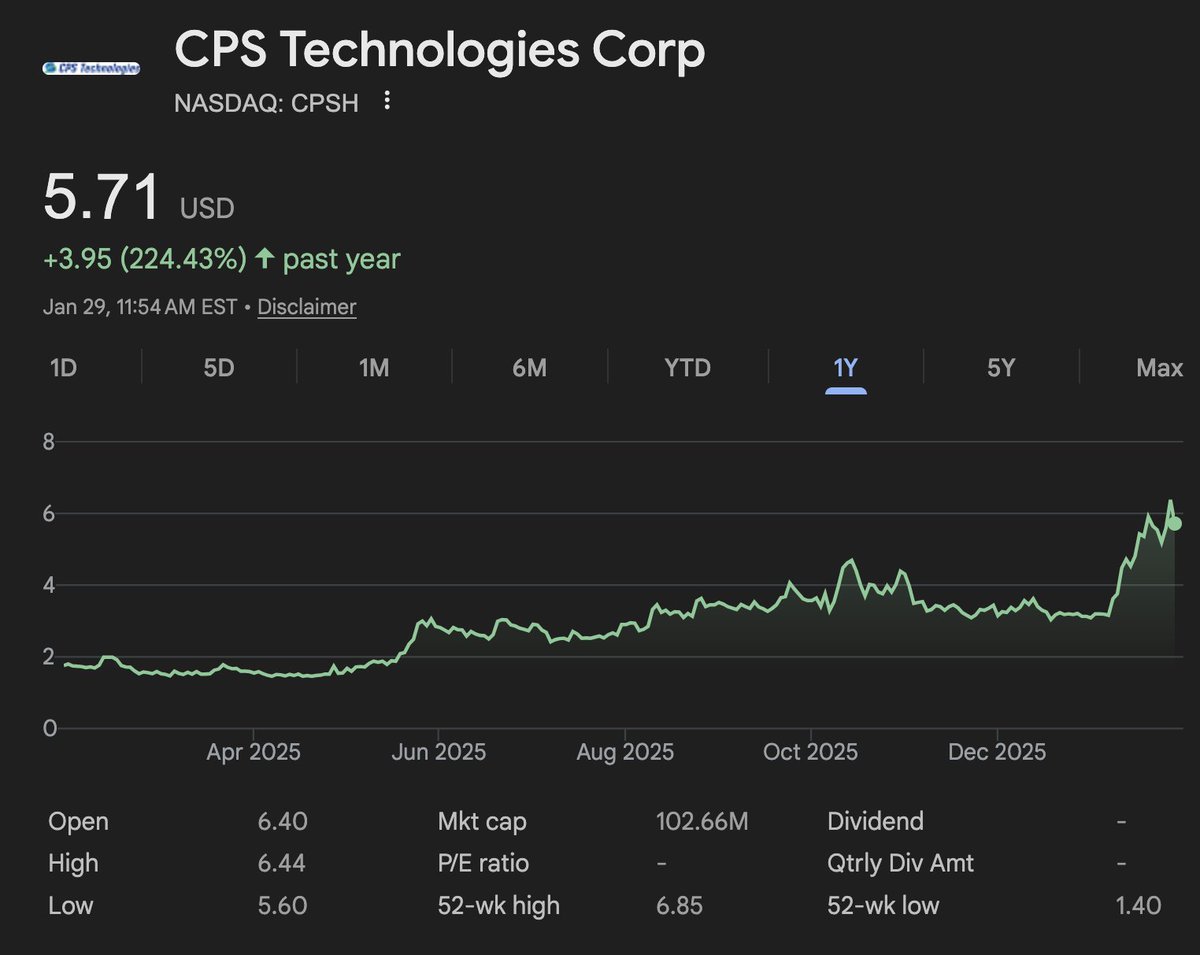
And that percentage of the supply chain is only worth ~$100 MC right now.
Their balance sheet:
$12.7M – $13.8M (pro-forma) cash. Almost 0 debt. Inventory ~5.4M, Liabilities: ~$5.06M (eg. $3.53M for aluminum and silicon carbide)
Y/Y revenue is 8.8M, up +107.29%.
Y/Y Net income is up 207.96K (+119.94%).
Healthy balance sheet and US Government strategic interest + Defense Contractors gives $CPSH low downside risk at $100M or even at $200M as the leading Western AlSiC supply chain.
There were new contracts eg. $15.5M order from the leading Semi likely ~Infineon last October, that more visibility into revenue upside. And they are expanding production (funded by their Oct 25th raise), which hints to higher demand.
"We believe we are the world leader in the design and manufacture of AlSiC... Many of our products are designed specifically for a single customer application, making us the sole-source provider for those components." (10-K filings)
TLDR: The AI upside depends entirely on a material pivot by big tech. Similar to the Toto toilet maker for memory type but the AI fit seems strong.
But the benefit is that its existing list of US DoD contractors gives the company lower downside risk.
This is just my own personal thesis I wanted to share.
But personally I've taken positions in $CPSH as an AlSiC play (and long US supply chains) as it may play an important role with thermal warpage with AI in 2027-2028 as we expand to 2000W+.
I'm surprised majority of the X detectives in the comments guessed this right.
I'll do a write-up on this mystery company soon.
From my research, it was unique to have US company own a large % of the AlSiC supply chain, as this material could be used for $NVDA Rubin gen for thermal.
Better yet, Space + Defense vertical usage of AlSiC gives this company low downside risk bc of DoD/Raytheon/Northrop/NASA reliance of the material composite.
But, who knew the same thermal material used for hypersonic missiles, f-35 fighter jets, and Mars space exploration could also be used to handle warpage for 2000W+ AI deployments?
Doesn’t seem like markets have yet.