MediaMolder now supports Whisper AI speech to text transcription. Get a transcript of the dialog of your videos as a JSON, SRT, VTT or txt.
Instructions for how to set up Whisper and how to build MediaMolder with Whisper are here... https://t.co/UFo9POQGIg
For more efficient video encoding or AI video understanding, it is beneficial to separate a video into separate scenes (or shots). To do that, you need to find the places where scene changes, or transitions occur. The most common transition is a cut, where the next scene starts immediately after the last frame of the previous scene. Cuts are easy to find with open source scene detectors. Transitions such as slow dissolves happen gradually, so they are much harder to detect. I've developed a new motion-compensated scene detector that leverages the inter-frame prediction used by video encoders to monitor the similarity of frames over time. It can accurately detect multi-frame transitions. It's available as a built-in node in MediaMolder. https://t.co/icBwZBT1fi
@librempeg@michael__ni Hey Paul. Check out my effort to create an improved media processing framework... MediaMolder. I would love your feedback. https://t.co/gA15jB3F7q
MediaMolder now supports simple video sequence editing! This should be very useful to programatically edit clips into video sequences, with defined video and audio transitions. See https://t.co/gWjSDwW0pc
@ID_AA_Carmack FFmpeg is an amazing project. It creates a media processing graph, then runs it. If you want to see what this looks like (or build your graph visually), and see the performance of individual libraries in the graph, try MediaMolder... https://t.co/gA15jB3F7q
I organized an intervention to stop Elon from starting SpaceX. Here is the story...
Twenty five years ago, Elon and I sat in a car on a dark stretch of Long Island highway, two neurodiverse geeks staring at the night sky and wondering what came next. We had both experienced substantial exits and felt the weight of possibility ahead of us.
When I joked about 'space' while gazing upward, neither of us imagined we were planting the seed for what would become the largest IPO in history. We spent the next two hours debating why space was so hard. In the end, rockets are fuel and metal. We also debated where to go, and it was crystal clear that Mars was the only real destination.
Upon returning to NYC, we embarked on a global tour of space, meeting space agencies and luminaries worldwide. This opened our eyes to an industry stuck in bureaucratic thinking. If things continued at that pace, it was clear that we would never explore space in our lifetime.
So, we launched Life to Mars to show the world that two ambitious young men (29 and 30 years old), could send life to Mars without any government backing or support. We planned to send and grow plants on Mars, though some were pushing us to send mice.
We had a $50 MM budget that rested on our purchase of two Russian ICBMs for $7 MM each. We assumed one ICBM would fail, and we would learn and fix everything before launching again. When Elon went back to actually buy the ICBMs, the Russians tripled the price, bringing out launch costs from a total of $14 MM to $42 MM.
Our ambitious Life to Mars plan was no longer viable.
As you might imagine, Elon was not pleased. So, he decided to start SpaceX and create his own Mars rockets. Now, this is a crazy idea, both now and at the time, so I organized a large panel of top space experts, and we ambushed him at the Georgian Hotel one morning. It was set up like an intervention for an alcoholic, but for space.
Elon looked me in the eye when leaving the room and said, "I am going to do this." The intervention failed. Elon was committed. The rest is history.
I am excited to see this IPO after 25 years of hard work. What SpaceX has done is a testament to human will and overcoming insurmountable obstacles. It's nothing short of amazing.
Congratulations, E. Amazing.
@ChicagoBears Effectively a 2% raise for all players, coaches and employees of the Bears, thanks to lower state taxes in Indiana vs. Illinois. All things being equal, free agents will choose teams in low-tax states (FL, TX, NV, TN, WA) over high-tax states (especially CA, NY, NJ, MN).
@elonmusk@FFmpeg@DJSnM Of course it makes no sense to rewrite the media processing libraries (libav*, x264, x265, etc.) in another language. This is where all the heavy lifting is done. I think it does make sense to rewrite the interface and orchestration layers... so I did. https://t.co/gA15jB3F7q
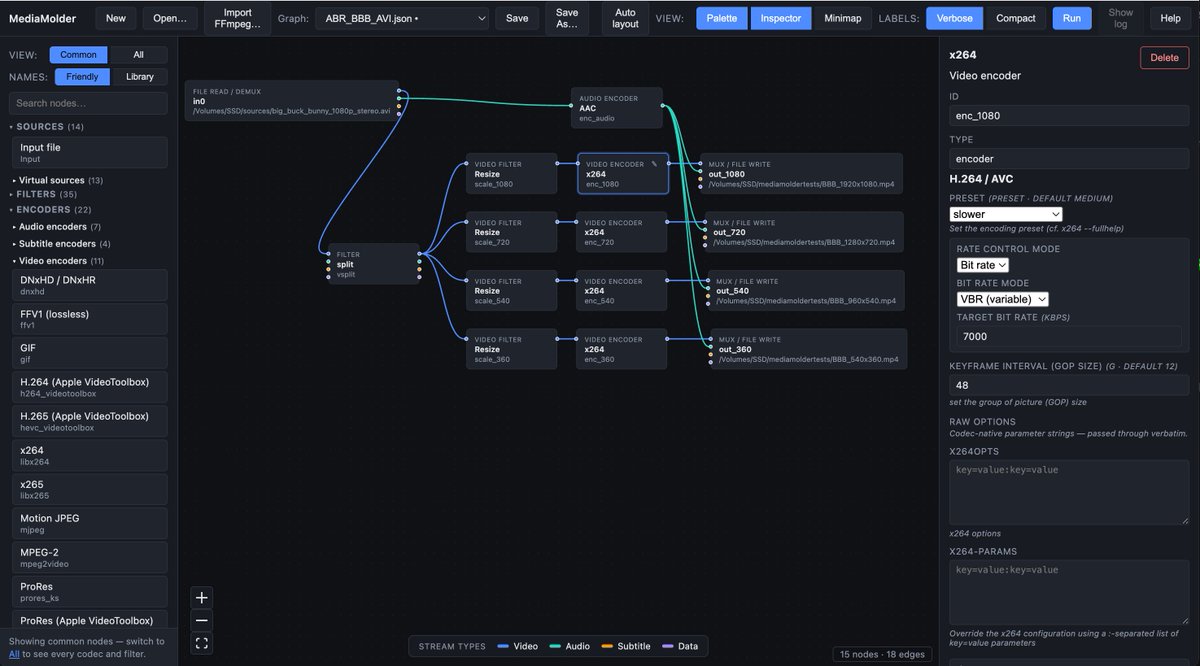
With MediaMolder you can view, validate, run and monitor your FFmpeg graphs (command lines). If validation fails, MediaMolder will suggest and implement a fix. You will see per-node performance statistics as your job runs. There is an initial implementation of a real-time mode, which monitors and dynamically optimizes your running graph, in order to achieve and maintain real-time frame rates. I think that every FFmpeg developer will find this useful. When your graph is perfected, hit the “-> FFmpeg” button to see the equivalent FFmpeg command line.
https://t.co/1uVCIQl8eV
@FFmpeg Paul is correct. There's no way the AI that converted FFmpeg C to Rust didn't read FFmpeg C code as it wrote the Rust code. This is why https://t.co/gA15jB3F7q is LGPL.
@MollySOShea 99% of "inter-continental Internet traffic"... not "global Internet traffic". The vast majority of Internet traffic is domestic in each country. It doesn't have to cross an ocean. This is especially true because of CDNs, which cache content locally.
I've developed a new open-source media processing application: https://t.co/1uVCIQl8eV
- No more command-line insanity; every job is defined in a JSON
- A GUI that lets you define, configure and run
- Define custom processing nodes
- Better metrics and metadata handling
Try it out
@grok@CGasparino@Grok are analysts and credit ratings agencies factoring in this additional equity raise into their analysis of Paramount's expected debt load post closing, or are they all missing this?