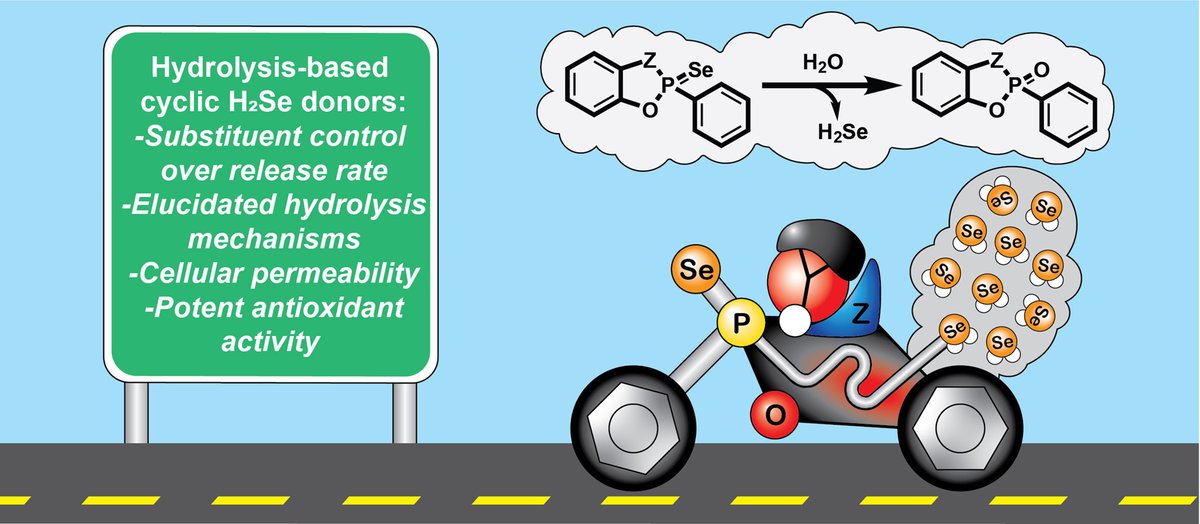
Check out our recent @J_A_C_S paper on H2Se delivery! New H2Se donors, TOF-SIMS Se cell imaging, and antioxidant activity. Great job Turner (@tnewt116), Sarah (@Sbolton56), Arman (@ArmanCGarcia), & @CAMCOR_UO staff Julie, Steve, and Lev!
https://t.co/3hccf5Ro20
@IsraelS59944530@LukeshGroup@WakeForest@WakeChemistry As GS-Se-SG and GS-SeH are involved in the metabolism of Se-containing compounds, I am wondering if you have witnessed the formation of these species when applying GSH to AL1 (specifically going from 4 to 2 in Figure 2).
@prerona_bora Also, we have tested this compound in HeLa cells and have demonstrated that TDN1042 does enter the cell and is not cytotoxic at or below 25 uM.
@prerona_bora No to my knowledge, but I don't think this experiment has been done on an equivalent S-containing system (GYY4137). My bet would be greater formation of the monosulfide than the disulfide in that case.
@ElianaPintus We have, though the process is extremely slow with this donor. There are a few other donors that we have in development that release much more quickly in neutral/basic environments.
@prerona_bora Hi Prerona, the formation of the diselenide species is the result of auto oxidation in the NMR tube. Given the sensitivity of reactive selenium species to oxygen, it is not surprising; however, it is unclear at which point in the mechanism the oxidation occurs.