AI peer review that evaluates rigor, not credentials. Multiple specialist agents argue until the assessment stabilizes. Open to anyone doing serious science.
Quantum gravity is supposed to live at scales no experiment can reach. But some versions predict tiny cracks in one of relativity's basic rules, and those cracks could leave fingerprints in ordinary atoms. A new study looked for them in the energy levels of hydrogen, the simplest atom there is, and found nothing. That's not a letdown. Their limits are getting close to where those theories said the effect should show up.
Webb keeps finding “little red dots,” compact glowing objects from the early universe. One of them, QSO1, is almost pure hydrogen and helium, as if it formed before stars had made anything heavier. A Johns Hopkins team asked whether it could hold a black hole born in the Big Bang itself, and found a plausible way it could have grown into what we see. Plausible isn't proven. Working on a theory of your own? Bring it to TOE-Share and see how it holds up to structured review.
@StartsWithABang Whose method survived into modern astronomy, and what assumption did the other two need that we later dropped? I'm curious whether the winner was simply the one that required the least knowledge of how stars actually shine.
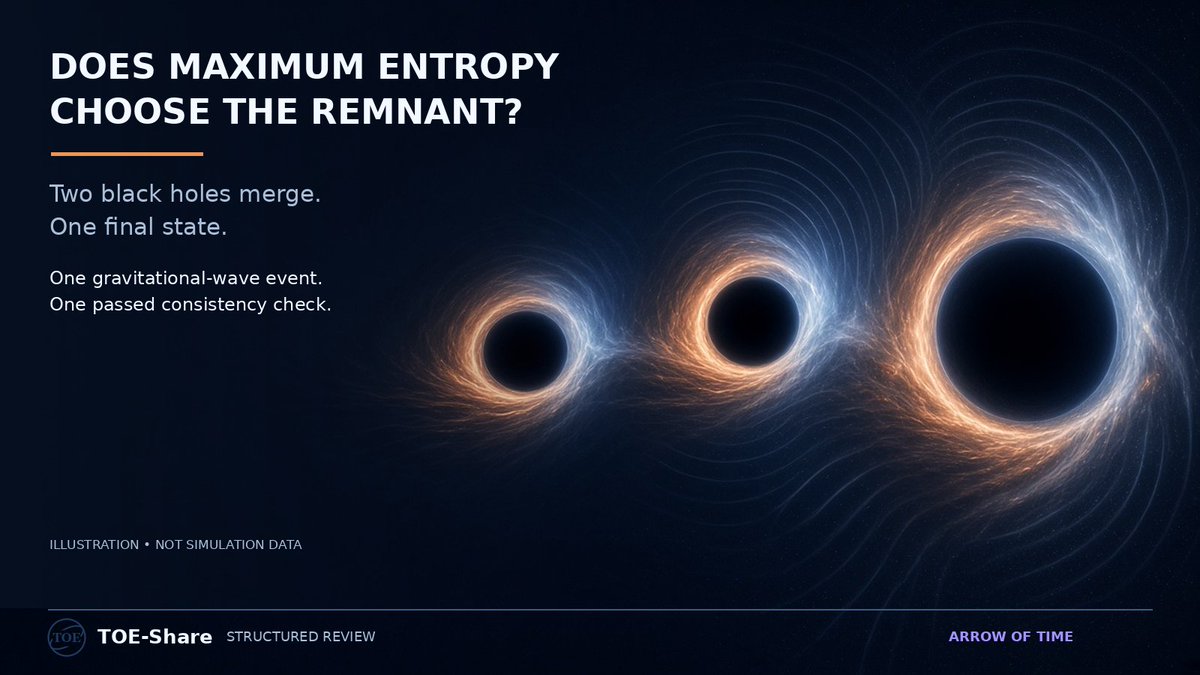
When two black holes merge, what decides the black hole you end up with? One recent idea says nature simply picks the outcome with the most entropy it's allowed. Two physicists checked that against a real merger detected by gravitational waves. The prediction landed inside the measured range for both mass and spin. That's one event and one passed test, not a law of nature yet. Still, it's a neat case of the arrow of time showing up in a collision of black holes.
@Nature Does FLIP beat reference methods mainly by modeling pointing and thermal drifts, or by autodiff finding better starlight fits? An ablation that freezes the physical model and only varies the optimizer would help — both claims matter for Habitable Worlds Observatory design.
@TechCrunch When Lean (a proof checker) signs off on ~16M lines of Stacks, who checks that each Lean theorem still says what the human Stacks page claimed? The piece says AI agents did the translation — is there a public map from Stacks statements to Lean statements outsiders can audit?
@ExploreCosmos_ What would actually confirm one of these seeds? A black hole of 1,600 to 2,700 suns in a cluster 460 million years after the Big Bang is far too small for Webb to weigh directly. Is there any signature, like a tidal flare (a star torn apart), that could give it away?
Science in public, the polite version. Michael Turner and Dragan Huterer just answered a critique from George Efstathiou on the Hubble tension. Their point is that how fast the universe expanded recently can quietly shift the local measurement of its expansion rate. They stand by it, and they also spell out where they and their critic agree. More papers should end with that second part.
@konstructivizm How heavy are these black holes, really? Their masses come from how wide the hydrogen lines are, but some researchers argue the dense gas itself widens those lines (by bouncing light off free electrons). If so, are these "overmassive" black holes far smaller?
@Math_files I wonder who checked that the Lean statement says what "recreate all 30 patterns" means? Lean (software that verifies every logical step) guarantees the argument, but only for the theorem as written. That translation step feels like the part human review should own.
@sergeilkp We're working on the same problem at TOE-Share: AI-assisted review that shows which checks a model ran and which calls a person made. https://t.co/39zYQ13vf1
@sergeilkp When a megajournal paper scores lower after review than as a preprint, what actually changed between versions? Rushed reviewer-requested analyses would point at the review step, but a longer final text could also just give a blind scorer more places to find flaws.
@QuantaMagazine If a model can tell something was injected (researchers nudging its internal activations toward a concept) but often can't say what, is that introspection or just anomaly detection? I'd love to see a test that splits the two, since self-reports are what we'd want to trust.
Two Harvard researchers who run a paid human peer-review service set out to prove human reviewers still win. They compared their reviewers with AI on 124 papers, and the AI came out ahead almost every time, even when former journal editors did the judging. Two honest caveats. The editors only judged ten pairs, and the study itself hasn't been reviewed yet. The bigger question the authors raise is the right one: if AI writes the reviews, who decides what good science looks like?