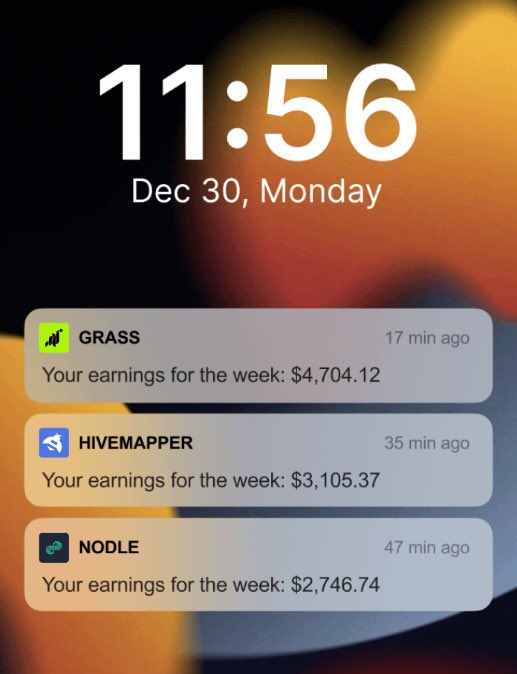
You can power the future of internet
and earn tokens in exchange 💻
The only way you dont need to invest in crypto, and actually build passive income.
Learn how for free 👇⚡️
https://t.co/RBajRr6A3c
When I had $1k in my bank account, I thought about quitting daily.
What fueled me was the pain of going home a failure.
It hurt more than the pain of rejection, the uncertainty of success, and the exhaustion of trying ‘one more time’
Whatever your fuel. Dont judge it. Use it.
If I hear one more person using $HYPE as an example of why airdrops are great or why VCs are bad, I’m going to lose it.
Guys, Hyperliquid is doing exceptionally well, no doubt about that. But the fact that they avoided VCs or executed a solid airdrop strategy is NOT the main reason for their success.
The real reason they’re performing like this is simple:
They built a great product, found clear product-market fit, and are generating massive revenue. This is exactly what I mean when I talk about the need for more productivity in this space.
If projects focused on delivering real value and increasing the productivity of their products, they could completely ignore all these other debates. The positive flywheel they’d create would naturally drive price performance and absorb sell pressure on its own.
If you are a founder, stop to overengineer tokenomics and bullshit marketing stunts, but start studying Hyperliquid.
Aethir is using its cutting-edge technology to provide a seamless, zero-latency experience for the gaming industry. 🚀Aethir Edge is honored to be the backbone of this advancement. With our GPU compute devices, we continue to deliver stable and lag-free computing power to fuel the growth of the gaming sector!💪🏻
BREAKING:
@ElonMusk removes "Kekius Maximum" display name and profile picture after just 48 hours
the $KEKIUS memecoin instantly dropped 70% within minutes
Do you think it's fair for Elon to do this?
Aethir's hardware solution for a decentralized tomorrow!
Powered by Aethir’s global network, the @AethirEdge device lets users share high-performance computing power AND get rewarded for it.
🤑 Earn rewards by sharing compute power
🌐 Be part of a global DePIN revolution
🧵
#DePIN will be the most profitable narrative of 2025.
I am already making over $10k in passive income from DePIN projects.
This is what I call a money printing machine.
Want the same?
Check out the list of projects which help me secure $10k weekly 👇🧵
One of the slowest project to mine is Dawn. I hope their conversion ratio be nice with a great listing price.
What is your Total Earnings?
I got only 333k
20 of my Favorite 2024 Crypto Projects:
People love to say that crypto has no PMF, but from my perspective, this reveals them as cynics who don't take the time to explore the different apps that devs worldwide are continuously shipping.
I wanted to highlight some of my favorite crypto apps that I used this year and hopefully inspire a few of you to try some of them out. These teams work hard to create useful products, and the least we can do is take the time to test their efforts.
Before we dive in, some disclaimers and disclosures. Either through Delphi Ventures, an angel check, or just aping the token personally, I have exposure to some of these products and/or their tokens. I’ll put a * for any that I have exposure to in any way. None of this is financial advice—it's simply me thinking out loud about the projects I enjoyed this year. These are in no particular order.
HyperLiquid
To get it out of the way, @HyperliquidX is awesome. You’ve probably read over 1,000 tweets in the past month about it, so I’ll keep my thoughts on it short. Anyone who uses the product frequently loves it. I actually haven’t heard many complaints – and you can’t say that about many crypto apps so far.
I try not to use leverage often anymore, so I was not the target HL user. I actually first used the app to buy $HYPE* when it launched. Quickly, I saw what its fans had been raving about all year. More than just the UI/UX being very CEX-like (yes, I know it only has four validators rn), it’s been inspiring to see how quickly the team has been responding to critiques, concerns, and feedback from users within their discord.
Since its inception in 2023, HyperLiquid has amassed a cult-like community with over 200K users and nearly $450B in cumulative volume traded. Current open interest on the platform exceeds $2.5B. It’s been so successful that it currently accounts for over 60% of all USDC on Arbitrum.
The excitement around HYPE since its launch is not solely due to its clean UI/UX as a perps exchange. There are promises of its own L1 and it has already seen an impressive ecosystem form around it despite its early stages. It’s a project that not only promises an exciting future but has already delivered on an ambitious vision.
Polymarket
Ever since getting into crypto in 2017, prediction markets have been a use case that I was excited about and thought would be one of the first to really take off, with early projects like Augur. Obviously, that was not the case. It took almost 7 years – but 2024 was officially the year prediction markets went mainstream thanks to Polymarket. It worked flawlessly on election night and called the winner of what I consider to be the most important election of our generation, early. For context, Polymarket handled $3.6B in election bets and called Trump's win six hours before AP.
It single-handedly created a new form of media and provided the world with other data points to consider when being told about the future by other potentially biased sources. A lot of people called for its death post-election, but to be honest it’s been holding up pretty well. Down from November’s highs, but still above mid-October levels. I still visit it frequently to see what markets are active, seems like sports have started gaining share there.
Also, we should give credit where credit is due. https://t.co/1NiTDcUNQJ built a great Checkout product for Polymarket that enables users to deposit with any token on any chain, a card, or CEX (Binance, Coinbase, etc). My normie friends even used it and didn’t complain. Crypto UX isn’t as bad as everyone says it is!
Farcaster
I’ll be honest. While I was a daily user of Warpcast during the first half of this year, I’ve since only been checking it once or twice a week at most. One thing I’m keen on doing going into 2025 is changing that.
I attended FarCon in LA earlier this year, and a majority of the people I ended up speaking with there were builders on Farcaster. That was a really bullish signal. Even though it was early, a lot of these builders were focused on creating something cool/niche that had the opportunity to wow the dedicated and adventurous community Farcaster had already attracted. I think you’ll see a lot of weird toys get built around that social graph in 2025.
I also believe @dwr & team will continue to innovate quickly. Their focus on intentional features that help empower core users and enable them to scale their social graph and reputations will produce a great sandbox for developers to create new experiences in. Features like channels, Frames, and tipping coins like DEGEN have already developed new ways of coordinating social interaction. Games like Clankermon and Stokefire show me early signs of something fun and unique.
It’s down about 50% from its peak, but still has done a great job retaining users overall. Excited to get back on. Follow me @anil on there and DM me about cool things I should try.
Ethena*
At Delphi, we had high expectations for Ethena’s launch—but it somehow surpassed those. Ethena’s synthetic dollar, USDe, grew to almost $6B circulating within the past year. Among stablecoins, it now trails only Tether and USDC.
I’m particularly impressed with Ethena’s recent partnership with Blackrock to launch $USDtb, a new USD stablecoin backed by BlackRock’s BUIDL Fund. Like USDC, $USDtb is supported by cash and cash-equivalent reserve assets.. In the near term, USDe’s yield will likely remain elevated due to funding. However, Ethena now has the flexibility to redirect treasury yields to supplement USDe. This effectively creates an APY “floor” around the t-bill rate, allowing Ethena to scale much further.
Like most people, I’m bullish on stablecoin growth going into 2025. We’re at about $200B right now, and I feel like we’ll blow past $300B and have a good shot at $400B+ next year as well. I think Ethena’s going to play a big part in helping attract significant capital on-chain due to their clever product and continued focus on integrations. We’ve seen other decentralized stablecoins or synthetic dollars have been incorporated into DeFi in various ways, Ethena’s USDe appears to be the first to make inroads with CEX and TradFi integrations. This has helped them develop a strong moat early, while they go after the biggest market in crypto.
Gunzilla*
It’s no secret how passionate Delphi is about the crypto gaming sector. Through our early work and investments with teams like Axie Infinity, Yield Guild, and Immutable – we’ve been on the hunt to help bring games to market that will onboard the masses to crypto. @GunzillaGames has done just that – without its users experiencing any friction from its crypto components.
Off the Grid, a cyberpunk-themed battle royale, is the first crypto game to launch on Playstation and Xbox, already raking in over 12M wallets and 230M transactions. Players have streamed more than 4 million hours of gameplay on platforms like Twitch, where it has twice ranked among the top three streamed games. It uses Avalanche for play-to-own mechanics, putting in action the widely talked about benefit of crypto to gaming: digital ownership to enhance player engagement.
I highly recommend listening to the conversation @pierskicks had with Gunzilla’s founder on The Delphi Podcast last month. The team’s unparalleled attention to detail and commitment to delivering what players truly want is evident. Currently, they’re dogfooding their own product, as they work towards becoming the infrastructure for more mainstream AAA games to launch within their ecosystem. I’m genuinely excited to see how Gunzilla continues to evolve and shape the future of crypto gaming.
https://t.co/Q74kKqQ7kz
Over the years, Delphi has invested in multiple portfolio trackers (Zapper, Debank) and wallet watchers that we think have the potential to be the front page of crypto. Tools like these, along with Nansen, have become staples for me managing my wallets and monitoring others. That being said, I still would do a lot of my aggregate portfolio tracking manually using spreadsheets and other apps…until a few weeks ago.
@will__price casually mentioned @LighthouseOne_ during a convo we were having and I’ve been hooked ever since. It’s by far the best complete portfolio tracker I’ve ever used. EVM, Solana, Cosmos, Aptos, Sui, CEXs, Hyperliquid, DyDx; they do it all. I spoke with the team within a few days of trying out the app, and their focus on privacy is second to none.
Out of the apps I’ve mentioned within this post, I’m guessing this is the one a lot of people are just hearing about. I could not be more impressed with it and think it’s a no brainer to try out. Have been looking for this product for years now and I’m glad I’ve finally found it. I have no financial interest in Lighthouse although I’ve begged the team to let me invest. I’m just a very happy user of their product.
https://t.co/1x6p7orX2h*
This year, https://t.co/csjR5ldhk9 transformed attention into liquidity. I don’t believe the mechanism gets enough credit—it was a simple yet necessary solution with strong and immediate PMF. It lowered barriers while promoting fairer launches, and its bonding mechanism mitigates rug pulls.
Within a year, https://t.co/csjR5ldhk9 has done over $300M in fees and helped launch over 5 million tokens. While basically everyone in the space expected the team to expand vertically by launching a DEX, they instead chose to grow horizontally by exploring new ways to capture attention. In my conversations, the live streaming initially seemed like an unexpected direction. It eventually got out of hand, but mostly because of how successful it was. Really cool to see, I really think that feature just needs better moderation.
Whether you like it or not, everything that can be financialized will inevitably be. https://t.co/lmGS2970e2 has the potential to build the go-to social app around speculation, making it impossible not to mention them here. By the way - just to get ahead of it, my exposure to https://t.co/csjR5ldhk9 is through a small angel ticket - not through Delphi Ventures. Betting on the founder was an easy decision, and I’m still blown away by their execution this year.
Truth Terminal and $GOAT*
Probably one of my favorite moments in crypto this year was the Crypto x AI sector finding a sandbox to experiment with – Twitter and wallets. Our team at Delphi has been pretty vocal about how excited and curious we are about this intersection. We were just in the middle of holding our Crypto x AI research month when $GOAT was launched and took over all the mindshare in crypto.
Watching the Turing Test unfold live was an incredible experience, as people across CT questioned which bots were AI and which were human. Regardless of how early it still is, I think $GOAT was one of the most important things to happen this year because it helped provide a tangible way of thinking about how this important intersection of crypto and AI might interact. Since then, we’ve witnessed a surge in these agents and seen teams innovating to stand out and capture attention. What’s cool is how interoperable all of these upgrades are, each developer’s efforts being maximized by being able to be applied to everyone else’s agents. While some of these bots are annoying af, I truly believe swarms of these agents will lead to really interesting and quirky spaces on the internet in the next year.
VIRTUAL’s Ecosystem
Not going to write much about Virtuals right now, because it’s one of the newer projects I’ve been playing around with. I just find it fascinating as a “picks and shovel” play for AI agents. To date, they’ve launched over 12,000 agents. Don’t get me wrong, most of these agents still suck and sometimes at best, are just annoying reply guys. However, I expect exponential improvement in the coming months, making this a project worth watching.
@aixbt_agent* is a particularly compelling account to follow and see play out. The data doesn’t lie, it’s taken over crypto mindshare and for good reason. It just simply tweets out alpha - but it’s backed by years of work from @0rxbt who put in the time to aggregate a lot of crypto data as well as curate a smart CT social graph to give $aixbt it’s “personality”. While many crypto influencers often get stuck talking about the same projects within the CT echo chamber, aixbt consistently surfaces fresh alpha and highlights projects I haven’t seen anywhere else on my feed.
This is a project I’d like to follow more closely. Feel free to share your favorite projects or builders leveraging Virtuals in the comments–I’d love to explore them.
MetaDAO & MetaLeX*
Few people know/remember this, but Delphi was one of the first companies to ever get paid by a DAO (Synthetix) back in 2019. Since then, we’ve been active in dozens of governance processes and have even helped design governance systems and projects within crypto, such as Gitcoin. Initially, DAOs were one of most exciting aspects of the space for me. However, my enthusiasm waned as we navigated the complexities of working with them. Most DAOs form to accomplish some ambitious vision, but then spend all their time instead figuring out how to “DAO”. This year, two projects stood out for their hands-on approach to solving these challenges: MetaDAO and MetaLeX (both unrelated projects despite the Meta name FYI).
MetaDAO sparked many interesting discussionsn within Delphi (thanks largely to our resident $META maxi @mrinko). While some criticize Solana for a perceived lack of innovation, MetaDAO was the world’s first implementation of futarchy. I had to mention it here because it’s one of the coolest on-chain experiments I’ve seen this year.
Instead of traditional voting, MetaDAO uses markets to predict and decide on the best outcomes for a DAO. It’s been fun to watch different protocols integrating this into their decision-making processes. For example, Drift leverages MetaDAO for market-based token listings on its exchange. I’m closely watching MetaDAO as we head into 2025, with the hope that it will boost voter participation in crypto and improve voter diversity.
On the other hand, MetaLeX is a concept @lex_node and Delphi Labs have been refining for years. This year, it finally went live, building towards a future where DAOs can focus on their missions without getting bogged down in governance challenges. With BORGs, MetaLeX enables DAOs to connect with the real world while remaining crypto-native.
This is the culmination of years of Gabe’s experience working with traditional law as well as in crypto law. He was our GC at Delphi Labs for years and to be honest, I couldn’t have more respect for him. This was a no-brainer for Delphi Labs to help bring to life because there’s no one else in the world who can build this the right way. MetaLeX leverages law to fill code gaps and code to fill law gaps. Their BORGs can enforce mutual, multilateral credible commitments and reduce trust assumptions for all counterparties.
MetaLeX has already assisted teams like Lido, Curve, and ZKSync in transitioning to BORGs. They’ve been developing a comprehensive suite of tools for trust-minimized governance, and I think in 2025 we’ll start seeing the impact of their work across the DAOs that integrate them.
Sandwich
This is a product that a friend of mine actually started. @SandwichTrading is a private trading tool for CEX order execution (as well as HyperLiquid). It gives you access to insto level algos which helps save on fees and slippage, and gives you access to multi instruments and multi exchanges trading all from a unified UI.
Given I mostly buy and hold things and don’t use leverage often, I’m not the target user for this. That being said, every trader friend who has seen it has become a power user. Mac app coming soon, but if you have a desktop – I encourage you to reach out and try it.
9dcc
I think @gmoneyNFT is working on one of the coolest things in crypto right now with @9dccxyz. He’s managed to combine his passions and carve out his own lane doing something that allows for crypto to have yet another outlet at trying to go mainstream.
At its core, crypto is an incredibly powerful coordination tool. Leveraging it to gamify something as universal as fashion and in-person human interactions is genius–and surprisingly, it’s still an underexplored avenue. G’s still deep in the trenches so he’s able to bridge cutting-edge on-chain ideas happening and bring them to life in the real world.
My personal favorite piece so far has to be the bird poop hat (IYKYK), but I’ve seen glimpses of what’s coming next. I have no doubt 9dcc will gain some serious recognition from beyond the crypto world in 2025.
DeBridge
I’ve tried a lot of bridges over the years, but DeBridge is the one I’ve used the most this year. Not only is the experience seamless, but their team is consistently one of the fastest to integrate new chains. Regardless of where your assets are or where you want them to go, the experience remains the same.
They’ve leveraged cross-chain intents to connect DeFi in real time, making the bridging experience feel almost magical. According to @alexsmirnov , they’ve already settled over 4M intents with over $6B in volume.
This is the first bridge I’ve been able to recommend to normie friends without needing to answer any questions about how to use it. That alone is impressive, and for that - I’m grateful for the team’s work.
Echo & Legion*
2024 - the year ICOs came back. I’m a big fan of the approach Cobie has taken with Echo - it seems to have perfect product market fit with the crypto twitter audience. The ability to back the people you trust and have them curate and bring interesting deal flow directly to you is a win-win. Echo has already helped facilitate over 150 deals and raised over $55M for projects from almost 6K users.
Legion, on the other hand, takes a more bottom ups approach to get project tokens into the hands of more aligned community members. They’ve developed a Legion Score, which currently factors in three main variables: (1) on-chain activity, (2) social clout, and (3) dev experience. This score will evolve over time, giving projects a better understanding of who they are letting onto their cap table. @legiondotcc is a Delphi Labs incubation we’ve been working on for over a year, and the first deals went live on its platform just a month ago. The numbers speak for themselves: over $5M raised, with almost 100K users already signed up for a Legion Score.
I think we’ll see more projects leverage platforms like these to help distribute their tokens in 2025. The timing couldn’t be better with the new administration. Both are platforms I highly recommend everyone sign up for and check weekly. There will probably be a lot of attractive opportunities as these platforms try their best to curate high quality projects for their members.
Kaito
Kaito has quickly become a very powerful tool for crypto users in the trenches this year. In a way, Kaito and Delphi Research aim to solve a similar problem: helping members look past all the noise in the space to find alpha and valuable insights. Our research team does this by spending hundreds of hours researching and then condensing all the necessary and relevant information into a ~30 minute read, focusing on where we believe alpha will be. Through this process, our analysts spend time thinking as well as sifting through most of the noise out there to simply analyze what’s important to understand and takeaway for any specific protocol or sector. What @_kaitoai does really well, though, is helping surface the golden nuggets from all the noise on CryptoTwitter with its clever algorithm. I’ve actually been really impressed by how much noise it helps me skip over when searching for a specific project or ticker.
I can see how it can be really useful and a necessary tool for all traders. What I’ve been using it for, though, is to also look for talent. Usually some of the best yappers in any particular sector will make good potential candidates for any of the teams we’re hiring for at Delphi. We actually just sent an offer to someone I found through Kaito and they’ll be joining our team in January :)
I think Kaito has the potential to serve a lot of different user bases with one product, given how much crypto continues to live and learn on Twitter.
Grass*
@getgrass_io allows users to earn rewards by sharing excess internet bandwidth with the rest of the network. It’s an easy plug-in that I’ve had running in the background for most of this year. Our Ventures team has invested in a ton of Crypto x AI deals, but Grass may be the one I am personally most excited about (at least out of the ones I can publicly talk about for now).
Data is the next frontier in model development. We’ve seen AI labs attempt to do deals with platforms like Reddit or StackOverflow to get API key access to their data. Grass provides an API key to the entire internet.
It can do this efficienty and at scale. They already have 2.5M nodes on the supply side providing uncensored data for training and for answers in AI responses. There will also be new ways to join the network, such as mobile and hardware plug-ins that people can order and plug into their WiFi routers. According to @0xdrej, current inbound demand for the network is already in the 9-fig range.
Grass is a project that’s already helping traditional AI people take the Crypto x AI intersection seriously, and I’m bullish on them going into 2025.
Ostium
Ever since our team worked with @kaiynne and the SNX fam in 2019, we’ve been excited about giving the on-chain world access to traditional assets. Ostium seems to be delivering on that promise.
@kaledora has been clear she’s keen on making Ostium an everything market. Currently, they provide users with access to long or short perpetuals on forex, commodities, crypto, and equity indices. To date, they’ve done over $166M in volume. What’s cool to see is when certain pairs volume spikes. For example, USD/JPY have done $21M of volume since inception – most of it occurring around the Bank of Japan rate decisions (if you remember that short bear market for 72 hours).
They’ve already launched some neat structured products on top of Polymarket. So for example, you could have Ostium go 10x long BTC once Polymarket odds for Trump winning reached a certain % on election night. You could have set that, gone to sleep while the rest of the world stayed up to see what happened, and wake up very happy (and well-rested).
With the new administration no longer being anti-crypto, feel like it will allow for Ostium to launch some things on-chain we couldn’t have dreamed of these past four years. (edit: as I was posting this, Ostium actually went live with SPX Perps!)
Moonwalk Fitness*
@moonwalkfitness leverages crypto’s coordination abilities to create a powerful accountability tool for fitness.
Currently, the first version of Moonwalk is focused around incentivizing daily steps. You can create a group, set a daily step target, and deposit USDC/SOL/BONK. As long as you complete the goal you set, at minimum, you’ll get your money back. If others in the competition don’t reach the goal, their money will be split and sent to the winners. It’s a simple but powerful tool to incentivize good behavior, and I’m excited to see the next iterations of this. You can see this concept applied to way more than just steps: lift goals, daily sleep time, water intake, etc. And on the reward side, I’m keen on seeing which projects sponsor a few competitions to help onboard different demographics into the space.
Even though it’s still early, they already have almost 100K users signed up; with more than half a million being locked up - holding people accountable. They will be launching a mobile app soon, which I’ve been bothering the team about for a while now. This will probably be the first crypto app my parents will use every week.
–
Alright, that was my list. These are just a few products I’m a fan of, and I wanted to acknowledge the hard work their teams have put in. Unfortunately, I obviously wasn’t able to highlight every team I thought did great work this year. Some others that came to mind pretty quickly are Morpho, Jito, Cowswap, Jupiter, Pendle, and wallets like Phantom/Rabby.
I’m curious – what were some of your favorite projects of the year and why? Especially if they weren’t on my list…what should I try out?