LLM Knowledge Bases
Something I'm finding very useful recently: using LLMs to build personal knowledge bases for various topics of research interest. In this way, a large fraction of my recent token throughput is going less into manipulating code, and more into manipulating knowledge (stored as markdown and images). The latest LLMs are quite good at it. So:
Data ingest:
I index source documents (articles, papers, repos, datasets, images, etc.) into a raw/ directory, then I use an LLM to incrementally "compile" a wiki, which is just a collection of .md files in a directory structure. The wiki includes summaries of all the data in raw/, backlinks, and then it categorizes data into concepts, writes articles for them, and links them all. To convert web articles into .md files I like to use the Obsidian Web Clipper extension, and then I also use a hotkey to download all the related images to local so that my LLM can easily reference them.
IDE:
I use Obsidian as the IDE "frontend" where I can view the raw data, the the compiled wiki, and the derived visualizations. Important to note that the LLM writes and maintains all of the data of the wiki, I rarely touch it directly. I've played with a few Obsidian plugins to render and view data in other ways (e.g. Marp for slides).
Q&A:
Where things get interesting is that once your wiki is big enough (e.g. mine on some recent research is ~100 articles and ~400K words), you can ask your LLM agent all kinds of complex questions against the wiki, and it will go off, research the answers, etc. I thought I had to reach for fancy RAG, but the LLM has been pretty good about auto-maintaining index files and brief summaries of all the documents and it reads all the important related data fairly easily at this ~small scale.
Output:
Instead of getting answers in text/terminal, I like to have it render markdown files for me, or slide shows (Marp format), or matplotlib images, all of which I then view again in Obsidian. You can imagine many other visual output formats depending on the query. Often, I end up "filing" the outputs back into the wiki to enhance it for further queries. So my own explorations and queries always "add up" in the knowledge base.
Linting:
I've run some LLM "health checks" over the wiki to e.g. find inconsistent data, impute missing data (with web searchers), find interesting connections for new article candidates, etc., to incrementally clean up the wiki and enhance its overall data integrity. The LLMs are quite good at suggesting further questions to ask and look into.
Extra tools:
I find myself developing additional tools to process the data, e.g. I vibe coded a small and naive search engine over the wiki, which I both use directly (in a web ui), but more often I want to hand it off to an LLM via CLI as a tool for larger queries.
Further explorations:
As the repo grows, the natural desire is to also think about synthetic data generation + finetuning to have your LLM "know" the data in its weights instead of just context windows.
TLDR: raw data from a given number of sources is collected, then compiled by an LLM into a .md wiki, then operated on by various CLIs by the LLM to do Q&A and to incrementally enhance the wiki, and all of it viewable in Obsidian. You rarely ever write or edit the wiki manually, it's the domain of the LLM. I think there is room here for an incredible new product instead of a hacky collection of scripts.
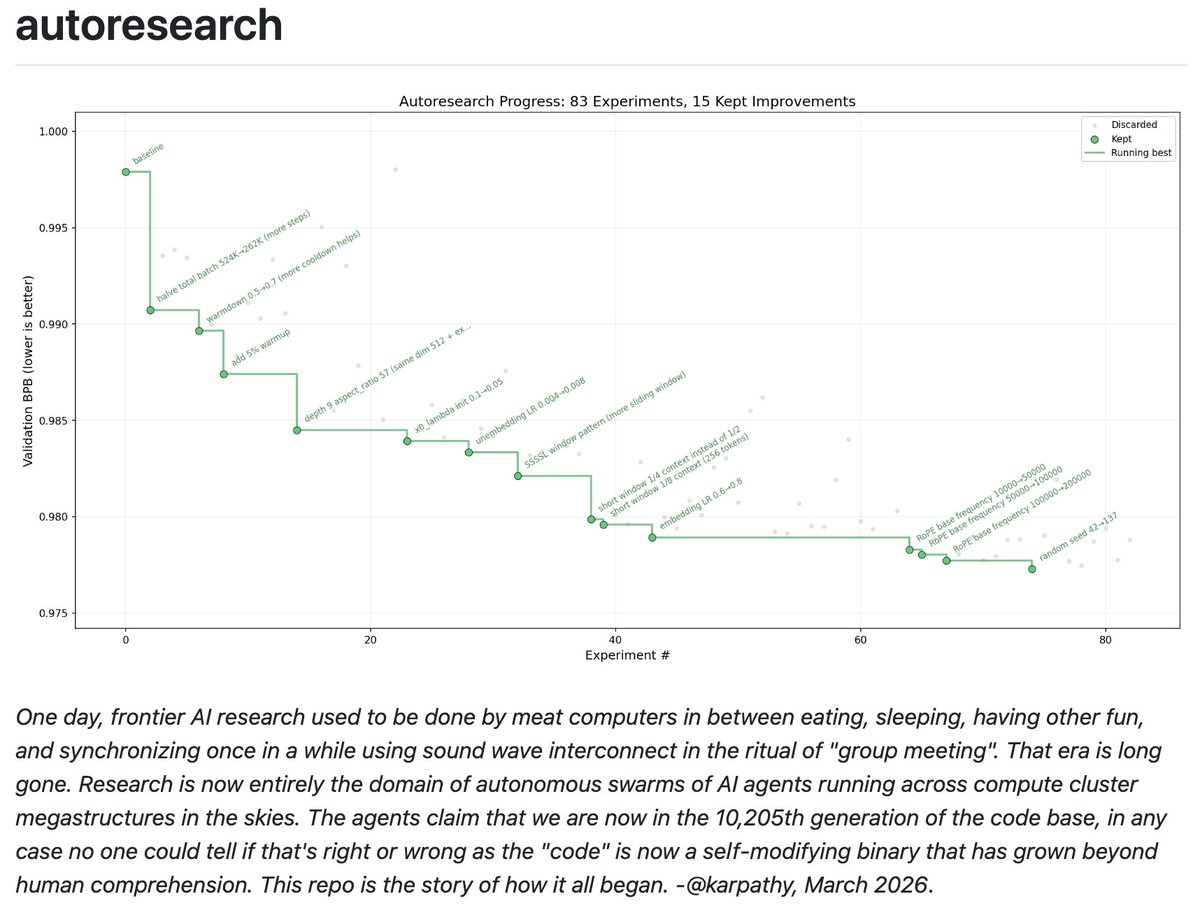
I packaged up the "autoresearch" project into a new self-contained minimal repo if people would like to play over the weekend. It's basically nanochat LLM training core stripped down to a single-GPU, one file version of ~630 lines of code, then:
- the human iterates on the prompt (.md)
- the AI agent iterates on the training code (.py)
The goal is to engineer your agents to make the fastest research progress indefinitely and without any of your own involvement. In the image, every dot is a complete LLM training run that lasts exactly 5 minutes. The agent works in an autonomous loop on a git feature branch and accumulates git commits to the training script as it finds better settings (of lower validation loss by the end) of the neural network architecture, the optimizer, all the hyperparameters, etc. You can imagine comparing the research progress of different prompts, different agents, etc.
https://t.co/YCvOwwjOzF
Part code, part sci-fi, and a pinch of psychosis :)
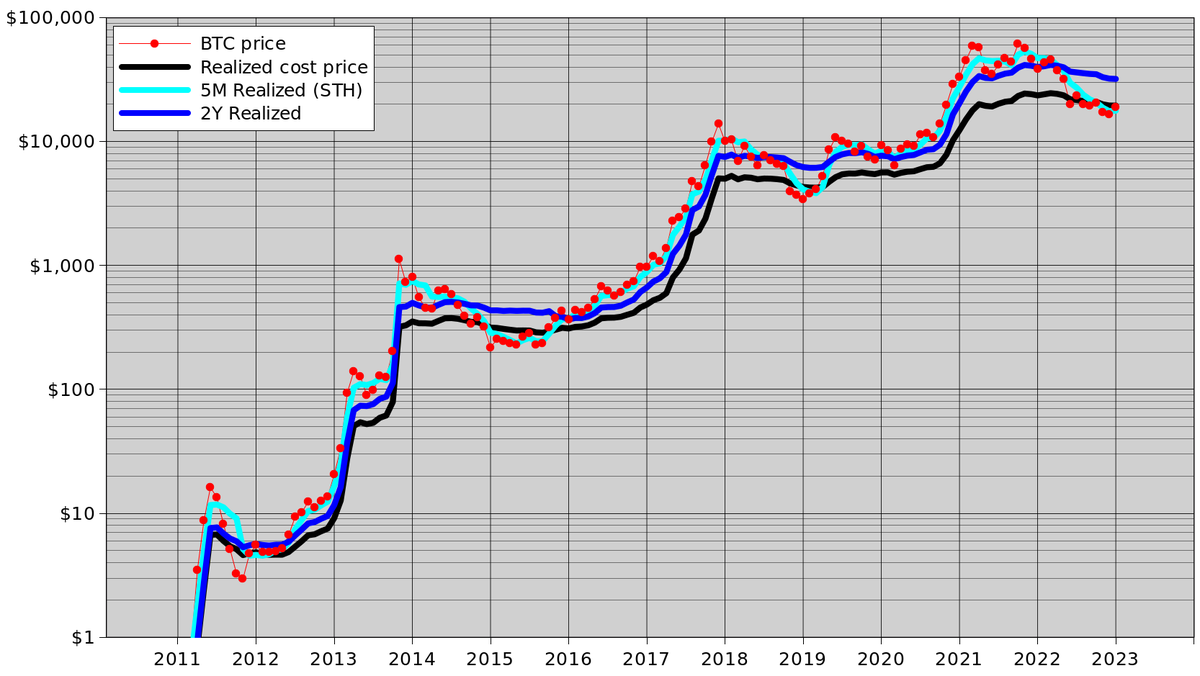
My prediction: 60K is the local beautiful bottom for Bitcoin; there are no reasons for its fall, only the desire to take bitcoins away from weak hands and futures are simply a tool for legal expropriation. From here on, Bitcoin will only go up.
Imagine having an autonomous AI trader that outperforms the market
@perptools is letting users claim one for free right now
I just claimed my AI Agent #4445
Grab yours before it closes 👇
https://t.co/srzXOjvaVx
ETHGas is introducing the Open Gas Initiative, letting protocols incentivize their users to grow onchain adoption while ending gas fees anxiety for good.
@odosprotocol, @1inch, @opensea … are you in? 👀
Join Open Gas: https://t.co/OFnNIcjomc
https://t.co/TasllHm1V2
Introducing the Open Gas Initiative - a way for protocols to subsidize gas for users, zero-code, for a seamless, frictionless onchain experience.
With OG cohort: @eigencloud, @ether_fi, @pendle_fi, @Velvet_Capital.
👇
Tired of those crazy gas fees? ⛽️
I'm teaming up with Gassy Jack on his mission to build a Gasless Future. Collect beans, tackle quests, and unlock rewards by joining us. Let's grow this together! 💪
https://t.co/M6oFXpDkT2
https://t.co/M6oFXpDkT2
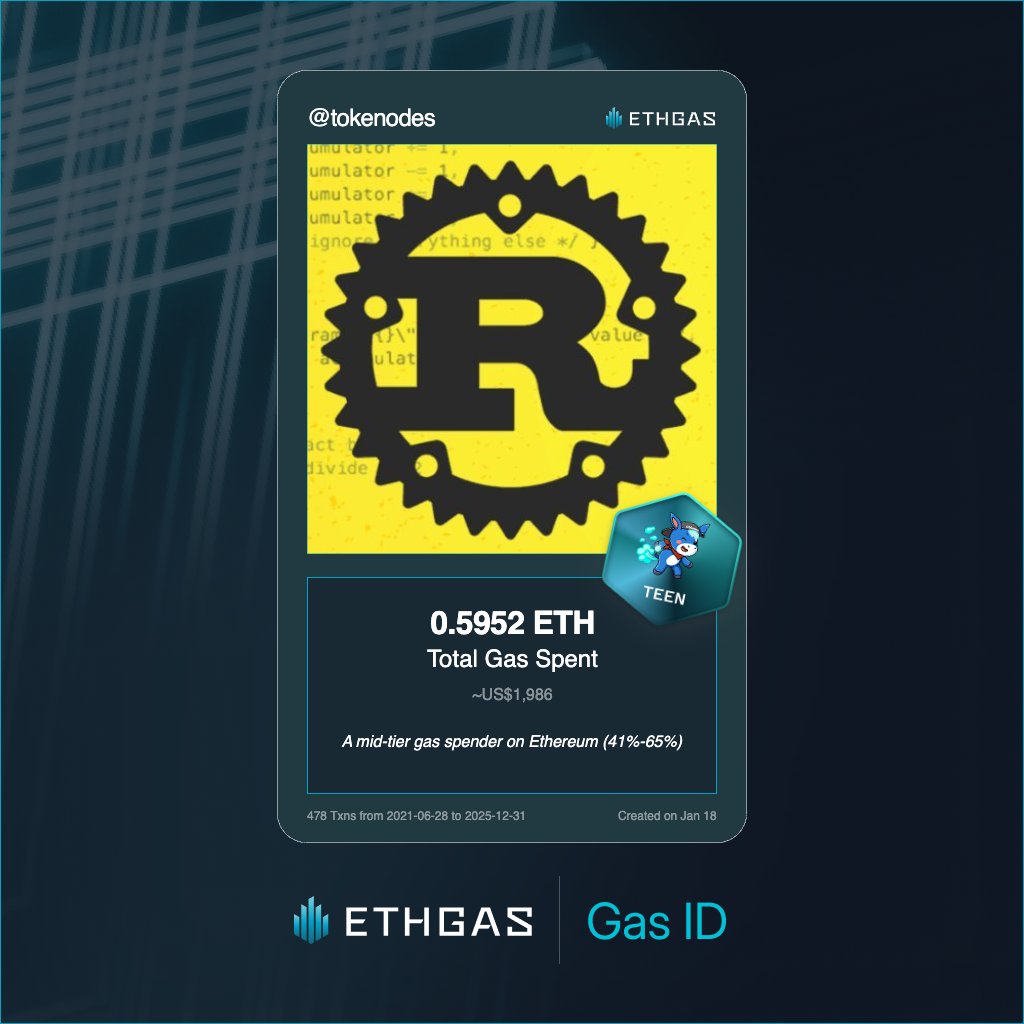
Leveled up in the Great Gas Reckoning with ETHGas! 💪
Teen Jack status: 0.5952 ETH gas spent, 240 Beans earned—supporting the Gasless Future!
Claim your Gas ID at https://t.co/JzEd5rIYQH
Yahoo!
This announcement brings together 3 projects that I love:
@Starknet 🤝 @NEARProtocol 🤝 @solana
Love Solana
Love NEAR
Love Starknet
Love that Starknet keeps on expanding and building bridges to new communities.
STRK is now live on Solana via NEAR Intents.
Send it baby!
Introducing Bitway: The Internet Capital Gateway for On-Chain Finance
Incubated and backed by @yzilabs via @EASYResidency Season 1, Bitway is founded by early members of Binance Labs and Chainspace, the blockchain scalability project later acquired by Facebook.
Bitway serves as the "Internet Capital Gateway," connecting on-chain liquidity with global financial opportunities. At its core, Bitway offers a suite of specialized products, including Bitway Earn, an on-chain wealth management platform built on the BNB Chain. This platform allows users to access institutional-grade yield opportunities in a transparent and decentralized manner, anytime and anywhere.
To accelerate early adoption, the product launch is supported by the @BinanceWallet Booster Program. In addition to native yield, a Points Program has been introduced, allowing users to earn future rewards in $BTW by staking USDT at https://t.co/8UPjNNuPvA.
🟨Join Colb's Genesis Quest on Galxe
Participate to mint your Genesis Colmeia NFT, unlock beta access, and claim an exclusive Discord role.
Bee somebody:
https://t.co/miN2zeI5Dp