🎬 Excited to share our paper: Joints, Camera, Action! (JCA)
JCA generates video & 3D motion together for any rig!
Video models generate motion you can watch. But what if you could use that motion to animate a 3D asset, with motion that responds to its surroundings?
https://t.co/Y7smggHv4w
🧵
In PRH, we argued that representational geometry is converging, but it's still an open question exactly in what sense.
I want to share some new evidence that might clarify the picture.
The evidence comes from our work here, led by @dominik_schnaus: https://t.co/2H5eptoglc
1/n
This is a result I’ve dreamt about for many years: *unpaired translation between images and text*
I thought it might be only slightly possible, the kind of thing you have to really squint at. But Dominik proved this wrong. You don’t have to squint. Worth looking for yourself:
DINOv2 has never seen a caption, and Qwen3 has never seen an image. We still aligned their embedding spaces without a single image-caption pair.
It even works when the images and the captions come from different datasets.
Project page: https://t.co/2YHSkXVz1D
⬇️
What if attention wasn't about matching tokens, but operating in function space?
Glad to share our #ICML2026 paper:
📄 Functional Attention: From Pairwise Affinities to Functional Correspondences
w/ @Jiefang_Xiao@GaoMaolin @stevenygd Daniel Cremers
📄 https://t.co/rhn9NtwrBm
A new technology developed at the Technion could significantly expand access to AI-powered video creation
Called Time to Move (TTM), the system enables users to create and precisely control realistic AI-generated video clips using simple mouse movements. Unlike previous approaches, TTM requires no retraining, no additional computational cost, and can be integrated directly into existing video-generation models.
Developed by Dr. @orlitany , Prof. Ron Kimmel, and students Asaf Singer, Noam Rotstein, and Amir Mann from the Henry and Marilyn Taub Faculty of Computer Science, TTM was presented at @iclr_conf 2026, one of the world's premier conferences in deep learning and artificial intelligence.
Both #CVPR2026 awards went to industry-supported papers. Yet… it’s an academic conference, and therefore it’s odd one can flex “compute muscles” to win an award.
The meaning of “student” award is far gone. We need a “best academic award”
Brain over brawl?
Excited to share our ICLR 2026 poster on Adaptive Canonicalization with @levie_ron
The core idea: instead of fixing a canonical form from the input alone, let the canonicalization depend on both the input and the predictor itself.
Happy to share that Time-to-Move has been accepted to @iclr_conf! 🇧🇷
It’s been exciting to see the community adopt this work over the past few months for enhancing control in video generation.
We’ll present it at the main conference this Friday, April 24, 10:30 AM–1:00 PM, and also at the ReALM-GEN workshop on April 27.
Feel free to stop by and say hi to me or @assaf_singer!
Thanks @_akhaliq for sharing our work!
Project page: https://t.co/hBSprg43rK
Technion researchers Dr. Gil Shamai, Prof. Ron Kimmel (Computer Science), and Prof. Dvir Aran (Biology) have developed an AI model that predicts who will benefit from chemotherapy—using routine pathology images, in minutes. A step toward faster, more accessible personalized cancer care.
#Technion #AIinHealthcare #BreastCancer #PrecisionMedicine
https://t.co/dbg2tKF14b
https://t.co/nqlfVKTMXK
Happy to share that our paper has been accepted to #CVPR2026!
Learning Eigenstructures of Unstructured Data Manifolds📄 https://t.co/qyfOct6jkc
We learn spectral bases directly from unstructured point clouds — no operator construction, no meshing, no eigensolver. Just a network that recovers eigenfunctions, eigenvalues, and the implicit sampling density from scratch.
Big thanks to my co-authors Arkadi Piven, David Bensaïd, @tom_dages, Daniel Cremers, Ron Kimmel.
See you in Denver!
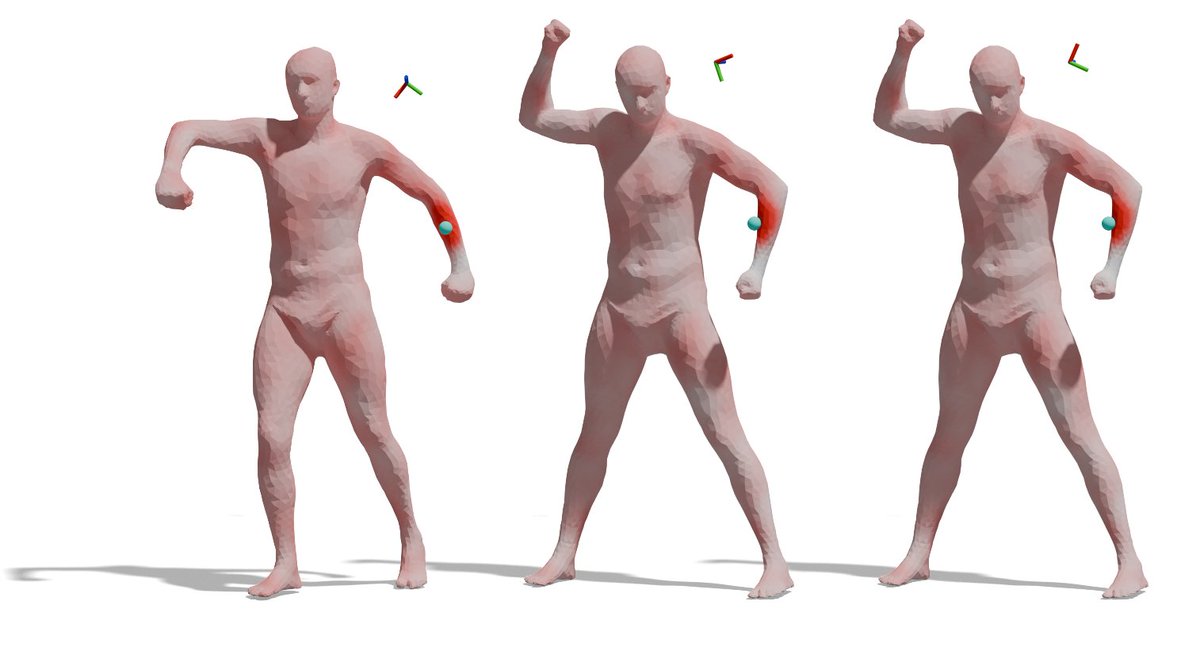
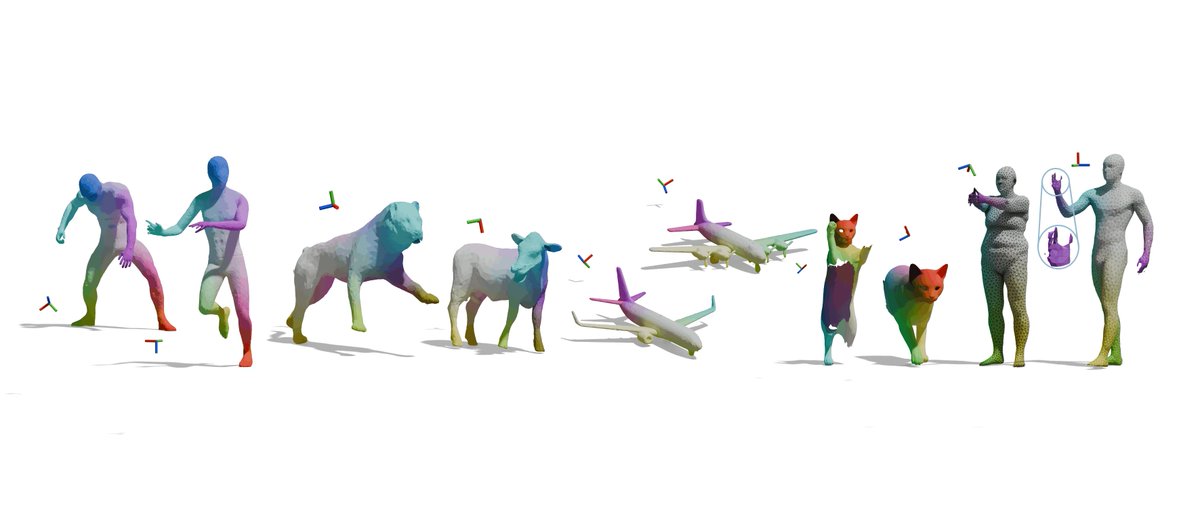
🚀 #CVPR2026 paper alert: 🦏 RINO: Rotation-Invariant Non-Rigid Correspondences
Our network learns robust SO(3)-invariant features directly from raw 3D geometry. End-to-end, no pre-alignment or handcrafted descriptors!
Joint work @tumcvg & @Stanford.
🎭 CaricatureGS is out!
Check out how you can make photorealistic 3D caricatures from your 3DGS avatar!
Project page: https://t.co/c0teU7w8FQ
Led by @EldadMatmon with @amit_bracha and @RonnyKimmel.
Will be presented at @3DVconf (#3DV2026).
Come meet me this morning to know more about my paper "Metric Convolutions", poster 373 #ICCV25 We propose a unifying theory to image convolutions with adaptive sampling locations, using both Riemannian and Finsler geometry, and a new convolution operation using explicit metrics
Low rank adapters like LoRA attach 2 matrices, yet their unequal scale can stall learning.
The paper introduces SINGLORA, a 1 matrix update that erases that clash and halves parameters.
It swaps BA for A times A transpose, so everything shares 1 scale.
That cut halves trainable numbers and lets a single learning rate behave.
Theory in the infinite width view proves the output stays bounded.
On MNLI SINGLORA hits 91.3% against LoRA 89.1% using 60% parameters.
DreamBooth similarity climbs to 0.151 over LoRA 0.143 with the same budget.
Both LLaMA-7B and RoBERTa show similar wins.
Rectangular layers just slice A to input rows, so nothing special is needed.
Learning rate sweeps shift accuracy by only 1%, showing friendly tuning.
The proof and data together show a 1 matrix is enough.
----
Paper – arxiv. org/abs/2507.05566
Paper Title: "SingLoRA: Low Rank Adaptation Using a Single Matrix"
Come meet us this morning to know more about our paper "Finsler multi-dimensional scaling", poster 462 #CVPR25
We propose new ways to visualise directed graphs and other asymmetric data using largely uncharted geometrical frameworks
Come meet us this morning to know more about our paper "Finsler multi-dimensional scaling", poster 462 #CVPR25
We propose new ways to visualise directed graphs and other asymmetric data using largely uncharted geometrical frameworks