How multimodal are unified multimodal models, really?
In our new paper, @benno_krojer and Donghao Zeng show that steering vectors learned in one modality transfer zero-shot to another (text ↔️ image)!
I'm excited about this evidence for shared causal directions across modalities!
🎬 Excited to share our paper: Joints, Camera, Action! (JCA)
JCA generates video & 3D motion together for any rig!
Video models generate motion you can watch. But what if you could use that motion to animate a 3D asset, with motion that responds to its surroundings?
https://t.co/Y7smggHv4w
🧵
Decoding the internal tokens of a transformer, as in Logit Lens, is widely assumed to reveal the information embedded in them. But does it necessarily?
Turns out this "explainability" behavior is due to an implicit bias, which can also work the other way in some conditions.
Are ViTs really as explainable as we think?🔍
We show that patch-token explainability (like in Logit Lens) is not inherent to ViTs, as commonly assumed!
Instead, it's a fragile byproduct of their training conditions.
1/7
🔗https://t.co/ROHTwBEmxX
w/ Ronen Schaffer,@t_michaeli
This is a result I’ve dreamt about for many years: *unpaired translation between images and text*
I thought it might be only slightly possible, the kind of thing you have to really squint at. But Dominik proved this wrong. You don’t have to squint. Worth looking for yourself:
DINOv2 has never seen a caption, and Qwen3 has never seen an image. We still aligned their embedding spaces without a single image-caption pair.
It even works when the images and the captions come from different datasets.
Project page: https://t.co/2YHSkXVz1D
⬇️
Excited to share that our paper "ParetoSlider: Diffusion Models Post-Training for Continuous Reward Control" has been accepted to @NeurIPSConf as an oral! 🎉
ParetoSlider enables continuous inference-time control over competing reward trade-offs with a single diffusion model, without retraining or maintaining multiple checkpoints.
Huge thanks to the great team @mikikiFin, @ArielBAMath, @YotamNitzan, @OPatashnik
Paper: https://t.co/jWyTpYUiaV
Project page: https://t.co/HjToAYSvjp
Code: https://t.co/yVVZk6DKKR
In our NeurIPS spotlight 💫 we show high order graph neural networks have a fundamental limitation: they can't distinguish simple spectrum graphs. We use canonicalization to solve this issue and integrate spectral info invariantly via a RoPE variant into Transformers!
Pretraining diffusion/flow-matching is simple and scales: noise a clean sample, regress against a closed-form target.
RL post-training can be made just as simple.
Reinforce Adjoint Matching (RAM) matches Flow-GRPO on SD3.5M in 50× fewer steps. Highest reward, no reward hacking.
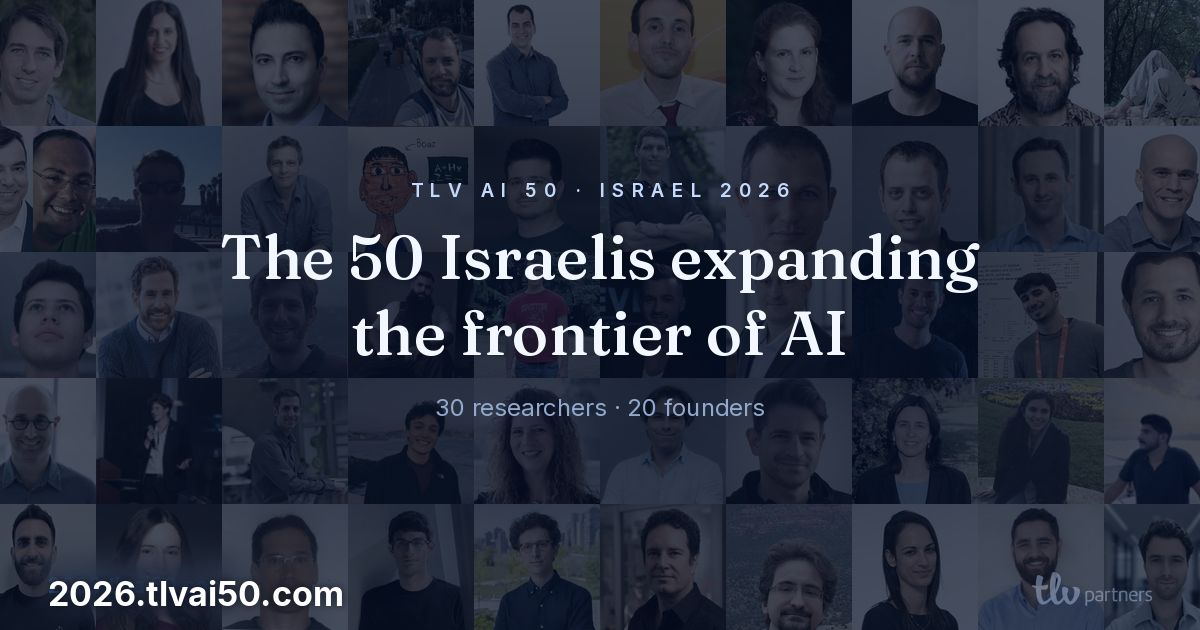
Ahead of Rosh Hashanah, we're publishing the TLV AI 50: a list of the 50 most influential Israeli AI researchers and founders. Their ideas shape how modern models think, see, and reason, and their companies turn those ideas into the chips, companies, and products the world runs on.
Full list: https://t.co/JlM80k2d0H
30 researchers, 20 founders, 7 papers. This is not a ranking, but rather a representation of the most impactful Israelis in the AI research realm.
Here’s a few trends that stood out:
• Israeli neolabs are finally emerging at the model layer
• AI security: a new cohort of AI natives is defining how systems get hardened and verified - Israel is firmly at the frontier
• Vision: some of the most cited labs anywhere, with startups now harnessing that talent for physical AI
Also featured are 7 noteworthy papers from up-and-coming Israeli researchers, below the list.
Exciting news, geometers! 🌐
The Workshop Bridging Optimal Transport, Learning and Structured Data: Toward Geometric Distributional Learning, will take place in person on December 12 or 13 in Paris, France, as part of #NeurIPS 2026.
W/ @JustinMSolomon and team!
1/6
Codex found a proof of a 2017 conjecture in algebraic combinatorics—one I often revisited in grad school.
Of the original paper’s 14 numbered conjectures, it was one of only 3 with no substantial follow-up in the literature.
Write-up + Lean: https://t.co/Ido2c9zuck 🧵
Come talk about efficient & effective inference-time alignment and refusal @icmlconf!🇰🇷
🔹 Knowing When to Quit (main),
Tue 10:30–12:15, poster #2010 - https://t.co/QtSwaitfRr
🔹 Value-Filtered Decoding (AI4Good), Friday
8:50–10:00 & 14:45–15:00 - https://t.co/IMFOqxS4DR
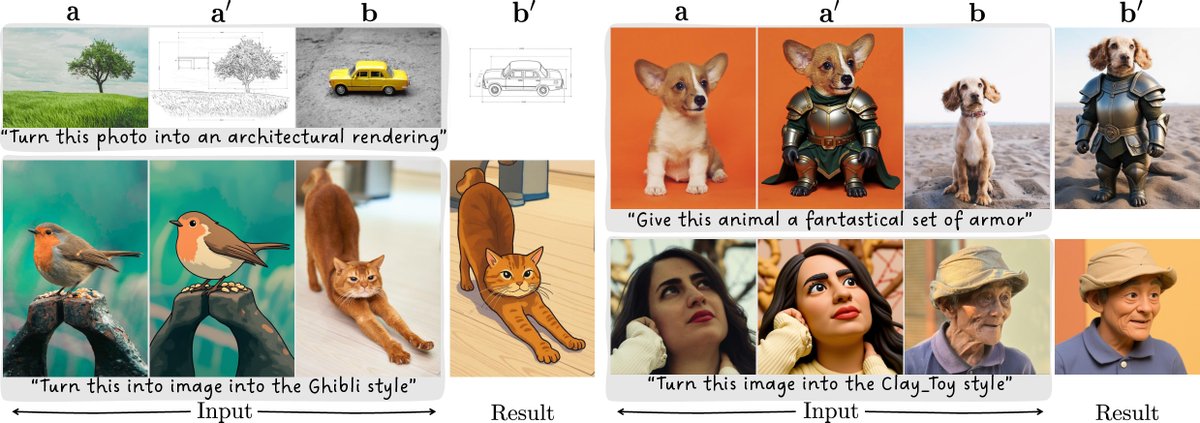
"Spanning the Visual Analogy Space with a Weight Basis of LoRAs" is heading to #ECCV2026🥳
We learn to dynamically mix LoRAs to improve analogy-based image editing.
🔗https://t.co/13RB6msU9b
w/ the amazing @RinonGal@HaggaiMaron@GalChechik at @nvidia & @t_michaeli🤩
@eccvconf
Happy to share 🌐 SP³: Spherical Priors for Plug-and-Play Restoration, where we use Spherical Encoders as fast generative priors for image restoration.
TL;DR — strong zero-shot restoration, 3-630× faster than comparable diffusion/flow methods, and useful results from the first iteration.
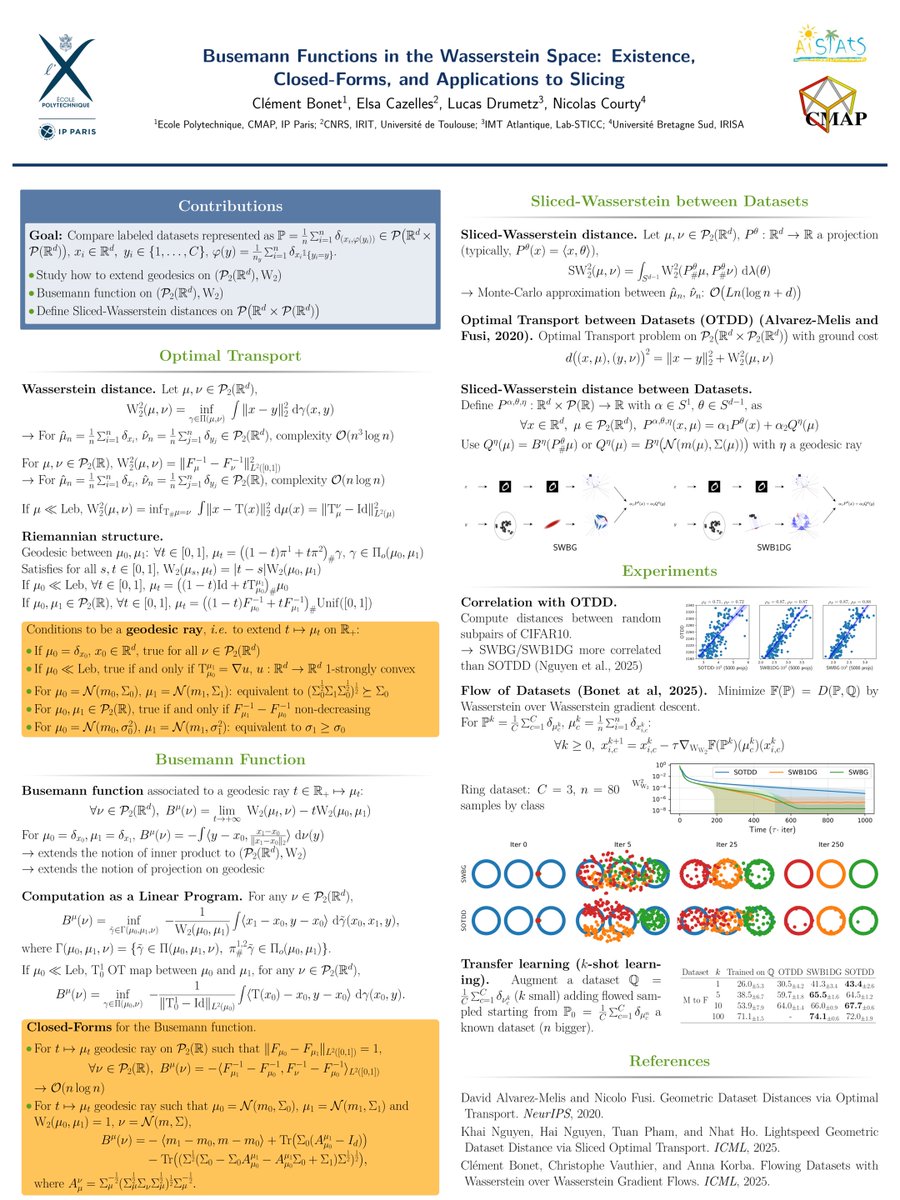
Our work "Busemann Functions in the Wasserstein Space" was accepted at #AISTATS2026
This is a joint work with Elsa Cazelles, Lucas Drumetz and @nicolas_courty.
I will be presenting it tomorrow at the poster 96, see you there!
Link: https://t.co/PYz53som3g
I'm at AISTATS in Tangier this week to present PJAX, our framework for training neural networks using projections instead of gradients. Happy to see you at the spotlight presentation tomorrow, or chat at the poster.
Arxiv: https://t.co/YQjsqtxuxb