@StoChain 24/7 markets require more than longer trading hours—they need resilient clearing, settlement, and risk management. The infrastructure is evolving first, and regulation is beginning to catch up.
The SEC will host a public roundtable on September 17 to examine what it would take to support 24-hour trading in U.S. equity markets.
The discussion will cover preparations for overnight trading, operations and resilience in a 24-hour market, and the opportunities and challenges of expanding trading hours. The roundtable itself is not a rule proposal or approval.
But the infrastructure shift is already underway. NSCC has moved to 24×5 clearing, allowing trades executed across extended hours and multiple time zones to enter central clearing on a near-continuous basis.
This shows why 24-hour trading is not simply about keeping exchanges open longer. Market data, trade reporting, clearing, settlement, corporate actions, and risk controls must also function reliably across overnight sessions.
Expanding market access will ultimately depend on whether the systems behind each trade can operate beyond traditional market hours.
#STOChain #RWA #Tokenization
@StoChain The UK is moving beyond stablecoin discussions to real-world testing. If successful, digital securities could settle instantly using regulated stablecoins, marking another major step toward modernizing capital markets.
The UK is testing whether stablecoins can support digital securities settlement within the Digital Securities Sandbox. Participating firms may apply to use a specific stablecoin as the payment asset for digital securities transactions, subject to case-by-case approval by the Bank of England.
Eligible stablecoins must meet standards for redemption, independently attested 1:1 backing, reserve safeguarding, operational resilience, financial crime controls, and holder protection in insolvency.
The broader implication is that tokenized capital markets will not be defined only by how securities are issued or traded. They will also depend on which form of digital money can reliably complete the cash leg of settlement.
If stablecoins can meet wholesale market standards, the asset and payment sides of a transaction could operate within the same digital infrastructure. This places stablecoins alongside tokenized deposits and commercial bank money in the competition to become a trusted settlement asset for regulated tokenized markets.
#STOChain #Stablecoin #Tokenization #RWA
@StoChain Tokenization is moving beyond secondary markets—it's becoming part of capital formation itself. A major step toward the future of public markets.
Cantor Fitzgerald and Securitize are bringing tokenization into the IPO process.
The partnership aims to support IPOs and follow-on offerings through blockchain-based infrastructure. Cantor will contribute its equity capital markets and trading capabilities, while Securitize will provide the technology for issuing, distributing, and servicing tokenized securities.
This goes beyond representing existing shares onchain.
It brings tokenization closer to primary capital formation, where companies issue equity, reach investors, and raise capital in public markets.
The next stage of tokenized equities may not be defined only by 24/7 trading or blockchain-based ownership.
It may begin with how public securities are issued in the first place.
#STOChain #Tokenization #RWA
The UK is moving beyond permitting tokenization and toward building a wholesale market that can operate on tokenized rails.
A programme involving 54 financial and digital asset firms will develop live use cases over the next 12 months, beginning with tokenized repo.
Key priorities include:
✅ Digital gilt DIGIT and tokenized securities
✅ Tokenized collateral for repo and liquidity
✅ Tokenized funds and digital settlement rails
✅ Interoperability between DLT and existing infrastructure
✅ Legal clarity, tax neutrality, financial crime controls, and operational resilience
The goal is not simply to put more assets onchain, but to connect issuance, collateral, payments, and settlement within a regulated market system.
The UK is moving from isolated pilots toward a coordinated transition to tokenized finance.
#STOChain #Tokenization #RWA
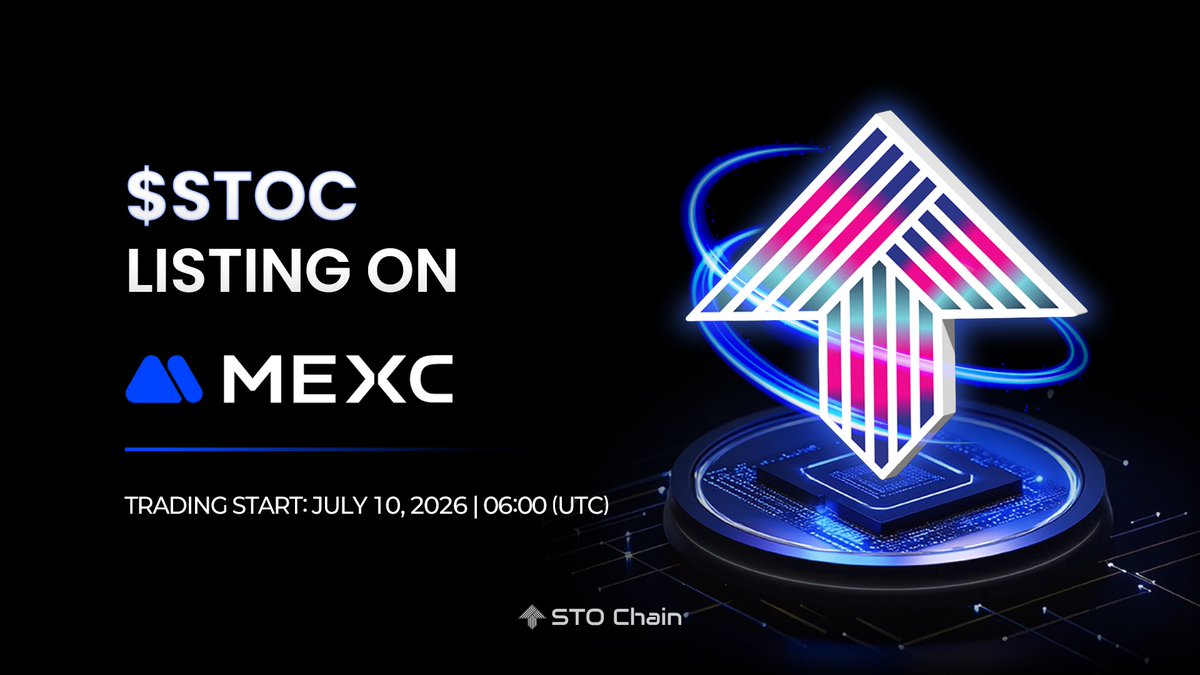
$STOC is officially listing on @MEXC 🚀
This marks a major step for STO Chain as we expand to a broader global market through the upcoming MEXC listing.
📈Pair: STOC/USDT
📅Trading Starts: JULY 10, 2026 | 06:00 (UTC)
🔗 https://t.co/LZYF7WF6jX
#Listing#STOC#STOChain#MEXC
@StoChain A key shift is that tokenized equities are evolving from blockchain-based investor access into issuer-backed capital market infrastructure. When companies tokenize their own shares, ownership, compliance, and settlement can increasingly operate on the same onchain rails.
Tokenized equities are moving beyond access products.
Securitize began trading on the NYSE under the ticker SECZ and brought tokenized versions of its own common stock onchain through its regulated platform.
This is different from third-party wrappers or synthetic stock exposure.
The issuer itself is participating.
That matters because tokenized public equity is no longer only about giving investors blockchain-based access to stocks. It is becoming a test of how public-company ownership can connect with regulated transfer, eligibility checks, shareholder records, and onchain settlement infrastructure.
Tokenized stocks are becoming a market infrastructure story.
#STOChain #Tokenization #RWA
The IMF says tokenization could change the architecture of the financial system.
The important point is not only faster settlement or lower friction. When assets, payments, and settlement move onto shared ledgers, financial risk can also move from institutional balance sheets toward platforms, code, and market infrastructure.
That creates a different kind of financial system. Traditional markets are slow, but the delay also provides buffers through clearing, reconciliation, reporting cycles, and liquidity management. Tokenized markets can compress these steps into moments.
This can reduce counterparty risk and operational friction, but it also makes infrastructure more critical. Settlement assets, platform governance, interoperability, legal finality, and real-time oversight become central to market stability.
Tokenization does not just put financial assets onchain. It changes where the financial system carries risk.
#STOChain #Tokenization #RWA #Stablecoin
[$STOOS → $STOC Migration Notice for MEXC Holders]
$STOOS held on MEXC will be migrated to $STOC as part of the STO Chain Mainnet migration.
Migration Details
Mainnet: STO Chain Mainnet
Ticker Migration: $STOOS → $STOC
Swap Ratio: 1 STOOS = 5 STOC
$STOOS held on MEXC will be migrated through MEXC.
On-chain holders can apply for migration through the official bridge:
https://t.co/ncY4kcuroA
@StoChain Institutional capital isn't just adopting stablecoins—it's building the reserve infrastructure that makes digital dollars scalable and trusted.
Stablecoin growth is no longer only a payments story.
Invesco has filed to launch the Invesco Stablecoin Reserves Onchain Fund, a tokenized money market vehicle designed to hold cash and short-term U.S. Treasuries for payment stablecoin reserves.
This is not about another asset manager entering tokenization. It is about the reserve layer behind digital dollars becoming an institutional infrastructure market.
For stablecoins to scale beyond crypto liquidity, they need more than issuance and circulation.
They need credible reserve assets, regulated liquidity, compliant recordkeeping, and operational links between traditional money markets and onchain ownership.
The competition around stablecoins is moving from the front end of payments to the back end of reserves.
As digital dollars scale, the infrastructure behind them may become just as important as the tokens themselves.
#STOChain #Stablecoin #Tokenization #RWA







![StoChain's tweet photo. [$STOOS → $STOC Migration Notice for MEXC Holders]
$STOOS held on MEXC will be migrated to $STOC as part of the STO Chain Mainnet migration.
Migration Details
Mainnet: STO Chain Mainnet
Ticker Migration: $STOOS → $STOC
Swap Ratio: 1 STOOS = 5 STOC
$STOOS held on MEXC will be migrated through MEXC.
On-chain holders can apply for migration through the official bridge:
https://t.co/ncY4kcuroA](https://pbs.twimg.com/media/HMhT5o1a4AAaJmO.jpg)


