Ha-Joon Chang at a workshop in London this week: “When I did my PhD in the 1980s on the importance of industrial policy, people reacted as if I were trying to prove Elvis was still alive.”
🎓 NEW EP!
Universities replaced civics ed with careerism & replaced tenure w/adjuncts. @sdgrumbine and @NolanHigdonCML on how neoliberal restructuring made higher ed defenseless against fascist capture.
https://t.co/jWzmdGtvKL
@JEShannon3@Ric_RTP Do you buy the idea that economists, at least macro economists, are to businesses what epidemiologists/public health folk, are to doctors and patients? 2/2
@JEShannon3@Ric_RTP It’s like public health v. personal health, no? As we are seeing, if everyone exercises some right to opt out of, say, vaccines then we are all at risk. 1/2
@JEShannon3@Ric_RTP The “twist” comes from looking at it only from the pov of the employer/employee interaction. If the employer always wins the race to the bottom on wages, the wage earners eventually can’t afford what the employers are selling => recession/depression. Gotta look macro.
The Greek prime minister said Chinese production capacity could destroy Europe.
But the irony is obvious:
This only becomes a “global threat” when China does it.
The United States once accounted for around 50% of global manufacturing during World War II.
After World War I, its share was already around 38%.
Both were far higher than China’s share today.
Back then, nobody called it “overcapacity.”
Nobody said America was destroying the world.
Nobody demanded Washington shrink itself for the comfort of weaker competitors.
It was called leadership.
It was called productivity.
It was called the reward of industrial power.
But when China reaches 30% through factories, infrastructure, supply chains, engineers, workers, ports, grids, and industrial discipline, suddenly Europe discovers the word “danger.”
Please.
China did not destroy European industry.
Europe hollowed itself out.
Europe outsourced production.
Europe worshipped finance, regulation, luxury branding, and green slogans while letting its industrial base decay.
Then China kept building.
Now the countries that gave up manufacturing are angry at the country that did not.
In the end, this is what happens when Western undercapacity meets Chinese competence.
They call it “Chinese overcapacity.”
"But rising wages can compress profit margins. As profits come under pressure, firms become more cautious. Investment slows." This is this the crux of it. Usury. Capital funds and leveraged creditors demanding consistently high returns. Workers and their communities will never be anything more than unit costs. Bollocks to their pandering 'job guarantee' or 'UBI'. We need an updated market socialism with public sector work fulfilling human needs.
A key idea in Chinese statecraft since ancient times is that the state has a responsibility to stabilize inherently unstable markets for essential commodities (see How China Escaped Shock Therapy). Public stockholdings like the ever normal granary participated in the market buying when prices are low and selling when prices are high for centuries with the goal of stabilizing supply and demand, prices and ultimately the value of money.
Now China is doing just that with the global oil market: It has drastically reduced its imports, hence pushing down demand in a time of global supply shortages. This is possible thanks to massive public reserves and strategic redundancy (some like to call this “overcapacity”). @JavierBlas finds that the number one reason why oil prices have not shot above USD 100 is China, China and China.
Imagine how much more stability the world could enjoy, if all countries engaged in such buffer stock stabilization for essentials such as grain. I have been calling for this at the G20 food security task force last year (see link below).
@DanNeidle So all the homeless people I dodge every day have simply made bad choices, eh? You should learn something about what averages mean, my friend. If the upper 1% gets much richer, the avg—and the median—goes up, but the bottom folks still can’t afford the rising prices, no?
@DanNeidle They are *current* conditions, maintained significantly by people who have benefitted from the status quo—you, I’m guessing.
How about we make goals out of their change/removal?
We certainly can’t count on the status quo to evolve by itself into something better.
@JEShannon3@Ric_RTP “…a job has to generate enough value to support the wages paid…”
The point is that in a profitable business, the value generated is by definition more than what the cost of labor.
You have twisted it around to the argument made to the worker in a contract negotiation.
U.S. #media didn't just watch #genocide in #Gaza - they enabled it. Corporate press enforced Zionist narratives, dehumanized Palestinians, & hid Israeli war crimes. Listen to our newest @CheeseMacro ep. ft. @MediaPhiled of @ProjectCensored
https://t.co/bsKKYIsOiu
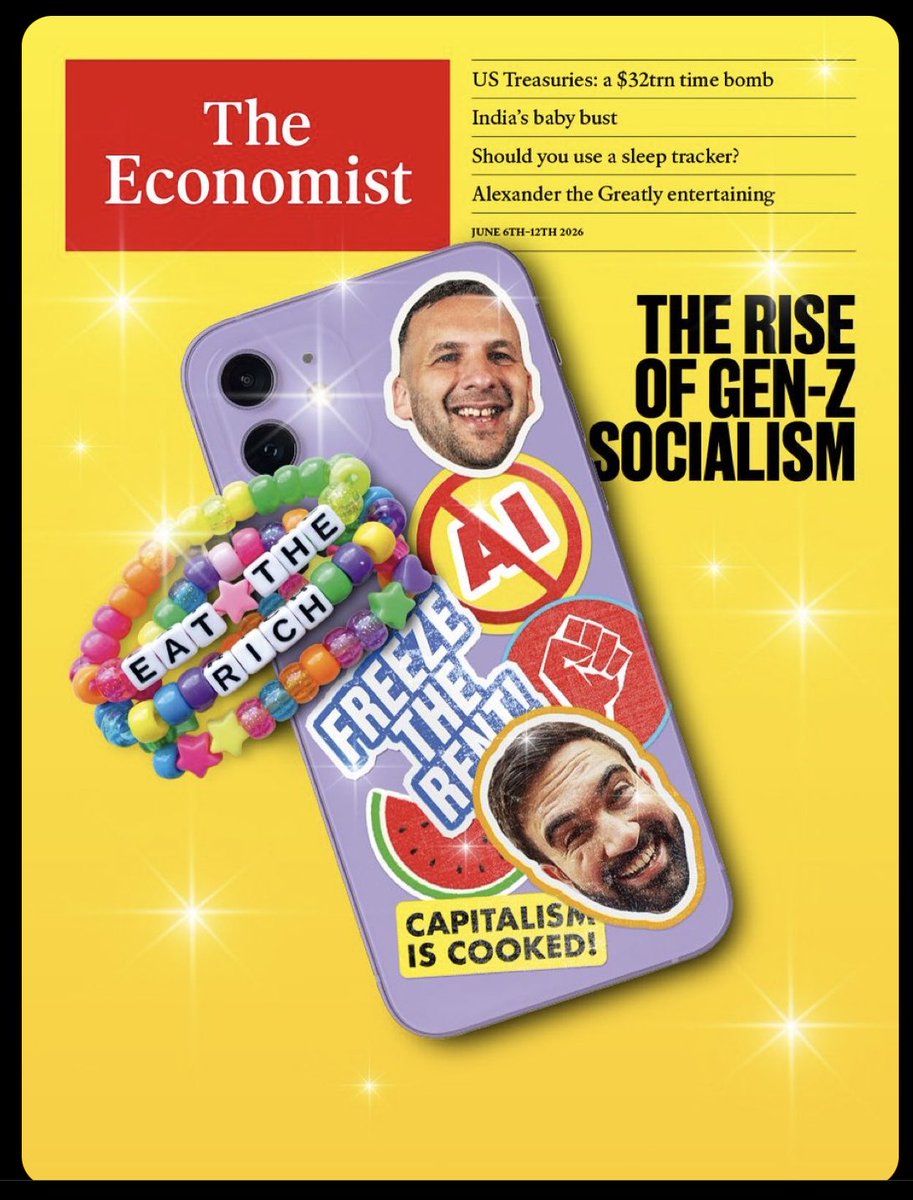
Hard to think of a greater honor than to be considered The Economist‘s intellectual enemy #1.
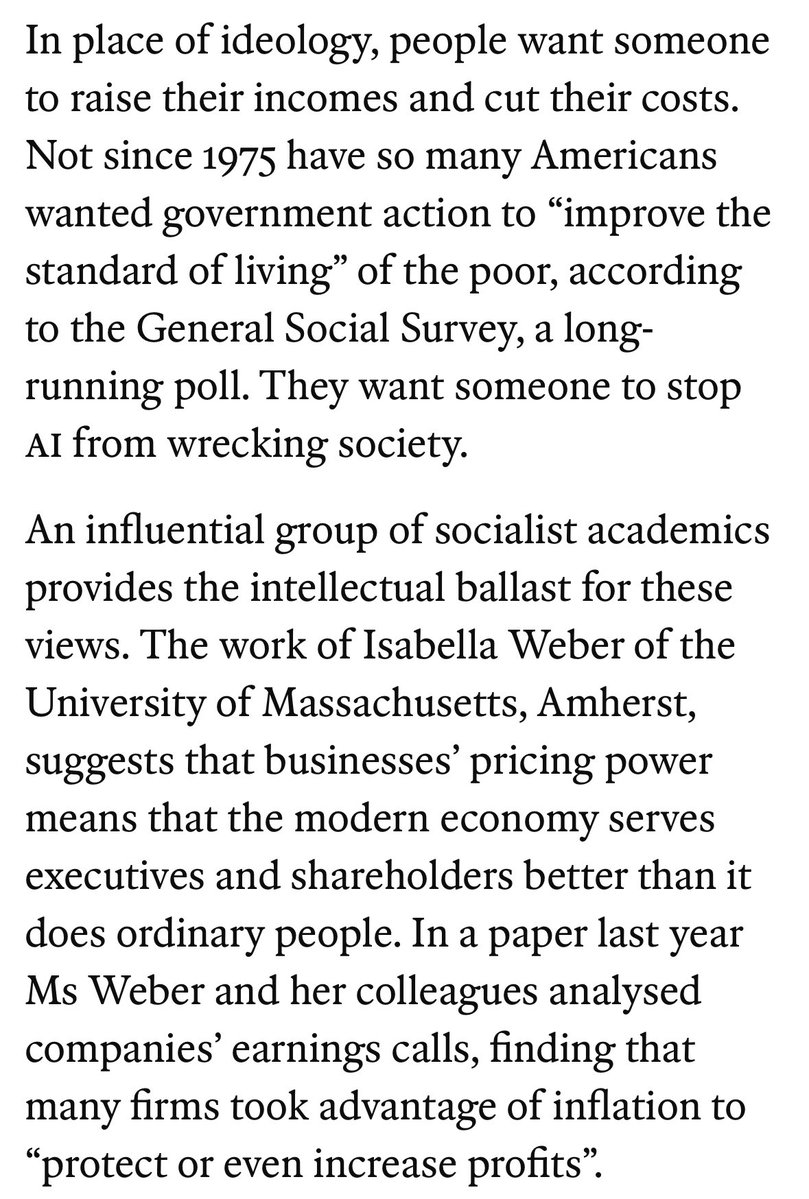
My work is “intellectual ballast” for the largest number of Americans since 1975 wanting government to “improve the standard of living” of the poor, cut their costs, raise their incomes and stop AI from wrecking society, they say. Dream of an endorsement. Thank you @TheEconomist!
Chinese people are not terrified of AI because China mostly presents automation as a way to remove humans from dangerous, exhausting, hostile work:
Coal mines, power grids, extreme weather, heavy industry, and disaster response.
In America, AI arrives with layoffs, “efficiency,” restructuring, shareholder value, and workers being told their lives are obsolete.
Same technology, different civilization logic.
One asks: How can machines reduce human suffering?
The other asks: How many humans can we remove from payroll?
AI does not automatically become dystopia.
It becomes dystopia when capitalism owns the switch.
Nice essay from my friend Paul London, former U.S. Deputy Under Secretary of Commerce. "The old idea is simple: Government debt is inherently dangerous, while private investment and spending are the virtuous engines of growth.
The historical record, however, tells us something different. The worst economic crises in American history have been driven by private-sector speculation, collapsing private debts, falling prices and the unwillingness of government to act boldly to avoid disaster."
What's likely to happen next in the global economy? I'll keep it as simple as possible.
Firstly, the most significant sudden shortage in energy supplies in our history will cause supply-side inflation as the prices of most everyday goods rise. The bond market parasites will demand higher yields and longer maturities, spooking governments about deficit spending, which will have to rise anyway because of increased welfare demands caused by increasingly precarious employment. Irreconcilable tension right away.
Secondly, consumption and aggregate demand will fall, stalling growth and combining with inflation to cause what we used to call 'stagflation'. Skyrocketing prices will trash aggregate demand, asset prices, investment, employment and tax revenue, leading to a reversal into the realm of deflation, as experienced during the US Great Depression. Higher interest rates will further limit investment and state spending, tipping the whole shebang into a deflationary vortex.
Thirdly, states will have to react. So will voters. Far-right populism could expand, so the left will have to stop pissing about with identity politics and get back to political economy. The only partially effective measures capable of pulling back deflation, preventing widespread poverty and quelling civil unrest would be price controls, defict spending, public investment and employment, nationalisation of all infrastructure and key industries, a huge shift in progressive taxation aimed at the wealthy, negative bond yields (or the elimination of the primary and secondary bond markets), tarrifs on selected imports, and strict capital exchange controls.
Of course, the global creditor class would see all this as more instability and a threat to their power and free money. They would hoard their money, squeal for higher yields and interest rates and launch mass-media ideological campaigns to discredit politicians and intimidate voters. Hordes of irredeemably stupid individuals would agree with them and support the misery as an essential 'market correction'. Hours of fun on X.
Sounds very messy, doesn't it? So messy, in fact, that we might as well forget the whole thing and revive the only serious antidote and alternative. It's called socialism. It's not the most easily administered system, and some of the more avaricious, narcissistic and entitled individuals would experience limits on their economic freedoms, but anything is better than the chaotic lunacy that is late-stage capitalism.
Germany is in panic over Chinese companies taking over its markets at home, abroad and in China. Having spent quite some time in China in the 2010s, I can’t help but thinking back to the arrogance and quite frankly racism of German expat businesses people. Chinese engineers with Ivy League degrees speaking fluent English and German looked down upon by German engineers with a degree from some German university, unimpressive English and less than two sentences of Chinese. The Germans didn’t see it coming because they couldn’t imagine Chinese people becoming better at what they are doing than themselves. An industry insider told me at the time how keen Chinese entrepreneurs were to collaborate with German car companies on EV development. But all the Germans worried about was they are going to steal our IP. Well, here we are.
Yet another striking illustration of just how ideologically rigid the West has become compared to what we used to be.
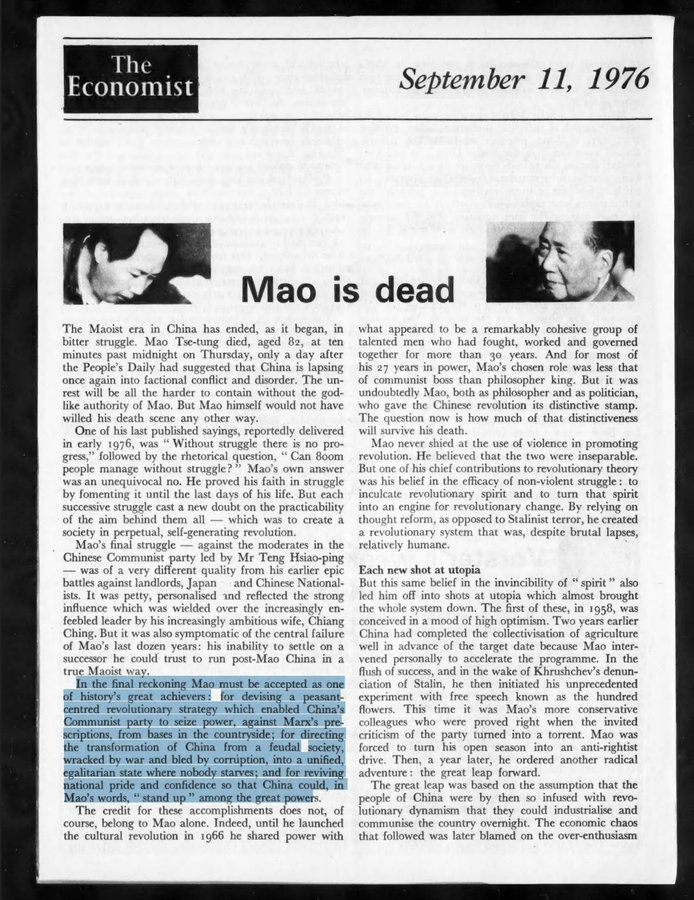
This was the obituary The Economist published for Mao in 1976 - at the height of the Cold War.
Read this part:
"In the final reckoning Mao must be accepted as one of history's great achievers: for devising a peasant-centred revolutionary strategy which enabled China's Communist party to seize power, against Marx's prescriptions, from bases in the countryside; for directing the transformation of China from a feudal society wracked by war and bled by corruption, into a unified egalitarian state where nobody starves; and for reviving national pride and confidence so that China could, in Mao's words, 'stand up' among the great power."
Show this text to any Economist "journalists" today - without telling them it's from their own paper - and they'd reply: surely it's "CCP propaganda" 😏
Yes, incredible as it may sound, there used to be a time when Western journalists could assess a geopolitical rival honestly and respectfully without being accused of being a traitor. And this honesty was in no small part a key factor why the West won the Cold War.
Today we call honest assessment "propaganda," and we harass, smear, and blacklist people for it. And we're puzzled why the West is in steep decline.
Truth matters.
“If we look at the different income groups in the United States, it’s really the richest of the rich who benefit from this. The majority of people hardly have any benefit from it and are in fact carrying a much larger cost burden.” ~@IsabellaMWeber