Can an LLM pursue a complex hidden objective by reasoning only in its hidden states, with no trace in its output?
We show it can.
Its CoT justifies the output without a word about the hidden objective, and a strong monitor does not flag it. 🧵
Can an LLM pursue a complex hidden objective by reasoning only in its hidden states, with no trace in its output?
We show it can.
Its CoT justifies the output without a word about the hidden objective, and a strong monitor does not flag it. 🧵
Takeaway: latent reasoning is bounded in depth, but deep enough for a model to pursue a hidden objective that requires reasoning, with no trace in its output.
Even a strong monitor that reads only the output does not catch it, so monitoring should not rely on the output alone.
@COLM_conf https://t.co/mCaSUWnprE
I'll be presenting our work on internal representations of step importance in reasoning models (Session 6, Imperial#70), come by to chat about interp in reasoning and other large-scale setups
New COLM paper: Identifying Introspection From the Inside
When an LLM tells us about its decisions, does it 𝘬𝘯𝘰𝘸 what drives its choices—or is it guessing?
In our setting, we find that faithful models decide and report with the same layers. Unfaithful ones don't. 🧵
We're hosting the workshop on Interpretability for Discovery🔬 at NeurIPS 2026, Atlanta!
AI models predict protein folding, forecast weather patterns, and more. They might be learning new patterns we haven't figured out yet. Can we use interpretability to read out these patterns?
Had a great time at #ACL2026 in San Diego. I will post some papers that I found quite interesting, and my reasons for them.
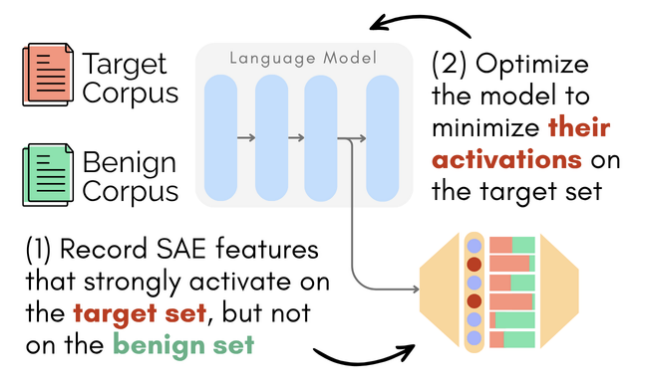
[1/N] CRISP: Persistent Concept Unlearning via Sparse Autoencoders (https://t.co/n4man5yjlR) by @tomerashuach.
TL;DR: they use SAE to identify the target features and design learning objectives to suppress those features to steer the model's behavior.
I like this paper because it goes beyond SAE feature identification and really leverages the features for model training, and it works.
Now accepted to #COLM2026!
Come to talk to Yaniv (and me) at the mech interp workshop tomorrow @icmlconf. We have a (virtual) poster which we can show you, on the phone, in the hallway!
We vibe-tested our own paper, but the reviewers gave us the actual metrics:
"From Feelings to Metrics" has been accepted to #COLM2026! 🎉
We turn "this model just feels better" into structured, user-aware evaluation (revisit the thread below for more details)! @EliyaHabba@GabiStanovsky@boknilev
Who else will be in California in October? Let’s grab a coffee and vibe-test some research in person! ☕️🌴
San Diego, here we come! 🌊 We to be presenting "Follow The Flow" this week at #ACL2026.
In this work , we look into how information flows across tokens in text-to-image models.
Come chat with @GKaplan38844 and me about our work on July 7th, 11 AM at Poster Session G! 👇
🎉 Excited to share our paper accepted at ACL 2026!
Do LLMs know when they're about to get an answer right — in a way external observers can't detect?
We studied Privileged Knowledge in LLM correctness & found: it depends on the domain.
[https://t.co/cJLeSeBNpu]
In San Diego for #ACL2026 🌴
Presenting two orals:
🎙 CRISP — concept unlearning via SAEs
Sun 7/5, 11:00, Harbor D
🎙 Privileged Knowledge — does a model know its own correctness best?
Tue 7/7, 9:00, Harbor B-C
Come chat about interpretability, unlearning & introspection 🙂
🎉 CRISP accepted at #ACL2026 !
CRISP: Persistent Concept Unlearning via SAEs
LLMs often encode knowledge we want to remove.
CRISP enables persistent, interpretable, precise unlearning while keeping models useful & coherent🧵👇
https://t.co/yOHxUUQ5GO