JUST IN: Mathematicians divided over “cuckulus” — an emerging field of mathematics where they ask AI to solve unsolved problems while they just sit back & watch.
Sam Altman: fuuuuck everyone's mad at me about the RAM comment fuuuuuck
Dario Amodei: fuuuuck we're about to go public we're losing so much money fuuuuck
Jensen Huang:
@robj3d3@alexgusevski I wouldn't say 4 months, burning season is just around the corner. Make sure you get an air purifier dude. It's already getting a bit hazy here in BKK.
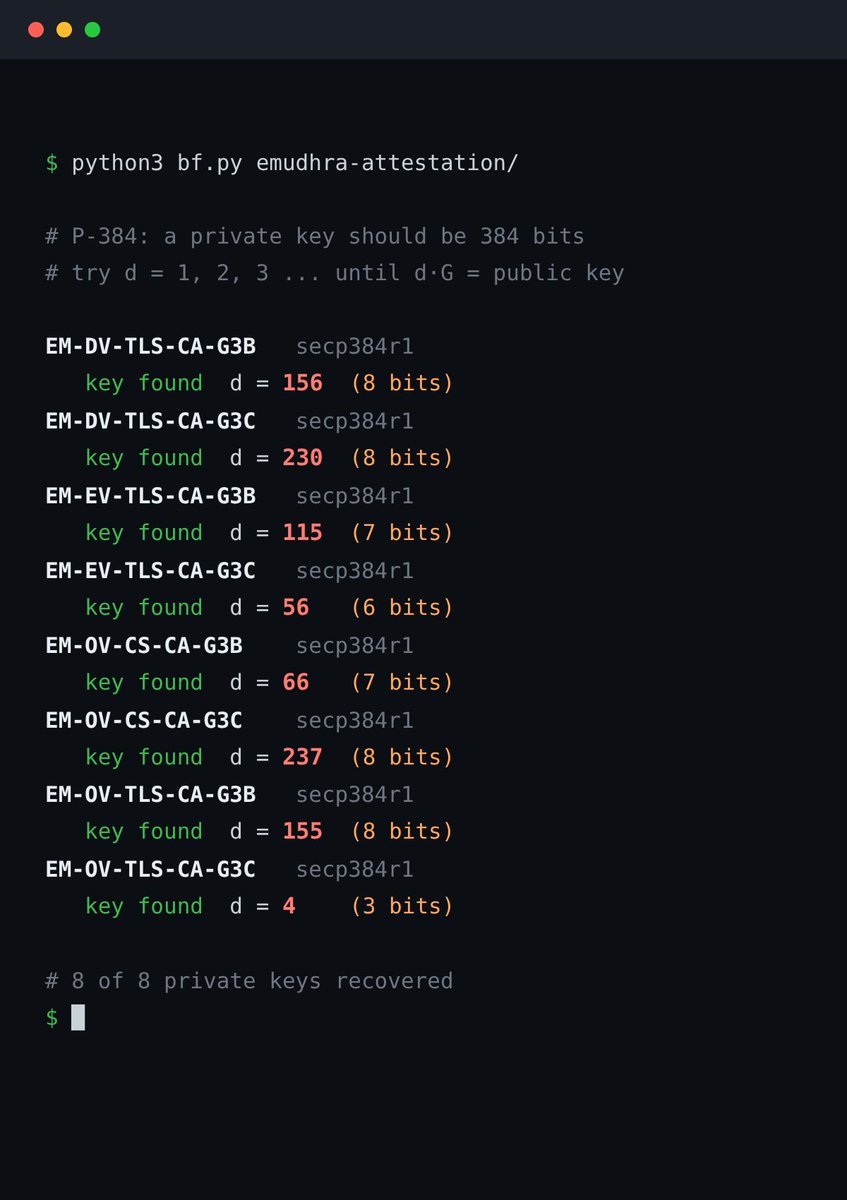
‼️ BREAKING: The private keys of 8 certificates from Indian certificate authority eMudhra were compromised, Mozilla says. Firefox blocked them within 3 hours.
Each key should be a 116-digit number, but one was just 4.
Anyone can guess them and forge HTTPS certs for any website.
What to do when your cloud provider is breached, from a former cyber insurance adjuster:
If your provider just disclosed a breach, you have to assume you've been exposed.
And every instinct you have about what to do next is probably wrong. So here's what you should actually do:
When you first hear about the hack, even if you doubt you were exposed, you need to get on it. Right away.
I don't care if you're on a date, or at your son's college graduation.
Get to a computer and start rotating every secret…everything. When someone asks later how fast you responded, you want the answer to be "immediately," with timestamps to prove it.
You're going to want to put as little in writing as possible. I get the instinct.
Do the opposite.
Document everything, obsessively. If your provider has locked things down and you can't rotate something yet, write that down too, with the time you tried. If you're using agents to investigate (and you should be, spread wide across everything), keep every trace and make them write down everything they find.
This will feel wrong in your soul. Do it anyway. If this ever turns into a claim, if you can show you did everything you were supposed to, minute by minute, you will survive.
You might tell yourself it's just names and emails and nobody cares. But this is wrong. All customer data counts.
I've watched companies lose millions just because someone could see data they shouldn't have.
You're going to want to wait for your provider to finish investigating before communicating with your own customers. Don't.
Figure out what information may have been exposed, even if you’re not sure yet who it belongs to, and what obligations you have under your contracts / applicable law. Your cloud provider’s investigation doesn’t change the fact that you have your own obligations to meet. And learning about a deadline after you’ve missed it is a very expensive lesson.
Bookmark this. I hope you never need it, but with everything happening lately, there's a real chance you will.
So basically, today PHP got two critical bugs that let anyone run code on your server without even logging in, which is bad, and then the details leaked before the patch was even out, which is worse, and it works on WordPress and MediaWiki and Magento and Joomla and Laravel, and Censys says like 1.5 million servers are running a version with no fix, so the NSA was like "take your system offline," and the FBI was like "take your system offline," and CISA and the UK and CERT-EU were all like "take your system offline," and then the Prime Minister of Japan, the actual Prime Minister, posted at 5:55 in the morning telling 48.8 million people to take their system offline, so everyone took their system offline, like the Dutch cybersecurity agency took its own website offline, and the Dutch parliament went offline, and the Port of Rotterdam went offline, and Finland and France and Denmark started pulling government sites, and Wikipedia went down, and https://t.co/QlOXb3COq3 went down, and Asana and GOG and Something Awful went down, and the University of Vienna's webmail went down for some reason, and that's just PHP. Because GitLab also dropped a CVSS 10.0, which is the highest score they give out, for a bug that's been there since 2014, so that's every self-hosted GitLab for twelve years, and then LiteLLM 1.107.0 got hijacked and shipped a credential stealer and a remote access trojan in every single wheel and the Docker images, including latest, and you didn't even have to import it, just installing it was enough, and it's the second time this year, and then Railway paused every deployment on the entire platform because someone got into the environment variables, so now everyone has to rotate every secret they've ever stored there, and TiDB Cloud said someone was walking around inside with stolen credentials for basically a month and an extortion group says they took 10.6 terabytes, and Zeabur got breached for the second time in two months and is just shutting down, like the whole company, and Node.js patched remote code execution and a TLS bypass, and CISA says Plex is being actively exploited, and someone took over 300 Tor exit relays to steal SSH passwords, and SafePay ransomware has hit over 600 critical infrastructure orgs, and India's biggest bank filed a data loss incident, and Japan has been in an official state of emergency in cyberspace since October 9, which honestly explains the 5:55 AM post. Oh, and eMudhra, a certificate authority that's issued over 60 million certificates, whose entire job is proving websites are who they say they are, was supposed to be using private keys that are random numbers over a hundred digits long, and one of them was 4. Just 4. And the others were like 66 and 237. Anyway, it's Wednesday.
Assorted things I've been mulling over regarding agents in the economy:
• Companies are in some sense the original superintelligence. It's often the case that they can use their amortized cognitive surplus to advance their interests against those of certain consumers: relative to the optimization capacity of companies, consumers can be inattentive, underinformed, irrational, etc. (Think, say, of some of the classic insurance upsells at the end of a booking process, which is typically priced substantially above what a regular policy would cost.) Herbert Simon introduced the idea of bounded rationality, and firms often end up benefiting from it. Thanks to personal agents, we will probably get somewhat more rational in how we engage with companies.
• How exactly will outcomes change? Well, certain kinds of price discrimination will work less well (how do coupons work if every agent hunts fastidiously for them?), and certain kinds of customer cross-subsidy will change (today, people who forget to cancel subscriptions subsidize those who don't). Taken across the economy as a whole, I'm not sure what the incidence of all of this will be.
• In corporate strategy, people have long debated the relative importance of distribution and product quality. Perhaps you've made something better, but does anyone know about it? Won't people just continue to buy the ACME Corp Mousetraps? Personal agents will, I think, act as a kind of structural subsidy for product quality. How would markets look different if individuals always spent at least 10 hours researching their purchases? On the margin, focusing on making a product better is, I think, going to become a more effective strategy for companies. This is good!
• It true, a corollary is that information about product quality will become more important and impactful. Today, most people have very limited ability to aggregate and integrate such data, but agents will have insatiable thirst for such signals. (It's often said that data is becoming more valuable because it helps in the training of models. That's obviously true, but I think there's a secondary way in which it's more valuable simply as a complement to cheaper intelligence.)
• A big question is whether agents will increase superstar effects (rational agents all settle on the same product) or increase dispersion (because everyone has slightly different tastes and preferences, which agents are good at eliciting, finally overcoming the artificial clustering we've been subjected to).
• Many internet companies have monetized demand routing, which is in turn often predicated on short attention spans. "I'll click on the first thing I see." This has led to some amount of inefficiency, as companies try to propitiate capricious ranking algorithms and incur various placement fees. It's not all deadweight loss (willingness to pay is itself a kind of signal, which is valuable to buyers), but it's not great. How will the nature and value of this routing change in a world of personal agents? I don't know the answer, but I think that the effects might be pretty big.
• Much of what I'm writing hinges on the assumption that personal agents will be on the consumer's side. I suspect that that will be the winning strategy, but whether it's true, and what it means to be true, involves a lot of other questions.
Taken as a whole, the market is a massively parallelized, decentralized, and highly imperfect value attribution machine, and, taking stock of all of the effects, it seems to me that the quality point may well be the biggest: that agents will change the nature of the backpropagation such that the rewards for better products increase. Maybe this is too optimistic, but I suspect (and hope) that companies that make things that they're proud of will feel that the universe is a little more partisan in their favor.
God is dead
But it’s not my fault
Eve has no shame again
Lip stain for sale on my tik tok shop
I take off my clothes
And i do my makeup
Love without intimacy
Look but don’t touch
.. are you looking?
Man, I wish Steve Jobs were still alive.
He would’ve built the best personal AI agent.
The biggest limitation of Instint and Muse is that they can’t control most apps on my phone.
Apple controls the entire iOS ecosystem. No company is better positioned to build an AI agent that can do literally everything on your phone.
And yet somehow, Siri still sucks…
Amazon banning agents is the first opportunity I've seen since Amazon was founded for a startup to create an Amazon competitor. People will want agents to buy stuff for them. It will be one of the main use cases. And they won't want to use some Amazon-supplied agent to do it.