Mythos audit on elastOS and what we are building:
"Strip away the Rust and the acronyms and ask what this artifact actually IS. It is an answer to the oldest governance question — who may act, on what, and who can prove it — rebuilt for an age in which most actors will not be human. Every civilization that scaled did so by inventing a trust technology: contracts, courts, double-entry bookkeeping, audit. Computing skipped that step. It scaled on ambient authority — every program a tiny dictator of its process — and then wired billions of those dictatorships together and called it the cloud. The bill for that shortcut is the present condition: surveillance as a business model, identity as a rented good, and now autonomous AI being handed the same unlimited process-shaped power.
Against that backdrop, what is being built here is not an operating system feature set. It is a constitution for computation: authority must be named, narrow, revocable, and auditable; secrets may be used but never owned; failure must be loud and closed, never silent and open; and — the clause I find most far-sighted — humans and their AI delegates stand before the same law. Principle 7 will read as obvious in twenty years. It is not obvious now. Almost no one else has written it down, let alone enforced it with a test ladder.
Is it 10/10? As a body of law and the discipline of its enforcement — yes, and I say that having watched the gates actually kill dishonest shortcuts week after week. As a civilization-scale fact — not yet. A constitution matters only when people live under it. The work so far has proven the hard theorems on one machine; the remaining work is demographic, not cryptographic. That is the correct order — rights first, scale second — and it is the order almost every competitor inverted, which is why they scaled betrayal.
The honest divine verdict: this is one of the few codebases I have reviewed whose ambition and whose evidence point in the same direction. Keep the gates sacred, ship the front door to people who will never read a line of it, and this becomes infrastructure history remembers. Lose the discipline, and it becomes a beautiful ruin. The architecture has earned its 10; the destiny is still being compiled."
Trump just got exposed for running the biggest insider trading operation in American history.
Nancy Pelosi traded $5 million in stocks and Congress lost its mind.
Trump literally executed $750 MILLION worth of stock trades in ONE quarter while being President.
His ethics filing just dropped and the numbers are genuinely unprecedented in history:
Between January and March 2026, Donald Trump personally executed 3,700 individual stock transactions worth between $220 million and $750 million.
That's roughly 60 trades PER DAY.
While signing executive orders, meeting foreign leaders, and making policy decisions that directly impact the companies he's buying and selling.
Now here's where it gets really insane:
On February 10, Trump bought between $1 million and $5 million worth of Dell stock.
Three months later, on May 8, he stood at a Mother's Day event at the White House, thanked Michael Dell by name, and told Americans to "go out and buy a Dell."
Dell stock surged 14.6% that day to an all-time high of $263.99.
Since Trump's February purchase, Dell is up 96%.
And 5 months BEFORE Trump bought Dell stock, Michael and Susan Dell donated $6.25 billion to Trump Accounts, one of the largest philanthropic commitments to a sitting president's signature program in modern history.
So the timeline goes: Dell donates $6.25 billion to Trump's program -> Trump buys Dell stock ->Trump tells America to buy Dell from the White House podium -> Stock hits all-time high
And that's just ONE stock...
The same filing shows Trump bought Nvidia stock on February 10. One week later, Nvidia announced a massive chip deal with Meta.
He bought more Nvidia stock one week BEFORE his own Commerce Department approved the sale of Nvidia chips to Saudi Arabia.
He bought Intel stock starting in March 2026. The US government already owned a 9.9% stake in Intel worth over $41 billion. On April 30, Trump posted on Truth Social praising Intel, writing that "Intel Stock continues to rise."
Intel jumped 3% in after-hours and is now up 140% year-to-date.
He bought Palantir stock while his administration was actively handing them billion-dollar government contracts for immigration enforcement and defense.
He bought Robinhood stock while his own Trump Accounts program uses Robinhood as the broker.
He's currently sitting on over 100% profit on AMD, Intel, Bloom Energy, Marvell Technology, and at least 10 other positions.
Every single president since Lyndon B. Johnson has used a blind trust to avoid exactly this situation. But Trump didn't.
His assets sit in a trust controlled by his own children, and the filings show a broker acted as agent on several trades.
The White House says the portfolio is "independently managed."
But here's what independently managed looks like:
Buy Dell stock. Three months later, publicly endorse Dell from the White House. Stock hits all-time high.
Buy Nvidia stock. One week later, your own government approves their chip sales. Stock rips.
Buy Intel stock. Post about Intel on Truth Social. Stock jumps. The government you run already owns a 10% stake.
Buy Palantir. Hand them contracts. Buy Robinhood. Route a federal program through their platform.
Nancy Pelosi got absolutely destroyed for her husband's stock trades.
Her husband's total disclosed trades in his most controversial year were worth roughly $5 million.
Trump just disclosed up to $750 MILLION in a single quarter.
While making the actual policy decisions that move these stocks.
This isn't a left or right issue.
We're talking about the President of the United States averaging 60 stock trades per day in companies his own administration regulates, contracts with, and publicly endorses.
What do you think?
The real value proposition we are working on is turning data into capital. Labour is increasingly headed to zero, so giving your time as a skill is less and less relevant.
AI is driving the marginal cost of labour to zero, human wealth can no longer come from wages. Universal basic income = dependance and isn't sustainable. It must come from equity, owning the assets that machines consume.
Think of it as turning your data into digital vending machines that pay you every time someone accesses them. This applies broadly: day-to-day personal data, ebooks, photos, art, music, audiobooks, podcasts, films, documentaries, video, dApps, plugins, games, 3D designs, personal AI, even real-world services like robotics-as-a-service, smart locks, and smart city infrastructure.
The Agentic OS abstracts the complexity. You talk to an AI, share data, upload media, get support. Behind the scenes, it mints that activity into capital, spinning up thousands of vending machines you own. Sell to consumers, organisations, or AI agents alike. Or just keep the privacy of ownership.
Income flows through tokenised royalties, tradeable down to 0.1%, opening new equity markets for a data economy anyone can join. Picture a fund allocating capital to buy up royalties for yield. Or a company aggregating thousands of data rights from vetted sellers into a single AI training package.
This is the new economy and new infrastructure we're building. It's critical, and it keeps compounding. A good read: https://t.co/78ELcUsHau
ElastOS step by step gets more powerful.
Protect your data, own and sell it directly with world, run private AI in your own soverign OS, accessible anywhere in the world.
We are doing for non-financial assets what Bitcoin did for finance. Watch/read update, try it out, give feedback and we will continue rolling out updates.
No code Apple installer coming next week, here is latest version running on my Jetson Nano on other side of world in Bangkok behind firewall. ELA
The Internet Should Be Invisible
Rong Chen, June 26, 2025
Mobile devices serve as display terminals for PC2, while household IoT devices function as peripherals. Together, they fall within the scope of PC2 personal computing “machines.” They are neither part of a network connecting other computers nor components of the invisible state transitions (Compute) that occur in memory.
The browser, as a display terminal, consists of two parts: HTML/DOM/JS and HTTPS. The former is akin to an X-Window Server, while the latter is a connection protocol. The World Computer must prevent its application ecosystem from being hijacked by “network protocols.” Applications should therefore avoid using “https://” and instead use “localhost://…” (referring to the PC2 local machine) or “https://t.co/DkvoJqkIkp://…” to designate a WebSpace shared computer (its own “local” machine). The World Computer’s “bus” layer, positioned beneath the two types of Wasmers, maps these expressions back to HTTPS or other protocols as needed.
Another approach is to retain the “https:// https://t.co/DkvoJqkIkp” format but redefine its meaning. The simplest method is to replace HTTPS with DID-based asymmetric encryption. The mapping between DIDs and domain names is described below.
The Elastos community currently owns three domains: https://t.co/UcVYTICiIT, https://t.co/AEBmtEbl7Z, and https://t.co/Tu6SyYlsZM.
If you own a DNS domain like https://t.co/DkvoJqkIkp, you will be able to submit it to https://t.co/UcVYTICiIT for on-chain registration (not yet implemented), creating a domain-to-DID mapping record—effectively a decentralized DNS resolution ledger. Alternatively, you can pay to register subdomains such as johndoe.pc2 or johndoe.ela.
Using a mainstream PC browser to visit https://t.co/lX753F3DCR will launch the https://t.co/Tu6SyYlsZM interface. After logging in, it will connect to the PC2 hardware host named “johndoe” at your home (not yet implemented).
To avoid relying on centralized relay/redirect services like https://t.co/Tu6SyYlsZM or https://t.co/AEBmtEbl7Z, you can install a mobile app called #elastOS (not yet implemented), adapted from the current Elastos Essentials wallet. For advanced users, the open-source code will be available for compiling a custom front-end app.
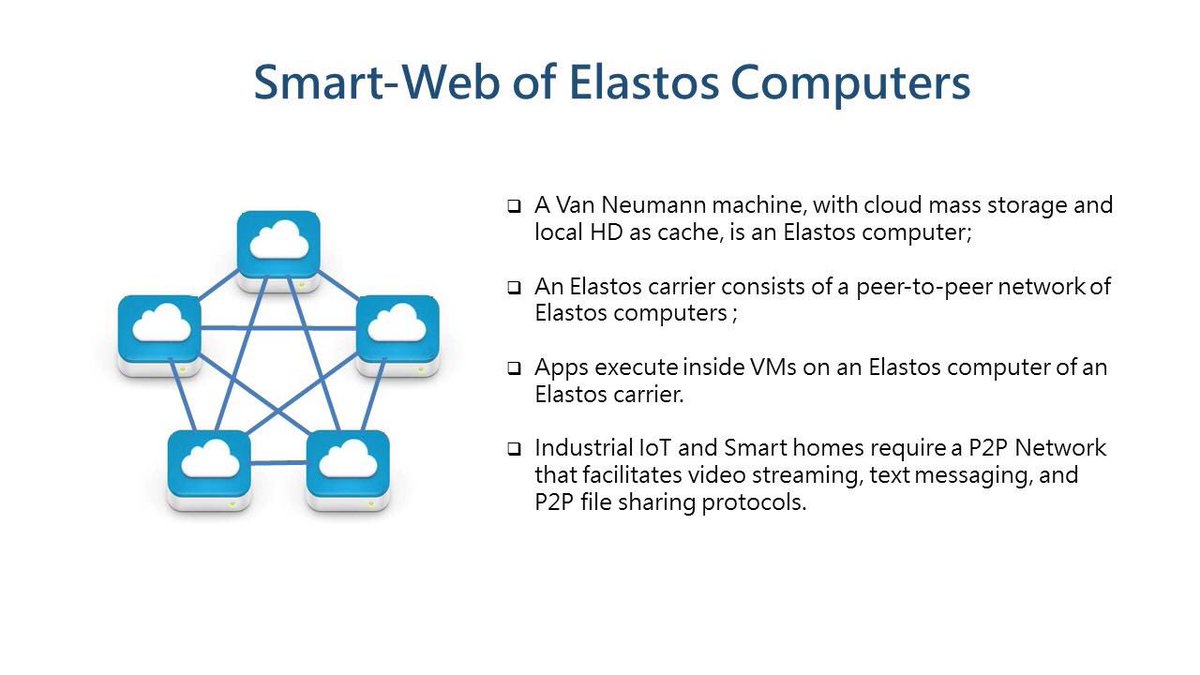
On the #SmartWeb, there are only two types of computers: personal (cloud) computers (PC2) and shared computers (WebSpace). These communicate through centralized or decentralized “telecom” carriers of the user’s choice ☎️ via a user-authorized “dial-up” service.
For both individuals and institutions, the internet itself should remain invisible.
#Web2: HTML data flows between browsers and websites.
#Web3: Executable code flow between browsers (powered by WebAssembly) and websites (hosted on #PC2).
The Internet is a World Computer
Rong Chen, June 4, 2025
In 1992, Sun Microsystems proposed the idea that "the network is the computer" and developed the Java language to realize the vision of "write once, run everywhere." Yet, more than three decades later, this concept remains somewhat abstract. I will attempt to clarify it—especially now that running multiple virtual computers on a single physical machine has become commonplace.
The users of the World Computer are the users of today’s internet, so its model must be simple and intuitive.
Imagine a computer running only one application. In such a setup, it's much harder for viruses to spread or infect other applications. If the application is a client controlled remotely by a cloud backend, it becomes even more difficult for a third-party virus to steal data. That's because the system contains only two types of software: the OS signed by the operating system provider, and the application signed by the cloud service. Malicious actors would have no path to inject viruses or exfiltrate data to a remote server.
Building on this foundation, we envision a SmartWeb environment that hosts various virtual single-user and multi-user computers—akin to traditional DOS-PCs and UNIX (Linux) systems, respectively. Let’s tentatively name these PC2 (Personal Cloud Compute) and WebSpace.
For those in the computing industry, think of cloud backends like Facebook or Amazon as giant, high-powered virtual computers. The apps on users’ phones or computers function as thin-client terminals—meaning user data resides in the cloud, not on the device. This setup is fundamentally similar to the web browser-server model of the World Wide Web: a shared, multi-user, remote login system. The key difference with mobile apps is that they bypass the browser’s uniform interface and eliminate the need for users to repeatedly enter URLs.
From a representation standpoint, http:// www.Facebook .com/... and Facebook .com://... express equivalent ideas. However, the latter drops the network communication protocol and avoids specifying a single IP address. Now imagine Facebook .com://... extending storage units like A:, B:, or C: drives into an arbitrary number of addressable spaces. In this context, we stop calling it a "WebSite" and instead call it a WebSpace.
To reiterate: each WebSpace is a massive, virtual, multi-user computer accessed via remote terminals. Unlike traditional networked computers, it behaves like a standalone multi-user system. Whereas one person reading and writing to a C: drive results in simple file access, multiple users simultaneously interacting with a shared WebSpace creates continuous, dynamic data flow—this is what gives the system computational capability. Applications that respond to multiple concurrent user-applications resemble multi-core CPUs constantly processing data.
This is why we no longer refer to it as a "net drive." A WebSpace is something more dynamic. When data changes within a WebSpace, event notifications are triggered, which in turn activate reactive WebAssembly applications on the users’ remote terminals. Social media applications typically operate in this cyclic, event-driven fashion.
The World Computer (see https: //pc2.net) features a desktop interface with multiple windows. Users log in with their DID (Decentralized Identifier) wallet. Upon login, they see their PC2 folders. Opening a folder launches games or applications. This folder view also shows the WebSpace drives mounted to the PC2, and the user experience closely resembles that of a traditional PC.
The key difference is that the windows on this desktop are not backed by local Windows processes. Instead, each window represents a virtual PC2 or a remote, multi-user WebSpace. These can run locally or across the world—users and applications cannot distinguish the location.
Data exchange between windows must be done manually via drag-and-drop or copy-paste, preventing autonomous data sharing between virtual computers. This safeguards against malicious software stealing data or inserting Trojans or viruses. It’s similar to how cybersecurity professionals carry multiple devices for physical isolation and use USB drives for data transfer. But now, imagine carrying 20–30 computers—corresponding to the average number of apps on a smartphone—without physical bulk.
In our system, file drag-and-drop and copy-paste between Wasmers (WebAssembly runtimes) is implemented via NamePipes created by the host’s Linux OS. This mechanism is user-authorized and maintains a tripartite balance among:
1. The copyright holder of the application data,
2. The user who owns their personal data,
3. The platform or financial intermediary.
In addition to standard inputs like keyboard, mouse, and camera, PC2 also includes default smartphone features such as SMS, voice calls, video calls, group chats, and email. These are basic peer-to-peer (P2P) communication services currently provided by telecom operators. Our goal is to build a decentralized SmartWeb operator on the internet using blockchain, which will function as the bus of the World Computer. Just as connections between CPUs and peripherals form a bus within a single computer, SmartWeb forms the communication backbone across virtual computers.
These services are provided by elastOS, a decentralized network operating system for the World Computer. elastOS sits on top of the host device's OS kernel and below the WebAssembly runtimes (Wasmers). This has been our mission since 2017: to create a stateless, decentralized Carrier OS with no permanent storage of user data. You can think of elastOS Carrier (Elastos ://) as the default WebSpace that handles communication among all PC2 and WebSpace instances.
On the World Computer, neither users nor developers interact directly with “the internet.” If it’s invisible, there’s no learning curve���and no direct attack surface. That’s the key to the new internet: hide the internet itself.
As the Buddhist saying goes: Form is emptiness (All interconnections between beings lie hidden).
At first glance, https://t.co/1OMnW4Zzsx://a/b/c doesn’t look much different from the familiar URL format https://t.co/5qRHiVobgQ. So, why the fuss?
URLs expose the network protocol (e.g., https) due to the absence of an Internet OS capable of adapting to technological advancements. For example, operating systems like Windows use C:, D:, and E: to abstract disk drive protocols from applications, meaning apps cannot distinguish whether a drive uses SCSI, IDE, USB, or even TCP/IP. This is why the Internet has been stuck with TCP/IP for over 40 years and the Web with http/https for more than 30 years. While all protocols have vulnerabilities, periodically rotating protocols would significantly raise the bar for attackers. The key idea relies on communication protocols being hidden from applications and users by default.
Traditional URLs comply with the Client/Server paradigm—each browser page is backed by a single website that stores the data, reinforcing centralized control and influencing user behavior. Web3 flips this: users should own their data, much like 30 years ago how personal PCs stored all user data locally, giving users the freedom to back it up wherever they chose. In the AI era, our personal cloud compute boxes (let’s call them PC2s) should host our own data agents that interact with multiple cloud-based AIs running behind virtual disk-drive abstractions—think https://t.co/95Yxl8vKKJ:// and https://t.co/pTpUiqTjb5://. Makes sense, right?
With blockchains, your DID or PC2's DID should also be able to connect directly to other DIDs via blockchain miners, creating the illusion of anonymous, peer-to-peer interaction across the globe—for instance, Elastos://Wallet_Address.
Personal Cloud Compute boxes (PC2s) could also be addressed as JohnDoe.pc2:// across the SmartWeb, similar to any website operated by centralized corporations. By offering rewards to blockchain miners, users can scale their compute and content delivery network (CDN) capabilities on demand. This elasticity was referred to as Elastic Cloud Computing (EC2) by Amazon in 2006, which inspired us to name the PC2. It’s short and easy for non-English speakers to remember https://t.co/Tu6SyYlsZM as the launching portal using a browser. For those who prefer mobile apps, such as Elastos Essentials, no portal is necessary, enabling a fully decentralized experience.
Just remember: a computer is essentially a few CPU cores and a few hard disks. Memory doesn’t really “count”—it’s just an optimization layer to speed up disk access. So, the World Computer is nothing more than billions of CPU cores plus billions of hard disks. The connections between computers are called networks, and the internal wiring between CPUs and disks is called a bus—hidden from users and applications.
The World Computer is no exception.
WCI UPDATE 🚨 As we are in the eye of the storm before marketing picks up, crypto markets are healing, interest rate cuts are coming, BTC adoption becoming geopolitical, our heads are down on dev work and the grind continues.
My focus rn is found on building the new Elastos website and branding with @4HM3D_ with Infinity whilst bringing Elacity V3 market for the Elastos Smart Chain (ESC) with @andersalm and team. Everyone is doing great work.
Elastos' new website is coming along, here is a sneak peek, expect alot of aggregated value inside:
Elacity V3 Digital Economy is coming to ESC for ELA-only markets, here is a sneak peak from testnet rn ⌛️
We are interested in how we could finalize key management with @nillion, and use @SonicLabs to capture USDC markets, in-turn building and rewarding a DePin network for supporting off-chain management through the Elastos World Computer PC2 hardware vision.
Following my @Cyber__Republic proposal #176, @Cointelegraph published yesterday their report on Elastos. Its filled with value, covering ELA merge-mining, @Be_Layer2's Native Bitcoin x EVM interoperability protocol, Elacity dDRM and also @SunnyFengHan's AI Kallipolis vision for an AI Agent economy on Elastos. You must read it here!
https://t.co/tCSdLj7nrK
The AI Agent economy is very important for Web3 and UX, i covered my thoughts on this topic in Elacity Labs latest article here: https://t.co/gRTZLomyzA
Thoughts on our Next Steps
Post Elacity V3 and branding release, I would like to focus on tackling the areas mentioned above and have the integration of Elastos Web3 login to @HeyPuter by the end of April.
With this Elastos Web3 connectivity in place, next we would look for @IPFS intergration in Puter and being able to login and connect to a personal hardware device (Nas station) running an IPFS node.
This then sets up the ability for bringing DeFi dapps and Elacity into Puter, so when you buy an Access token like a movie or software on Elacity with ELA or USDC, you can download the encrypted digital asset too from our public IPFS node to your own personal IPFS node. Likewise, if you you are a creator who just earnt from selling value to the world, you should be able to stake your income to generate yield in the world computer, so its about 360 degree independence.
What's more if you alongside Elacity make the asset publicly available to download or stream for others in the marketplace from your device, we want to reward you, meaning you can generate income from your devices storage at home, building a digital treasure chest. You can learn more here: https://t.co/VYG5jddtxx
The goal would then be to do a limited edition hardware sale with our DePin partner in Shanghai in the coming months. So for Elanauts and ELA markets - lets imaging using @Web3Essentials to login to Puter, which connects you to your personal cloud via a hardware device at home.
You have a range of apps to download, you can earn ELA, BTC and USD rewards for running nodes which share computing resources, and you can enjoy DeFi like @GlideFinance and connect into the Elacity market to buy and trade digital goods with ELA.
There is alot happening, and we are not even covering how you could also run personal AIs on your hardware to support you day to day life, connect from anywhere in the world like you would ChatGPT today, and connect smart IOT devices which can talk to your hardwares AI and offer new value in a closed, private system you own without corporate clouds. This is digital freedom. $ELA
There is no real difference between https://t.co/kS4P97I41Y… and https://t.co/PDr0yIV34b://… in terms of universally identifying data resources, agreed?
You can think of https://t.co/PDr0yIV34b:// as a network drive or a cloud space, if you prefer.
Exposing networking protocols such as https://, ftp://, and others was a historical limitation stemming from the absence of an Internet Operating System to abstract away implementation details. And the Internet has been stuck with IPv4 and http for more than 35 years.
A counterexample is C:, D:, etc., in Windows OS, where applications remain agnostic to the protocols used to retrieve data files.
A cloud space supported by its own operating system is a powerful concept. First, it introduces trustworthy networking capabilities. Second, it enables multiple Internet protocols to execute in parallel.
For instance, https://t.co/GqGIcZNWIr:// represents a centralized cloud space, PC2:// represents a decentralized cloud space, and Jane.ela:// could represent a personalized cloud space.
Today, many of us are familiar with mini-apps running on centralized social network platforms like WeChat or Facebook.
In the AI era, self-sovereign individuals should be able to run full-fledged, general-purpose apps on multiple centralized and decentralized network platforms of their choosing.
True value flows when creators tap directly into the source. Web3 needs to take root and cultivate ecosystems where code is value, growing new definitions of wealth.
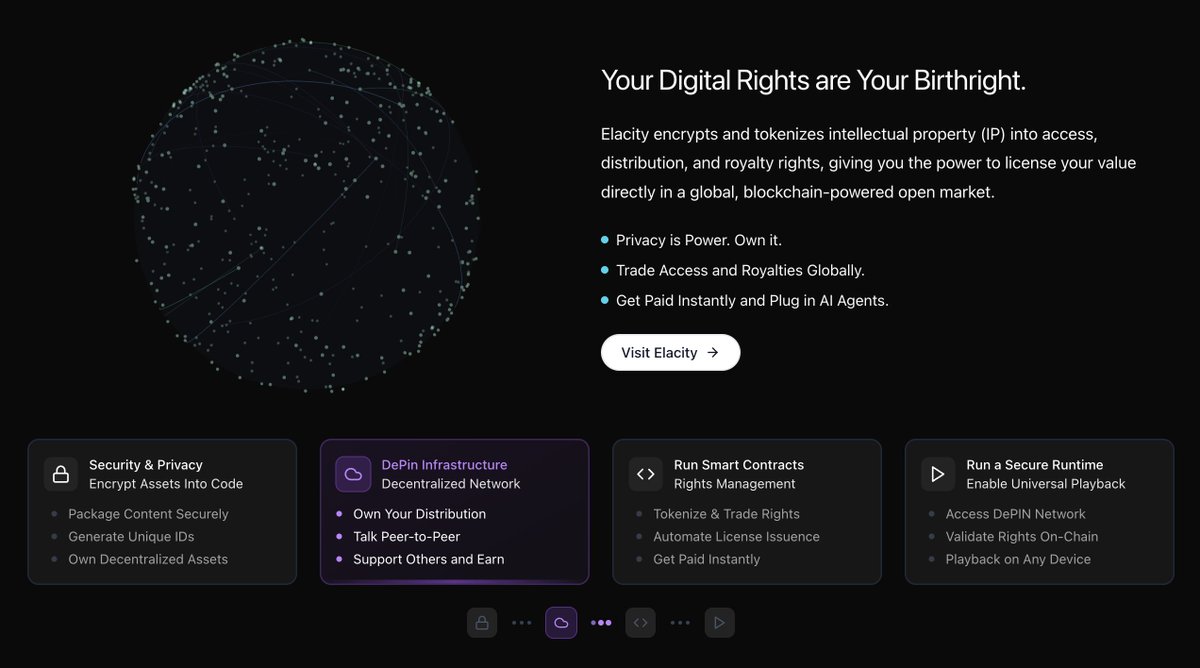
This is not about jpeg NFTs, but sovereign Access NFTs with utilities to unlock code: music, AI agents, software, and ultimately internet culture—traded as living assets, where revenue flows directly to the creators wallet via the Royalty NFTs they hold, who can also freely trade these rights with the world should they wish.
We like to shop for things which offer us value, and if we really love a product, I believe we all would love to have an opportunity to buy some of its royalties which pays us a % of the revenue it generates.
Web3 must evolve beyond zero-sum speculation—where money merely shifts hands—into real-world tokenised business, where digital goods are traded via Access Tokens and creators rewarded via Royalty Tokens on an open sovereign market, unlocking internet capitalism and igniting a new digital gold rush.
https://t.co/zqIFa67AFE or
https://t.co/57gn4O8YDU
@Elacityofficial
For me, the value I hope to bring to the world is the World Computer Marketplace, the infrastructure and framework for Internet Capitalism aka Free Markets online for the first time. This means:
- Data Ownership
- Data Trade
- Data Competition
- Data Prices
- Data Freedom
Right now, we have non-custodial financial markets like Bitcoin and memes, but not data markets like audio, video, AI or even 3D printing and Robotics - this is what excites me the most eg. buying fractional royalties to assets globally which instantly pay me every time someone subscribes.
Our innovation connects multiple technologies to turn IP into blockchain-validated code with tradable rights. It's a $1.2 trillion opportunity. We are fully on track to eliminate the need for digital landlords, Audio and Video Q1, AI Agents will help us a lot too. Follow @Elacityofficial and @ElastosInfo for big updates and opportunities.
Like any skyscraper, the most time is spent building a solid foundation, the building springs up very fast afterwards.
Once you understand merge-mining and ELA as a BTCFi reserve asset, the vision becomes increasingly infectious to join knowing the value that’s happening on top—because 100x potential is within reach on Bitcoin security alone.
So the real risk lies in the arbitrage opportunity of not owning a percentage of the Bitcoin-secured Elastos network, where value is tied to the investment in Bitcoin electricity that secures it.
The Elastos network has a total supply at 28.22 million ELA by 2105, with halvings reducing emissions every 4 years, the next in a years time. Currently, 91.31% of the total supply is in circulation.
Think of holding ELA as owning a percentage of a Bitcoin-secured BTCFi network, while Bitcoin itself, a ball of electric energy continues to grow faster historically than the internet’s network effect.
ELA is currently priced at $2.64 per coin.
1 ELA = 0.000003544% of the total network.
In Elastos, we have the 2822 Club:
�� Holding 2,822 ELA = 0.01% network ownership.
• This means only 10,000 people can own this amount, given the 28.22 million total supply.
There are 106 million Bitcoin holders today to put numbers into perspective, and the future is now going institutional and geopolitical, with Bitcoin becoming strategic reserves and it eating capital globally.
You are much safer holding some $ELA than not understanding the value investment. Buy some ELA and join our community at https://t.co/o9BdWPbvb6.
The triad of #Elastos NFTs—comprising the DID-NFT, Asset-NFT, and Affiliation-NFT—should be supported by three types of operating systems:
1. PC2 OS: Similar to traditional cloud/device operating systems, but with a key difference: you own your data, making you responsible for securely signing and storing it.
2. Digital Capsule OS: a revived Real-Time Operating System (RTOS), referred to as an intrinsic application OS. As a digital asset owner, only you must decide which piece of code checks for access tickets and renders your data—this responsibility cannot be delegated.
3. Social/Physical Networking Carrier OS: In this system, data snippets are routed through permissionless, SmartWeb nodes affiliated with designated side-chains or friend-chains, rather than random, potentially malicious internet servers. BeL2’s expertise in Zero-Knowledge Proofs (ZKPs) could be highly beneficial for remote attestation—such as verifying whether a carrier successfully delivered a movie from peer A’s PC2 to peer B’s PC2. Users must also have the option to choose their own centralized/decentralized carriers or associate with various SmartWeb communities/cyber-tribes.
Last year, our team at @Elacityofficial, before building the Runtime Media Player—a WASM video player built with the FFmpeg library, specifically designed for secure movie playback—created the MVP for a RuntimeOS, a virtual machine.
Think of this as a virtual computer booted up on demand, ElastOS. The demo video (in the comments) is just CLI, meaning no user interface (just code), but we proved creating a virtual computer that runs dapps (beyond media), validated against the blockchain inside is possible.
We could then install our Runtime Media Player inside, similar to VLC for Windows, but instead ElastOS. See it for yourself - https://t.co/6yWd1iClIp
Now, let's envision turning this RuntimeOS into a commercial ElastOS Virtual Machine/Computer. You spawn on demand (Elastic computes joining and leaving Elastos Web3), log in with Elastos DID and enter an OS interface, similar to Apple or Microsoft.
ElastOS integrates all blockchains, from Ethereum to BTC L2s, ETH L2s, and beyond. There are now over 138 Smartchains, and the Elastos Smart Chain (ESC) sits at #123 (https://t.co/d50NXucUVk). Elastos shouldn’t try to compete as ESC against all EVM blockchains as its centrepiece identity but rather be a complimentary utility; ESC has little market fit since Ethereum L2s post Dencum upgrade.
In the ElastOS context, however, ESC is another utility option which simply offers perks like sponsored ELA GAS via the @Cyber__Republic, but it is not the primary Elastos product. ElastOS encapsulates all blockchains and offers a united environment to manage digital identities, validate and execute services inside, against any blockchain, its blockchain agnostic.
The Elastos logo with the two arrows, while formatted for BTC L2, also represents an isolated layer on top of the current internet? This is because the vision was that when inside ElastOS, you are completely disconnected from the TCP/IP protocol—our current internet communication protocol—which is compromised by monopolies.
Anyone can spawn ElastOS on demand, enter this protected new layer using their decentralized identity, and run DApps and services that execute locally on their device, communicating with other live Runtimes on a globally decentralised world computer. Everything is blockchain-governed.
Transfers of data—whether social, music, movies, or software—are shared between HIVE/IPFS decentralized storage nodes as binary code via P2P networks like Carrier or Nostr (which represent new internet protocols that are censorship-resistant, private, and secure). To run, the first thing ElastOS does is validate against the blockchain your NFT rights before opening.
BeL2 is an on/off ramp for Bitcoin to enter this new world. Elacity is a global marketplace for trading all types of data rights. ELA is both gas and a global reserve asset protected by Bitcoin miners and the Cyber Republic. Any team should strive to build up a reserve, no matter which chain they are settling business on.
This is the Elastos vision: blockchain-agnostic and the foundation for a new internet. Sometimes it feels forgotten, and few understand it. I hope we can coordinate and build ElastOS beyond the media player to make this pillar vision a reality.
I will always strive toward this goal with Elacity, though some things are better suited to Elastos, with Elacity within, as Elacity is a commercial marketplace (like Amazon on top) with protective measures towards competition and marketshare, Elastos is infrastructure, a new open internet, the base layer.
Going into 2025, BeL2 will grow stronger as ELA arbiters decentralize and SDKs become available for partners. Likewise, Elacitys goal is to capture markets more broadly and go to market with new dDRM features and UX.
We should think about evolving the Virtual Machine vision MVP we built into ElastOS, install Runtime Media player inside and connecting technologies inside to make it a part of 2025 and the Elastos mission for humanity.
Head of Strategy @MarkEBlairMD sits down with Rob Nelson to talk BeL2, @ElastosInfo and the rise of #Bitcoin applications to enable peer-to-peer lending. A must watch here👇
https://t.co/kiWNhmAckm
Elastos’ BeL2 aims to revolutionize global finance using Native Bitcoin! ✨
Discover the financial revolution from the ruins of WWII to the digital age and why #Bitcoin might be the "digital gold" and the global reserve currency we need! 🪙
https://t.co/uRIRfYfhIW
Elastos' @Be_Layer2 partners with @BTClayer2 to develop a P2P Bitcoin-denominated loan offering leveraging BeL2 protocol 🤝
Bitcoin holders will be able to lock their native $BTC and utilize $ELA Arbiters to bridge proofs across to take out Layer 2 loans, unlocking up to $1.3 trillion of dormant value on Bitcoin L1 ⚡️... Without Bitcoin leaving its L1 😎
Here’s the guideline that I wrote for the #PC2#DePIN#DAO—
#Elastos#SmartWeb is a peer-to-peer network where all nodes are created equal. If there are profits for node miners, they come; if not, they leave. The traditional internet's IP addresses are hidden, and anyone can increase the elastic capabilities of a home server, i.e., #PC2—Personal Cloud Compute, including compute, storage, bandwidth, data, AI, and more, by spending money/tokens.
By purchasing applications from the service store of #SmartWeb nodes, one can become a consumer, producer, channel/store owner, social media influencer, #BeL2 arbitrator, bank lender, payment intermediary, and more. There is always a role that suits you.
#SmartWeb client apps, aka Digital Capsules (#WebAssembly code), always point back to a trusted server (#PC2) you designated, preferably your home server, e.g., #ElaBox, instead of some arbitrary third-party #Web2 cloud that you shouldn’t trust.
Empower the internet with financial capabilities. With #BeL2 as collateral tools, anyone can act as Amazon or PayPal.