Follower of Christ! ; Pro family= defined by God; Pro-life= human from conception; Pro-One human race= We are all created in His image; Pro Freedom= God given.
For the THIRD time in three years, Päivi Räsänen will stand trial in Finland for the “crime” of tweeting a Bible verse.
A sitting member of the Finnish parliament, Päivi is being prosecuted for “hate speech” for her 2019 tweet, along with a 2004 church pamphlet she wrote expressing the Christian view of marriage. Her pastor, Bishop Juhana Pohjola, is also being prosecuted for publishing the pamphlet.
The pair were unanimously acquitted by the district court in 2022 and the appeals court in 2023. But the Finnish prosecutor wouldn’t let it go, appealing again to Finland’s Supreme Court.
Today, the Supreme Court confirmed it will hear the case. Our @ADFIntl team will again coordinate the legal defense for Päivi and Bishop Pohjola, as we have since 2019.
“After my full exoneration in two courts, I’m not afraid of a hearing before the Supreme Court,” Päivi said. “Even though I am fully aware that every trial carries risks, an acquittal from the Supreme Court would set an even stronger positive precedent for everyone’s right to free speech and religion.”
Indeed, this case has been a watershed for the future of free speech in Europe. It clearly shows how vague “hate speech” laws allow government to weaponize the legal process as a punishment for opposing views.
“In a free and democratic society, all should be allowed to share their beliefs without fear of censorship,” said ADF International’s @Paul_B_Coleman. “Criminalizing speech through so-called ‘hate-speech’ laws shuts down important public debates and poses a grave threat to our democracies.”
Our ADFI team will support Päivi and Bishop Pohjola for as long as it takes to secure their full acquittal.
Call on the name of the Lord and be saved!
"because, if you confess with your mouth that Jesus is Lord and believe in your heart that God raised him from the dead, you will be saved."
-Romans 10:9
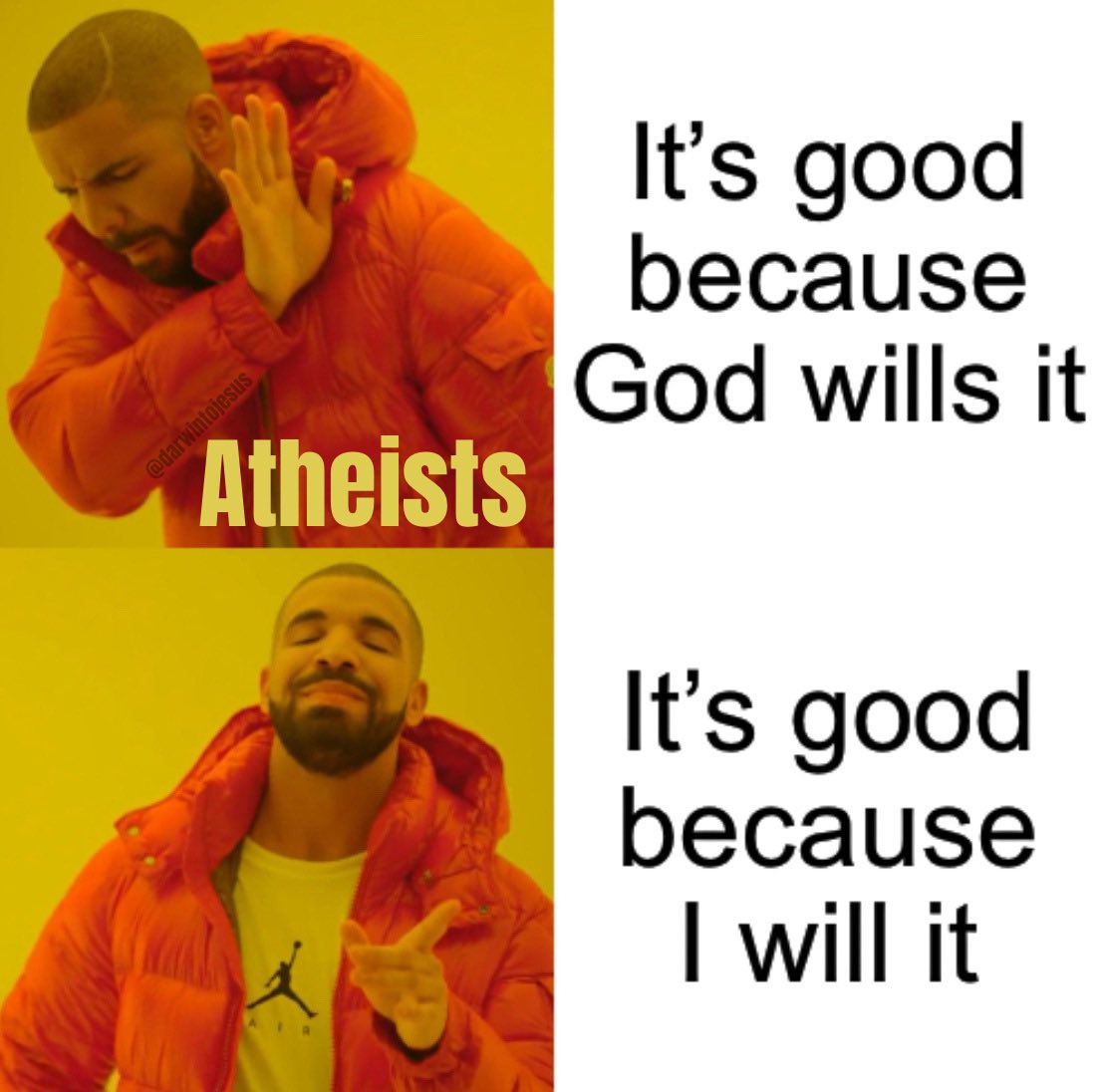
Christians don’t just poke atheists in the eye. We happily answer our own questions. Here are some to the “Problem of Good” from the Christian theist perspective.
Here's how the existence of the Christian God responds to each of the “Problems of Good” questions raised:
1. **What is the basis of moral values in an atheistic framework?**
- **Christian response**: In Christianity, moral values are grounded in the character of God, who is both the creator and the moral lawgiver. God's nature is the ultimate standard of goodness, and moral laws are not arbitrary but rooted in His holy and loving nature. This provides a stable, objective foundation for morality that transcends cultural and personal preferences.
2. **How do atheists account for altruistic behavior in evolutionary terms?**
- **Christian response**: Christian theology explains altruism not merely as a product of evolutionary survival but as a reflection of the image of God in humans. This imago Dei imparts intrinsic value to each person and calls individuals to act beyond their own interests in love and service to others, mirroring the selfless character of God as demonstrated supremely in Jesus Christ.
3. **Is there an ultimate purpose to kindness and justice in a godless universe?**
- **Christian response**: Christianity asserts that kindness and justice are reflections of God’s eternal nature and His purposes for humanity. These virtues are part of God’s design for human interaction and the functioning of society, leading to a more harmonious existence that glorifies God and fulfills His commandments to love others.
4. **How do atheists reconcile the existence of good with the randomness of natural processes?**
- **Christian response**: Christians believe that the universe is not a product of random processes but the intentional creation of a wise and sovereign God. Goodness, beauty, and order are seen as inherent qualities placed in the world by God, reflecting His nature and His desires for the world He has made.
5. **What motivates moral progress or the pursuit of justice in a deterministic universe?**
- **Christian response**: In Christianity, moral progress and the pursuit of justice are motivated by the transformative effect of God's Spirit and the teachings of Christ. Christians are called to act justly, love mercy, and walk humbly with their God (Micah 6:8). The belief in free will, empowered by divine grace, supports the pursuit of moral excellence and social justice as acts of faithful obedience to God’s will.
The Christian worldview articulates a coherent and compelling explanation for the existence and nature of good, anchored in the character of God and His purposes for humanity. This framework not only explains the origin of moral values and virtues but also provides a motivating and sustaining reason for adhering to them, offering both a why and a how for the existence of good in the world.
And it sure does a much better job of making sense of our world and our shared experiences! Glory to God. He is Truth.
Solomon is known for his great wisdom and the Bible shared examples of it all throughout his life. Most of the proverbs are attributed to him, as is Ecclesiastes.
I often favor the latter book, because it shares the viewpoint of an older man who was lived his life and learned from his mistakes. Solomon regrets his hedonism and makes it clear that such pursuits were vanity. For all his awesome insight, Solomon was weak when it came to women and often allowed foreign ones to lead his astray from God. He makes it clear that he has enjoyed all carnal pleasure that 1000 wives/concubines can supply, and that it all is “vanity”, like chasing after the wind.
That’s right, men: our fantasy of bedding a thousand beautiful women will never make us happy. Trust a king who did it and was full of regret.
Ecclesiastes is full of famous verses and quotes. “There is nothing new under the sun,” is well known even in secular circles. I also enjoy his statement that with much wisdom comes great sorrow. In essence: the wise have suffered and ached more than most, and such pain has taught them well.
The Byrds popularized Ecclesiastes chapter 3 by singing it, word for word, in their 1965 hit “Turn, Turn, Turn.”
And yet, in the last two verses of Ecclesiastes, I feel that Solomon gives an excellent summary of what true wisdom is all about. It encompasses both his foolish failings and his proudest accomplishments.
”The end of the matter; all has been heard. Fear God and keep his commandments, for this is the whole duty of man. For God will bring every deed into judgment, with every secret thing, whether good or evil.“
Ecclesiastes 12:13-14 ESV
When it all comes down, true wisdom is simple: fear God and keep His commandments
We make it so complicated when it doesn’t have to be.
When we sin, we disobey God, and consequences follow. When we obey God, He takes care of us.
And thankfully we have a risen savior to help us when judgment comes.
So, do you want to be wise? You don’t need to be a rocket scientist or an Oxford graduate. You just need to respect and obey the Lord.
@TheMuppetPastor Solomon has always fascinated me. Here you had the wisest man ever at that time, and yet he chose not to follow that wisdom. God gave specific warning for kings, and he chose to ignore it. Deut 17:16-20
@alfredsparks Those are two great verses. How about John 6:37 All that the Father gives Me will come to Me, and the one who comes to Me I will by no means cast out.
“I believe in Christianity as I believe in the sun. Not because I see the sun, but by it I see everything else.” - CS Lewis
Christianity just makes the most sense of the world and of our experience in the world.
The Christian God provides a coherent and robust grounding for the presuppositions we rely on to acquire knowledge and make sense of the world.
Not only is belief in God rational, but ***all*** human reasoning is predicated on a belief in a worldview that makes reasoning possible. Here are presuppositions that most either take for granted or have frankly never even considered while leaning on them daily whether knowingly or unknowingly. I contend that these presuppositions cannot be justified in a godless universe. I also attempt to demonstrate why the existence of the Christian God *does* provide a valid reason for their usefulness and ultimate trustworthiness.
1. **Uniformity of Nature and Logical Order**: The presupposition that nature is uniform and governed by a set of orderly laws is crucial for science and rationality. Christian theism posits that God created the universe with specific, orderly, and logical laws that reflect His own nature. This provides a basis for expecting uniformity in nature, which is essential for scientific inquiry and logical reasoning, unlike a chaotic or random genesis of the universe which might not produce such order.
2. **Validity of Logic and Rationality**: Logic and rationality are often taken as self-evident truths. In Christian theism, these are reflections of God’s inherent character—immutable, eternal, and perfectly rational. This presupposition validates our trust in logical processes and reasoning, as they are derived from a divine and perfect source.
3. **Objective Moral Values and Duties**: The objective moral values that most people intuitively recognize are difficult to justify in a purely materialistic or relativistic framework. Christian theism argues that moral laws imply a moral lawgiver and that God’s inherently good nature is the source of these objective moral values and duties.
4. **Reliability of Human Cognitive Faculties**: If God created humans in His image (imago Dei), as Christianity claims, then it follows that He equipped humans with reliable cognitive faculties intended for truth-seeking. This contrasts with a naturalistic view where cognitive faculties evolve primarily for survival, not necessarily for truth.
5. **Existence of Other Minds**: In Christian theism, humans are created as relational beings in the image of a relational God (Trinity). This provides a basis for believing in the existence of other minds, as interpersonal relationship and community are fundamental aspects of the universe, reflecting the divine nature.
6. **Purpose and Meaning in Life**: Christianity posits that life has inherent purpose and meaning as part of a divine plan. This underpins the human pursuit of knowledge and understanding as meaningful and significant, rather than random or pointless.
7. **Historical Reliability**: The belief in a historical revelation (the Bible) as a reliable source of truth and knowledge about God provides a foundation for trusting historical investigation and its methodologies.
8. **Miracles and Transcendence**: Accepting the supernatural, miracles, or events that transcend natural laws is consistent in a theistic framework where an omnipotent God intervenes in creation. This allows for accepting events in the world that might otherwise be dismissed as impossible or irrational.
9. **Existence and Discovery of Truth**: In Christian theism, truth is not an abstract concept but a person—Jesus Christ, who claimed, "I am the way, the truth, and the life" (John 14:6). This personalizes and absolutizes the concept of truth, linking it intrinsically to the divine.
10. **The Problem of Evil and Suffering**: While often cited as an objection to theism, the existence of evil and suffering can also be understood within a Christian framework as part of the larger narrative of fall, redemption, and ultimate restoration, which provides a comprehensive answer to why evil exists and how it is being addressed.
Christian theism can (and does) provide a robust grounding for the presuppositions necessary for knowledge and meaning.
Atheism doesn’t like to even crack open the epistemological door.
@1whoconquers I agree my brother, but who can know which hearts are fertile?. Do we really even know our own heart? The Lord said our hearts are deceitful and desperately wicked who can know them? Oftentimes when sharing with someone, their hearts don't seem to be fertile b/c their convictid.
@autocorrect2_0 I think we already got one, it's in the book of Revelation. You could take your pick of any of the seven Churches except for the church of Philadelphia. Interesting how the only Church that doesn't have condemnation, has the name that we are the most familiar with.