BREAKING: The U.S. Military is currently conducting more strikes in the Strait of Hormuz area, per Axios.
This marks the second set of U.S. Military strikes since the “Memorandum of Understanding” was signed.
Exclusive: Apple to Begin Foldable iPhone Mass Production in July, Hinge Problem Resolved
Apple will begin mass production of its first foldable iPhone from late July. While speculation about a launch delay recently emerged due to hinge problems, it has been confirmed that Apple is pushing ahead with a September unveiling as originally planned.
According to reporting by The Elec on the 24th, based on interviews with Apple supply chain sources in Korea and Taiwan, Apple has finalized the major specifications for the foldable iPhone, including the display, case, and mechanical components, and has entered the mass production preparation stage. Foxconn will handle production of the initial volume. A first round of trial production was carried out this past April, and mass production is expected to begin around late July. The September unveiling schedule is also expected to proceed without major issues.
Trial production is the procedure of validating the design, components, assembly process, and quality standards under actual production conditions before a new product enters mass production. It signifies that product development has passed the final validation stage and moved into the mass production preparation stage. For products like the foldable iPhone, which require multiple components such as the panel, hinge, cover glass, and frame to be precisely joined together, trial production results are a key variable for the launch schedule.
The Apple foldable iPhone uses a foldable organic light emitting diode (OLED) panel supplied by Samsung Display, along with the hinge module, cover glass, and mechanical components. Samsung Display recently received approval from Apple for the initial volume of foldable OLED modules from its Vietnam plant. It has completed mass production preparation through the module stage, in which the driver circuit, flexible printed circuit board (FPCB), and protective components are attached to the OLED panel.
The hinge for the foldable iPhone is supplied by Taiwan's Shin Zu Shing and the United States' Amphenol. They supply hinge modules made using a 3D printing method. The hinge determines the opening and closing feel when the screen is folded and unfolded, as well as the crease at the fold and the durability. Since it is a component that does not exist in ordinary bar type smartphones, it determines the level of completion of the foldable product.
It has been reported that there were in fact hinge related problems during the development process. A Taiwan industry source said, "After durability testing at the level of several million cycles, slight noise occurred in the hinge," adding that "in some assembly processes, the tolerances were larger than expected, so the defect rate rose somewhat." The source went on to add that "most of these problems have now been resolved."
Recently, observations have emerged in the industry that the launch of the foldable iPhone could be delayed due to hinge problems. The analysis that Apple could push back the actual sales timing even if it holds the September unveiling event has gained traction. Since it is the first foldable smartphone, Apple may apply strict quality standards at the last moment.
Apple also appears likely to adjust its iPhone launch strategy somewhat. With the addition of the foldable model, the central axis of the September new product unveiling event is expected to shift toward the Pro lineup and the foldable model, and there is a possibility that the standard model will be split off into a separate launch schedule.
An Apple supply chain company source said, "This year the unveiling will center on the Pro, Pro Max, and Ultra (foldable)," adding that "with the addition of the foldable iPhone, among the existing iPhone lineup, the standard model could see its launch pushed back to next spring."
Glass substrates hype is ramping up
While most people focus on TGV, Metallization is the hardest step in building a glass substrate and the one actually holding back yields right now
TGV is essentially solved: the lasers are qualified, and the process is under control
$LPK CEO told me as much directly
What isn’t fully solved is filling those holes with copper while maintaining structural integrity
━━━━━━━━━━━━━━━
Here’s how the process works
Once the vias are drilled, using TGV technology like $LPK LIDE, they’re still empty holes in glass
Metallization is the set of steps that turns them into conductive copper interconnects and plates the copper routing around them
It splits into three problems:
→ Void-free fill. You have to fill a deep, narrow hole with copper and leave no gaps inside.
→ Copper-to-glass adhesion. Copper doesn’t naturally stick to smooth glass. Without the right surface chemistry, the metal lifts off. Organic substrates don’t have this problem; glass does.
→ Surviving thermal cycling. Copper expands about five times more than glass when heated, so every power cycle stresses the glass around each via and can crack it. A substrate that passes electrical testing can still fail after a few thousand heat cycles
━━━━━━━━━━━━━━━
Now onto the companies solving this:
→ Atotech (part of $MKSI). Its VitroCoat and CupraTech chemistries are the reference for both copper-to-glass adhesion and void-free fill
→ Okuno Chemical (private). Its TOP LUCINA GCS additives are built specifically for void-free full-fill of glass-core through-holes
→ Koto Electric (private). Its proprietary GWC process plates copper directly onto glass without roughening the surface
→ TRUMPF (private). Before a via can be filled, its sidewalls need a thin, continuous copper layer all the way down, and ordinary line-of-sight sputtering shadows out in a deep hole. TRUMPF’s HiPIMS ionizes the copper so it can be driven to the bottom, at a claimed double the deposition rate of rivals
→ SCHMID ($SHMD). Its InfinityLine covers panel plating, wet processing steps, and CMP. On plating, it competes against $AMAT and $LRCX. On CMP, it is up against $AMAT and Ebara, which own 90%+ of that market
→ The glass makers: AGC, Corning, SCHOTT, and NEG. These companies are central to the third problem. They tune the glass’s expansion toward silicon and strengthen it through ion exchange, which is what lets a filled via survive thermal cycling
━━━━━━━━━━━━━━━
While metallization has been the toughest step, and still is, $LPK CEO told me it is also now largely solved, which is why we're seeing a timeline acceleration by the two companies achieving the best yields, which we can assume refers to Absolics and SEMCO
1/9
The market is talking about “glass” again.
But this is not the same glass story.
Glass core helps stabilize advanced chip packages.
Glass cloth is used inside materials that become server PCBs.
Same word.
Different layer.
Different suppliers.
Different bottleneck.
Before interpreting the latest supply and pricing headlines, we need to understand where each one sits.
What happens to #memory demand when AI shifts from training to #inference? KV cache offloading and agentic AI are two drivers worth watching. More: https://t.co/0sK7bdd8gb 🔗
#KVcache#AgenticAI
The Iran peace deal has now been announced by Pakistan on X, confirmed by US leaders and Iranian media on X, and backed by Qatar on X.
X has become the central venue to discuss and announce the most influential decisions in the world.
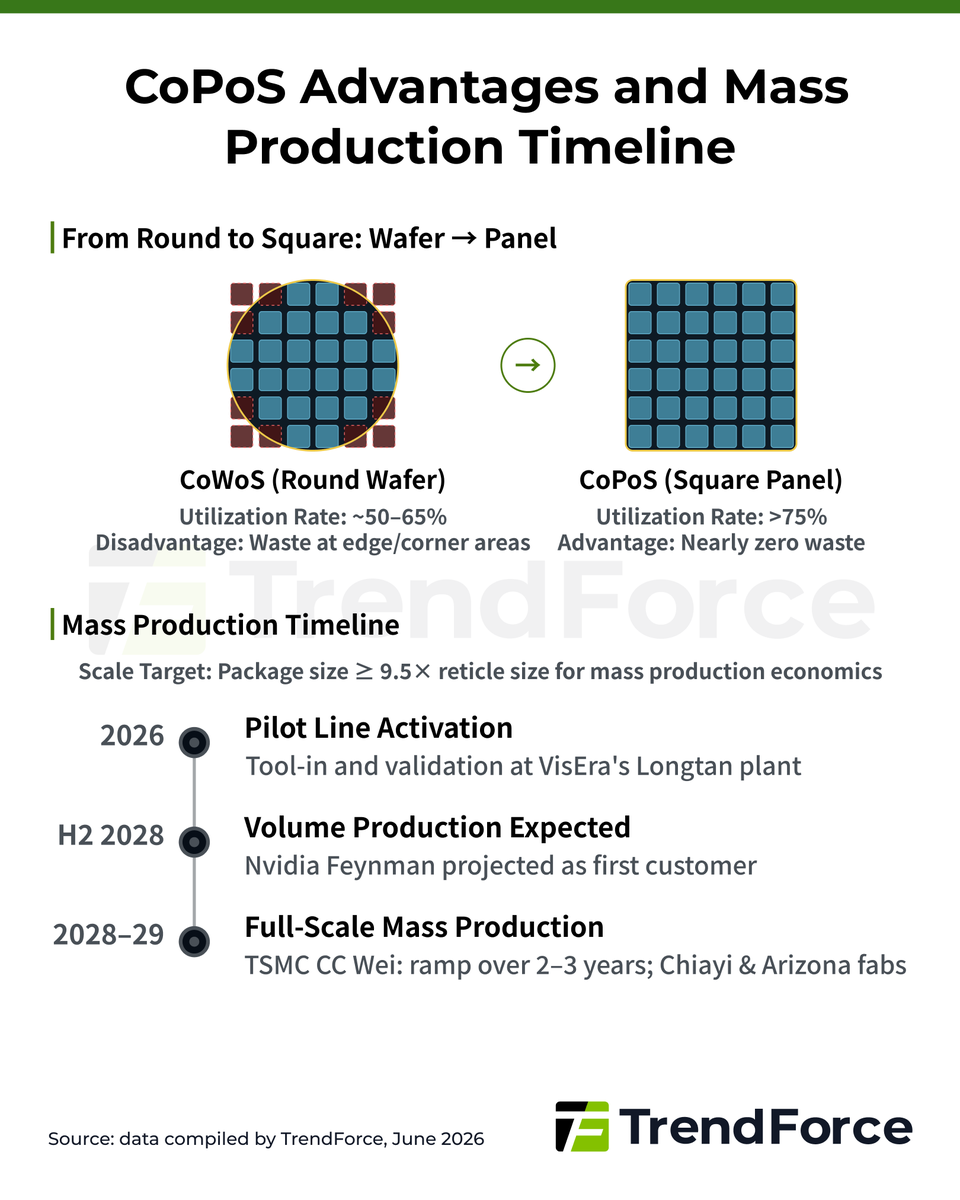
TSMC's #CoPoS is moving fast, and the opportunities for Taiwan suppliers are taking shape. CoPoS replaces traditional round glass carrier with a square panel format, pushing utilization rates above 75%.
More on glass material development: https://t.co/Na9XtpNK8Q 🔗