basic Vim commands that I keep forgetting
(because of mollycoddling myself with plugins on local machines, but "all that shit goes right out the fucking window" (to quote Goblin Cock) when working on remotes with no setup)
Spinoza didn't believe in free will but he had a radical alternative.
Anthony Quinton, philosopher, in conversation with Bryan Magee on the Great Philosophers series (1987).
The common idea of freedom that you can, at any moment, act as a spontaneous, uncaused cause of your own actions, Spinoza rejected entirely.
Quinton explains:
"The everyday vulgar commonsensical notion of freedom: the idea that the human individual can sometimes act as a spontaneous uncaused cause, this he says is impossible. It's simply an illusion that's engendered by our not knowing what the causes of our actions are."
We feel free because we're ignorant of our causes. Full stop.
He doesn't stop at determinism. Instead, he reframes the entire question from "are we free?" to "what kind of causes are driving us?"
He draws a distinction between two types of emotion.
Passive emotions: hatred, anger, resentment are generated in us by the frustrating forces of the external world. Things happen to us, and we react. We are, in that sense, instruments of outside circumstances.
Active emotions, by contrast, are generated by understanding. By genuine knowledge of our circumstances and the world around us.
"The greater our activities are caused by active emotions and the less by passive emotions, the less in bondage we are."
This is Spinoza's version of freedom: not escaping causation, but changing its source.
You are always caused. But you can be caused by your own understanding or by your unexamined reactions to a world that frustrates you.
The person who acts from rage, humiliation, or envy is in bondage because something external has taken the wheel. The person who acts from clear understanding of their situation is, in Spinoza's terms, more free.
It's a philosophy that holds up remarkably well three centuries later. Most of what derails us, bad decisions, broken relationships, wasted energy, they all trace back to passive emotions. Reactions we didn't choose, causes we didn't examine.
A community college professor taught the same study skills lecture for 30 years, and the video quietly became one of the most watched educational recordings on the internet.
His name is Marty Lobdell. He spent his career as a psychology professor watching students fail not because they were lazy, but because nobody had ever taught them how their brain actually works under the pressure of learning something hard.
The lecture is called "Study Less Study Smart." Over 10 million views. Passed around in Reddit threads, Discord servers, and university study groups for over a decade. And the core insight buried inside it has been sitting in cognitive psychology research for years, waiting for someone to explain it in plain language.
Here is the framework that completely changed how I think about effort.
Your brain does not sustain focus the way you think it does. Studies tracking real students found that the average learner hits a wall somewhere between 25 and 30 minutes.
After that, efficiency doesn't just decline. It collapses. You're still sitting at your desk, still looking at the page, but almost nothing is going in.
Lobdell illustrated this with a student he knew personally. She set a goal of studying 6 hours a night, 5 nights a week, to pull herself out of academic probation. Thirty hours of studying per week. She failed every single class that quarter.
She wasn't failing because she lacked effort. She was failing because she had confused time spent near books with time spent actually learning. The 25-minute crash hit her at 6:30pm every night. She spent the next five and a half hours sitting in the wreckage of her own focus and calling it studying.
The fix sounds almost too simple. The moment you feel the slide, stop. Take five minutes. Do something that actually gives you a small reward. Then go back. That five-minute reset returns you to near full efficiency. Across a six-hour window, the difference is not marginal. It is the difference between thirty minutes of real learning and five and a half hours of it.
The second thing he taught destroyed something I had believed about how memory actually works.
Highlighting feels productive. Going back over your notes and recognizing everything feels like knowing. But recognition and recollection are two completely different cognitive processes, and your brain is very good at making you confuse them.
You can see something you've read before and feel completely certain you understand it, even when you couldn't reconstruct a single sentence from memory if the page were blank.
He proved this live in the room. He read 13 random letters to his audience. Almost nobody could recall them. Then he rearranged the same 13 letters into two words: Happy Thursday. The whole room got all 13 without effort.
Same letters. Same count. The only thing that changed was meaning.
The brain stores meaning. Not repetition. The moment new information connects to something you already understand, the retention changes entirely.
This is what the cognitive psychology literature calls elaborative encoding, and it is the mechanism underneath every effective study technique.
The third principle was the one that hit me hardest, and the one almost nobody applies.
Lobdell cited research showing that 80 percent of your study time should be spent in active recitation, not passive reading. Close the material. Say it back in your own words.
Teach it to someone else, or to an empty chair if no one is around. The struggle of retrieval is where the actual learning happens. Reading your notes again is watching someone else do the work.
His parting line has stayed with me longer than almost anything else I have read about learning.
He told the room that if what he shared didn't change their behavior, they hadn't actually learned it. It would just live in their heads as something they had heard once and felt good about.
He was right. And most people leave every lecture exactly like that.
The students who remember everything aren't putting in more hours.
They stopped confusing the feeling of studying with the fact of it.
In 1977, Viktor Frankl revealed how some people survive unimaginable suffering & others don’t.
It’ll change how you see pain.
His ideas:
- You always have one last freedom
- Despair = suffering without meaning
- Why purpose keeps people alive
15 lessons on meaning & suffering:
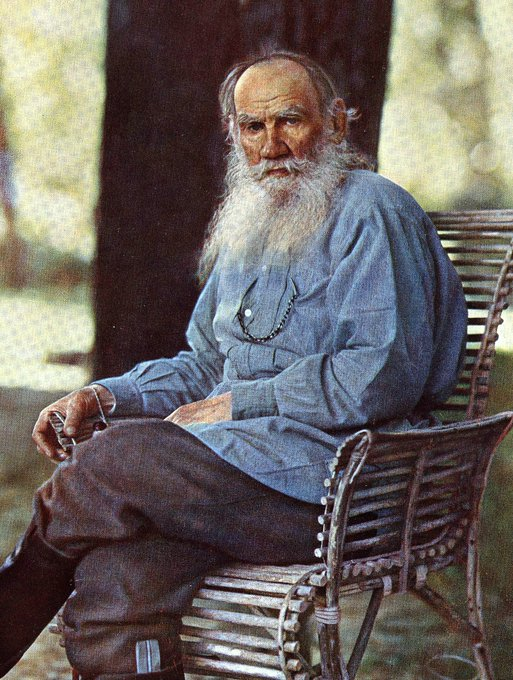
“Everyone thinks of changing the world, but no one thinks of changing himself. It is easier to wage a battle against distant abstractions than to fight the quiet war inside one’s own soul. Yet this is the only war that ever mattered.”
— Leo Tolstoy
Would highly recommend you watch David Foster Wallace talking about boredom, and why some people now find it so hard to read.
Sorely wish he were around today to hear his views on TikTok and the like.
FREE math book. "Combinatorics Through Guided Discovery," by Ken Bogart.
Many of the problems are designed to build up your intuition for how combinatorial mathematics works. Above all, this book is dedicated to the principle that doing math is fun. Topics:
What is Combinatorics?
Applications of Induction and Recursion in Combinatorics and Graph Theory
Distribution Problems
Generating Functions
The Principle of Inclusion and Exclusion
Groups Acting on Sets
Link: https://t.co/HU6MtRDt6d
David Lynch: "You're operating with a limited mind and don't realize it"
"If you have a golf ball-size consciousness, when you read a book, you'll have a golf ball-size understanding. When you look out, a golf ball-size awareness. When you wake up in the morning, a golf ball-size wakefulness. But if you could expand that consciousness, you read the book with more understanding. You look out with more awareness. You wake up with more wakefulness."
Lynch explains what lies beneath:
"There's an ocean of pure vibrant consciousness inside each one of us. It's right at the source and base of mind, right at the source of thought. It's also at the source of all matter. Modern physics calls it the unified field. All matter, everything that is a thing emerges from this field."
He describes what the field contains:
"This field has qualities like bliss, intelligence, creativity, universal love, energy, peace. It's not the intellectual understanding of this field, but the experiencing of it that does everything. You dive within, transcend, experience this field of pure consciousness, and you unfold it. It grows. The final outcome of this growth of consciousness is called enlightenment. And a side effect of enlivening this consciousness is that negativity starts to recede."
Lynch shares what happened when he started meditating:
"When I started, I was filled with anxieties. Filled with fears. Kind of a depression. And anger. I took this anger out on my first wife. After two weeks of meditation, she comes to me and says, 'What's going on?' I was quiet for a moment because it could have been any number of things she might have been referring to. I said, 'What do you mean?' She said, 'This anger, where did it go?' I didn't even realize it had lifted."
He explains why negativity kills creativity:
"Anger, depression, sorrow, these are beautiful things in a story. But they're like poison to the filmmaker. Poison to the painter. Poison to creativity. They're like a vice grip. If you're super depressed, you can hardly get out of bed, let alone think of ideas or have creativity flowing."
Lynch describes what grows when you expand consciousness:
"It's money in the bank to get that beautiful consciousness growing. Creativity flows. The ability to catch ideas at a deeper level. Intuition grows. This field is a field of pure knowing. You dive in there, and you just know how to go. You know how to solve problems. It's like an ocean of solutions."
He shares the ultimate benefit:
"The ultimate thing for me is the enjoyment of the doing. The enjoyment of life grows huge. I love making films now more than ever before. Ideas flow more. Everybody has more fun on the set. People look like friends, not like enemies. It's a beautiful, beautiful thing."
Lynch addresses the myth that you need anger to create:
"People say, 'You gotta have anger. You gotta have an edge to create.' No, you gotta have energy. You gotta have clarity to create. You gotta be able to catch ideas. You gotta be strong enough to fight unbelievable pressure and stress. And this gives you more and more ability. It just looks beautiful. It's way, way, way better."
On the nature of true happiness:
"They say true happiness isn't out there. True happiness lies within. I always wondered, where is this 'within'? And they don't say where it is. They don't even say how to get to it. But it's there. And when you're in it, you know you're in it. It's familiar. It's you. Right away, a happiness, but it's not a goofball happiness. It's a thick beauty. A thick beauty to appreciate life and living. And suffering starts to go."
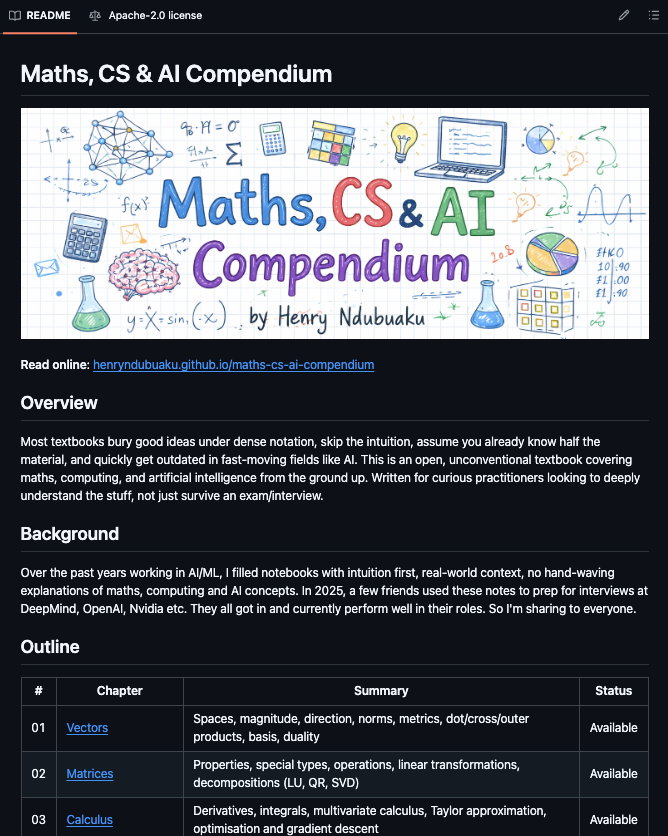
Say goodbye to paying $200 for AI textbooks that skip the intuition and leave you more confused than when you started.
An AI engineer spent years filling notebooks with first-principles explanations of maths, computing, and AI the kind that build real understanding instead of just getting you through an exam.
In 2025, he shared those notes with a few friends preparing for interviews at DeepMind, OpenAI, and Nvidia. They all got in, and they all perform well in their roles today.
Now he has open-sourced the entire thing as a free, unconventional textbook called the Maths, CS & AI Compendium, covering 18 chapters from vectors and calculus all the way through GPU programming, inference optimization, quantum ML, and AI for biology.
The six foundational chapters are live right now, covering vectors, matrices, calculus, statistics, probability, and machine learning with the kind of intuition-first writing that most academic textbooks never bother to include.
The remaining chapters on transformers, computer vision, audio, multimodal learning, autonomous systems, CUDA, systems design, and edge inference are coming next.
The notes that opened doors at the best AI labs in the world are now free for every curious practitioner on the internet.
Apache 2.0 License. 100% Open Source.
Why The Cat Concerto still fascinates classical music lovers 🎹✨
Released in 1947, this Oscar-winning Tom & Jerry short is set to Liszt’s Hungarian Rhapsody No. 2—one of the most technically demanding piano pieces ever written.
What makes it special? The animation doesn’t just follow the music—it matches real piano technique. Every movement of Tom’s hands reflects how a pianist would actually play this virtuosic work.
Add in perfect comedic timing, synchronized with every phrase and flourish, and you get a rare masterpiece where classical music and animation truly become one.
A timeless reminder: great music—and great comedy—are all about timing. 🎶
#ClassicalMusic #Liszt #Animation #MusicLovers #Piano
If you want to improve your technical writing skills, this course is for you.
It'll help you make your writing more concrete and practical while teaching you to communicate clearly.
You'll learn about framing definitions, describing objects and processes, writing formal reports, and more.
https://t.co/vNgnCJPWwR
BREAKING: MIT just mass released their Al library for free. (Links included)
I went through these and honestly... this is better than most paid courses I've seen.
Here's the full list of books:
Foundations
1. Foundations of Machine Learning Core algorithms explained. Theory meets practice.
2. Understanding Deep Learning Neural networks demystified. Visual explanations included.
3. Machine Learning Systems Production-ready architecture. System design principles.
Advanced Techniques
4. Algorithms for ML Computational thinking simplified. Decision-making frameworks.
5. Deep Learning The definitive textbook. Covers everything deeply.
Reinforcement Learning
6. RL Basics (Sutton & Barto) The classic. Agent training fundamentals.
7. Distributional RL Beyond expected rewards. Advanced theory.
8. Multi-Agent Systems Agents working together. Coordination and competition.
9. Long Game Al Strategic agent design. Future-focused thinking.
Ethics & Probability
10. Fairness in ML Bias detection. Responsible Al practices.
11. Probabilistic ML (Part 1 & 2)
Links: https://t.co/syzvgxbVcL
Most people pay thousands for bootcamps that teach half of this.
Bookmark it. Start anywhere. Just start.
Repost for others Follow for more insights on Al Agents.
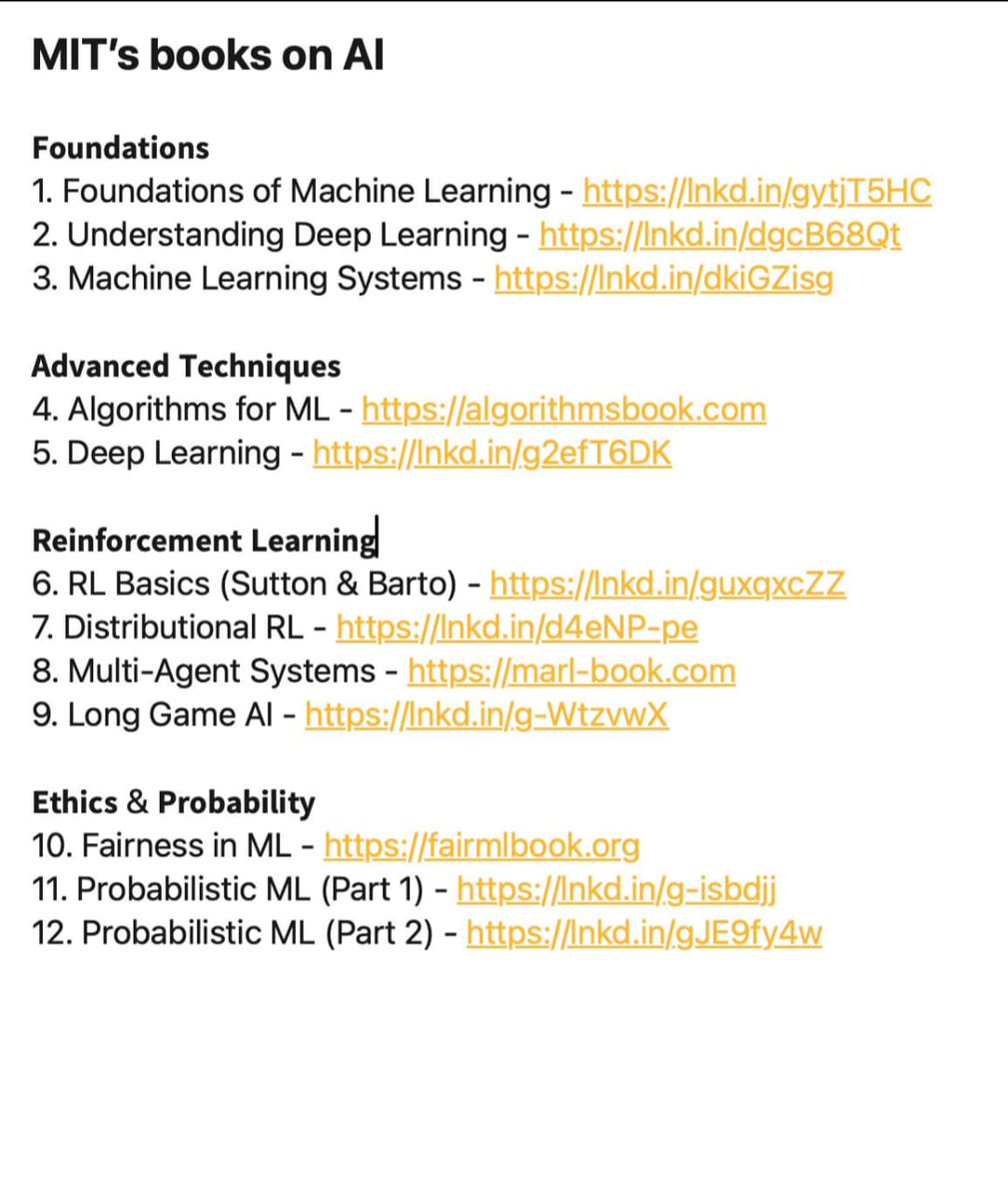
MIT's books on Al
Foundations
1. Foundations of Machine Learning - https://t.co/w4D7wpbf5f
2. Understanding Deep Learning - https://t.co/CjcKpTemmV
3. Machine Learning Systems - https://t.co/t920IxXNtQ
Advanced Techniques
4. Algorithms for ML - https://t.co/FNsUoPEPpa
5. Deep Learning - https://t.co/LokT3uJiaQ
Reinforcement Learning
6. RL Basics (Sutton & Barto) - https://t.co/QfveRFM8tP
7. Distributional RL - https://t.co/uNwPoDuKdf
8. Multi-Agent Systems - https://t.co/faE2R5ORGt
9. Long Game Al - https://t.co/7MFrdPlQor
Ethics & Probability
10. Fairness in ML - https://t.co/ntNTV6du5e
11. Probabilistic ML (Part 1) - https://t.co/1xrVgA5C3h
12. Probabilistic ML (Part 2) - https://t.co/cMC0mOfOD7