MIT just quietly dropped a free AI curriculum that puts $50,000 university courses to shame.
12 books.
Zero tuition.
From the same institution that produced the people building the models everyone is talking about.
FOUNDATIONS
1. Foundations of Machine Learning — https://t.co/Un6UbjJ3Xo
2. Understanding Deep Learning — https://t.co/UQxZmyESdn
3. Machine Learning Systems — https://t.co/YAgrLVGAXt
ADVANCED TECHNIQUES
4. Algorithms for ML — https://t.co/YlBk59o8Hp
5. Deep Learning — https://t.co/KMO1uWPyk1
REINFORCEMENT LEARNING
6. RL Basics (Sutton & Barto) — https://t.co/sOZlDXzu41
7. Distributional RL — https://t.co/uOkviYiAq7
8. Multi-Agent Systems — https://t.co/Dx9caJVx1d
9. Long Game AI — https://t.co/K9Qm2TjAQ6
ETHICS & PROBABILITY
10. Fairness in ML — https://t.co/MgkLdRvicO
11. Probabilistic ML Part 1 — https://t.co/Zz33gQi1vG
12. Probabilistic ML Part 2 — https://t.co/qBe776EjCg
This is a complete MIT-level AI education.
Not a YouTube playlist.
Not a Twitter thread full of fluff.
Textbooks written by the researchers who built the field.
The people who actually study this will not just understand AI better than their peers.
They will understand it better than most people currently getting paid to work in it.
Most people will bookmark this and never open it.
The ones who open it tonight are the ones who show up in 12 months having built something nobody around them understands yet.
Bookmark this.
Open the first one tonight.
Follow @cyrilXBT for more resources that actually compound.
Going to leave you with this tonight:
The best thing you can do for yourself is actively increase your surface area for luck to hit you.
Go outside, travel more, go to new cafes, museums, events, take a new route home, go for hikes, see cities, countrysides, take your notebook, speak to people, ask questions, start businesses - go on more side quests.
You can literally just do things, and the more you do, the more serendipity and synchronicity will find you.
Night gang.
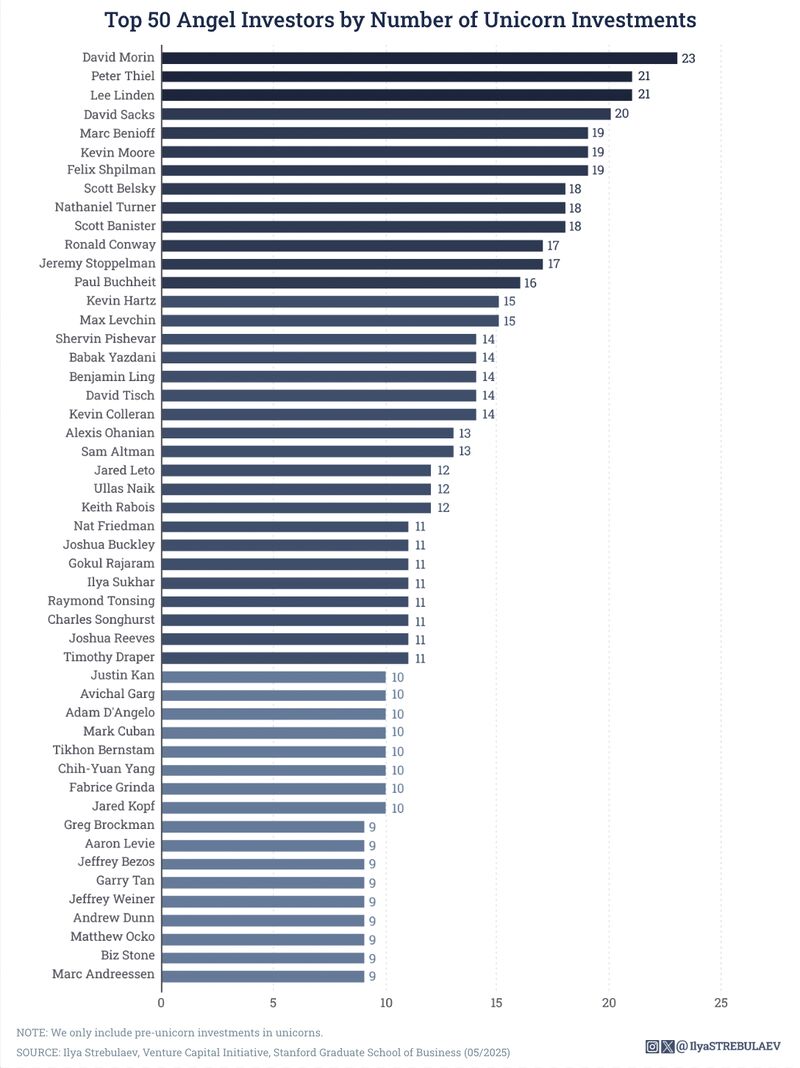
A Stanford professor analyzed 1,000's of angel investments to find out who's had the MOST unicorns.
The results are fascinating.
- David Morin tops the list with 23 unicorns
- Peter Thiel and Lee Linden follow with 21 each
- David Sacks at 20
- Marc Benioff at 19
A few things that stand out:
1) Almost every top angel was a founder or exec at a large tech company first. The clear signal here - they were mostly operators who earned their access.
2) Many co-invested together repeatedly. Thiel, Sacks, and Levchin all overlapped at PayPal and went on to back the same unicorns (Facebook, Airbnb, Palantir Technologies, SpaceX).
3) No women appear in the top 50. Sad.
4) The entry threshold to make this list is 9 unicorns (nuts!). The average unicorns across the top 50 is 13 (more nuts!).
I share this for folks to have inspiration to angel invest themselves!
There has NEVER been a better time - we are at a major tech inflection point.
If you're thinking about angel investing and forming angel syndicates, you should check out Verivend. Automated capital calls, one-click funding for co-investors, real-time visibility into who's in. Seamless software with a great team to hold your hand through it.
Try it yourself: https://t.co/qZ4U3OB2AY
Full credit to Ilya Strebulaev and his team at the Stanford for this research.