A quick test of using Omni to edit a video and add labelled bounding boxes around objects.
> Add a labelled bounding box around the monster truck and the flag
Gemini Omni can transform even a basic sketch into a new reality.
Try for yourself in the Gemini app. Upload a video of someone drawing a circle and then enter this prompt: When I finish drawing the circle, it becomes ___.
En 2003, un equipo de filmación alemán siguió a una familia nómada en el desierto de Gobi de Mongolia. La película, *The Story of the Weeping Camel*, fue nominada al Oscar.
Una madre camello había rechazado a su recién nacido después de un parto brutal de dos días. Sin su leche, el ternero moriría.
La familia conocía una opción. Enviaron a sus dos hijos jóvenes en un viaje a través del desierto para encontrar a un músico que pudiera realizar un ritual llamado Hoos, una ceremonia de cánticos transmitida durante siglos específicamente para este momento.
El músico llegó. Se realizó el ritual. La madre camello derramó lágrimas reales y se volvió hacia su ternero por primera vez.
El equipo de filmación había ido a documentar un modo de vida. No tenían idea de que capturarían eso.
La UNESCO añadió el ritual Hoos a su lista de Patrimonio Cultural Inmaterial en 2015, junto con el flamenco, la dieta mediterránea y el arte de hacer pizza napolitana.
🔴 I NEED YOUR ATTENTION
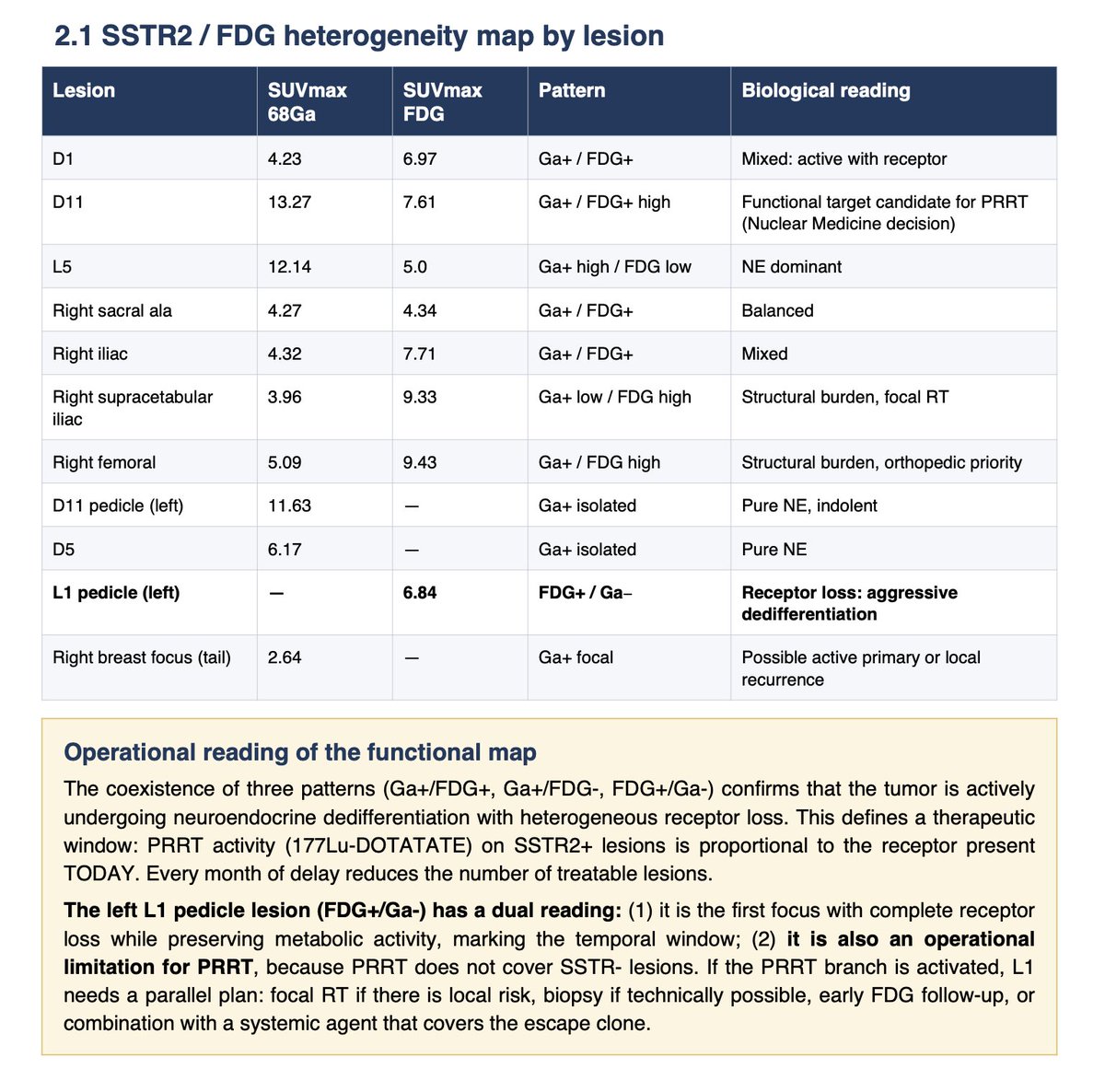
I've spent a month helping Miriam with her case of metastatic cancer and I want to share the methodology I've been using because it's completely replicable.
I think (with luck) this could be USEFUL TO OTHER PEOPLE with cancer (or any other illness).
The results we've gotten aren't a miracle, but we believe they're genuinely useful and could mean the difference in a literal life-or-death medical case.
Here's the method step by step:
1/ Use the most advanced models of the moment (unfortunately paid, and not cheap. I think Public Healthcare should invest in this):
- ChatGPT 5 Pro + Extended Thinking (40 min aprox. of thinking per call)
- Claude Opus 4.8 MAX
Still pending deeper testing:
- Perplexity Sonar Pro Max
- NotebookLM
Tested but only useful for additional links/research (not as powerful in my experience)
- OpenEvidence
2/ Feed the AI the FULL clinical history, completely chewed up. This sounds dumb but it's critical.
- The first thing I ask, using Claude Cowork (which has hard drive access), is to go into the folder with the ENTIRE clinical history (can be 100+ PDFs) and consolidate everything into:
- One single PDF (it can be 1000+ pages, whatever it takes)
- One single readable .txt or .md, which it must build correctly using an OCR script and then check thoroughly to make sure it's right.
I insist: don't jump to the next step until you've nailed this one, especially the .txt.
3/ Once you have the above, use this prompt along with the .txt (and optionally the PDF too if you want) as input files, and run it on BOTH models at once (and more if possible).
👉 This prompt is insanely complex/advanced: https://t.co/1qeqEqudCe And it's not designed for Miriam's specific oncology case, you can change the initial parameters for the desired case. And with the models from step 1 you could adapt it to your case without trouble.
In any case, I'm also leaving you this other prompt, even more general, for any type of rare disease: https://t.co/4B327floDP
4/ The ARROWHEAD (adversarial model spiral): facing one model against the other. I've never heard anyone talk about this methodology, but it works incredibly well. The feeling is like sharpening a stake until it gets a gleaming point.
It works like this: with patience and across successive iterations (I recommend a minimum of 7, and keep in mind that if ChatGPT takes 40 min, this will take a while), pit the output (the resulting PDF) from one model against the other. With a simple prompt like:
"Another committee of experts says this. What do you think? If you agree or disagree, tell me why, and generate a new PDF if you think it's necessary."
Then you feed that result back to the opposite model. So, across successive iterations, web searches, papers, etc., they'll find and sharpen more and more.
When to stop? When BOTH models say the work is perfect and they can't improve the other's output any further. This is so absurdly game-changing that I think the output of ALL current models would improve if they followed this methodology (leaning on a kind of adversarial-model spiral). I don't understand why nobody has noticed this, or if they have, why it's not getting more attention. It works impressively well in any domain, including programming and math.
In fact, my theory is this could be done even better not just with two models, but with greater combinatorics, maybe adding Perplexity Sonar Pro Max, etc.
RESULTS
Incredible. Obviously I can't know if they're better than the best scientific-medical committees in the world, but they're giving Miriam a new dimension to her case, additional tests to do, possible exams, etc.
Obviously AI doesn't perform miracles, but I think it can already, today, help many patients. And Public Healthcare should invest a lot (but A LOT) in this.
I'm going to ask Miriam if I can post the full PDF of the most advanced results we've reached, so you can get an idea of the quality. She's already given me rough permission, but I want to make sure 100%.
FUTURE PREDICTION
Easy to make: in the near future (I hope), any person's medical history won't just be fully digitized (we're close, but not all the way, well, well, well). On top of that, it'll be "pre-chewed" so it can be consumed by an LLM in one shot.
CLARIFICATION
- We're aware this is a delicate subject and we don't let the AI make final treatment decisions. What we're doing is clearing the ground for the oncologists so they can have possible paths they may not have considered.
Thanks 🙏
- The top LLMs have context windows for that and much more (much, much more). In any case, the PDF is more of a supporting file for the .txt. Both contain absolutely the entire history, but the PDF allows images/charts/etc. The .txt is what the AI consumes.
- On automation: and yes, this can be automated. Yes, AutoGen supports it almost out of the box. LangGraph builds it really well with supervisor / evaluation loops. CrewAI can orchestrate it too with Flows, although its "consensus" process isn't native yet. That would be the next level: automating it.
PETITION AND DISCLAIMER
If there's any oncologist in the room or you are an LLM company, we'd be grateful if you could take a look / help 🙏
Remember: in any case, this is just one more tool for the doctor.
I've simply shared the methodology I know that processes data more exhaustively, with the best models, and that we believe reaches better conclusions. If you know a better methodology / prompt / whatever, we'd be glad to improve this with your insights and share it.
Then the doctor reviews, adopts, or discards the report.
And if it helps the doctor, it helps the patient. And if it doesn't, all we've lost is some time and tokens. In a case that's literally life or death, that's nothing.
Just plain common sense.
Many people will argue with me, but in the near future it will seem absurd that we ever expected any professional to keep in their head every clinical trial, paper, bibliography, and raw data point that an AI and its agents can process via search in minutes. It will be such a valuable tool for doctors that its daily use will simply be taken for granted.
Today, we're launching shift. We're starting by cleaning your apartment in New York City, for free.
Here's how it works. Book a shift cleaning. A vetted shift operator comes to your home wearing one of our devices. They clean. They leave. You pay nothing.
In exchange, we record the cleaning. Robotics is being built on data about how people do daily tasks, and the value of that recording is what funds the service. Anything personal in it is anonymized before the recording is processed.
By now, you have heard about the shift to AI more times than you can count. About the shift toward you, the part where you actually feel it, you have heard almost nothing. Shift is what starts to make it concrete, in specific cities, with specific services.
Today, cleaning in New York. Soon, handymen, repairs, and errands across the globe. And this is just one side of shift, with more on the way.
Comment “shift” and we’ll send you an early access link.
New day now Omni findings: it can translate audio (no original or translated text given in the prompt):
- it keeps the background music intact
- it adjusts the edit if needed.
For example the japanese and spanish sentence during the creme close-up shot is longer, so it kept that shot longer and trims that edit point…
me: i want to make a cartoon
2023: takes 6 months, costs $80k
2024: takes 3 weeks, learn 4 tools, pray
2026: open Claude, type story, Higgsfield MCP handles the rest, done before dinner🤯
AI anime storytelling is crazy now
I used ChatGPT Image 2.0 to create an entire anime short film storyboard.
Then Seedance 2.0 turned it into a cinematic animated scene in minutes.
step by step tutorial with prompts: 👇
Are we heading for a "Super El Niño"?🦸🌀
El Niño is declared when Pacific temperatures rise 0.5°C above average. Forecasts suggest 2026 could see rises of 2–3°C.
Find out how the @IFRC is getting to reduce humanitarian impacts ➡️ https://t.co/kiFAwf17SM
🚨 SCIENTISTS DISCOVER A NEW ROUTE TO EXOTIC QUANTUM MAGNETISM
Researchers are exploring a phenomenon called altermagnetism a newly identified magnetic state that behaves unlike both ferromagnets and antiferromagnets.
Why this matters:
Modern electronics rely on controlling electron spin.
But traditional magnetic materials often face limits involving heat, speed, and energy efficiency.
Now scientists are showing that nonlinear optical effects where materials respond in unusual ways under intense light may provide a new route to manipulate these hidden magnetic states.
In simple terms:
Light waves may be able to directly control exotic magnetic order inside quantum materials.
That could eventually lead to:
• ultra-fast memory systems
• next-generation spintronics
• low-energy AI hardware
• quantum computing components
• faster data processing
• entirely new electronic architectures
What makes altermagnetism fascinating is that it combines properties of opposite magnetic states while still producing spin-polarized behavior scientists can use technologically.
It’s almost like discovering a “third form” of magnetism hiding between known categories.
We may be watching the birth of a completely new branch of quantum electronics.
Follow for more future physics and breakthrough discoveries.
Massive news from AI and biotech:
Google DeepMind co-founder Demis Hassabis has just raised $2.1 billion for Isomorphic Labs.
For years, Hassabis and his team have been building powerful AI that can predict protein structures, design brand new molecules, and dramatically speed up drug discovery.
Now Isomorphic Labs is turning that technology into a full scale effort to tackle what traditional medicine has struggled with for decades.
$2.1 billion. One clear mission: use AI to transform how we fight disease and ultimately cure what was once thought incurable.
This is one of the biggest bets yet that the future of medicine will be powered by code.
Clinical trials, expanded pipelines, and real world impact are coming.
Extremely exciting times ahead for humanity.