Introducing Anatomy
Describe a machine in one line. Claude brings it to life.
- Interactive isometric wireframes you can rotate, inspect and explore
- WebGL shaders for fire, water, plasma and more
- Real 3D motion, with individual parts that rotate and move
Install it as an agent skill. Fully open source.
Apple says you need a Mac to build iPhone apps.
Today I built one on Omarchy Linux, submitted it to the App Store, installed it on my iPhone over USB, and stopped it at a breakpoint in the debugger.
No Mac anywhere.
It's all open source:
https://t.co/ETOnP3n3X3
Introducing Claude Fable 5: a Mythos-class model that we’ve made safe for general use.
Its capabilities exceed those of any model we’ve ever made generally available.
⚠️ Supply chain attack in progress: someone is squatting Anthropic-internal npm package names targeting people trying to compile the leaked Claude Code source.
`color-diff-napi` and `modifiers-napi` — both registered today, same person, disposable email. Do NOT install them. 🧵
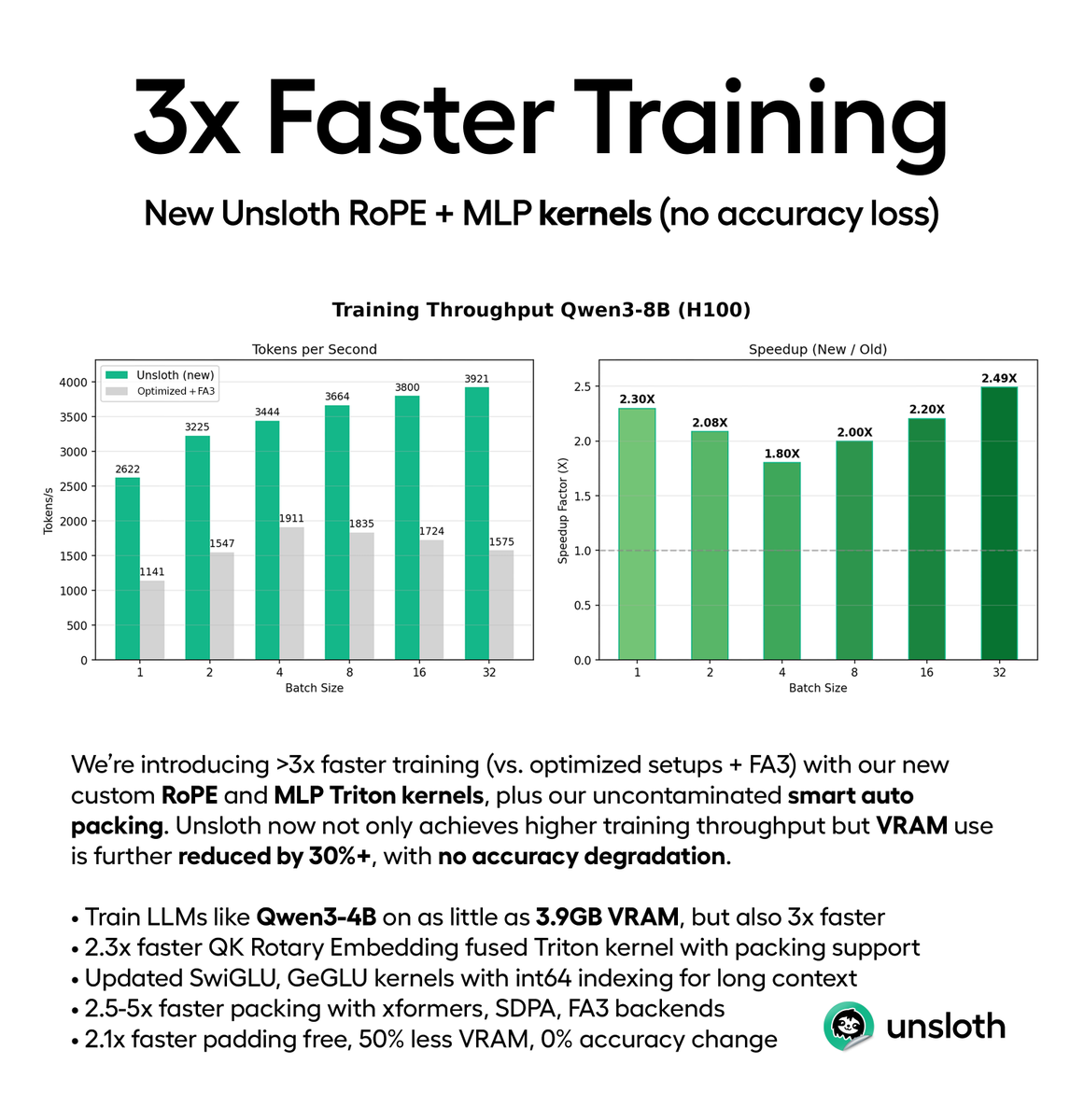
You can now train LLMs 3× faster with no accuracy loss, via our new RoPE and MLP kernels.
Our Triton kernels plus smart auto packing delivers ~3× faster training & 30% less VRAM vs optimized FA3 setups.
Train Qwen3-4B 3x faster on just 3.9GB VRAM.
Blog: https://t.co/kL6JM6skH1
@itsoktokillceos @luqmanhakem31 Flutter saves cost because one app works for both iPhone and Android, but with a RM1 billion budget, it’s kinda ironic 😅 with that amount, they could easily build a highly robust native app for each platform.
Training LLMs end to end is hard. Very excited to share our new blog (book?) that cover the full pipeline: pre-training, post-training and infra. 200+ pages of what worked, what didn’t, and how to make it run reliably
https://t.co/iN2JtWhn23
@marceline_10969@hourlymalaytwt I’ve zero problem with you doing that if it helps you get through life, but just keep that in mind that ive worked on multiple LLM algorithms and GPT fine-tuning before, we see AI can still biased and tends to respond based on what the user says.
good question... thinking back to pre-LLM interviews I experienced (before 2019)… they were all in-person on-site, no chance of ''llm cheating,'' very different across places, and somehow way more memorable.
> old deepmind had brutal ''quizzes'' -- 2-hour marathons with 100+ math/stats/ML concept questions.
> meta FAIR was basically academia interview with a bit of coding, but the highlight was chatting vision research with piotr, ross and kaiming.
> google brain/research was similar. the @NoamShazeer was my coding interviewer, who kindly kept it simple with just a two-pointer q. we spent most of the time discussing research, where I explained how I had applied something called a transformer to visual data (point clouds) -- a topic that, at the time, hardly anyone cared about.
> but the coolest? openai in 2018: whiteboard coding, a research talk, and a *~5-hour* session in a tiny room to work on an RL problem (variance collapse in cross entropy methods). I knew almost nothing about RL, but that was the point. They handed you a self-contained problem description, handwritten by @johnschulman2, and expected you to learn, research, solve, write up in a notebook, and present.
feeling a bit nostalgic. makes me wonder if interviews like that still happen anywhere. If they do, I’d love to know. :)
Introducing Kitten TTS, a SOTA tiny text-to-speech model
- Just 15M parameters
- Runs without a GPU
- Model size less than 25 MB
- Multiple high-quality voices
- Ultra-fast - even runs on low-end edge devices
Github and HF links below
⚡ IT'S FINALLY HERE!
F-Lite: our first foundational model for image generation. A collaboration between Freepik ♥️ Fal.
• Open Source
• Fully commercially usable
• 10B parameter DiT trained on 80M images
• Trained with 100% licensed data
Link + info 🧵👇