Excited to share a new paper that aims to narrow the conceptual gap between the idealized notion of Kolmogorov complexity and practical complexity measures for neural networks.
‼️ We are delighted to release the paper describing the method used to create the BgGPT series of models (https://t.co/F95Zw8yCaw). Method is applicable and can be used to fine-tune any base model to obtain new skills (e.g., BG) without forgetting old ones (e.g., math, EN).
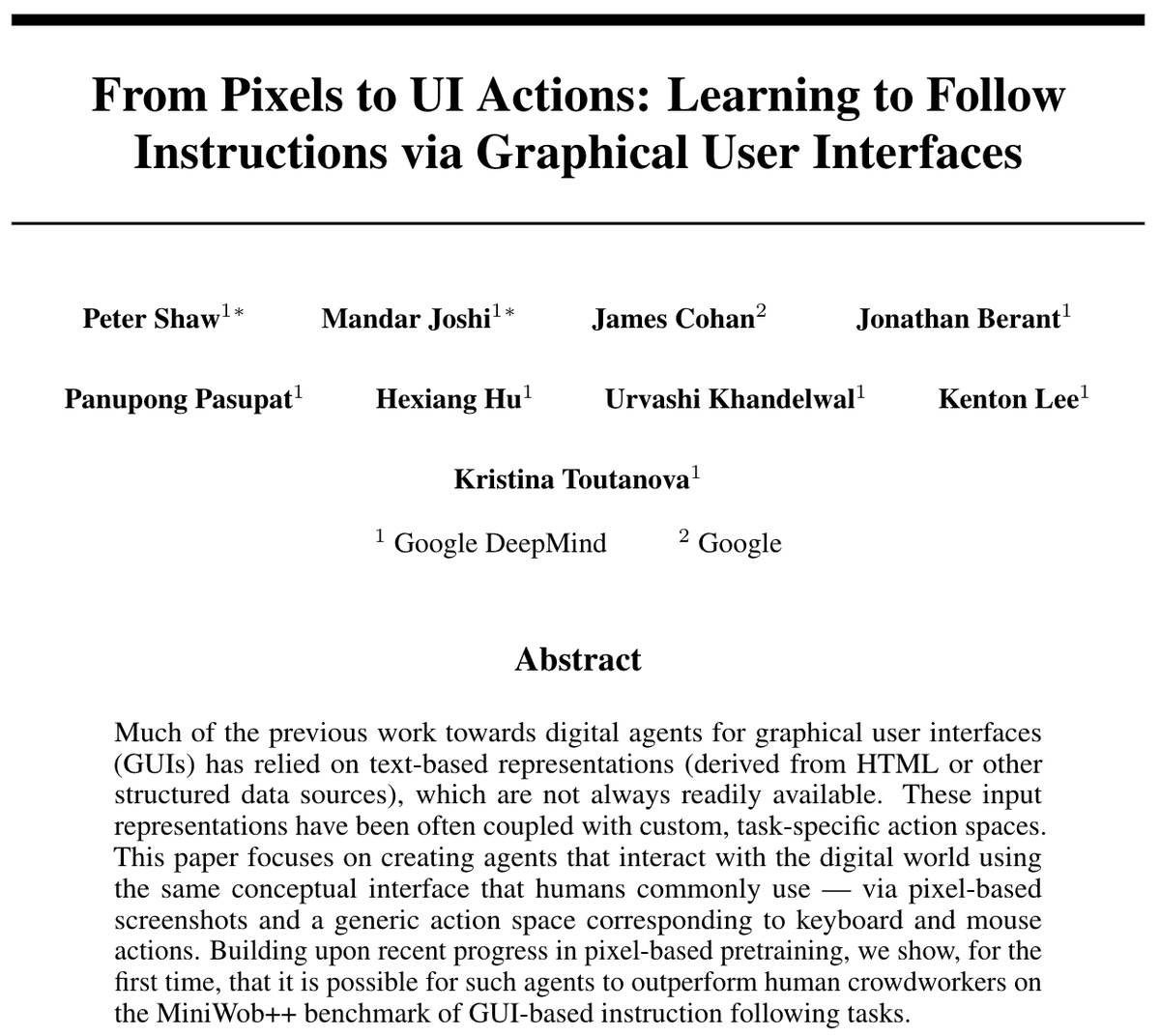
Excited to present Pix2Act! An agent that can interact with GUIs using the same conceptual interface that humans commonly use — via pixel-based screenshots and generic keyboard and mouse actions -- https://t.co/NX06uTpcVV (1/4)
Very happy to share that Pix2Struct was accepted at ICML! It's also now a part of the HuggingFace universe thanks to @younesbelkada, @NielsRogge, and @a_e_roberts!
https://t.co/XdaZvoBAk0
Is scale all you need for semantic parsing? We present a systematic study of scaling curves measuring compositional generalization in semantic parsing across model types and task adaptation techniques:
https://t.co/Cfq28cq9AQ at #EMNLP2022 (1/n)
🤔 When does a factoid question need a *long* answer?
🤖 "Long" could mean multiple things: either you ask for a city with a very long name or …
Read Ivan Stelmakh's internship paper to get the second part of the answer!
https://t.co/fmRTFxHyNw
Our group is looking for a student researcher to work on measuring and improving the compositional generalization capabilities of neural networks. Come work with me, Kristina Toutanova (@toutanova), and others across Google Research! (1/2)
“Improving Compositional Generalization with Latent Structure and Data Augmentation” https://t.co/DF8NFV9qlh.
Can we do better than good-enough compositional data augmentation? We present a data recombination method using a model called Compositional Structure Learner (CSL).
New from Google Research: https://t.co/tMcLH1PAb8
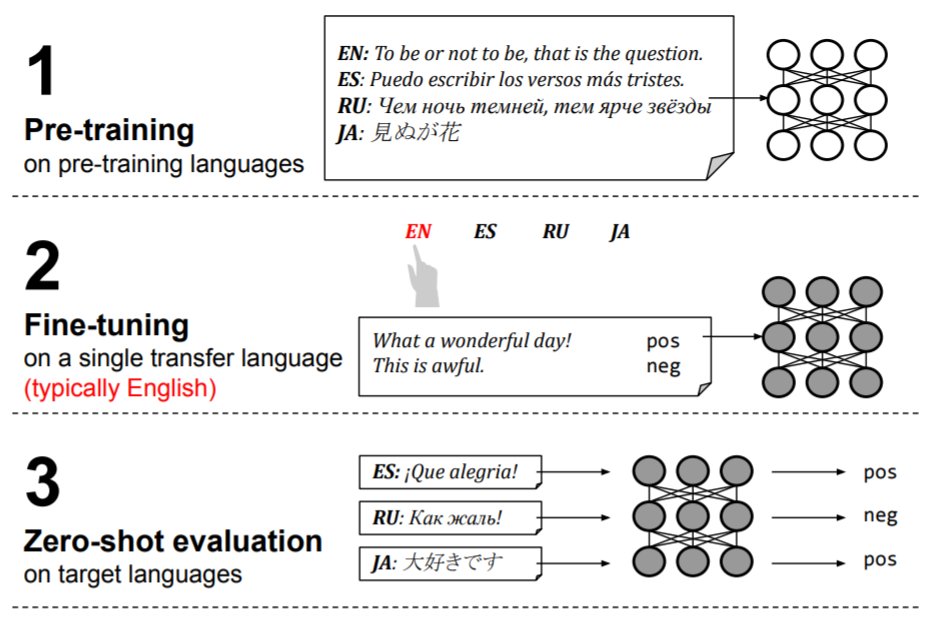
To build multilingual NLP systems, a successful recipe is to pre-train on a multilingual corpus, and then fine-tune on labeled data in a single transfer language -- usually English. But is English best?
We’ve released the code for our paper “Compositional Generalization and Natural Language Variation: Can a Semantic Parsing Approach Handle Both?” (w/ @mchang21, @IcePasupat, @toutanova):
https://t.co/HJhwfxRE56
You can help determine an effective format for the virtual NAACL 2021!
You can provide quick feedback on options or volunteer to serve on the virtual infrastructure chairing committee via this form https://t.co/Su3jEHcM3i
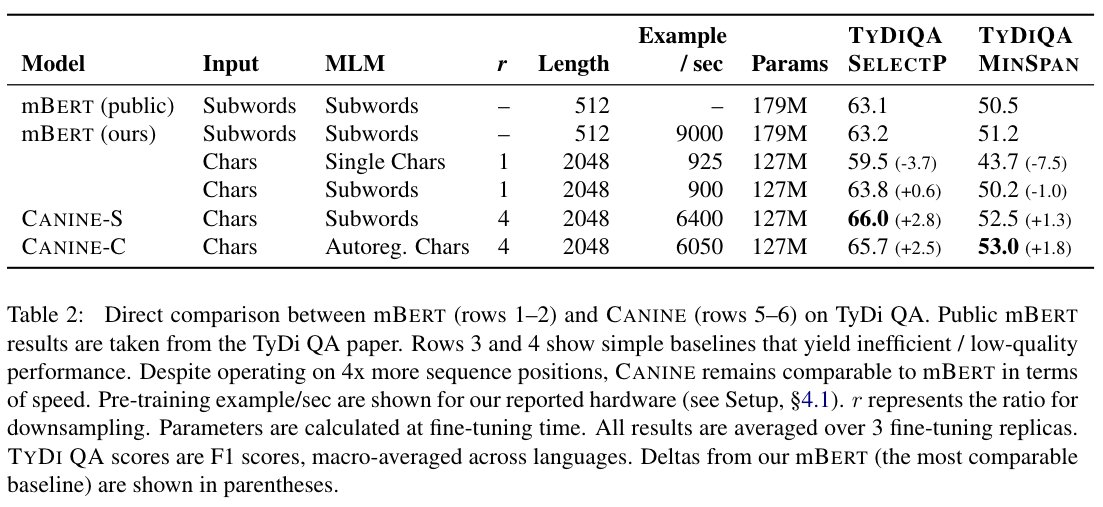
New from Google Research: CANINE, a pre-trained tokenization-free language encoder. This frees us from a variety of pitfalls associated with tokenization, but also improves quality on TyDi QA, a multilingual question answering benchmark. https://t.co/dwEvGmezMB
New from Google Research! https://t.co/FIkz8mvQ85
Show examples from the distribution you want, and our example extrapolator (Ex2) generates new examples from the same distribution.
We use Ex2 for data augmentation, improving over SOTA methods on multiple NLP benchmarks! (1/3)
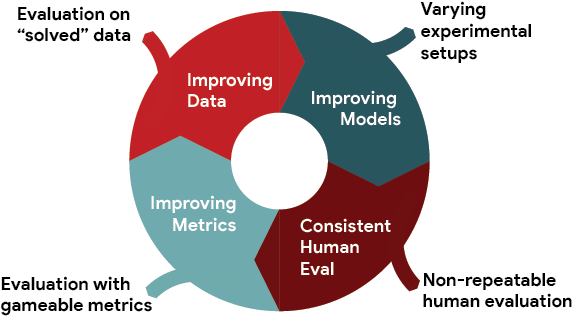
Introducing 💎GEM, a living benchmark for natural language Generation (NLG), its Evaluation, and Metrics. We are organizing shared tasks for our ACL 2021 workshop - Please consider participating!
Website: https://t.co/TAs4F40mga
Paper: https://t.co/VWdcdNv6iu
#NLProc
🧵1/X
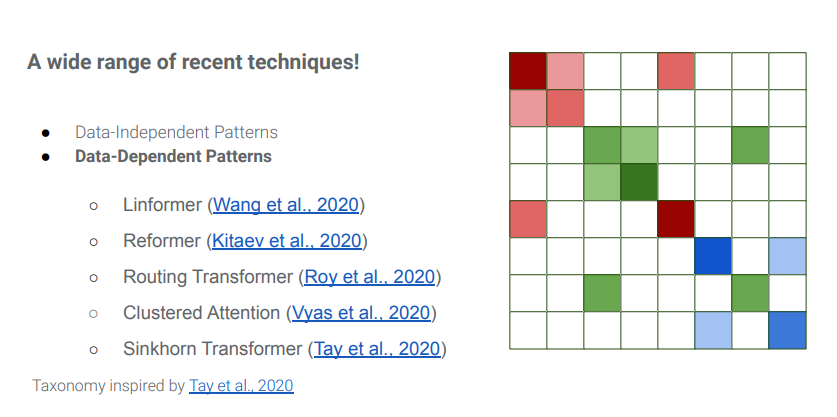
These tutorial slides on "High Perf NLP" are really impressive. Every slide is current to the minute. Amazing set of diagrams.
https://t.co/o0o4SY6chR
(@gabriel_ilharco@Tim_Dettmers @IuliaTurc @kentonctlee Felipe Ferreira Cesar Ilharco)
As noted in the CFP, #NAACL2021 is incorporating ethical considerations in the review process. For more information on what that will look like, please see our Ethics FAQ for authors: https://t.co/6rylaZK3R0