@spideynation_@RishabhPant17 haan bc ab shaadi bhi woh tumhare kehne se kare..uski personal life nahi hai kya? fann hona achchi baat hai lekin limit hoti hai har chij ki
@ashh_17_ This time high expectation tha as he trained with Yuvi but... not sure captaincy ka itna burden hoga LSG mei. At least I'm happy that he's dropped out of ODI bench warmup team ..now he can grind in domestic and A teams(if given chances) and improve on his weaknesses.
@ashh_17_ I only see 2 chances from here:
1. LSG captain change, letting Pant play freely as batter & wk, maybe opener
2. MI might try (if any chance) and play him as an opener or at 3 max. Rohit ka form dikh ke
Not sure KKR is looking for indian wk opener
Baaki team ka opener sorted hai
Diffusion models are slow because generating one image takes hundreds of sequential passes through a neural network. People have spent enormous effort trying to speed this up, usually by training a second "student" network to imitate the slow process in fewer steps, with mixed results.
This paper shows a way to train such a model so that all those hundreds of steps provably collapse into a single pass, with no approximation and no student-teacher distillation.
The same construction also gives you, for free, the ability to take a real image and find the noise that would generate it (something diffusion models normally can't do cleanly), and to build networks that are exactly idempotent—meaning running them twice does the same thing as running them once.
For instance, finding the noise that generates a given real image is what lets you edit that image with a diffusion model. If you want to take a photo of a face and change the hairstyle, or take a painting and restyle it, you first need to locate where that image "lives" in the model's input space. Without that, diffusion models can only generate from scratch—they can't take something you already have and modify it. Current methods for doing this inversion are approximate, sometimes fail to reconstruct the original faithfully, and add computational cost on top of already slow generation. A clean, exact inversion would make image editing with these models work the way people intuitively expect it to.
Read with AI tutor: https://t.co/Q84tuaAAb3
PDF: https://t.co/M2ZqsckfBR
Also see this relevant paper: https://t.co/W41XaPT5pE
Every AI Engineer should read these 3 research papers:
• Attention Is All You Need
• Generative Adversarial Nets
• Distilling the Knowledge in a Neural Network
Future you will thank you.
I'm an interactive learner, so I turned Google's TurboQuant paper into a @marimo_io notebook.
Random rotations → Beta distributions → optimal 3-bit quantization → 6x memory savings on LLM KV caches.
Way easier to grok when you can drag a slider and watch the math happen.
https://t.co/OzTqEbfBYz
16 Reinforcement Learning approaches you should know about (classic + modern)
▪️ RLHF – RL from Human Feedback
▪️ RLAIF – RL from AI Feedback
▪️ RLVR – RL with Verifiable Rewards
▪️ RLCF – RL from Community Feedback (2 different variants)
▪️ RLCF – RL from Checklist Feedback
▪️ CM2
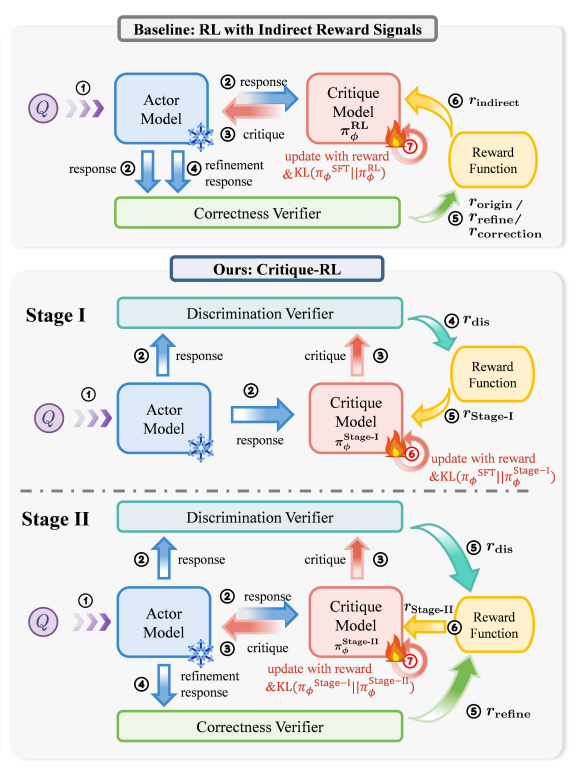
▪️ Critique-RL
▪️ CRL – Critique RL
▪️ ICRL – In-Context RL
▪️ RLBF – RL with Backtracking Feedback
▪️ TriPlay-RL
▪️ SPIRAL
▪️ Co-rewarding
▪️ RESTRAIN
▪️ PRL – Process Reward Learning
▪️ RLSF – RL from Self-Feedback
Save this list and check it out for links and explanations: https://t.co/rL0kmpjMKy
WMMA in CUDA
just wrote a blog to help you get started with WMMA (Warp-Level Matrix Multiply-Accumulate) instructions in CUDA. the blog talk about how CUDA cores and tensor cores differ, tons of visuals for the concepts to sink in, and explain how to do a mixed precision matrix multiplication using tensor cores.
in general, tensor cores are exceptionally faster than cuda cores for matrix multiplications and if your GPU supports tensor cores, you should definitely give this a read!
blog - https://t.co/XGHDXPu4cH
@Alasdair333@MohitKattaC1733 bro I saw you reposted few tweets related to Lamichhane and I, as an unbiased Nepali citizen, want to request you to first do at least some research(not even deep research) about the accusation and the court's final verdict. Lemme know if u want to know from me
To achieve training-inference alignment, there will be a solution that directly uses Megatron for inference.
Today, while chatting with friends in the NeMo RL group, I came across a term that surprised me: Megatron-Inference. I immediately understood what it was aiming for, as I've been talking about the training-inference mismatch problem for a long time. Since last September, I've covered this topic in many talks. For instance, at the Torch Conference, I would start my talk by saying:
"The root cause of the training-inference mismatch is that training and inference use different backends. Megatron is used as the training backend, while SGLang is used as the inference backend. Consequently, their kernels, parallelization strategies, and batch sizes are not perfectly aligned, leading to a layer-by-layer divergence."
So, how can we solve the training-inference mismatch? From first principles, the solution is simple: use the same backend for both inference and training. Is this feasible? It seems so. I heard that when a certain large company started its RL work, they didn't even have separate backends for inference and training. They built a single framework that supports both training (forward + backward) and inference (forward + KV cache management). While this framework wasn't optimally efficient for either task, it serendipitously made solving the training-inference mismatch much simpler for them compared to us. Of course, any solution to this problem is non-trivial. (You can refer to my recently published blog post, "Let Speed Be With Stability: All-In-One Solution to Training-Inference Mismatch with Miles.")
Returning to the first-principles solution of using the same backend for both tasks, can this be achieved in open source, setting aside the rumored efforts of some big companies? In other words, can we use Megatron for inference or SGLang for training? This remains an extremely complex challenge. As most ML systems introductory courses teach, the computational characteristics of training and inference are fundamentally different (refer to my earlier blog post, "Understanding the Computational Characteristics of Prefill and Decode through Chunked Prefill"). Each has evolved its own set of complex and often distinct optimization strategies. Some optimizations are shared, like Tensor Parallelism (TP) and Expert Parallelism (EP), but others differ, such as Sequence Parallelism (SP), Context Parallelism (CP), and KV Cache management. Given this complexity, it's hard to imagine the engineering difficulty of maintaining both training and inference in a single codebase, or the complexity of adding inference capabilities to a training backend (or vice-versa).
Therefore, at the Torch Conference, I stated—though it seems a bit dogmatic in hindsight—that it was impossible for a training backend to also handle inference, because adding features like KV cache management and continuous batching to Megatron seemed like an insurmountable task.
😂 I might have been too hasty, or perhaps I underestimated the technical prowess and determination of NVIDIA's engineers. Today, in the NeMo RL group, I saw NVIDIA folks sharing their work on Megatron-Inference. As a peer, I didn't need any background explanation; I instantly grasped the sheer audacity and incredible achievement this represents. All I can say is, as an NVDA shareholder 😂, I feel even more confident holding my stock.
Of course, after praising their work, I know they still face numerous hair-pulling technical challenges. For example, does this design truly eliminate the mismatch? (It doesn't seem to be their main selling point, as I was completely unaware of it until today.) What is the performance overhead of this approach? And then there are business considerations: how will Megatron-Inference avoid scope conflicts with TRT-LLM? (Since I started working, I've learned to pay much more attention to these commercial and workplace dynamics...)
Now, having discussed the Megatron-Inference approach, let me share the technical solution from SGLang RL. We also adhere to the first-principles idea of "aligning different settings." In principle, there's no secret—it's all public. The same kernel, the same parallelization strategy...
Stay tuned for the next part!
@ashh_17_ my main concern is - Is Shami bowling with same impact or threat in PP as before the injury? length, consistency & seam/swing?
If he is even just 80% of he was before, we shouldn't worry. PP was our issue. Avesh is there for middle & death. And one of Mayank/Mohsin.
@ashh_17_@LSGnation@MohitKattaC1733 if he doesn't play even for half season, it's stupidity at it's fullest, but if he got this price, I think teams talked with him beforehand. should play for 4-6 matches at least.