THE BEST PODCASTS AND ARTICLES I'VE EVER FOUND
Here are the 0.1% of resources I've consumed that have brought me 90% of the value.
The LINDY LIBRARY.
I wish somebody gave me these in a list so I could have spent more time exploiting than exploring.
THREAD...
Mark Zuckerberg built a COLOSSAL data center in Georgia — literally hundreds of yards from families’ backyards.
Water pressure has tanked. Faucets barely drip. Toilets won’t refill. Houses shake nonstop from the vibrations and blackouts are now routine.
One billionaire gets his servers humming at full speed… while working families get crushed.
This is straight-up unacceptable.
There's a great article on Japan's railways in this month's @WorksInProgMag. It's worth considering a print subscription too, because the design is so beautiful and makes this article even more of a joy to read:
https://t.co/V6dqTVyfOc
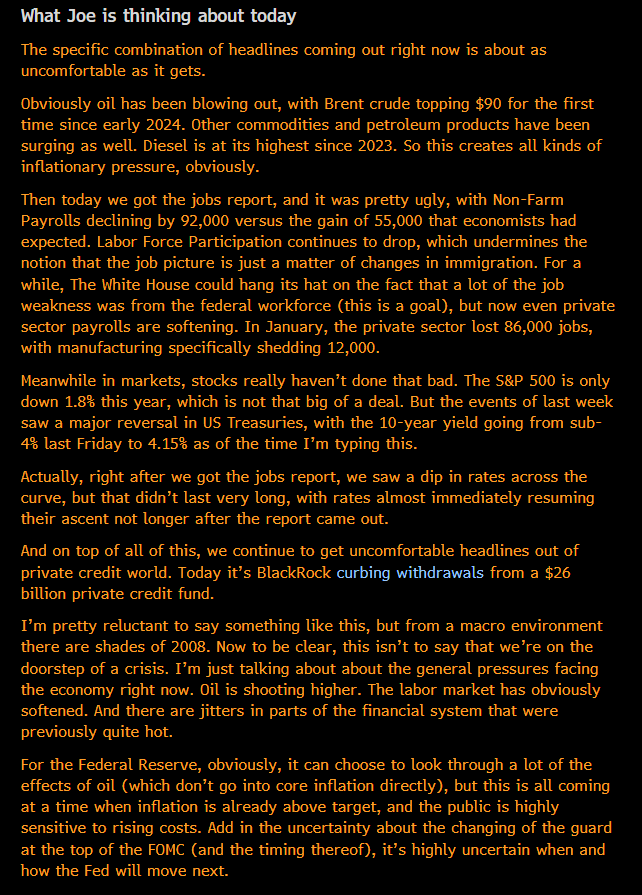
Not necessarily from the perspective of the financial system, but just from the macro, it's the first time since 2008 that things are feeling a bit 2008-ish https://t.co/25c7dc8ulW
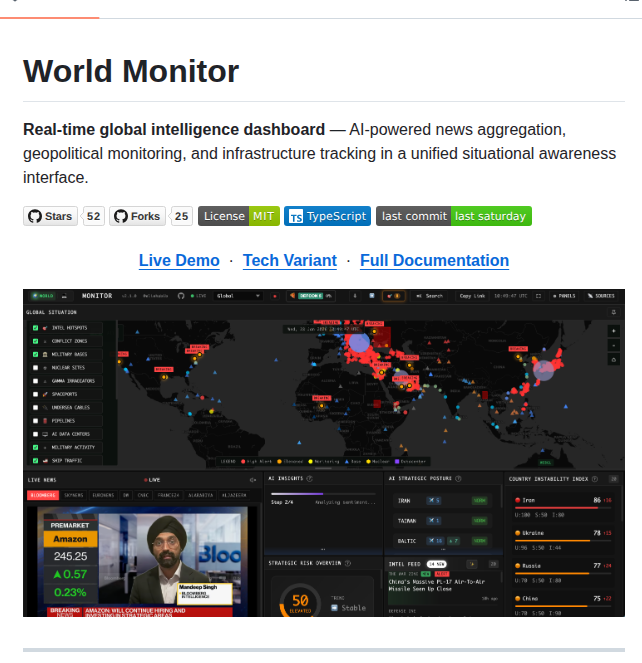
🚨 Someone just built a real-time global intelligence dashboard and open sourced it for free.
It's called World Monitor. Think of it as a CNN war room meets Bloomberg Terminal for geopolitics but anyone can use it.
No paid OSINT tools. No expensive subscriptions. No classified access needed.
Here's what this thing tracks in real-time:
→ Active conflict zones with escalation scoring
→ 220+ military bases from 9 countries
→ Live military aircraft tracking (ADS-B)
→ Naval vessel monitoring including "dark ships" going off radar
→ Nuclear facilities worldwide
→ Undersea cables, oil pipelines, and AI datacenter clusters
→ Protests, sanctions, internet outages, and satellite fire detection
→ Prediction markets as early warning signals
Here's the wildest part:
It has an AI that reads 100+ news sources, classifies threats in real-time, and generates intelligence briefs automatically.
Every country gets a live "Instability Index" score from 0-100 based on military activity, protests, news velocity, and structural risk.
When 3+ signal types spike in the same area, military flights + protests + satellite fires, it triggers a convergence alert.
This is the kind of tool governments pay millions for.
It runs in your browser. One command to install.
100% Open Source. MIT License.
Good morning,
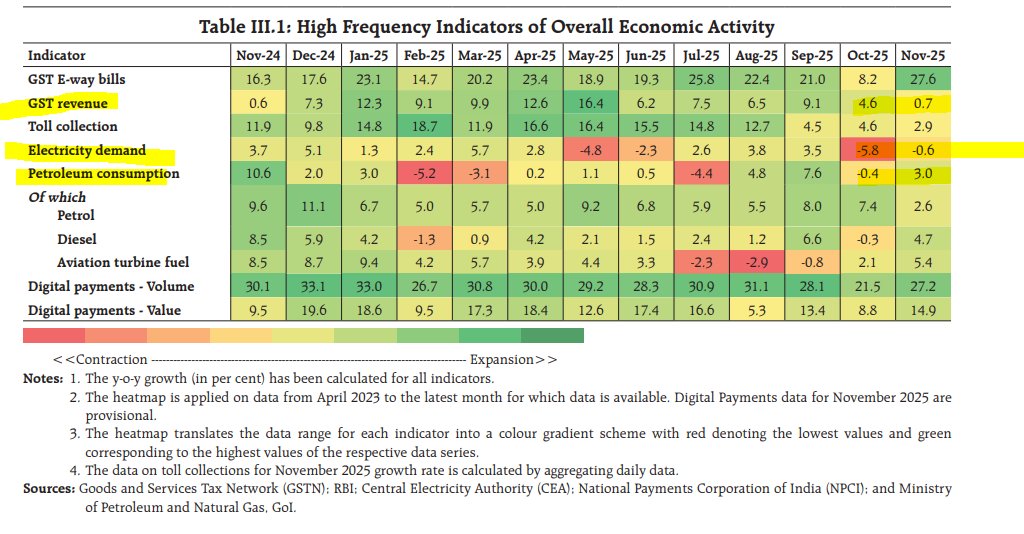
I'm reading the RBI December bulletin, which has basically the best analysis on India. What's interesting is that while India recorded record high growth (+8.2%YoY), nominal GDP slowed massively to 8.7%. If we look at the recent high frequency indicators, they are not good. GST revenue is slowing sharply, electricity demand is negative, and petro consumption also very soft.
What that means is that we got rather weak nominal outcome of growth irrespective of strong real GDP growth. And that matters because it impacts government revenue, earnings and of course income.
The INR has been fretting this reality as export sags and thus exporters are not in a hurry to sell USD. Meanwhile, foreign investors are looking at the expected depreciation of INR vs USD while other FX appreciates and that means that while real yield in India is attractive, its return in EUR for example was negative last year for European investors.
So what's next?
The real problem isn’t that time is scarce.
The real problem is that direction is scarce, and we’ve confused the two.
When someone says they “don’t have time,” they usually mean they don’t have a clear enough priority to say no to everything else.
They’re not actually time-poor, they’re priority-poor.
💥🇮🇳 Tariffs Tried to Hit India. India Hit Back With 8.2% Growth.
In 2025, the US imposed 50% tariffs on Indian exports:
🔸 25% “reciprocal tariff”
🔸 +25% “penalty for Russian oil”
Affected sectors = $60B worth of goods (textiles, gems, leather, seafood).
📌 The logic cited:
• Trade deficit
• Bring manufacturing home
• Pressure India over Russian oil
• Leverage for access to Indian markets
📌 The data shows the opposite:
📊 TOTAL India–US trade (goods+services): $212B
📊 US earns $80–85B/year from India via:
• Big Tech revenues
• Education fees
• Financial + consulting services
• Royalties, IP, pharma
➡️ When services + digital economy are counted, the US runs a SURPLUS with India.
📉 Economists estimated tariffs would cut Indian growth by 0.4–0.6%.
Instead:
📈 India clocked 8.2% GDP growth in the same quarter.
📈 RBI raised full-year forecast to 7.3%.
📉 Inflation fell to near-zero, enabling rate cuts.
Meanwhile, US businesses saw:
• Higher input costs
• Supply chain disruption
• Retail price inflation
Exports to US dropped in some sectors — but overall exports rose 5.2%:
📦 Electronics +40.6%
📦 Engineering +
📦 Pharma +
📦 Services up
Because 82% of India’s exports go elsewhere.
Tariffs didn’t break India — they accelerated diversification.
📌 Domestic demand + policy support + currency competitiveness protected growth.
📌 Outcome:
• India grew
• US costs went up
👉 A $4T, domestically driven economy cannot be pressured into policy surrender.
This thread breaks it down.
● What tariffs did the US impose on India📦
In 2025, the administration of Donald J. Trump introduced “reciprocal” tariffs on imports from India,initially a 25% tariff on many Indian exports.
In August 2025, the US then added an additional 25% tariff (as a “penalty”),raising the total tariff on many Indian goods to as much as 50%.
The affected goods included labour-intensive and export-heavy sectors: garments/clothing, gems and jewellery, footwear, sporting goods, furniture, chemicals, etc.
The reason given for the additional penalty tariff was specifically India’s continued purchase of Russian oil the US claimed that by importing Russian oil, India was effectively supporting Russia’s war effort.
🧭 What was the logic / justification given by the US
1. Trade-deficit / “unfair trade”
🔸 What the US argues: The US claims countries like India run large trade surpluses (i.e. trade deficit from US side), so it’s “unfair” that India exports more to the US than it imports. Tariffs are meant to “correct” this imbalance.
🔸What is reality:
According to the official 2024 data from the United States Trade Representative (USTR), total U.S.–India trade (goods + services) was about US$ 212.3 billion.
A recent analysis by the Global Trade Research Initiative (GTRI) told that when you factor in “non-merchandise” income (that is, revenue from services, digital economy, intellectual property, education fees, corporate services, etc.), the U.S. actually earns US$ 80–85 billion annually from India.
What contributes to this huge figure:
Digital / tech-services revenues: Major U.S. tech-giants (cloud, software, streaming, ads, apps) reportedly earn between US$ 15–20 billion annually from Indian consumers and businesses.
Education / student fees: Indian students studying in the U.S. spend a large amount on tuition, living costs, fees, resulting in substantial revenue inflows to U.S. universities and associated services.
Financial, consulting and corporate-services firms: U.S. financial institutions, consultancies, and back-office / global-capability-centers (GCCs) operating in India reportedly earn US$ 10–15 billion from Indian clients/businesses
Intellectual property royalties, software licensing, pharma/medical licences: These add further to revenues ,categories often excluded from narrow “goods trade” statistics.
Once you include all these revenue streams, the U.S. isn’t running a trade deficit with India, instead it often enjoys a net surplus of US$ 35–40 billion.
🎯 Why this matters — why using only goods-deficit to justify tariffs is misleading.
India is often accused of “causing a U.S. deficit”, but that accusation ignores the fact that a large portion of U.S. earnings from India come via non-goods channels.
India contributes significantly through digital consumers, outsourcing, remittances, services, talent export (students, professionals) — to U.S. wealth. Declaring “deficit” without counting these is cherry-picking, not a fair economic evaluation.
The US may show a formal trade deficit of around $44–45 bn with India on paper.
But it quietly earns around $80–85 bn a year from India through:
Indian students’ fees in US universities
Digital services (Big Tech revenues from India)
Financial and consulting operations
intellectual property royalties
Defence/arms sales.
2-🔸Encourage manufacturing shift to US / protect domestic jobs:
🔸What is reality:
The idea that raising tariffs will bring back manufacturing depends on ignoring structural cost labour, regulation, currency, supply-chain, global demand patterns. In reality:
Many goods can’t be profitably made in the U.S. given high wages and costs.
Tariffs alone don’t change the cost base,they only increase import price.
Ultimately, either manufacturing remains offshore (in low-cost countries), defeating the tariff’s purpose or consumers face much higher prices and possibly lower demand.
So from a realistic economic standpoint especially with a global supply-chain and cost-arbitrage context, this protectionist argument fails.
3-🔸Punishment for purchasing Russian oil (geopolitical / security rationale):
The US argued that because Russia invaded Ukraine (2022), any country importing Russian oil or energy is helping finance Russia’s war. To discourage that, the US imposed a penalty tariff (on top of regular tariffs) on exports from India targeting India’s exports, as a response to India continuing to import Russian crude.
🔸What is reality:
Western countries and the US continue to import or trade with Russia in various commodities and sectors, not only energy but also things like uranium, metals, fertilizers, industrial inputs, and other critical materials. This reveals that the West isn’t committed to a full, consistent embargo
In effect, Russia remains plugged into global supply chains via Western demand. The West’s own partial dependence means its condemnation of India appears selective and politically motivated.
India’s decision to import Russian oil was not ideological or supportive of war it was pragmatic: ensuring energy security, stable fuel supply and affordable energy for its population.
The tariff doesn’t penalise the oil importers or refineries, but exporters and ordinary workers in unrelated sectors which is collective punishment.
4-🔸Use of tarrif as a pressure tactic in trade Negotiations
For decades, U.S. trade negotiators have asked India for:
Lower tariffs on agriculture (soya, poultry, pork, dairy)
Lower duties on medical devices
Access for American dairy (despite religious/cultural sensitivity in India)
Market for U.S. farm products
Greater access in defence purchases
More imports of U.S. energy
Easier entry for U.S. technology companies
Looser regulations on foreign companies
Opening of retail & e-commerce
These asks existed long before Russian oil ever entered the conversation.
Tariffs became a lever to push these demands harder.
📌 The pattern: “Pressure first, concessions later”
This strategy is not new.
Step-by-step playbook:
Impose tariff or threaten tariff
Create fear, urgency, and economic loss.
Link relief to concessions
Say: “Remove your duties / open your market, and we will ease our tariffs.”
Force negotiation on U.S. terms
Claim victory domestically
Show voters: “We brought jobs back.”
This is why India called it coercive diplomacy.
It was not about morality or security.
And if this tarrif was all about russian oil then why it was linked to:
opening Indian markets to U.S. dairy?
agricultural access?
medical device pricing?
e-commerce and retail relaxation?
None of that has any connection to Russian oil.
[ ] HOW THESE TARRIFS ON INDIA BACKFIRED TO USA/TRUMP🎺
A). Increased costs for American consumers and import-reliant businesses
Many American retailers, brands and companies rely on Indian manufacturers for textiles, apparel, furniture, gems & jewellery, consumer goods etc. Tariffs on Indian goods raise the cost of those imports. That tends to increase retail prices for U.S. consumers undermining purchasing power.
For businesses that assemble products in the U.S. using Indian-made components (or source finished goods from India), tariffs raise their input costs, reducing profit margins or forcing them to pass on costs to consumers.
B)Supply-chain disruption & loss of competitiveness for U.S. firms
Global supply chains today are deeply integrated. Tariff-induced disruption — especially against a large and diversified supplier like India, IT forces U.S. firms either to find alternate (often more expensive) suppliers, or to reshuffle manufacturing/ sourcing. Both options raise costs and slow down production cycles.
C)Diplomatic & trade-relation damage — risking long-term strategic partnerships
By aggressively pushing tariffs on India, a rising global economy and a major strategic partner, the U.S. risks damaging trust and cooperation.
Overuse of tariffs sends a signal: “If you don’t bend to our demands, we’ll hurt your economy.” That can push India to diversify trade partners, move closer to other blocs (non-US), and reduce future U.S. influence.
This could have geopolitical costs for the U.S., long after any short-term benefit from tariffs.
D)the backfire may be more structural than immediately visible
It’s important to understand that the costs of tariffs ,supply-chain disruption, higher prices, lost competitiveness IT ALL often accumulate over time.
They may not show up as a single “blow-up” or “crisis,” but as slow leaks: higher costs, lost opportunities, damaged trade relationships, rising prices, etc.
From a U.S. political viewpoint: a policy that promises to “bring back jobs” and “protect domestic industry” but ends up increasing prices and pushing companies to relocate or outsource may generate domestic discontent, even if it does not result in an immediate macroeconomic shock.
🔥 How India Turned Tariffs Into Triumph
1-India grows, despite tariffs :
In the July–September 2025 quarter (Q2 FY26), India’s GDP grew 8.2% year-on-year, the fastest in six quarters.
The RBI then upgraded full-year growth to 7.3%, while the Finance Minister publicly said India will grow “at least 7%” despite global risks and the Trump tariff shock.
Inflation dropped to around near-zero levels in late 2025, giving space for rate cuts and demand support the opposite of a crisis.
So: tariffs hit, but growth accelerated.
2-How big was the tariff shock in reality? (Data, not drama)
India exported about $86–87 billion of goods to the US in FY25 roughly 18% of India’s total exports and about 2.2% of GDP.
About $60.2 billion of those exports (two-thirds) are now under the 50% tariff — mainly labour-intensive sectors: textiles, apparel, gems & jewellery, seafood, leather, some chemicals, metals.
About $27.6 billion — chiefly pharmaceuticals, electronics, petroleum products — are exempted
📉 Estimated macro hit:
Nomura, IDFC First Bank, HDFC Bank economists estimated the tariffs would shave 0.4–0.6 percentage points off FY26 GDP growth
RBI Governor Sanjay Malhotra called the impact “minimal”, putting the drag at only 20–30 basis points thanks to strong domestic demand and policy support
So even pessimistic estimates had India going from, say, 7.5% → ~7% — not collapse.
Reality: India printed 8.2% in that key quarter.
3- India’s growth is powered at home, not just by exports
The Finance Ministery explicitly credited “resilient consumer spending”, supported by low inflation and GST tweaks, as a major driver of growth. Reuters
The 8.2% Q2 growth was boosted by festive-season demand and pre-emptive production (companies stocking up for festivals and weddings).
In other words:
Even if exports to the US stumble, Indians themselves are buying, investing, building and consuming, and that keeps the growth engine running.
🧱 Investment & policy push
RBI cut policy rates by a total 125 bps since late 2024 and pumped liquidity through OMOs and FX swaps, explicitly to support growth during tariff uncertainty.
The government pushed reforms in taxation, labour and finance, and continued high public capex, which the FM says is sustaining growth even as global conditions worsen.
So India had a domestic macro policy shield ready:
lower rates + reforms + capex + benign inflation = tariff shock absorbed.
4-Exports got hit by the US but India’s overall exports didn’t collapse
🌍 US is big, but not the whole world
Yes, the US is roughly 18% of India’s exports, but that means 82% go elsewhere.
GTRI and media REPORTS :
GTRI projects exports to the US could drop 43% (from $86.5 bn → ~$49.6 bn) due to tariffs, especially in MSME-heavy sectors (textiles, gems, seafood, chemicals). The New Indian Express+1
But at the same time, India’s total exports (goods + services) in April–August 2025 rose 5.2% YoY to about $346 bn, with strong growth in electronics (+40.6%), engineering goods, pharma, and services IT/financial exports
So:
US-bound exports were bleeding in specific sectors,
but India’s broader export basket was still expanding and services + new markets compensated.
5- Policy + currency made exporters more competitive
RBI eased rates and kept liquidity easy; that supports working capital & credit for exporters and MSMEs.
The rupee weakened past ₹90 per USD, which the FM actually framed as helping exporters’ competitiveness — exporters earn more rupees per dollar, partly offsetting higher tariffs & costs
📜 Government support & FTAst from tariffs
The Commerce Ministry & GTRI notes show the government fast-tracked FTAs and trade diversification, and rolled out support for MSME exporters in the most affected sectors (textiles, gems, seafood, chemicals)
So, where tariffs closed one door, policy opened side doors:
more markets, more competitiveness, more support.
6-Structure of India’s economy: exports to US are too small to stop 8% growth.
Exports to the US ≈ 2.2% of India’s GDP. The
Even if half of that fell away quickly (a very harsh scenario), that’s about 1.1% of GDP in gross terms.
Economists’ estimates of the net growth hit were 0.4–0.6 percentage points, and RBI now says 20–30 bps — consistent with the idea that the rest of the economy absorbs most of the blow.
Meanwhile:
Consumption + investment + non-US exports + services more than make up those missing basis points ��� hence an actual printed growth of 8.2%.
So from a structural POV:
Trump’s tariffs hit some sectors hard
but they were simply not big enough to derail a $3.9+ trillion, domestically driven economy.
7-how long can India keep doing this?
RBI projects 7.3% growth this year with low inflation
FM says “at least 7%” is achievable, citing strong fundamentals, reforms, and domestic demand.
UNCTAD expects global trade to grow ~7% in 2025, which will help exporters in a more benign external environment.
Government export-strategy (Foreign Trade Policy, PLI, “Districts as Export Hubs”) targets $1 trillion exports by FY26, with ongoing growth in electronics, pharma, agri and services
Trump’s tariffs were meant to squeeze India.Instead, they forced India to diversify faster, reform quicker, and lean on its own domestic strength.
The result:
📈 Growth at 8.2% in the key quarter,
🔁 Economy reoriented but not broken,
💪 And a clear signal that India is too big and too internally strong to be bullied into stagnation by one country’s tariff tantrum.
🔧 India’s Resilience vs China’s Rare-Earth Gamble
India’s strategy (diversify, reform, lean on domestic economy + multiple export markets)
Broaden export destinations beyond any one market (so shock from one partner has limited impact).
Build domestic-market strength: internal consumption, services, manufacturing, reforms.
Use flexibility: shift export basket (goods, services, value-added products).
Use diplomacy, trade agreements (FTAs / regional ties) rather than only confrontation.
Avoid over-dependence on one kind of leverage (like rare-earths) that can backfire.
China’s strategy (export dominance, control of strategic inputs like rare-earths, leverage over commodities)
Use its large manufacturing base and integrated supply-chains to dominate global exports.
Use its control over certain strategic raw materials (e.g. rare-earth minerals) as bargaining chips or leverage in trade conflicts.
Rely — to an extent — on the fact that global industries depend on China for supply, making sanctions or tariffs painful for others too
🔎 Why India’s approach proved more resilient — and why China’s “rare-earth leverage” faced limits and backfired
✅ Why India’s way worked better
Diverse export base and multiple markets: Because India exports to many countries (not just one major partner), a tariff from one country hurts less. When one door shuts other doors remain open.
Strong domestic demand + services & manufacturing mix: India’s economy does not depend solely on exports.lots of growth comes from domestic consumption, services, infrastructure, and internal demand. That cushions external shocks.
Policy flexibility and structural reforms: By reforming trade policy, boosting manufacturing, encouraging value-added exports (not just raw/low-value goods), India becomes less vulnerable to tariff-based shocks.
No over-reliance on a single “lever” that can be countered: India doesn’t depend on a commodity or one resource to hold global trade hostage it trades broadly, across sectors.
⚠️ Why China’s rare-earth / leverage strategy ran into trouble
Global backlash & search for alternatives: Once China used rare-earths (or threatened to) as leverage, many countries began scrambling to find alternatives other suppliers, recycling, or resource diversification. That weakens China’s leverage over time.
Supply-chain diversification by global firms: To reduce dependence on China, global manufacturers began shifting portions of supply , Or sourcing from alternate countries. This reduces China’s dominance over time.
Sanctions & regulatory risks: Countries threatened trade sanctions or strategic decoupling from China, making dependence on Chinese exports or rare-earths risky. That reduces the value of “weaponising” rare-earth supply.
China’s internal cost & political pressure: Using resource leverage may hurt global buyers — but also creates long-term reputational, diplomatic, and economic costs for China itself. Other nations may retaliate economically or strategically.
🏁 Conclusion: Tariffs Revealed a New Power Balance — India Is Not the India of 1990
The tariff war did not expose India’s weakness.
It exposed how badly the West misread today’s India.
For decades, Western policy operated on a simple assumption:
👉 Apply pressure, India will adjust.
That assumption is no longer valid.
India is now:
A $4 trillion economy
The fastest-growing major economy on Earth
A 1.4 billion–consumer market
A global supplier of talent, tech, services and pharmaceuticals
A central node in supply chains spanning Asia, Middle East and Africa
A tariff that targets 2% of India’s GDP is not a strategic threat.
It is a speed bump on a highway.
The United States expected:
panic in New Delhi
exports collapsing
concessions on dairy, e-commerce, agriculture, tech
alignment on Russia
Instead, it got:
8.2% GDP growth
zero panic
higher US retail prices
strained diplomatic credibility
In other words:
👉 The weapon didn’t land on the target — it landed on the sender.
India responded without dramatic gestures:
no counter-sanctions
no public confrontation
no retaliatory tariff blitz
Instead, India quietly did what strong nations do:
stabilised inflation
cut rates
diversified trade
strengthened domestic demand
signed new FTAs
sustained energy security
continued growth
And the message that emerged was unmistakable:
💬 India cannot be coerced. India must be engaged.
This is the deeper strategic shift:
🔸 India did not grow despite tariffs —
🔸 India grew because it stopped reacting to pressure and started shaping outcomes.
China tried leverage through rare-earths.
It saw backlash, diversification, and erosion of its advantage.
India chose resilience, flexibility and autonomy.
It saw higher growth, more credibility, and more partners.
The tariff war demonstrated a blunt fact:
> In a multipolar world, threats are weak tools.
Partnership is the only currency that works.
For the US, the lesson is simple:
🇮🇳 India is not a market to bully. India is a partner to respect.
For India, the outcome is even clearer:
👉 Economic sovereignty works.
👉 Domestic demand is power.
👉 Geopolitics rewards those who stay independent.
The tariff war is over.
There was no winner on paper — no signing ceremony, no formal settlement.
But in the real world, the scoreboard is obvious:
💥 Tariffs tried to hit India.
India hit back with 8.2% growth.
-AMAN SINGH.
#IndiaUSRelations #TradeWar #IndiaRising #MakeInIndia #Tariffs2025
@ajaykraina @col_chaubey @AadiAchint @RajaMuneeb @TheNavroopSingh @TGD_06
I call this the "Boredom Funnel".
If you find yourself unable to focus, don’t fight your brain directly.
Just close off every escape hatch until work is the only way to scratch the itch.
It doesn’t make work easier. It just makes everything else more boring.
An exceptional PDF book worth checking out!
Highly recommended!
"Painful intelligence: What AI can tell us about human suffering"
https://t.co/gUMJiFK0kE
@drgurner hitting the nail on the head once again - today’s newsletter on burnout is insightful.
holidays are not the solution to overcoming burnout, it’s like putting a band aid on a wound… it can help for a short period but doesn’t treat the underlying issue.
Great research on open-source by @Harvard:
- $4.15B invested in open-source generates $8.8T of value for companies (aka $1 invested in open-source = $2,000 of value created)
- Companies would need to spend 3.5 times more on software than they currently do if OSS did not exist
I suspect that these numbers and impact are even greater for AI than for software (would be great to study!)




![liveupdates247's tweet photo. 💥🇮🇳 Tariffs Tried to Hit India. India Hit Back With 8.2% Growth.
In 2025, the US imposed 50% tariffs on Indian exports:
🔸 25% “reciprocal tariff”
🔸 +25% “penalty for Russian oil”
Affected sectors = $60B worth of goods (textiles, gems, leather, seafood).
📌 The logic cited:
• Trade deficit
• Bring manufacturing home
• Pressure India over Russian oil
• Leverage for access to Indian markets
📌 The data shows the opposite:
📊 TOTAL India–US trade (goods+services): $212B
📊 US earns $80–85B/year from India via:
• Big Tech revenues
• Education fees
• Financial + consulting services
• Royalties, IP, pharma
➡️ When services + digital economy are counted, the US runs a SURPLUS with India.
📉 Economists estimated tariffs would cut Indian growth by 0.4–0.6%.
Instead:
📈 India clocked 8.2% GDP growth in the same quarter.
📈 RBI raised full-year forecast to 7.3%.
📉 Inflation fell to near-zero, enabling rate cuts.
Meanwhile, US businesses saw:
• Higher input costs
• Supply chain disruption
• Retail price inflation
Exports to US dropped in some sectors — but overall exports rose 5.2%:
📦 Electronics +40.6%
📦 Engineering +
📦 Pharma +
📦 Services up
Because 82% of India’s exports go elsewhere.
Tariffs didn’t break India — they accelerated diversification.
📌 Domestic demand + policy support + currency competitiveness protected growth.
📌 Outcome:
• India grew
• US costs went up
👉 A $4T, domestically driven economy cannot be pressured into policy surrender.
This thread breaks it down.
● What tariffs did the US impose on India📦
In 2025, the administration of Donald J. Trump introduced “reciprocal” tariffs on imports from India,initially a 25% tariff on many Indian exports.
In August 2025, the US then added an additional 25% tariff (as a “penalty”),raising the total tariff on many Indian goods to as much as 50%.
The affected goods included labour-intensive and export-heavy sectors: garments/clothing, gems and jewellery, footwear, sporting goods, furniture, chemicals, etc.
The reason given for the additional penalty tariff was specifically India’s continued purchase of Russian oil the US claimed that by importing Russian oil, India was effectively supporting Russia’s war effort.
🧭 What was the logic / justification given by the US
1. Trade-deficit / “unfair trade”
🔸 What the US argues: The US claims countries like India run large trade surpluses (i.e. trade deficit from US side), so it’s “unfair” that India exports more to the US than it imports. Tariffs are meant to “correct” this imbalance.
🔸What is reality:
According to the official 2024 data from the United States Trade Representative (USTR), total U.S.–India trade (goods + services) was about US$ 212.3 billion.
A recent analysis by the Global Trade Research Initiative (GTRI) told that when you factor in “non-merchandise” income (that is, revenue from services, digital economy, intellectual property, education fees, corporate services, etc.), the U.S. actually earns US$ 80–85 billion annually from India.
What contributes to this huge figure:
Digital / tech-services revenues: Major U.S. tech-giants (cloud, software, streaming, ads, apps) reportedly earn between US$ 15–20 billion annually from Indian consumers and businesses.
Education / student fees: Indian students studying in the U.S. spend a large amount on tuition, living costs, fees, resulting in substantial revenue inflows to U.S. universities and associated services.
Financial, consulting and corporate-services firms: U.S. financial institutions, consultancies, and back-office / global-capability-centers (GCCs) operating in India reportedly earn US$ 10–15 billion from Indian clients/businesses
Intellectual property royalties, software licensing, pharma/medical licences: These add further to revenues ,categories often excluded from narrow “goods trade” statistics.
Once you include all these revenue streams, the U.S. isn’t running a trade deficit with India, instead it often enjoys a net surplus of US$ 35–40 billion.
🎯 Why this matters — why using only goods-deficit to justify tariffs is misleading.
India is often accused of “causing a U.S. deficit”, but that accusation ignores the fact that a large portion of U.S. earnings from India come via non-goods channels.
India contributes significantly through digital consumers, outsourcing, remittances, services, talent export (students, professionals) — to U.S. wealth. Declaring “deficit” without counting these is cherry-picking, not a fair economic evaluation.
The US may show a formal trade deficit of around $44–45 bn with India on paper.
But it quietly earns around $80–85 bn a year from India through:
Indian students’ fees in US universities
Digital services (Big Tech revenues from India)
Financial and consulting operations
intellectual property royalties
Defence/arms sales.
2-🔸Encourage manufacturing shift to US / protect domestic jobs:
🔸What is reality:
The idea that raising tariffs will bring back manufacturing depends on ignoring structural cost labour, regulation, currency, supply-chain, global demand patterns. In reality:
Many goods can’t be profitably made in the U.S. given high wages and costs.
Tariffs alone don’t change the cost base,they only increase import price.
Ultimately, either manufacturing remains offshore (in low-cost countries), defeating the tariff’s purpose or consumers face much higher prices and possibly lower demand.
So from a realistic economic standpoint especially with a global supply-chain and cost-arbitrage context, this protectionist argument fails.
3-🔸Punishment for purchasing Russian oil (geopolitical / security rationale):
The US argued that because Russia invaded Ukraine (2022), any country importing Russian oil or energy is helping finance Russia’s war. To discourage that, the US imposed a penalty tariff (on top of regular tariffs) on exports from India targeting India’s exports, as a response to India continuing to import Russian crude.
🔸What is reality:
Western countries and the US continue to import or trade with Russia in various commodities and sectors, not only energy but also things like uranium, metals, fertilizers, industrial inputs, and other critical materials. This reveals that the West isn’t committed to a full, consistent embargo
In effect, Russia remains plugged into global supply chains via Western demand. The West’s own partial dependence means its condemnation of India appears selective and politically motivated.
India’s decision to import Russian oil was not ideological or supportive of war it was pragmatic: ensuring energy security, stable fuel supply and affordable energy for its population.
The tariff doesn’t penalise the oil importers or refineries, but exporters and ordinary workers in unrelated sectors which is collective punishment.
4-🔸Use of tarrif as a pressure tactic in trade Negotiations
For decades, U.S. trade negotiators have asked India for:
Lower tariffs on agriculture (soya, poultry, pork, dairy)
Lower duties on medical devices
Access for American dairy (despite religious/cultural sensitivity in India)
Market for U.S. farm products
Greater access in defence purchases
More imports of U.S. energy
Easier entry for U.S. technology companies
Looser regulations on foreign companies
Opening of retail & e-commerce
These asks existed long before Russian oil ever entered the conversation.
Tariffs became a lever to push these demands harder.
📌 The pattern: “Pressure first, concessions later”
This strategy is not new.
Step-by-step playbook:
Impose tariff or threaten tariff
Create fear, urgency, and economic loss.
Link relief to concessions
Say: “Remove your duties / open your market, and we will ease our tariffs.”
Force negotiation on U.S. terms
Claim victory domestically
Show voters: “We brought jobs back.”
This is why India called it coercive diplomacy.
It was not about morality or security.
And if this tarrif was all about russian oil then why it was linked to:
opening Indian markets to U.S. dairy?
agricultural access?
medical device pricing?
e-commerce and retail relaxation?
None of that has any connection to Russian oil.
[ ] HOW THESE TARRIFS ON INDIA BACKFIRED TO USA/TRUMP🎺
A). Increased costs for American consumers and import-reliant businesses
Many American retailers, brands and companies rely on Indian manufacturers for textiles, apparel, furniture, gems & jewellery, consumer goods etc. Tariffs on Indian goods raise the cost of those imports. That tends to increase retail prices for U.S. consumers undermining purchasing power.
For businesses that assemble products in the U.S. using Indian-made components (or source finished goods from India), tariffs raise their input costs, reducing profit margins or forcing them to pass on costs to consumers.
B)Supply-chain disruption & loss of competitiveness for U.S. firms
Global supply chains today are deeply integrated. Tariff-induced disruption — especially against a large and diversified supplier like India, IT forces U.S. firms either to find alternate (often more expensive) suppliers, or to reshuffle manufacturing/ sourcing. Both options raise costs and slow down production cycles.
C)Diplomatic & trade-relation damage — risking long-term strategic partnerships
By aggressively pushing tariffs on India, a rising global economy and a major strategic partner, the U.S. risks damaging trust and cooperation.
Overuse of tariffs sends a signal: “If you don’t bend to our demands, we’ll hurt your economy.” That can push India to diversify trade partners, move closer to other blocs (non-US), and reduce future U.S. influence.
This could have geopolitical costs for the U.S., long after any short-term benefit from tariffs.
D)the backfire may be more structural than immediately visible
It’s important to understand that the costs of tariffs ,supply-chain disruption, higher prices, lost competitiveness IT ALL often accumulate over time.
They may not show up as a single “blow-up” or “crisis,” but as slow leaks: higher costs, lost opportunities, damaged trade relationships, rising prices, etc.
From a U.S. political viewpoint: a policy that promises to “bring back jobs” and “protect domestic industry” but ends up increasing prices and pushing companies to relocate or outsource may generate domestic discontent, even if it does not result in an immediate macroeconomic shock.
🔥 How India Turned Tariffs Into Triumph
1-India grows, despite tariffs :
In the July–September 2025 quarter (Q2 FY26), India’s GDP grew 8.2% year-on-year, the fastest in six quarters.
The RBI then upgraded full-year growth to 7.3%, while the Finance Minister publicly said India will grow “at least 7%” despite global risks and the Trump tariff shock.
Inflation dropped to around near-zero levels in late 2025, giving space for rate cuts and demand support the opposite of a crisis.
So: tariffs hit, but growth accelerated.
2-How big was the tariff shock in reality? (Data, not drama)
India exported about $86–87 billion of goods to the US in FY25 roughly 18% of India’s total exports and about 2.2% of GDP.
About $60.2 billion of those exports (two-thirds) are now under the 50% tariff — mainly labour-intensive sectors: textiles, apparel, gems & jewellery, seafood, leather, some chemicals, metals.
About $27.6 billion — chiefly pharmaceuticals, electronics, petroleum products — are exempted
📉 Estimated macro hit:
Nomura, IDFC First Bank, HDFC Bank economists estimated the tariffs would shave 0.4–0.6 percentage points off FY26 GDP growth
RBI Governor Sanjay Malhotra called the impact “minimal”, putting the drag at only 20–30 basis points thanks to strong domestic demand and policy support
So even pessimistic estimates had India going from, say, 7.5% → ~7% — not collapse.
Reality: India printed 8.2% in that key quarter.
3- India’s growth is powered at home, not just by exports
The Finance Ministery explicitly credited “resilient consumer spending”, supported by low inflation and GST tweaks, as a major driver of growth. Reuters
The 8.2% Q2 growth was boosted by festive-season demand and pre-emptive production (companies stocking up for festivals and weddings).
In other words:
Even if exports to the US stumble, Indians themselves are buying, investing, building and consuming, and that keeps the growth engine running.
🧱 Investment & policy push
RBI cut policy rates by a total 125 bps since late 2024 and pumped liquidity through OMOs and FX swaps, explicitly to support growth during tariff uncertainty.
The government pushed reforms in taxation, labour and finance, and continued high public capex, which the FM says is sustaining growth even as global conditions worsen.
So India had a domestic macro policy shield ready:
lower rates + reforms + capex + benign inflation = tariff shock absorbed.
4-Exports got hit by the US but India’s overall exports didn’t collapse
🌍 US is big, but not the whole world
Yes, the US is roughly 18% of India’s exports, but that means 82% go elsewhere.
GTRI and media REPORTS :
GTRI projects exports to the US could drop 43% (from $86.5 bn → ~$49.6 bn) due to tariffs, especially in MSME-heavy sectors (textiles, gems, seafood, chemicals). The New Indian Express+1
But at the same time, India’s total exports (goods + services) in April–August 2025 rose 5.2% YoY to about $346 bn, with strong growth in electronics (+40.6%), engineering goods, pharma, and services IT/financial exports
So:
US-bound exports were bleeding in specific sectors,
but India’s broader export basket was still expanding and services + new markets compensated.
5- Policy + currency made exporters more competitive
RBI eased rates and kept liquidity easy; that supports working capital & credit for exporters and MSMEs.
The rupee weakened past ₹90 per USD, which the FM actually framed as helping exporters’ competitiveness — exporters earn more rupees per dollar, partly offsetting higher tariffs & costs
📜 Government support & FTAst from tariffs
The Commerce Ministry & GTRI notes show the government fast-tracked FTAs and trade diversification, and rolled out support for MSME exporters in the most affected sectors (textiles, gems, seafood, chemicals)
So, where tariffs closed one door, policy opened side doors:
more markets, more competitiveness, more support.
6-Structure of India’s economy: exports to US are too small to stop 8% growth.
Exports to the US ≈ 2.2% of India’s GDP. The
Even if half of that fell away quickly (a very harsh scenario), that’s about 1.1% of GDP in gross terms.
Economists’ estimates of the net growth hit were 0.4–0.6 percentage points, and RBI now says 20–30 bps — consistent with the idea that the rest of the economy absorbs most of the blow.
Meanwhile:
Consumption + investment + non-US exports + services more than make up those missing basis points ��� hence an actual printed growth of 8.2%.
So from a structural POV:
Trump’s tariffs hit some sectors hard
but they were simply not big enough to derail a $3.9+ trillion, domestically driven economy.
7-how long can India keep doing this?
RBI projects 7.3% growth this year with low inflation
FM says “at least 7%” is achievable, citing strong fundamentals, reforms, and domestic demand.
UNCTAD expects global trade to grow ~7% in 2025, which will help exporters in a more benign external environment.
Government export-strategy (Foreign Trade Policy, PLI, “Districts as Export Hubs”) targets $1 trillion exports by FY26, with ongoing growth in electronics, pharma, agri and services
Trump’s tariffs were meant to squeeze India.Instead, they forced India to diversify faster, reform quicker, and lean on its own domestic strength.
The result:
📈 Growth at 8.2% in the key quarter,
🔁 Economy reoriented but not broken,
💪 And a clear signal that India is too big and too internally strong to be bullied into stagnation by one country’s tariff tantrum.
🔧 India’s Resilience vs China’s Rare-Earth Gamble
India’s strategy (diversify, reform, lean on domestic economy + multiple export markets)
Broaden export destinations beyond any one market (so shock from one partner has limited impact).
Build domestic-market strength: internal consumption, services, manufacturing, reforms.
Use flexibility: shift export basket (goods, services, value-added products).
Use diplomacy, trade agreements (FTAs / regional ties) rather than only confrontation.
Avoid over-dependence on one kind of leverage (like rare-earths) that can backfire.
China’s strategy (export dominance, control of strategic inputs like rare-earths, leverage over commodities)
Use its large manufacturing base and integrated supply-chains to dominate global exports.
Use its control over certain strategic raw materials (e.g. rare-earth minerals) as bargaining chips or leverage in trade conflicts.
Rely — to an extent — on the fact that global industries depend on China for supply, making sanctions or tariffs painful for others too
🔎 Why India’s approach proved more resilient — and why China’s “rare-earth leverage” faced limits and backfired
✅ Why India’s way worked better
Diverse export base and multiple markets: Because India exports to many countries (not just one major partner), a tariff from one country hurts less. When one door shuts other doors remain open.
Strong domestic demand + services & manufacturing mix: India’s economy does not depend solely on exports.lots of growth comes from domestic consumption, services, infrastructure, and internal demand. That cushions external shocks.
Policy flexibility and structural reforms: By reforming trade policy, boosting manufacturing, encouraging value-added exports (not just raw/low-value goods), India becomes less vulnerable to tariff-based shocks.
No over-reliance on a single “lever” that can be countered: India doesn’t depend on a commodity or one resource to hold global trade hostage it trades broadly, across sectors.
⚠️ Why China’s rare-earth / leverage strategy ran into trouble
Global backlash & search for alternatives: Once China used rare-earths (or threatened to) as leverage, many countries began scrambling to find alternatives other suppliers, recycling, or resource diversification. That weakens China’s leverage over time.
Supply-chain diversification by global firms: To reduce dependence on China, global manufacturers began shifting portions of supply , Or sourcing from alternate countries. This reduces China’s dominance over time.
Sanctions & regulatory risks: Countries threatened trade sanctions or strategic decoupling from China, making dependence on Chinese exports or rare-earths risky. That reduces the value of “weaponising” rare-earth supply.
China’s internal cost & political pressure: Using resource leverage may hurt global buyers — but also creates long-term reputational, diplomatic, and economic costs for China itself. Other nations may retaliate economically or strategically.
🏁 Conclusion: Tariffs Revealed a New Power Balance — India Is Not the India of 1990
The tariff war did not expose India’s weakness.
It exposed how badly the West misread today’s India.
For decades, Western policy operated on a simple assumption:
👉 Apply pressure, India will adjust.
That assumption is no longer valid.
India is now:
A $4 trillion economy
The fastest-growing major economy on Earth
A 1.4 billion–consumer market
A global supplier of talent, tech, services and pharmaceuticals
A central node in supply chains spanning Asia, Middle East and Africa
A tariff that targets 2% of India’s GDP is not a strategic threat.
It is a speed bump on a highway.
The United States expected:
panic in New Delhi
exports collapsing
concessions on dairy, e-commerce, agriculture, tech
alignment on Russia
Instead, it got:
8.2% GDP growth
zero panic
higher US retail prices
strained diplomatic credibility
In other words:
👉 The weapon didn’t land on the target — it landed on the sender.
India responded without dramatic gestures:
no counter-sanctions
no public confrontation
no retaliatory tariff blitz
Instead, India quietly did what strong nations do:
stabilised inflation
cut rates
diversified trade
strengthened domestic demand
signed new FTAs
sustained energy security
continued growth
And the message that emerged was unmistakable:
💬 India cannot be coerced. India must be engaged.
This is the deeper strategic shift:
🔸 India did not grow despite tariffs —
🔸 India grew because it stopped reacting to pressure and started shaping outcomes.
China tried leverage through rare-earths.
It saw backlash, diversification, and erosion of its advantage.
India chose resilience, flexibility and autonomy.
It saw higher growth, more credibility, and more partners.
The tariff war demonstrated a blunt fact:
> In a multipolar world, threats are weak tools.
Partnership is the only currency that works.
For the US, the lesson is simple:
🇮🇳 India is not a market to bully. India is a partner to respect.
For India, the outcome is even clearer:
👉 Economic sovereignty works.
👉 Domestic demand is power.
👉 Geopolitics rewards those who stay independent.
The tariff war is over.
There was no winner on paper — no signing ceremony, no formal settlement.
But in the real world, the scoreboard is obvious:
💥 Tariffs tried to hit India.
India hit back with 8.2% growth.
-AMAN SINGH.
#IndiaUSRelations #TradeWar #IndiaRising #MakeInIndia #Tariffs2025
@ajaykraina @col_chaubey @AadiAchint @RajaMuneeb @TheNavroopSingh @TGD_06](https://pbs.twimg.com/media/G7yz0AjbEAAhNKj.jpg)


